Working with UNCONNECTED People in a Genealogical Database

© Julie Goucher, Dec 2020

This is a long awaited post, requested by several Pharos students….(sorry for the wait!).

Working with unconnected people in a genealogical database is one of the biggest issues for those with surname projects, or One-Name Studies.

I personally struggled with this in my early days, and my way of coping with this obstacle was to “hitch” people together – I use a marriage, whereas others might use a census.

The reason I use a marriage is that you have less people to deal with when compared to a census. Those with studies do require details from the census, but not necessarily immediately.

The way I approach this, is to open my genealogical program and create a new database. For my Orlando study, the file is simply called Orlando ONS. I add each individual with the Orlando surname to the database, each one, unattached to others, apart from their spouse. As I then build the family, or reconstruct the family, I do so using parish registers or other suitable data, which enables each family to develop, of course some of those individual with the Orlando name, may well form part of a wider family.

Let me give you this example – imagine a family reunion, Grandma is the top of the family, her six relatives each with their spouses and their children. The six children are in the database, hitched to their spouses, with their family reconstructed. Also at the reunion, are a further seven people, bearing the same name, with their Grandfather at the top of their family group. The seven people might be related to the previously mentioned six people, but not necessarily, but to all intent and purposes, the groups of six and seven people with their spouses are entered into the database and are of equal standing to each other.

I have three individuals that are in my Orlando database, and completely unattached from their spouses and other suitable individuals. The image below comes from my Pharos European Ancestors course. The source is Dachau Concentration Camp, Jewish Gen index. From the material entered on the card, it provides a starting point, from which I can begin to establish their lives. Up until now, these three individuals have sat in my Orlando Miscellaneous Workbook – more on that tomorrow.
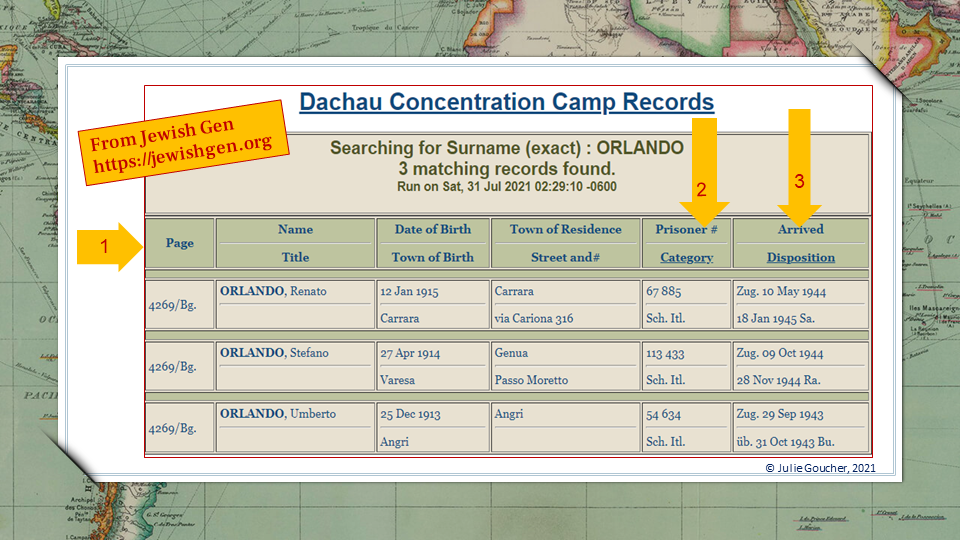
© Julie Goucher, 2021

Posted in Genealogy, Introduction to One-Name Studies (Pharos course 901), One-Name Studies, Practicalities of a One-Name Studies (Pharos Course 903) | 6 Comments

European Ancestors – Understanding France – Index to the Series

Courtesy of Wikipedia
Flag adopted 15 Feb 1794

This post is part of a series about genealogy in France. You can read the complete series HERE. If you are wondering what the various posts were about, wonder no more, this is the index!

  1. Census
  2. Paris
  3. Births
  4. Baptisms
  5. Deaths
  6. Burials
  7. Marriages
  8. Divorce
  9. 30 Year War
  10. Geographical Name Changes
  11. Calendar
  12. Causes of Revolution
  13. Foundation for Revolution
  14. New Regime
  15. New Regime Phase 1
  16. New Regime Phase 2
  17. New Regime Phase 3
  18. New Regime Phase 4
  19. Revolution and Migration
  20. Territories outside France
  21. Religion and the Roman Catholics
  22. Religion and Mennonites
  23. Religion and Huguenots
  24. Religion and the Waldensians
  25. Franco-Prussian War
  26. Acadians
  27. DNA
  28. French Surnames (Geographical)
  29. Official Name Changes
  30. French Surnames (Alias and dit)
  31. French Surnames
  32. Resources
  33. Jewish Migration
  34. Overseas Territories, Empire and Slavery
  35. Corsica
  36. Department, Districts, Cantons and Communes
  37. Migration from France
  38. Romani Research
  39. Surname Distribution
  40. Military

Index to the series

Posted in European Ancestors, France, French Surnames, Understanding France Series | 2 Comments

Q & A – Recording Ethnicity in a One-Name Study or in Genealogy

Created by Julie Goucher – Feb 2020 Using Wordclouds.com

A few weeks ago I received an email from a Guild of One-Name Studies member asking me

How do you handle the identification of people of colour (Negro) in your studies?

I must admit I took a while to respond to the email, as I wanted time to think. For me there is more to the question that just the colour of our skin – it is about who we identify with. I do not believe we can put a label on the situation and use that to reflect who we are, either how we see ourselves or how others might see us. As humans I believe we probably care more about the latter than the former, but I stand to be corrected.

There is also the question of, does it matter what colour your skin is, in relation to a surname study? If I record 100 people with a particular surname into our databases, the only deciding factor is likely to be the surname. In the case of the Orlando study – the colour of skin is irrelevant, as long as you (or the name of one of your parent) is Orlando, your are in! However, the context of how and why you took the name is important.

For example, the National Archives at Kew has Examination of Invalid Soldiers in record class WO 23. Contained within the set is a record of Roland Orlando, he is aged 38 years in 1860 and had served in the 1st West India Regiment as a private. His character is recorded as good, with four good conduct badges. His initial trade was that of a labourer. The regimental surgeon reported him as “rheumatism and worn out”. His hair, eyes and complexion are all recorded as black. His place of residence is Jamaica and his place of birth is Africa.

In order to answer the question put to me, I recorded the facts of Roland Orlando, each fact is an entry within the Roland Orlando’s record in my database, with the source of that information as the Examination of Invalid Soldiers WO23/157 and the date of 24 Jan 1860. In my software, which is Family Historian, I use the class of physical attributes to record any characteristics that exist within the document.

But is that it? Is that sufficient? In the case of Roland, there are some curious issues and questions that come to mind. Did he think of himself as African? Jamaican? He was employed by the British Army, so did he think of himself as British? The reality was probably very, very different. Why though do I think that?

Looking at the range of information just from this document provided some clues and they became plausible when I thought of the clues, plus with the history of the region.

  • The climate in the Caribbean was not perhaps a natural environment if you were not born there, or from a climate that was much cooler. Many British soldiers fell ill, a mixture of temperature and disease. The decision was taken that those more accustomed to the weather might be more suitable.
  • The place of birth recorded as Africa, coupled with residence in Jamaica, suggested that perhaps this was not just a working transaction.
  • The Regiment is a further clue – The 1st West India Regiment was raised in 1795 though the merging of two units that were formed by the British between 1775 and 1783. One of the units included personnel that were recruited on Martinique.
  • By 1795, many of the soldiers in this region were enslaved Africans who had been “purchased” by the British Army, and this was a key feature of the lengthening of the slave trade until 1807.
  • The service of Roland was recorded as good with four good conduct badges, yet he remained a private – those who were black were not able to progress through the ranks with the ease of white soldiers.
  • His name is curious – Orlando is the Italian form of Roland. The name Roland has old German origins, so it is similar to having someone with the surname James and being called James.

I find the concept of people being purchased as distasteful, and appalling. Sadly, that was the way of the world during this period, and as such I have recognised that. I want to see if I can establish how Roland was recruited, amongst other things.

I do have a few more snippets of information about Roland Orlando and hope to share them in a follow up post.

Resources

Posted in Orlando One-Name Study, Q & A | Leave a comment

Orlando Military Personnel in France

As I was writing the post about military records in France for my Understanding France Series, I did a number of searches and was surprised by the results, and thought it worth sharing.

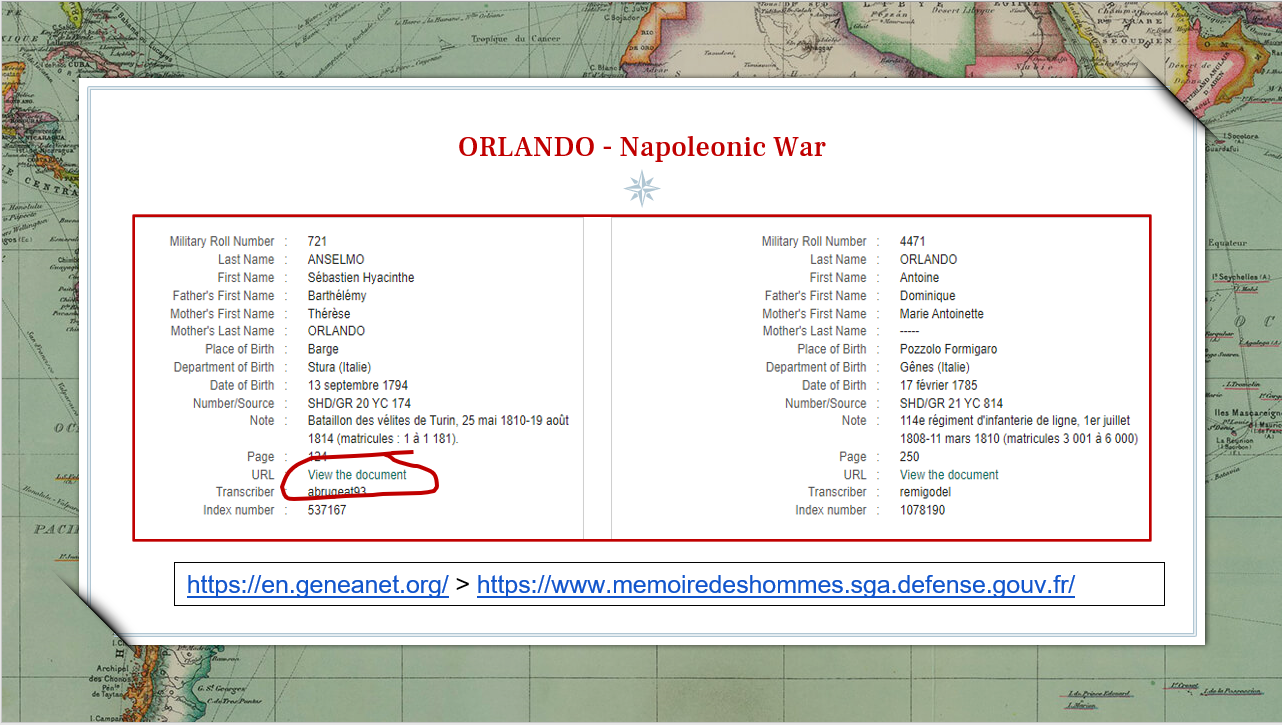
The first search I did was for the Napoleonic War – This database. The site is that of a collaboration and there were two instances of the surname Orlando in the database, as shown below:

Slide Created by Julie Goucher, 2022

If you look at the red oblong on the left entry, you can hopefully see that the text is hyperlinked – this goes to Memoire des Hommes website, where I can see the image, free of charge. The surprising thing is, I had already visited the Memoire des Hommes site and did the same search, which revealed zilch! The other interesting thing is that the search results shown here includes an instance where the enlisting soldier’s mother has the birth surname of Orlando.

The second search relates to the French overseas territories, located HERE. A search for Orlando revealed the following:

Image created by Julie Goucher, August 2022

Six individuals who were French citizens who were living in Algeria, by clicking the small image to the left of the surname you can see the actual document image.

Posted in France, Orlando One-Name Study | Leave a comment

European Ancestors – Understanding France (40) Military

Courtesy of Wikipedia
Flag adopted 15 Feb 1794

This post is part of a series about genealogy in France. You can read the complete series HERE.

  • Memoire des HommesMilitary Enlistments of the old Regime of France 1682-1793 is a significant depository of records in browse mode only, of:
    • Enlistment Records
    • Different branches of the army, such as artillery, Calvary etc
    • Different units, towns and battlefields
    • Early records are in the name of the old Provinces, towns etc, for example Anjou
    • Includes records relating to Belgians.
  • Memoire des HommesNapoleonic War 1802-1815 enlistments, in a searchable database. This also incorporates what we now know as Belgium. – with images
  • Ancestramil – A useful site with details of the structure of Military forces of France
  • Collaborative Military Archives (Geneanet) – Napoleonic War 1802-1815 – no images
  • France GenWeb 1914-1918
  • France Memorial GenWebSoldiers and Resistance fighters who died, including civilians AND foreign soldiers that died in France
  • Military Registration Records for French citizens in the Overseas Territories
    • French West Africa (1888-1917)
    • Algeria (1866-1921)
    • French Coast of the Somalis (1910-1917)
    • Comoros (1895-1918)
    • Guyana (1890-1914)
    • India and Indochina (1897-1909)
    • Madagascar (1889-1918) –  Some later registers are kept in the Archives of Paris.
    • New Caledonia (1907-1918)
    • Polynesia (1894-1919)
    • Reunion (1884-1918)
    • Saint-Pierre-et-Miquelon (1901-1921) – The later registers are kept in the Archives of Paris.
Posted in European Ancestors, France, Understanding France Series | Leave a comment

European Ancestors – Understanding France (39) Surname Distribution

Courtesy of Wikipedia
Flag adopted 15 Feb 1794

This post is part of a series about genealogy in France. You can read the complete series HERE.

One of the things that is useful, is to see a visual display of where a surname appears across a country. In the case of France, the site http://www.geopatronyme.com displays the births of a given surname across varying periods of time.

In the example below, I used the surname of my paternal Great Grandmother, VIRCIGLIO and the results show there were four births between 1941 and 1965, all of which were in the department of Moselle (57). The only other births for the surname occurred in the same department (57) between 1966-1990 when there were eight.

Posted in European Ancestors, France, French Surnames, Understanding France Series | Leave a comment

European Ancestors – Understanding France (38) Romani Research

Courtesy of Wikipedia
Flag adopted 15 Feb 1794

This post is part of a series about genealogy in France. You can read the complete series HERE.

Romani’s are an ethnic group originating from northern India. The number of Romani’s in France could be anywhere between 20,000 and 400,000, likely because being a transient population recording numbers could be tricky and perhaps an element of mistrust, as a result of persecution experienced.

In spoken French, Romani’s are known as:

  • Gitans – family ties to Spain
  • Manouches – family ties to Germany and Italy, where they are known as Sinti and Sinte in Germany and Holland

The French National Gendarmerie has been accused on referring to the Romani’s with the term Minorités Ethniques Non-Sédentarisées (MENS), as a way of administration processing, though this is far from proved, and far from widespread. Furthermore, creating ethnic data is illegal in France.

Departments of France where there are a particular Romani population are: Alsace, Aquitaine, Île-de-France, Languedoc-Roussillon, Lorraine, Midi-Pyrénées, Nord-Pas-de-Calais, Provence-Alpes-Côte d’Azur, and Rhône-Alpes.

The Yeniche People are of a travelling culture, much in the spirit of Scottish and Irish travellers, that are living in Western Europe, across Germany, Switzerland, Austria, Luxembourg and Belgium, as well as parts of France. Official figures from 2010 show that the Yeniche population in France is 300,000 strong.

Posted in European Ancestors, France, Roma/Gypsies, Understanding France Series | Leave a comment

European Ancestors – Understanding France (37) Migration from France

Courtesy of Wikipedia
Flag adopted 15 Feb 1794

This post is part of a series about genealogy in France. You can read the complete series HERE.

The reality is, that migration of any kind, shares some commonality with other countries, both in terms of migrating from, migrating to, why and when.

France, like other nations in Europe with an element of colonial rule, provided a wide range of opportunity for migration. People could migrate within the European continent itself, or within the wide global focused Empire. Movement could be in a variety of formats involving people of Money and wealth, those who had saved and saved and saved from a small income, those who were to be incarcerated, those who were merchants and travelling as such, those who were indentured servants and those who were enslaved. Depending on the time frame, migration could be within the country itself and by a particular group of people, who might have been forced into migration.

Europeans learnt in 1497 of the rich cod stocks to be found in Newfoundland and Labrador waters. In 1504, the French were the first documented nation to be fishing there, and by 1520 between 60 and 90 vessels were regularly sailing each year and by the middle of the 18th Century this number had grown significantly with about 10,000 French migrating each year.

Most of the migrants came from Brittany and Normandy; plus the Norman ports of Rouen, Dieppe, Honfleur Granville, as well as the Breton ports of St Malo and St Brieuc. Those in the St Malo region were from the villages of Cancale, Coulomb, Chateauneuf, Pleudihen, Pleuguenec, and Dol.

Most of the migrants were single, young and poor men who were happy to spend the Spring and Summer away from France, despite sounding idilic, it would have been hard continual labour. That said, some of the fisherman migrated permanently, settling mainly at Plaisance prior to 1713, and along the north and west coast of the Island.

Prior to France and other nations becoming aware of the rich cod stocks of Newfoundland and Labrador, there was reliance on the cod fisheries of Scandinavia and the herring fisheries of the English Channel. The demand for fish existed heavily in France, whose religion was predominately Roman Catholic, which meant that for religious reasons many could not eat meat for more than 150 days. Fish was a protein alternative. Fresh fish was expensive and not easily readily available, as a result salt fish grew in popularity, as it was cheaper and more readily available. Cured cod preserved well and was easily transported when compared to the less tasty herring

Acadians also arrived in the west of Newfoundland and Labrador area from the late 18th Century into the mid 19th Century, mostly from Cape Breton. They were principally farmers, who migrated in family groups taking advantage of the rich soil. Many acquired land at St George’s Bay and Codroy Valley.

Posted in European Ancestors, Europeans beyond Europe, France, Understanding France Series | Leave a comment

European Ancestors – Understanding France (36) Departments, Districts, Cantons and Communes

Courtesy of Wikipedia
Flag adopted 15 Feb 1794

This post is part of a series about genealogy in France. You can read the complete series HERE.

Building on from an earlier post (Understanding France 14).

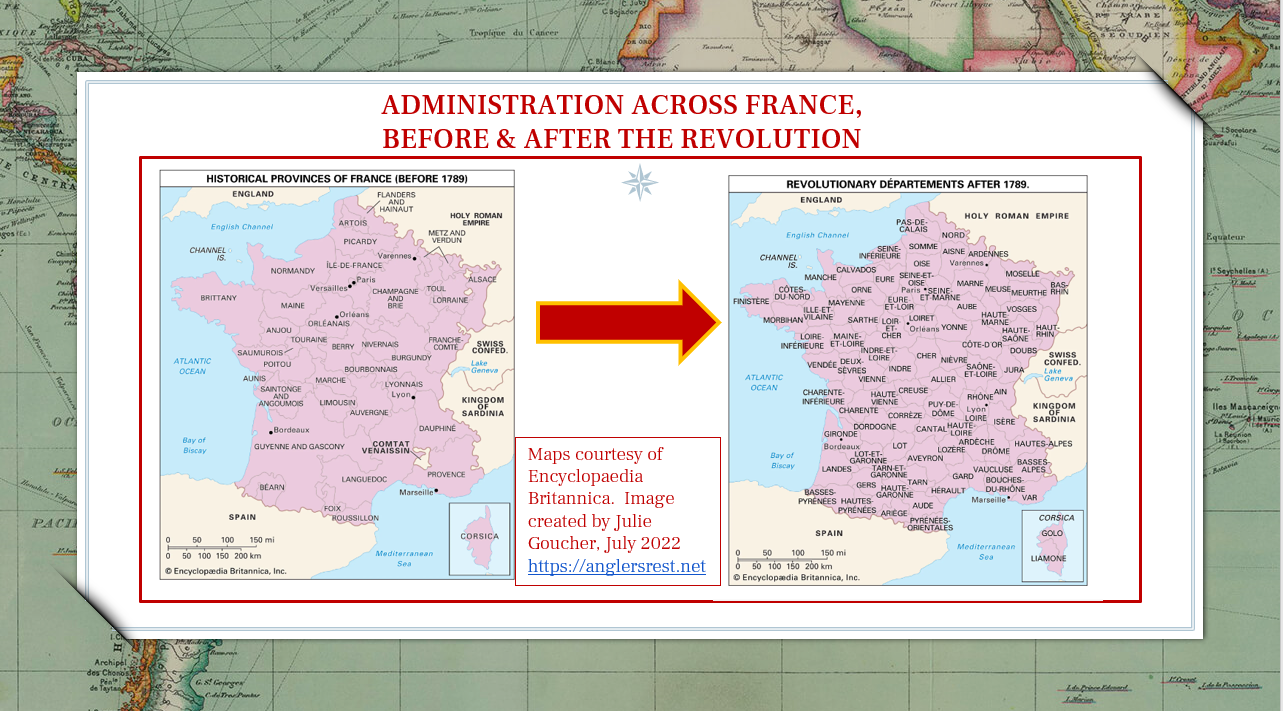
The structure of administration after the Revolution across France changed, and was divided into Departments, Districts or Regions, Cantons and Communes. This is important for those undertaking genealogy research in France, as where you look for information will depend on what you are looking for. Some is held at local level, in the Communes, whilst other material is potentially held at Departmental, Region, or Canton level.

  • Departments  – initially there were 82, but this was expanded as the population grew, especially near the capital. There are now 96 of these excluding the overseas territories. Each Department has a unique number which is used for a variety of administrative reasons – vehicle registration, postcodes for examples.

  • Regions – Until the end of 2015 there were 22 regions, with 5 overseas regions. Following government discussions there was a change from January 2016, there are now 13 + 5 overseas regions

Map courtesy of FRANCE.PUB.COM

  • Districts (arrondissements) of these there are 342 which breaks down into
  • Cantons of these there are 2,054 and that further breaks down into
  • Communes and of these there are 36,529 – this is the lowest level of administration across France.

Click HERE to download a full list of the Departmental Archives for France.

Posted in European Ancestors, France, Understanding France Series | Leave a comment

European Ancestors – Understanding France (35) – Corsica

Courtesy of Wikipedia
Flag adopted 15 Feb 1794

This post is part of a series about genealogy in France. You can read the complete series HERE.

Corsica, an island located in the Mediterranean Sea and one of the eighteen regions of France. The island lies to the southeast of the French mainland, west of the Italian Peninsular and immediately north of the Italian island of Sardinia which is it’s nearest landmass.

The regional capital is Ajaccio and whilst the region is divided into two administrative departments, Haute-Corse and Corse-du-Sud, their respective regional and departmental territories were merged on 1 January 2018. Corsica has a greater degree of autonomy than other French regionals, and island officials are permitted to use their limited executive powers. As of January 2022, Corsica had a population of 349,465.

Copyright, Julie Goucher, 2022

The official language is French, as it is administered by France, but the majority of the Islanders speak Corsu. Traditionally, the language only had an oral presence, but gradually, over time into the late 19th Century, it was developed into a written language. Originating from Tuscany, influenced by Latin, and is part of the Indio European Romance languages. Corsu is not a dialect of either Italian or French.

Some useful sites can be found below:

  • Corsica Genealugia Research Association – You need to register for the site. There is a complimentary 5 day access after which your access is cancelled, alternatively the joining fee is a very reasonable 10 €.
  • Corsica Genealogy DNA Project (FTDNA)
  • DNA Article – Genome-wide analysis of Corsican population reveals a close affinity with Northern and Central Italy. Published September 2019 Nature.com
  • Corsica GenWeb
  • Deportees 1939-1945 – Those who were soldiers and resistance fighters who died during the war and those from elsewhere, who died on the island. Part of a larger website relating to French who were deported during the Second World War – HERE
  • Corsica Department Archives (Departments 2A & 2B merged since 2020)
Posted in European Ancestors, France, Understanding France Series | Leave a comment