Introduction to One-Name Studies Course (901)

Copyright  – Julie Goucher, 2018

Remarkably, researching surnames is seen as a very niche topic, despite the vast majority of people having one (FN1).

Our individual family histories are littered with surnames. Hopefully all different ones, though if your ancestors like my maternal line, they lived within the same 30 mile radius for 300 years, crossing the borders of Surrey, Sussex and Hampshire. As a consequence I have multiple occurrences of the same surname, nearly all of which do connect, even if a generation back, or individuals to the side of my direct ancestors.

The Introduction to One-Name Studies course is as you might expect, an introduction. It introduces students to consider each surname of their individual choosing, looking at the elements of Origins, size of a study, organising a study and considerations of software use and so forth. If you are interested, then look no further, as the Introduction course starts today, Monday 19 January, and there are a few spots left.

Members of the Guild of One-Name Studies can avail themselves of a discount, the code is to be found in the members area here (members ensure you are logged in), whilst non-members who have purchased the course receive complimentary membership for the first year, subject to completing the online form, the link to which is provided within the Pharos forum.

For more information and to sign up visit the Pharos website.

FN1 – the country which does not use surnames is Iceland.

Posted in Introduction to One-Name Studies (Pharos course 901), One-Name Studies | Leave a comment

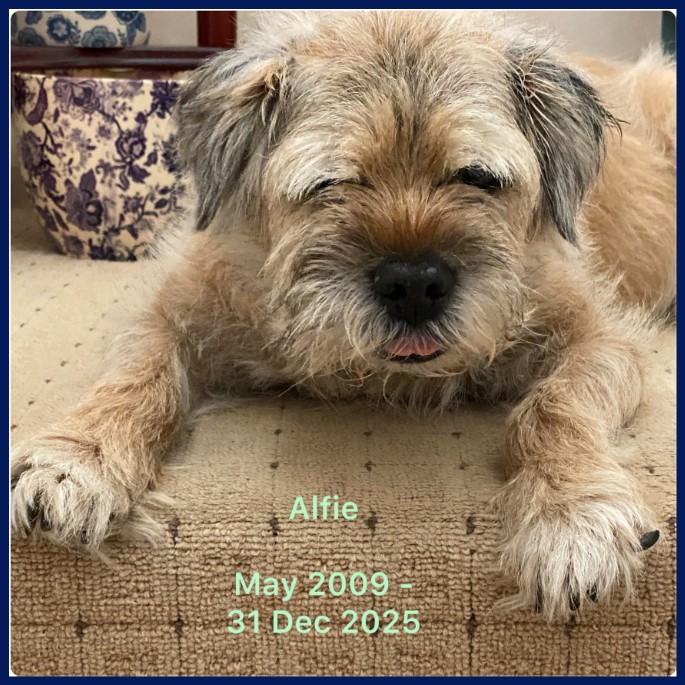
Alfie, Border Terrier, May 2009 – 31 Dec 2025

© Julie Goucher, October 2022

2011, and we were about to board a ferry to the Isle of Bute. There was a phone call; a rescue Border Terrier that needed to be re-homed. As soon as we were back we went to see the BT. There we saw a very sad Stanley aged two. I was sceptical, what would the little one be like? was he coming with history?

We could not leave him there, his little face looking at us, so he came home with us on 22 July 2011. We wanted to put his sad life behind him, and gave him a name change, to Alfie. He settled in, he quickly mastered the point of squeaky dog toys, chews & treats.

The last 18 months have been a challenge, problems with his liver but we elected him to bring him home and enjoy what time we had, as long as he was doing ok. We saw the vet frequently. That time ran out today, when we made the decision to say a final farewell to Alfie, who was 18 1/2, by far the oldest BT the vet had seen.

Alfie was a loyal little thing. He preferred Stuart to me, he loved sleeping, exploring, eating cheese & even steak. He followed us around, knew when it was time for a walk. He was loved & loved us back.

Alfie, you are very missed.
May 2009 – 31 Dec 2025

© Julie Goucher, October 2022

Posted in Miscellaneous | 2 Comments

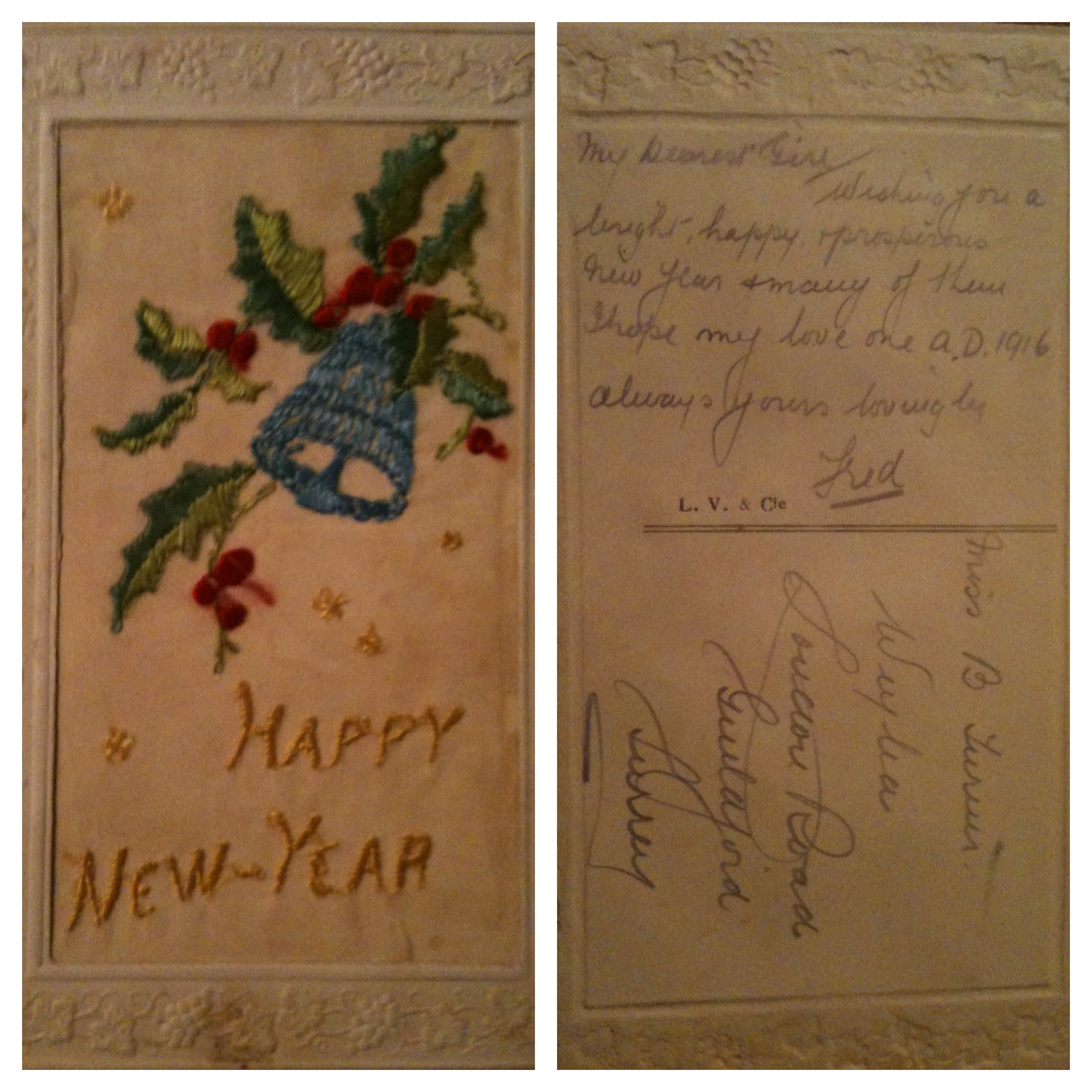
Happy New Year – 2026!

Image from Julie Goucher personal collection

Purchased for my Guildford & District Collection, this was sent from Frederick Wait whilst he was serving from the Front in 1916.

So, Who was Fred?…..

A search of the Marriages for a B Turner in Guildford 1916+ to a Fred revealed one such entry. The marriage of Bertha A Turner to Frederick W Wait in the September Quarter of 1917 at Guildford. (Ref 2a, 201).

Working backwards to the 1911 Census. Did that reveal more of Bertha? The index revealed one entry for a Bertha E Turner. I took a chance and looked at the data. It didn’t pay off, and revealed a Bertha Elizabeth Turner residing at 144 Walnut Tree Close Guildford, not far from the childhood home of my Grandmother who grew up at number 114, though my Grandmother wasn’t born until December 1912 – Isn’t research curious?.

Anyway, A quick look through the First World War records didn’t prove obviously helpful, neither did the Commonwealth War Graves website. So I still didn’t know who Fred was. A quick search of the 1911 Census for him and I was surprised. It revealed one entry; just one.

Frederick William Wait, Single and aged 20 years born 1891 Guildford. On overseas military duty and recorded as in the 7th Dragoon Guards and stationed at Hislop Barracks, Trimulgherry, Duccan, India. Not what I had expected, but I do know that regiments based in India, and elsewhere across the Empire were sent to fight in France, for King and country.

Now, I have not looked more into Frederick Wait since I originally wrote the majority of the text in 2011. There is still more to explore about Fred and his life after the postcard was sent to Bertha Turner.

I don’t descend from Fred and/or Bertha, but would like to find out more about the couple and perhaps return the postcard to the family. If you descend from the couple please drop me a note. Below is a larger version of the image for easier reading!

Image from Julie Goucher personal collection

Posted in Genealogy, Guildford & District ~ A Pictorial Archive, Guildford, Surrey, England | 1 Comment

Festivities of the Season

Merry Christmas image – from the collection of Julie Goucher, 2021

However you spend the season, I hope you enjoy it whatever you are doing. Perhaps with friends, family and perhaps a little genealogy too.

Posted in Advent Posts, Archive - Imported from Blogger | Leave a comment

(Advent 22) – Variants

Created Julie Goucher using word cloud

The topic of variants and deviants is addressed in detail during the Introduction to One-Name Studies course. Essentially we have likely all come across variants and deviants to our surnames, even if we have not called them that.

Variants

For the purposes of my own One-Name Studies I have registered two variants for ORLANDO, these are ORLANDE and ORLANDA. For my BUTCHER study I registered just one, BUTCHERS. It is also worth pointing out that you do not need to register a variant and at the initial point of registering the surname Butcher I did not register a variant. I did so when I came across a divorce record in the name of Butchers in which the male stated that his name was Butcher and not Butchers.

When looking at my husband’s ancestry his early Goucher ancestors were recorded as Goacher. The Goucher surname was listed as a variant in the Goacher One-Name Study when it was registered by another member of the Guild of One-Name Studies. When the study was deregistered, following the death of the registrant, my husband registered the surname and listed Goacher as a variant. He also added several other variants, one of which is the topic of a forthcoming post.

Deviants

A deviant is a change of surname that happens inconsistently. In the case of the 1939 Register, my husband’s Grandmother, was recorded as GROUCHER.

Why do variants exist?

Accents, spelling and people writing what they think they hear rather than what they actually do – Goucher is a case in point and I regularly receive correspondence in the name of Goucher and Groucher. In a letter recently, I was referred to as Goucher and Goacher, within the same sentence and that is not all, the envelope was handwritten and addressed to Mrs Groucher!

In a time when not everyone could read and write it was very easy for the inconsistencies with the spelling to exist because the person writing the surname would not be corrected if the person could not read what was written down.

Those with “foreign” surnames might change their surname, to make themselves fit in more and I gave an example recently. Surnames that have spellings that are not familiar in one country might become changed over time, just to be easier to manage.

You might find this page on the Guild of One-Name Studies website useful as you consider your own surnames and their potential variants. Those of you who read this earlier post might find it useful to read it again and consider the potential variant I discovered. I will at some point write about this again and my hypothesis about this.

Posted in Advent Posts, Genealogy, One-Name Studies | 2 Comments

(Advent 19) – Software

Created by Julie Goucher, using word cloud, 2020

This continues the process from Advent 17, where I talked about how to create the database. This post is about where to put the database – which genealogy software?

The most frequently used software by those with One-Name Studies, and many other projects are these (listed in alphabetical order).

  • Family Historian
  • Family Tree Maker
  • Legacy
  • Roots Magic

The first software listed is very much used by researchers in the UK, the others are US focused. The reality is regardless where you are living, and where your research is centred, the most important factor in software is which one do you find the most intuitive to use? If you have taken a Pharos course with me, then you will have likely heard my story with software.

In short, I used Family Origins starting with version 4 and updating to the final version, number 10. I then switched to Roots Magic. The relationship I had with the software up to this point was a love-hate relationship. It worked, doing just what I set out in the Advent 17 post, but there was something that was not intuitive to me, and I could not put my finger on what the something was. Over the years I had taken trials with Family Historian and I could not get to grips with it, no idea why that was the case.

Then Family Historian released version 7, I was drawn to take another trial, which I did. I have no idea what happened, only that I began to feel more in tune with Family Historian. I purchased the software and purchased the manual which focuses on version 6, but if I got stuck then I prefer to be able to open a book to find the answer, rather than trawl through help in the program itself. 

I then extracted the Gedcom from Roots Magic and imported it into Family Historian. There was no issues with the data transfer, but I did, and still need to do some sorting with data, sources and repositories within the program.

We do explore software as part of the Introduction to One-Name Studies course, and more so in the Practicalities of a One-Name Studies course. The important message though is this – take the time to explore the software, create a test database, add a source and some basic data. Don’t take hours adding information at this point, instead spend the time on checking the functionality of the software. Does it feel comfortable to use?  Is entering data feeling like a hassle or a joy? Whilst you won’t spend enormous amounts of time entering endless data into your software, what time you do invest in your study needs to be spent wisely and with ease.

There is other software out there, and I would suggest think about the following:

  • What are the aims of your study?
    • If you want to have a Guild hosted website for your registered study and to use TNG then using software that does not enable you to meet those aims might not be a good idea.
  • Does the software produce a Gedcom?
  • Is the software available to purchase or free?
  • Consider the longevity of free software?
  • Is the software maintained by the developer?
    • Update to the latest version to keep your program in tip-top order

In the Pharos courses we discuss these things and more.

Posted in Advent Posts | Leave a comment

(Advent 18) – Records

© Julie Goucher, 2019

This is a post that I wrote probably about five years ago, and I think it is worth resharing now.

I kept spreadsheets full of unprocessed and unrelated data prior to it being added to my software database. 

I use Excel, but this will work with the Google and Mac equivalents. Also the aesthetics will look different if you are on a tablet Apple or Android, or on a laptop etc.

When I open Excel and create a new workbook I create a series of sheets, these are the tabs at the bottom (or might be at the top).  The first sheet is always a guidance sheet, this tells you a variety of things, depending on the purpose of the file.

If you look at the download of the 1837 onwards GRO download which can be found HERE you can see an example, the first sheet is the Guidance sheet, the next three sheets are the births, marriages and death sheets.

In my Miscellaneous data workbook I have the guidance sheet, and instead of having different workbooks, each with a sheet of different data I have moved the individual sheets to the Miscellaneous workbook. That way, each different data group retains the columns for each field header and yet there are not lots of different spreadsheet files.

There is a trade off, a workbook marked Miscellaneous is not exactly helpful, but the alternative is lots of different spreadsheet workbooks, and one worksheet containing a variety of field headings means the amount of columns could and, in my case did, mean the open workbook went off the screen and I had to resort to scrolling across, which was just unhelpful.

I should point out that for each study (or database) I have a Miscellaneous workbook. My file names are defined as:

  • BUTCHER – Miscellaneous
  • GOUCHER – Miscellaneous
  • ORLANDO – Miscellaneous
  • VIRCIGLIO – Miscellaneous
  • EUROPE – Miscellaneous

The first three are my One-Name Studies, the fourth is a surname study that is unregistered with the Guild of One-Name Studies currently, and the fifth is my gathering of data resources for European Ancestors.

The first lesson in the Practicalities of a One-Name Studies course, looks at spreadsheets, their uses, creations and why they are not a great fit for storing a One-Name Study long term – correct tool for the job!

My method is effectively using a spreadsheet as a holding pen. Once I add the data to my database, which is generally when I have expanded the detail beyond one person, I annotate the line as done, eventually deleting the sheet from the workbook.

Whilst the sheet maybe removed from the Miscellaneous workbook, it moves to the archived workbook, just in case I want to refer back to it in the future, with my archived material stored in Dropbox.

As an addition to the original post, I have made some tweaks, not necessarily to the structure of the Miscellaneous workbook, but in the processing of the information. When I download the material, adding it to a sheet within the Miscellaneous workbook, I include the URL that the information came from and the date I accessed it. I also make a note in my research log. Whilst I do tend to date data gathering material, it means that I can backtrack easier should I need to.

Posted in Advent Posts | Leave a comment

(Advent 17) – Questions…..

Created by Julie Goucher – Feb 2020 Using Wordclouds.com

One of the most frequent questions I am asked by Introduction to One-Name Studies students is HOW do you use family tree software, or HOW do you keep One-Name Study information?

It takes a while to find your rhythm in how you can retain information for a One-Name Study, the same also applies to One-Place Studies or anything else which relates to a gathering of genealogical data where the individuals could very well be unrelated, or some related, but others not.

I had a mental block of how these people who did not connect to each other could be retained within a genealogical software, and at the beginning I did a test case, just by creating one project, called Butcher test case and entered six different John Butcher’s – one was mine and the others were unrelated to my family, actually they came from a different county completely. I did not add lots of data, name, parents name and baptism dates. I then closed down the file.

Three days later I opened the Butcher test case file and did a search within the database itself. There listed, were six individuals bearing the same name, each had a unique reference number, this is generated by the software itself. I then made two additions to the file.

In our usual family tree software we have a root person, this is someone who is always the starting point when you open your software. In the case of my own family tree that root person is my late Mum, who is individual 04.

As I said, I added two individuals, myself who I made the root person and then my husband. I did a search of the database, there listed was an alphabetical list of everyone in the database, now 8 individuals, everyone unconnected from each other, apart from myself and my husband. I could now begin to see how the database would look. I then selected one other individual that had lots of information. I made that person the new root person and added the bear bones of three facts. I closed the database and left it for a few days.

The next time I opened the file up, the root person was the last person I added, I added one more fact, then added a new individual, making that person the root individual.

I then set about writing my methodology out, which is essentially what I have written here. I then created my actual database project called Butcher One-Name Study and selected my first individual….. I am going to pause here and come back to this thread (Advent 19).

Posted in Advent Posts | Leave a comment

(Advent 13) – Migration

Migration is the reason that a true one-name study is global. There have been peaks of migration, from the United Kingdom and various countries in Europe over time. The reasons for that migration varies depending on the starting point for the migration.

Having made the decision to migrate there are a number of factors to consider, here some are listed from the view point of the migrant and the view point from the researcher. They are listed below in a potentially random fashion and I plan to as we move into 2026 undertake a series of posts.

Each point should be considered in alignment with WHO, WHAT, WHEN, WHERE, WHY and HOW.

  • Reasons for migration
  • Is the migration for a set period of time?
    • Chain migration
    • Migration to establish a family base
    • Plan to return home after earning 
  • Time of migration
    • Weather
    • Economy
    • Environment of homeland
  • Route of migration
    • Nearest port or cheapest port
    • Direct migration – Place A to Place B
    • Varied migration route –
      • Did they need to work to afford the next part of the trip?
      • Did they Country hop, perhaps overland, via sea or a mixture of both
  • Traveling alone or with a Companion?
    • Was the Companion friend, family or friend of family member, family member of a friend?
  • Religion of the individual/family migrating
  • Which port did the migrant arrive at?
    • Was that the intended place?
    • Did they need to travel further, into the Country interior?
    • If so, did they travel directly, or work/stop off on route?
  • Where did they settle?
    • settle in one place, one town/state
    • settle for a while then move on to a different town/state
    • Did they benefit from a land grant?
  • Working
    • What did they do back home?
    • What employment did they do after the migration?
  • Names – names with vowels are frequently open to being changed – A,E,I,O,U
    • Accents, Dialect, Alphabet
    • Name changes because it is being said, and it is written as what is thought to have been heard
    • Name changed to make it more aligned with local population
    • Name Changed to begin a new life with new partner
      • Getting on the ship as Mrs X
      • Getting off the ship as Mrs Y

With all that, I am sure you can see why migration plays such a part in researching surnames. 

As I said, I will look at this element in the early part of 2026, so if you are not a subscriber, either watch out on social media or to ensure you receive the posts, please subscribe.

Posted in European Ancestors, Genealogy, One-Name Studies | Leave a comment

(Advent 12) – Learning and Reading

Created by Julie Goucher, 2018 using word clouds

The way we each learn is different, I prefer to write notes, so for me I am likely to recall something if I wrote it down having read it or heard it. There is a plethora of genealogical and historical learning offerings out there, so much so it is easy to feel overwhelmed by it all.  If I am undertaking research, say planning a book, article, course, I tend to make notes as I read.

If I make a direct copy, perhaps a sentence that “speaks to me” then I do that in a different colour and create the citation so that I and anyone else can find their way to the same information, in the same format. I must stress, this is not taking someone’s work as mine, it is identifying that this particular bit (sense, concept, theory etc.) was written by author/presenter ABC in (name of book, presentation etc.) and published/presented (year and publisher or date and host if in a presentation. This is about recognising and respecting another person’s work product mentioning what they said and in what format they said it.

The more reading and listening you do the more grounded your knowledge and subsequently your research will be. However, it is not just about reading and listening on our own. Interactions with us – peers, tutors, presenters etc is just as valuable and provides a mechanism for sharing ideas.

The following are the Pharos courses that I teach the first three are about Surnames and these are in a layered learning style:

Introduction to One-Name Studies coursea foundation for undertaking a study – learning about the numbers that reflect the people in your study, the history of surnames, and then drawing conclusions as to the history of your surname of interest.

Practicalities of a One-Name Studies coursefocuses on tools that you can use in your study. I am often asked whether this should be taken first, or the Introduction course, and it is probably as broad, as it is long. If I was coming to this as a fairly new genealogists, or surname researcher, I would likely take both courses; they focus on different things and provide a rounded focus on researching a surname and developing a study.

Advanced One-Name Studies coursebuilds on the material learnt in the introduction course and is probably best taken when you have some time under your belt with a study. This provides the opportunity to create an article and for those who elect to, to have the article tutor assessed and published in the Journal of One-Name Studies.

Each time a course runs, students are invited to leave feedback. Feedback is important and provides a mechanism for me to develop the course, or perhaps create an additional paper. A recent addition, as a support document is guidance for developing, and building a study profile – you can download a copy HERE.

Researching Ancestors in Continental Europe – this is a course that I designed to give a broad understanding to mainland Europe. The course has description can be read HERE. There is focus on how complicated Europe is, given how many countries make up the Continent, the differences and similarities, religious focuses and prejudices. We look at the scale of influence of Europe and most importantly, we hone in on events within the last 100 years or, BUT, war in the 20th Century can and does impact records from pre 20th Century era. 

This course is very much about getting the basics right, building research on solid foundations, because without that, it would be a bit like building a house in the middle of a swamp. As this is already quite lengthy, I am going to continue this on day 21!

Posted in European Ancestors, Genealogy, Introduction to One-Name Studies (Pharos course 901), One-Name Studies | Leave a comment