European Ancestors – Understanding France (34) – Overseas Territories, Empire and Slavery

Courtesy of Wikipedia
Flag adopted 15 Feb 1794

This post is part of a series about genealogy in France. You can read the complete series HERE.

Building on from Part 20 where we looked at territories located outside of France; in this part I want to address the facts resources relating to researching those who were enslaved. Some of this might not be easy reading, and for that I hope I am forgiven. Alas we cannot change the past, instead I want to acknowledge the facts as gently as I can and hope the information contained here is useful.

France was the third largest slave trading country, elevated to that position due to the number of Africans arriving in Haiti (Saint-Domingue) during the latter part of the eighteenth century. It is believed there were about 1,381.ooo Africans transported on French ships during this period and around about 1,165.000 survived, arriving in the French Caribbean colonies. The Africans would have been loaded into the ships, having spent time, already incarcerated, perhaps on land or even on board ships in port. Then they endured weeks at sea, encountering what would have been pretty brutal conditions, before moving across land to the final stop on the journey.

Substantial numbers, around 73,000 sailed to Guadeloupe, with 217,000 to Martinique, the vast majority, but 773,000, went to Saint-Domingue which was the most profitable colony during the eighteenth century.

The French locations in the Caribbean were considerably larger than the British and Spanish lands in the region. Voyages were often beginning from Le Havre which was France’s first major slave trading port which deposited Africans to Martinique, French Guiana, and mostly Saint-Domingue. There were also large number of voyages from regions in west Africa to West Central Africa, to the Dutch and French Guianas, Islands of the Caribbean, Spanish Caribbean, and even the State of Louisiana. The sugar plantations of France, in Saint-Domingue, remained the destination for African survivors until 1791 when the Haitian Revolution commences.

The French Empire abolished slavery in April 1848. Thousands of people became full citizens. For a great many people there was no records available, those in Martinique found that a new type of registration, actes d’individualité was to be introduced. This was a standard format, declaring the name and age of the person, place of birth, names of parents and the registration from the Slave Register if applicable to them. The records have been filmed and can be viewed HERE

Each individual was required to visit the Mairie, or town hall, in each Commune, to claim their citizenship. If the individual did not have a surname, they were asked to choose one. Some were unsure of what to choose and the clerk was able to give a surname. Some choose names of the plantation, of the master or owner, some chose a name that meant something to them, perhaps linked to the location or work undertaken.

Not everyone who ventured to overseas territories of France was enslaved. Some wanted a new life and took opportunities where they were present – more on that in another post.

Resources:

Posted in European Ancestors, Europeans beyond Europe, France, Genealogy, Understanding France Series | Leave a comment

European Ancestors – Understanding France & Jewish Migration (33)

Courtesy of Wikipedia
Flag adopted 15 Feb 1794

This post is part of a series about genealogy in France. You can read the complete series HERE.

Between 1880 and 1939 more than 110,000 Jews migrated west from central and eastern Europe. They settled, creating a thriving, yet crowded community in the fourth district of Paris. Here they embraced their Jewish religion, culture and traditional life. Jewish trade unions were active, as the local population comprised of many artisan workers, mainly in the textile industries.

In 1940, France fell to the German military who almost immediately took control of a modern high rise residential apartment block, known as La Cité de la Muette (“The Silent City”). Initially the Germans used the site for a police barracks, but it was later converted to a detention centre for holding Jews and others who were labelled as “undesirables” before deportation. The site was built to hold 700 detainees, but the site, at its peak held at least 7,000 people.

On 20 August 1941, the French police, at the demands of the German authorities. conducted raids through the Jewish quarter of Paris, where they arrested around 4,000 foreign or stateless Jews who were the first intake of individuals to Drancy, The site was under control of the French police, where it remained so until July 1943. Drancy itself also contained five subcamps which were located around the capital, three of which were the Austerlitz, Lévitan and Bassano camps.

On 16 July 1942 most of the Jewish families in the area were rounded up by 4,500 French police, continuing the demands of the German authorities. More than 11,000 Jews were arrested and initally confined in the Vel d Hiv (velodrome) or Winter Stadium, as it is known. The conditions were crowded, with very little access to water, food and sufficient sanitary facilities, families were at this point able to stay together, unlike at Drancy. Within a week the number had swelled further, to around 13,000 of which 4,000 were children. There was also almost 5,000 that were immediately sent to Drancy.

On 19 July 1942 the Jews began to be transferred to transit and Concentration camps located outside Paris. Families were taken to Austerlitz railway station where sent to camps in the Loiret region. Some were transferred to Drancy, and then onward to Auschwitz. The journey from France was brutal, five days in a cattle train. On arrival, many were murdered as soon as they arrived.

In November 1943, around 350 Jewish refugees, many of whom had left France for Italy in an attempt to escape persecution, and had been arrested in Italy following the Italian surrender, arrived at Drancy from Borgo San Dalmazzo camp in Italy, before onward travel to Auschwitz.

Drancy was liberated by the Allies in August 1944 and immediately handed to the French Resistance and a Swedish Diplomat who were responsible for the care of around 1500 people who remained detained there. Following the war, until 1946, those who collaborated with the Nazi’s were interned at Drancy.

More that 76,000 French Jews perished during the war.

Posted in European Ancestors, France, Jewish Genealogy & Research, Understanding France Series | Leave a comment

European Ancestors – Understanding France (29) Official Name Changes

Courtesy of Wikipedia
Flag adopted 15 Feb 1794

This post is part of a series about genealogy in France. You can read the complete series HERE.

Surnames did not become widespread to the 15th Century for the majority of those in France. Those that wanted to change their name had to obtain permission from the King.

These changes are indexed in L Archivist Jerome

Dictionary of changed names from 1803-1956 is available in Paris, at the Library of France, published 1974.

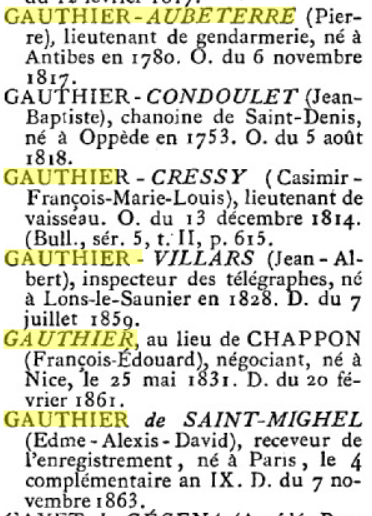
Some early examples are available online at Gallica or Internet Archive.  A Dictionary of those who had their name changes 1803-1865 can be found HERE and an example looks like this (accessed 28 July 2022):

Posted in European Ancestors, France, French Surnames, Goucher/Goacher One-Name Study, Surname Series, Understanding France Series | Leave a comment

European Ancestors – Understanding France (25) Franco-Prussian War

Courtesy of Wikipedia
Flag adopted 15 Feb 1794

This post is part of a series about genealogy in France. You can read the complete series HERE.

  • Began 19 July 1870
  • Fighting began in the north eastern part of France; Alsace & Lorraine
  • Soldiers doing military service we mobilised initially
    • Increased to all soldiers aged 35 years old and under who had completed national/military service
    • Single men under 40 years old in the National Guard
  • Most of the fighting resulted in losses, both in terms of men and territories
    • Suden, resulted in the French surrendering
    • Capture and Abdication of the Emperor, Napoleon III leading to the
    • Third Republic of France.
  • The war continued, heading in the direction of Paris, the siege of Paris started 19 September 1870, but fighting continued in other regions.
  • Food shortages began to affect civilians
  • 28 July 1871, Paris surrendered and subsequently the war ended.

Map below, showing how Europe looked at the end of the War in 1871.

Courtesy of Education Technology Clearinghouse, University of Florida (1)

Alsace-Lorraine

  • Treaty of Frankfurt led to annexation of territory of Alsace Lorraine
  • Citizen of these regions had to select citizenship:
    • Become German and remain in the region
    • Remain French and emigrate
      • 161,000 opted for French citizenship, but only 50,000 actually emigrated.
      • Those who remained became officially German citizens and the official language became German.
        • From 1872-1919 records are in German,
      • As a result of the Treaty of Versailles in 1919, Alsace-Lorraine returned to France

Almost all regions in Alsace and part of the departments of Moselle and Meurthe (54) which are now:

  • Bas-Rhin (67)
  • Hant-Rhin (68)
  • Moselle (57)

As a result of this annexation, a large part of northern France was occupied by German military between 1871-1873. The German military stayed in military or garrison towns, the local had to supply accommodation and food to the soldiers.

There were restrictions, food shortages and of other supplies, leading to outbreaks of Typhoid and Dysentery.

There was revolts amongst workers in some cities, such as Lyon and Paris. The Commune of Paris as a revolutionary government that ruled Paris for two months, between March and May 1871. The lasting change was the creation of the French Third Republic which lasted until the beginning of the Second World War.

The La Commune de Paris of 1871 database is an excellent addition to the French genealogist toolkit. The two month existence of the revolutionary government known as an insurrection, identified the insurrectionists as Communards which gives the name to what is a fantastic database.

The Communards were either arrested and sentenced to death or their charges dismissed. The database, which can be found at communards-1871.fr provides the following data:

  • Name of those charged
  • Names of the parents
  • Place of birth
  • Place of residence
  • Occupation
  • Charges faced.

(1) – Educational Technology Clearinghouse, University of South Florida – https://etc.usf.edu/maps/pages/6900/6933/6933.htm (accessed 26 July 2022)

Posted in European Ancestors, France, Understanding France Series | Leave a comment

European Ancestors – Understanding France (26) – Acadians

Courtesy of Wikipedia
Flag adopted 15 Feb 1794

This post is part of a series about genealogy in France. You can read the complete series HERE.

Acadian is the term given to French settlers, who migrated from primarily the Vendee region of France, and colonised the lands,  settling in what is now known as Nova Scotia, where they established prosperous lives as farmers, or fisherman. They Co-existed alongside the indigenous peoples. The Arcadians were though, a target for numerous wars between the French and English.

The term of Arcadians has two reference groups:

  1. In Canada – Descendants of French speaking descendants of early French settlers in the region known as Acadia
  2. In USA – Descendants of those who were deported to Louisiana in the 18th Century

Acadians also arrived in the west of Newfoundland and Labrador area from the late 18th Century into the mid 19th Century, mostly from Cape Breton. They were principally farmers, who migrated in family groups taking advantage of the rich soil. Many acquired land at St George’s Bay and Codroy Valley.

Posted in European Ancestors, Europeans beyond Europe, France, Understanding France Series | Leave a comment

European Ancestors – Understanding France (28) French Surnames (Geographical)

Courtesy of Wikipedia
Flag adopted 15 Feb 1794

This post is part of a series about genealogy in France. You can read the complete series HERE.

Continuing the French Surname posts from (31)

Geographical surnames are a feature of many countries, based upon a person’s residence, perhaps the town or place they lived or formerly lived, or a location within a place, or a description of a place.

Here are a few examples:

  • Jacques Marsielle could be either from there, or formerly from there.
  • Jacques Leglise could be living next to the church.

Whilst it is useful in part, these types of surnames are not overly helpful. Names passed from father to offspring, might be representing a family connection from previous generations, rather than specific to a particular one.

Prefixes used as such de, des, du or le which translate to of – some using Jacques above might include the prefix with the surname, whilst others dropped it, but retained the place name.

Posted in European Ancestors, France, French Surnames, Genealogy, Non-British Surnames, Understanding France Series | Leave a comment

European Ancestors – Understanding France (30) French Surnames (Alias & Dit)

Courtesy of Wikipedia
Flag adopted 15 Feb 1794

This post is part of a series about genealogy in France. You can read the complete series HERE.

In some areas a second surname was likely adopted to distinguish between branches of the same wider family; this was especially so if the family had been in the same village for generations.

Alias names are often preceded by the word “dit”. In some instances, an individual adopted the “dit” surname and dropped the original name. Using wills is a useful way of identifying wider family, especially if the “dit” name was adopted.

Dit names were common in France amongst soldiers or those who made their living at sea.

Posted in European Ancestors, France, French Surnames, Non-British Surnames, Understanding France Series | Leave a comment

European Ancestors – Understanding France (31) French Surnames

Courtesy of Wikipedia
Flag adopted 15 Feb 1794

This post is part of a series about genealogy in France. You can read the complete series HERE.

Surnames can be traced back to the 11th Century, but these were not widespread, and it took several centuries for it to become commonplace.

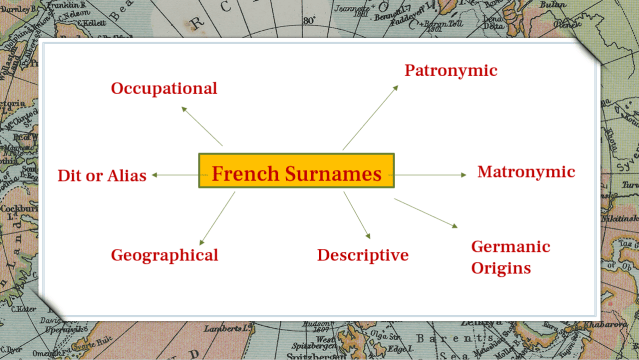
Surnames evolve through a variety of key pointers, and this post is going to provide some basic information and examples.

Copyright – Julie Goucher, July 2022

  • Patronymic based on the first or given name of the father and example is Tomas Robert, Tomas is the son of Robert
  • Matronymic –based on the given name or first name of the mother, especially relevant if the father is unknown.

Typical way of attaching a suffix, meaning son of is – de, des, du, lu or the Norman Fitz. Less common in France than in some European countries, although it still occurs, such as in this case, Tomas FitzRobert = Tomas, son of Robert.

Other suffix meaning “Little son” are eau, elet, elin, elle and elit

Occupational Surnames

These surnames are based on a trade, job or even aligned to something used in order to deliver a trade or job – Pierre Boulanger = Peter the baker.

Here are a few examples:

  • Caron – Cartwright
  • Fabron – Blacksmith
  • Pelletier – Fur Trader
  • Boucher – Butcher
  • Barbier – Barber
  • Carpentier – Carpenter
  • Cartier – Carter
  • De la Cour – Of the Court
  • De la Rue – Of the Street
  • Chaterlain – Constable, Prison warden, from the Latin word Castellum (watch tower)
  • Donadieu/Donnadieu – “given to God” – often given to children who became priest/nuns, or orphaned, with unknown parents.
  • Gagneux – Farmer
  • Lane – Wool or wool trader
  • Vachon – Cowherd
  • Vercher – Farmland
  • Satre – Tailor (sewing of clothes)

Descriptive Surnames

These are based upon an individual, developed from nicknames or pet names. For example Jacques le Grand = Jack the big (or could be the senior, if his son was given the same name). Le Blanc = blond hair or complexion, Petit = small

Some of these can be ironic, so Jacques le Grand, instead of being tall or big, could have been small or short.

French Names with Germanic Origins

With so many French surnames originating from a first name, some of the most common French names have Germanic origins.

These names became part of French culture as a result of German occupations, so Germanic names do not necessarily mean German ancestors.

Posted in France, French Surnames, Non-British Surnames, Types of Surnames, Understanding France Series | Leave a comment

European Ancestors – Understanding France (24) – Religion and the Waldensians

Courtesy of Wikipedia
Flag adopted 15 Feb 1794

This post is part of a series about genealogy in France. You can read the complete series HERE.

Waldensians, known as the Poor men of Lyon were a religious movement from 12th Century which spread to the Alps of France and Italy, based on the religious teachings of Peter Waldo, a wealthy merchant who in 1173 gave away his property to preach apostolic poverty on the way to perfection.

Conflict with the Catholic church began and by 1215 followers of the faith were labelled as heretical, due to them failing to recognise the Prerogatives of the local Bishops over content and for failing to recognise and observe the standards of those who were fit to preach. Members were offered the chance to return to the Catholic faith, which some did, bearing the label of “poor Catholics”. Others did not and over the following Centuries many were persecuted.

In the 16th Century they were absorbed into the Protestant movement under the influence of an influential Swiss reformer, called Heinrich Bullinger. Aligning themselves with Protestantism, with the Resolution of Chanfaran on 12 September 1532, and formerly became part of the Calvinist tradition – members of the Community of Protestant Churches in Europe.

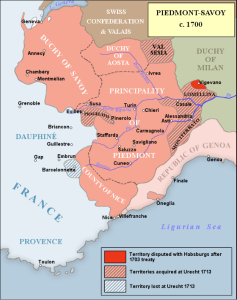
During the 17th Century there were almost destroyed, through a series of conflicts between the Communities and the Savoyard military in the Dutchy of Savoy between 1655 and 1690, though to be fair these battles were with the church rather than militaristic. The Piedmontese Easter was the catalyst for the next series of events. It was reported in 1685, that there were about 15,000 Waldensians following the faith

In certain areas of Piedmont there was tolerance and freedom of beliefs which had been documented over centuries. These rights were threatened, indeed two specifically undermined the situation further:

  • Edict of 15 May 1650 redacting the agreed privileges.
  • Edict of 25 January 1655 which was a religious expulsion order

The order specified that every head of household with the individuals of that household, and of the religion, of every specific “rank” were not permitted to inhabit or possess property in  Lucerne, St. Giovanni, Bibiana, Campiglione, St. Secondo, Lucernetta, La Torre, Fenile and Bricherassio, and should, within three days of the publication of the order depart from the place, under pain of death, and confiscation of their homes and property, unless they returned to the Catholic faith.

Upon refusal, the government sent soldiers to plunder and destroy Waldensian homes and some 15,000 soldiers were garrisoned there. On 24 April 1655, Piedmont Easter, a massacre began. The slaughter of between 4,000 and 6,000 civilians which led to the Movement of refugees to the Valley of Perosa. Several states intervened – England, France, Germany and Protestant areas of Switzerland. On 18 August a peace treaty between Charles Emmanuel II and the Waldensians was issued, known as the Pirenolo Declaration of Mercy.

In 1685 King Louis XIV rescinded the Edict of Nantes and began purging the Waldensians, forcing some to convert to Catholicism. Fighting broke out again, a great many Waldensians were killed, their meagre forces crushed within days. The fighting did not stop there, more than 2,000 Waldensians were killed in later massacre’s, and 3,000 survivors, mostly children were forced to convert through baptisms and placed in Roman Catholic homes. A further 8,500 were incarcerated in a number of fortresses, and by the time of their release the number had dwindled to a little more than 3,840. A number fled to Switzerland or Germany during 1685-1687. Others were resettled by Catholic Savoyard Subjects from elsewhere in the summer of 1686 as part of a government colonialism scheme to confiscate and resell Waldensian homes.

On 17 September 1686 some Waldensians were granted a free pass to Switzerland, some prisoners released as were the forcibly converted children who returned to their families. Many Waldensians settled in Bradenburg, Wullemburg, Hesse and Palatine between 1687 and 1689. On 23 May 1694 the official annulment of the Edict of Persecution was undertaken followed by new legislation of Edict of Reintegration allowing Waldensians to live in their original place of residence. On 29 June 1696 in Savoy a separate peace deal with France was agreed, that some land originally promised could only be granted on the understanding that no Protestants were to reside there. All reformed Christians born in France would be expelled from the Dutchy of Savoy-Piedmont, which was swiftly followed on 1 July 1689 by an edict expelling French born Protestants from Savoy-Piedmont subjecting 3,000 Waldensians to leave the valleys within two months.

Map Courtesy of Wikipedia

This has been a whistle-stop view of the Waldensian turmoil, but in closing it is important to understand that whilst this is a post about France there are significant overlaps with Italy.

Borders were not as they are now, as this part of Italy was originally French. Movement to safety was undertaken by the Waldensians with them moving across Europe and further still in the 17th and 18th Centuries, to Argentina, Uruguay, and the United States. Some migration was direct, in other instances migration occurred in more than one stages. In some cases out of necessity, in other instances they were encouraged to migrate again with people they knew or perhaps met following the initial move. That is something that drives the focus on surnames with groups that have migrated.

Posted in European Ancestors, France, Italy, Understanding France Series | Leave a comment

European Ancestors – Understanding France (21) Religions and the Roman Catholic Church

Courtesy of Wikipedia
Flag adopted 15 Feb 1794

This post is part of a series about genealogy in France. You can read the complete series HERE.

Catholicism has been the predominate faith in France from the 6th Century. There were other religious denominations that gained foothold and momentum in France, in particular the Alsace Lorraine region and the Montbeliard region near the border with Germany and Switzerland – more on these in the coming posts – Mennonities, Huguenots, and Waldensians

  • Baptisms began to be recorded in many regions of France from around 1540, with some regions starting a few years later. In a few instances, Catholic baptisms can be found in earlier records, some as early as 1334, within the region of Saône-et-Loire
  • Marriage records began around 1545
  • Death records from about 1555.

Parish Registers (Registres paroissiaux) from 1540 to 1793, and Civil Registers (Registres de l’état civil) were the responsibility of the departements.

  • Some records date back to 1334 in the City of Givvy, but these are are until circa 1539.
  • Council of Trent of 1563 issued the mandate that Roman Catholic parishes keep baptisms from 1579
  • Later, records were extended to incorporate deaths and marriages.
  • Huguenot records from 1559, but some of these have not survived.
  • Migrants to neighbouring countries before further migration to the United States, South Africa, especially after 1685.

Catholic Encyclopaedia 

Posted in European Ancestors, France, Understanding France Series | Leave a comment