European Ancestors – Understanding France (22) Religion and Mennonites

Courtesy of Wikipedia
Flag adopted 15 Feb 1794

This post is part of a series about genealogy in France. You can read the complete series HERE.

Mennonites are a Christian religious denomination that originated in the Netherlands and Switzerland from around 1523, forming in opposition to the Roman Catholic faith, aligning with the Anabaptist movement. The movement spread across Europe, the northern German states and the Netherlands with a leading activist, Menno Simons who was a former Roman Catholic priest.

Mennonites hold, and adhere to the religious principles of:

  • Non Violence, and pacifism
  • Dedicated to the practices and beliefs as outlined in the New Testament
  • Against infant baptism – belief that baptism is a choice and not something undertaken as an infant.
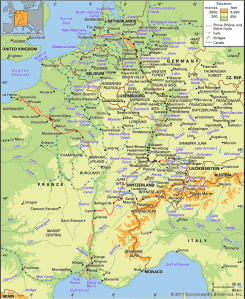
Map courtesy of Encyclopaedia Britannica

Mennonites were persecuted during the 16th Century, those from Switzerland and south Germany migrating west, settling in Alsace and Palatine, settling along the Rhine Valley, (larger version of the map can be found HERE), whilst those who were Dutch or from northern Germany migrated eastwards, towards Poland, Ukraine, and into Russia, by the end of the 18th Century.

In the 17th Century, there was a split between the Liberal and Conservative Mennonites, with the latter taking the name of Amish. Into modern times, technological advancement has provided and enabled the liberal of the faith taking advantage of modern elements, such as cars and electricity.

Gradually, as the religious turmoil continued, many migrated to the New World, initially settling in Pennsylvania (those originating from Switzerland or south Germany) and eventually the mid west arriving in states such as Ohio, where they worked the land and farmed.

Around 1776, others, around 2,000 began migrating to Upper Canada, a defining feature was spoken German language. Between 1825 and 1870 there was further movement, as others acquired land in York and Waterloo Counties.

About 7,000 Mennonites from Prussia, Russia and United States were attracted to Manitoba and the Prairie provinces of Canada by Homesteading lands between 1890 and 1914, this led to Mennonite communities being established in Saskatchewan and an increased number to Ontario.

Following the United States joining the First World War, some Mennonites migrated to the Prairies, but the largest migration was still to come. In 1917, with the Russian Revolution underway, a further 20,000 escaped from the famine in Russia, by 1920 those living in Ukrainian areas of Russia followed suite.

With the Second World War underway across Europe a further 12,000 migrated to Canada from Russia and Germany via Displaced Person camps. Following the conclusion of the war in Europe another 8,000 went to Canada.

Whilst we have touched on other countries in this post, some being a long way from France, religious persecution across the centuries and war has by far been the most reasons for Mennonites to flea Europe, in many cases families would be split, some perhaps entering the United States, others to Canada and elsewhere.

Today, Mennonites can be found across the United States, Canada, Mexico, Paraguay and others in Europe. The total across north America was about 450,000 (2003). The Canadian census for 2001 revealed about 190,000 following the faith in the Country, with around half living in cities. About 20,000 or so are living in Winnipeg which boasts of 45 Mennonite churches. France has about 2050 Mennonite Churches, of which most are in the east of the country, but there are three in Paris.

Here are a couple of links which might be of interest:


Posted in European Ancestors, Europeans beyond Europe, France, Understanding France Series | Leave a comment

European Ancestors – Understanding France (23) Religion and Huguenots

Courtesy of Wikipedia
Flag adopted 15 Feb 1794

This post is part of a series about genealogy in France. You can read the complete series HERE.

  • Huguenots is the name given to those following the French who followed the Protestant faith.
  • War had existed between Roman Catholics and Huguenots as far back as 1562, which resulted in several waves of migration.
  • First wave of migration began in 1572 after St Bartholomew Day.
  • Edict of Nantes granted religious freedom in 1598,
  • In 1685, the Edict of Nantes was revoked and thousands fled France.
  • Some Huguenots renounced their faith and converted to Catholicism.
  • Converts are listed in a register, especially after 1685.
  • Some converts left France and reverted to their Protestant religion in their new country.
  • In the 18th Century, there was a revival of Protestant and some intolerance.
  • Louis XVI signed the Edict of Tolerance which granted freedom to Protestants.
  • Some useful websites (there are also further links on the resources post (32):
  • Protestant GenWeb
Posted in European Ancestors, France, Understanding France Series | Leave a comment

European Ancestors – Understanding France (19) Revolution and Migration

Courtesy of Wikipedia
Flag adopted 15 Feb 1794

This post is part of a series about genealogy in France. You can read the complete series HERE.

The period of Revolution and migration spans from 1798 through until 1815. During this period there was political, social and cultural changes which very much leads to an exodus from one country to another, and France was no different.

It is estimated that 150,000 migrated from France following the Revolution, spreading across Europe. In the book, Revolutionary Exiles by Jasanoff, published 2010 (pg 49)  “Sweden to Sicily, Portugal to Russia…” There was also migration to the United States, French, British and Spanish colonial regions, some going further still, to China and India.

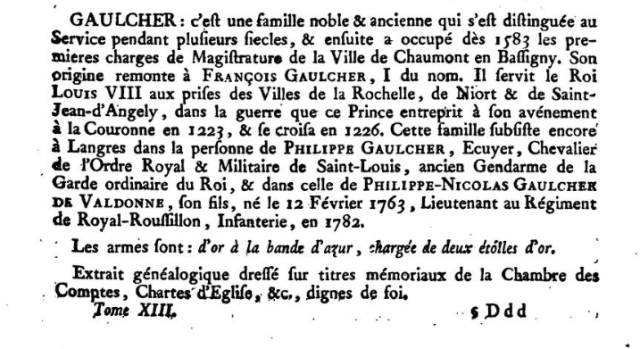
In nineteen volumes, the Dictionnaire de la noblesse which can be found on the Internet Archive documents numerous family genealogies.

The description from the Internet Archives, (accessed 28 July 2022), along with an example:

“Dictionary of the nobility, containing the genealogies, the history & the chronology of the noble families of France, the explanation of their arms, & the state of the great lands of the kingdom… We have attached to this dictionary the genealogical table, history, of the sovereign houses of Europe, & a notice of the foreign families, the oldest, the noblest & the most illustrious..”

Posted in European Ancestors, France, Understanding France Series | Leave a comment

European Ancestors – Understanding France (12) Causes of Revolution

Courtesy of Wikipedia
Flag adopted 15 Feb 1794

This post is part of a series about genealogy in France. You can read the complete series HERE.

The causes of the Revolution can be defined into five core points:

  1. The Bourgeoisie (Middle class who typically held view or social behaviour aligning with Capitalists) resented the exclusions from positions of honour or political power.
  2. Those labelled as peasants were aware of the situation, becoming less and less happy to support the feudal system.
  3. French participation in the American Revolution had caused France to be on the brink of bankruptcy.
  4. A country with a significant population, more so in France than elsewhere in Europe were impacted by a number of factors. Crops failing in 1788, added to the significant economical issues already being experienced.
  5. French monarchy not seen as being divinely ordained and were unable to adapt to political and social pressures that were faced with.
Posted in European Ancestors, France, Understanding France Series | Leave a comment

European Ancestors – Understanding France (18) The New Regime Phase 4

Courtesy of Wikipedia
Flag adopted 15 Feb 1794

This post is part of a series about genealogy in France. You can read the complete series HERE.

As the war entered this fourth phase:

  • France reoccupied Belgium
  • The National Convention began to debate the new Constitution.
  • Royalist tried to seize Paris, but were heavily opposed by General Napoleon Bonaparte, leading to
  • The National Convention collapsing.
  • The Rhineland and Holland occupied.
  • In 1795 Holland, Tuscany, Prussia and Spain negotiated for Peace.
  • France, under Bonaparte entered Italy in 1796, Sardinia quickly negotiated terms.
  • Austria was the last nation to agree to the Treaty of Campo Formio in 1797.
  • Countries occupied became “Sister Republics” with their Constitutions modelled on Revolutionary France.
  • Peace in Europe did not remain.
  • In 1798-99 France occupied Switzerland, the Papal states, Naples and set up Republics:
    • Helvetic (1798-1803)
    • Roman (1798-1799)
      • Pope into Exile, and reinstated in 1801
    • Parthenopean (1799-1802)
  • Great Britain remained at war with France
  • Bonaparte threatened the British by occupying Egypt and Malta.
  • Second Coalition formed:
    • Austria, Russia, Turkey and Great Britain all successfully driving Bonaparte back into mainland France.

This was deemed to be the end of the Revolution by Bonaparte, but the reality was, it was about to gain momentum, spreading in new forms across Europe.

Posted in European Ancestors, France, Understanding France Series | Leave a comment

European Ancestors – Understanding France (17) The New Regime Phase 3

Courtesy of Wikipedia
Flag adopted 15 Feb 1794

This post is part of a series about genealogy in France. You can read the complete series HERE.

  • The third phase began in the Spring of 1793.
  • Austria, Prussia and Great Britain formed a Coalition, which generally speaking most rulers in Europe adhered to
  • France lost Belgium and the Rhineland.
  • Paris was threatened by invading forces.
  • New Republican calendar introduced.
  • Introduction of maximum Government control of prices,
  • Confiscation of property from emigres
  • Rich taxed
  • National assistance available to the poor and disabled.
  • Education available, free of cost.
  • Reign of Terror began – many arrests of those opposing, approximately 300,000 people, with 17,000 given a sentence of death, some of which were executed without a trial.
  • The Revolutionary government raised an army of around one million men.
Posted in European Ancestors, France, Understanding France Series | Leave a comment

European Ancestors – Understanding France (16) The New Regime Phase 2

Courtesy of Wikipedia
Flag adopted 15 Feb 1794

This post is part of a series about genealogy in France. You can read the complete series HERE.

  • From September 1792 through to April 1793, Belgium, Rhineland, Savoy, and the County of Nice were occupied by French armies.
  • The National Convention was divided into
    • Girondins who wanted to organise a bourgeois (middle class) republic across France and for it to spread across Europe.
    • Montagnards (Mountain men) who wanted to give a greater share of political and economical power to the lower classes.
    • Despite the efforts of the Girondins, Louis XVI was judged and condemned to death for treason and executed on 21 January 1793, with Marie-Antoinette guillotined in the September of the same year.
Posted in European Ancestors, France, Understanding France Series | Leave a comment

European Ancestors – Understanding France (15) The New Regime Phase 1

Courtesy of Wikipedia
Flag adopted 15 Feb 1794

This post is part of a series about genealogy in France. You can read the complete series HERE.

  • France declared war against Austria on 20 April 1792.
  • During the timeframe of April-September 1792, France suffered defeats.
  • In July 1792, Prussia joined the war with an army rapidly moving towards Paris.
  • Maria-Antoinette was born in Austria, and began encouraging her brother, Holy Roman Emperor Leopold II to invade France.
  • As a counter measure, Revolutionaries occupied Tuileries Palace where Louis XVI was living, with the Royal family held in the temple.
  • September 1792, a number of nobles and clergy were massacred.
  • People in France were inspired by the wave of Nationalism.
  • French military checked Prussians on 20 September 1792 at Valmy which was also the day the New Assembly met.
  • On 21 September  1792, the Assembly, now called The National Convention proclaimed the abolition of monarchy, and the establishment of the Republic.
Posted in European Ancestors, France, Understanding France Series | Leave a comment

European Ancestors – Understanding France (14) The New Regime

Courtesy of Wikipedia
Flag adopted 15 Feb 1794

This post is part of a series about genealogy in France. You can read the complete series HERE.

The new regime in France looked like this:

  1. Complete abolishment of feudalism.
  2. Suppression of previous orders.
  3. Establishment of equality amongst man, though slavery remained in the French colonies.
  4. More the half the male population were now entitled to vote.
  5. Naturalisation of lands of the Roman Catholic church in France in order to pay off public debt, leading to
    1. Widespread distribution of property
    2. The middle classes and peasant landowners gained the most, and some peasant workers were able to buy land.
      1. Land transfers were made though sale of assignats, which were paper bonds issued as currency in France between 1789 and 1796. Bonds issues by the National Constituent Assembly, were retired once transfer of property was complete and were guaranteed by value of church lands.
  6. An undertaking to reorganise the Church, enacting the Civil Constitution of the clergy, which was rejected by Pope Pius VI and many French clergy.
  7. Structure of administration of France, divided into
    1. Departements
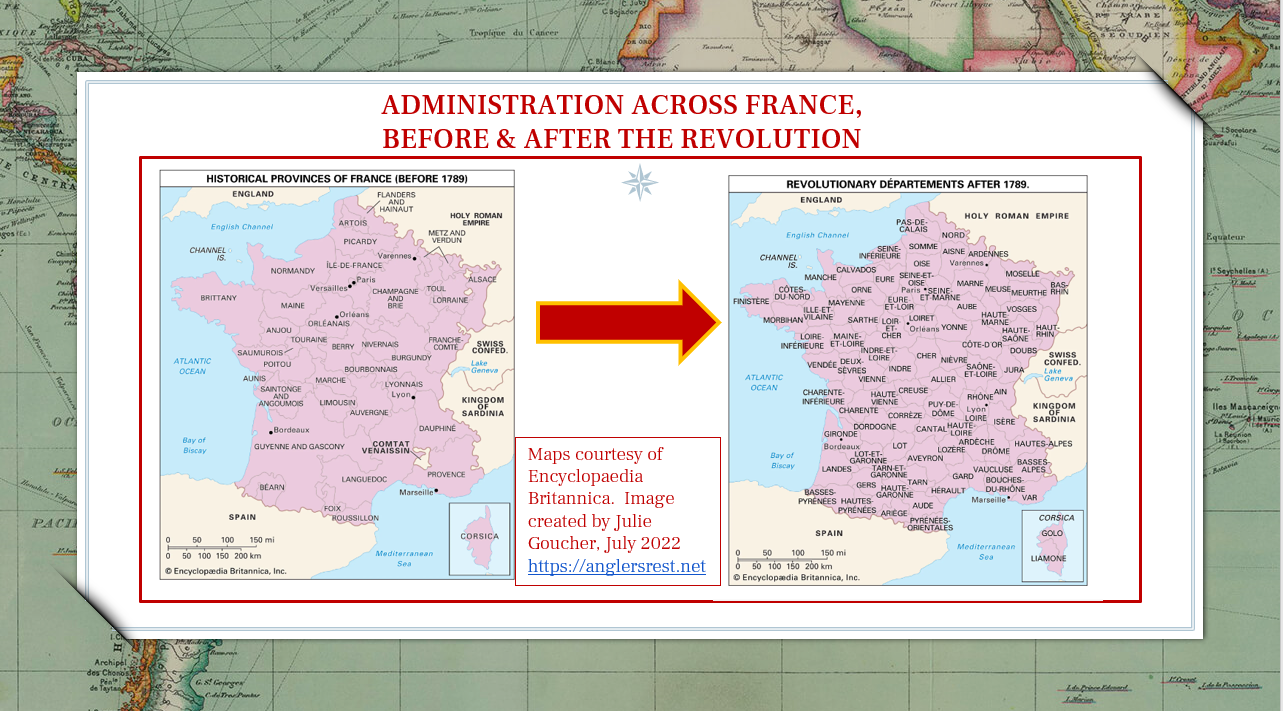
    2. Districts
    3. Cantons
    4. Communes

Louis XVI tried to flee France on 20 June 1791, but was brought back to Paris. The events in France were unfolding, inspiring other nations, such as Belgium and Switzerland. Those that wanted change in England, Ireland, States across Germany, Austria and Italy looked on at the Revolution sympathetically and perhaps with a little envy.

The Principality of the Papal area of Avignon reunited with France on 13 September 1791. The King was hopeful that the War would strengthen his position, or even allow the military of other nations to rescue him.

Posted in European Ancestors, France, Understanding France Series | Leave a comment

European Ancestors – Understanding France (13) Foundation for Revolution

Courtesy of Wikipedia
Flag adopted 15 Feb 1794

This post is part of a series about genealogy in France. You can read the complete series HERE.

The foundation for the Revolution began in February 1787 when the controller of finances arranged for the assembly of those who were deemed as “notables”, essentially great noblemen and some representatives of the middle classes.

The proposed reforms were an attempt to remove a budget deficit by taxation increases of the privileged classes. The assembly refused to agree to the reforms, suggesting that the Estate Generals which represented the Clergy, the Aristocracy and the Third Estate (Commoners).

who had not met since 1664, should have. The fiscal reforms, despite not being supported were enforced, leading to a “revolt” of the aristocratic bodies (Parliaments – important courts of Justice) whose powers were restricted by the Edict of May 1788.

In 1788, there was more unrest, King Louis XVI reappointed a reform-minded finance minister and promised to convene the Estate General on 5 May 1789. He also granted “Freedom of the Press”, and soon France was flooded with publications relaying the message of reconstruction of the state.

There were elections between January to April 1789 for the Estate-General which coincided with disturbances following the failure of the harvest of 1788. There were no exclusions from voting:

  • 600 deputies of the Third Estate (the Commoners)
  • 300 for the Nobility
  • 300 for the Clergy

The Estate Generals met on 5 May 1789 and immediately they could not agree on:

  1. Vote by individual – essentially, one head, one vote which gave advantage to the commoners
  2. Vote by the Estate – the privileged orders might be outvoted

On 17 June 1789, the struggle led to the Commoners (Third Estate) declared themselves the National Assembly, saying they would proceed without the other two orders, if necessary. There was support from many parish Priests who were outnumbered by the Upper Clergy of aristocratic.

Royal Officials locked the church deputies out of their usual meeting place on 20 June. The meeting moved to the King’s indoor tennis course with the oath, stating they would not move until a new Constitution was given to France.

The King urged the nobles and remaining clergy to join the assembly. On 9 July, the assembly took the name of National Constituent Assembly though the King also began moves to gather the military to remove it. Rumours began to circle The Third Estate, of them being overthrown, an aristocratic conspiracy, leading to what is known as the Great Fear of July 1789.

This led to the peasants rising against their Lords and on 4 August 1789 it seemed the only way out was to abolish the feudal system. On 26 August the Declaration of the Rights of Man and of the Citizen, proclaiming Liberty, Equality and the Inviolability of Property, and the right to resist oppression.

The King refused to agree. There was a growth of newspapers, all keeping citizens informed of the developments. Public ceremonies promoted the planting of “Liberty Trees” in villages and a Festival of Federations was held in Paris in 1790.

Posted in European Ancestors, France, Understanding France Series | Leave a comment