European Ancestors – Understanding France (32) Resources

Courtesy of Wikipedia
Flag adopted 15 Feb 1794

This post is part of a series about genealogy in France. You can read the complete series HERE.

The following are some useful resources for researching in France, & French Ancestors:

Posted in European Ancestors, France, Understanding France Series | Leave a comment

European Ancestors – Understanding France (20) Territories outside of France

Courtesy of Wikipedia
Flag adopted 15 Feb 1794

This post is part of a series about genealogy in France. You can read the complete series HERE.

France, like many nations in Europe controlled lands outside of the country, such as:

  • Martinique
  • Reunion Island
  • Wallis & Fortuna
  • Guadeloupe – located in the archipelago in the Caribbean and consists of six inhabited islands
    • Basse-Terre
    • Grande-Terre
    • Marie-Galante
    • La Desirade
    • Iles des Saintes
    • other inhabited islands
  • French Guiana – bordering Brazil and the Republic of Suriname
  • New Caledonia
  • French Polynesia
    • Society Islands
    • Marquesas Islands
    • Austral Islands (scattered)
    • Tuamotu Islands (scattered)
  • Mayotte – Located in the Indian Ocean and became a departmental region of France in 2011 following a referendum in 2009
  • Crozet Islands
  • Kerguelen
  • Amsterdam and St Paul
  • St Pierre and Miquelon
  • Saint Martin & St Barth – Saint Martin is an island shared with the Netherlands – More information found HERE

Courtesy of Wikipedia

Some of these locations have records included at FamilySearch.

Posted in European Ancestors, Europeans beyond Europe, France, Understanding France Series | 1 Comment

European Ancestors – Understanding France (27) DNA

Courtesy of Wikipedia
Flag adopted 15 Feb 1794

This post is part of a series about genealogy in France. You can read the complete series HERE.

French Bioethical Law states that DNA testing is only allowed for specific purposes – Medical, Scientific or Judicial reasons.

There is a significant concern relating to paternity and medical tests, with tests being undertaken with supervision, which includes DNA tests.

France remains steadfast in its view, that DNA tests remain illegal, and France is the only country in Europe which takes that view.

Posted in European Ancestors, France, Understanding France Series | Leave a comment

European Ancestors – Understanding France (11) Calendar

Courtesy of Wikipedia
Flag adopted 15 Feb 1794

This post is part of a series about genealogy in France. You can read the complete series HERE.

The period from 1792 until 1806 is challenging for genealogists researching in France. During this period two things happened

  1. “Revolutionary” calendar introduced
  2. Some town names changed

The calendar was created in October 1793, but set to begin 22 September 1792, which was the day the French Republic was created. Napoleon stopped this and the calendar reverted to “normal” on 1 January 1806.

The year was divided into four seasons, with each of the months within a particular season having different endings:

  • SPRING – ending in al
  • SUMMER – ending in dor
  • AUTUMN – ending in aire
  • WINTER – ending in ose

All months were 30 days long, but that did not make a full year, so there was an additional 5 days to include, or 6 in leap years.

In records, Revoluntary dates are written in full letters. When the dates are written as numbers, Roman Numerals are used for the year.

A tool has been made available by the Archives of Pas de Calais which converts the Gregorian calendar to the Revolutionary calendar, you can access this HERE.

A reverse tool, converting Revolutionary calendar back to the Gregorian calendar can be found HERE

During this period some communes changed their name, removing any signs of Royalty, Nobility or religion. New names were selected based on the principles of the Republic or on geographical features. There is a list of communes that changed their name on Wikipedia, which can be found HERE. Most towns reverted to their original name in 1814, but even so it can be problematic to researchers.

Posted in European Ancestors, France, Understanding France Series | Leave a comment

European Ancestors – Understanding France 30 year War (9)

Courtesy of Wikipedia
Flag adopted 15 Feb 1794

This post is part of a series about genealogy in France. You can read the complete series HERE.

 The Thirty Year War spanned 1618-1648.

Conflict in France commenced in 1635, and battles took place in the north east of France, mostly centred in the Alsace and Lorraine region. Lorraine lost 60% of its inhabitants during this period.

The decisions by the Duke of Lorraine and the King of France from 1660 was to repopulate the region and rebuild the destroyed villages of Boismont, Lorraine and Wadgassen German Village.

Stonemason and builders from other regions of France, in particular Picordie and Savoie took the opportunity to access employment, as did many from Austria.

The map below is from Encyclopaedia Britannica (accessed 20 March 2022) and shows the changes in territory at the conclusion of the war.

Posted in European Ancestors, France, Understanding France Series | Leave a comment

European Ancestors – Understanding France (8) (Divorce)

Courtesy of Wikipedia
Flag adopted 15 Feb 1794

This post is part of a series about genealogy in France. You can read the complete series HERE.

Divorce was allowed in France during:

  • Revolutionary period 20 September 1792 – 8 May 1816
  • Reinstated in 1884

Divorce records are usually found in the registers as Marriages.

Divorce Certificate (acte de divorce)

Divorce Certificates are obtained from the Office of the Mayor (La Mairie) where the divorce took place. The request must include:

  • Date of the divorce;
  • Full names of the two persons involved. The request must be accompanied by a self-addressed stamped envelope.

There is not normally a charge for a copy of a divorce certificate.

Divorce Decree (jugement de divorce)

Divorce judgments are obtained from the Greffe du Tribunal Civil where the judgment was
pronounced.

The request must include:

  • Date of the divorce
  • Full names of the two persons involved

The request must be accompanied by a self-addressed stamped envelope. There is not normally a charge for a copy of a divorce judgment

Posted in European Ancestors, France, Understanding France Series | Leave a comment

European Ancestors – Understanding France (7) Marriages

Courtesy of Wikipedia
Flag adopted 15 Feb 1794

This post is part of a series about genealogy in France. You can read the complete series HERE.

During the period of 22 September 1792 and 26 July 1800 marriages had to be celebrated in the main canton, rather than in the commune, which is where they would have expected to have taken place.

Marriages are only legal in France if they have been undertaken in the presence of a civil authoritarian. They may subsequently be followed by a religious ceremony.

The civil marriage registers give many details, such as:

  • the birth date and birthplace of the bride and groom
  • parents’ names, including mother’s maiden surname, for both bride and groom
    • if the parents have died, their death date and death place are recorded.
  • Civil marriage records may even include the same information for the grand-parents
  • Witnesses are listed, (usually four), with their age, occupation, residence, and relationship.
  • Birth information of the couple’s children who are born prior to the wedding.
  • Marriage contract information, if one was made, include the date, the name of the notary, and the town where this contract was written may be included.
  • Civil marriage records may also mention the date of the banns.

A couple was required to announce their intention to give other community members the opportunity to raise any objections to the marriage. These are known as Banns and were required to be lodged twice in the weeks prior to the marriage. Banns were lodged in the parish of both the bride and groom and usually also indicate the parish where the marriage took place, or the residence of the bride. Some registers of marriage banns before 1927 have been preserved.

Marriage Supplements were sometimes filed by the bride and groom as a way of supporting their application to marry. This often included other useful genealogical information such as:

  • Birth record extracts of the bride and groom,
  • Death certificates of the parents,
  • Divorce decree of a previous union of either party
  • The certificates of residence,
  • Information of a Marriage contract,
  • Information and acknowledgement of children,
  • Parent’s consent
  • Military status of the groom

Sometimes documentation on earlier generations may be included. In France these marriage supplements were originally kept by the clerk of the court, but on occasions they may have been given to the departmental archives.

A Marriage Contract was created for the protection of property. The certificate often showed the name and town of the notary and when it was written. These are always deposited with the departmental archives.

In 1877 a family register was created. It seems likely that the need for this came about following the fire in Paris in 1871 when all the birth, marriage and death records were destroyed for events prior to 1860.

This was given to the couple following the marriage. As children were born to the couple it was updated. This was a document held by the couple and very often these pass down the generations.

The current minimum age for marriage is 18 years.

Same sex marriage was legalised in 2013. There 10,522 registered in 2014 and 7,751 in 2015 [1]

[1] – Statista.com

Posted in European Ancestors, France, Understanding France Series | Leave a comment

Stationery Joys

Copyright – Julie Goucher, June 2022

Over the years I have shared about my notebook and writing obsessions and thought that I might share with you the ones I have enjoyed over recent months.  Some of these have been new, some extracted from my stash of notebooks and only one Moleskine! If you missed the post where I shared how it all began click HERE

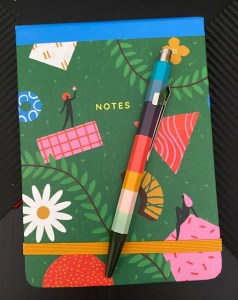
This notebook was a recent addition by way of a stationery subscription box that I subscribe to. I am not a fan of these reporter style books, but I was drawn to the design and it is my current book. The pen which is a Caran d’Ache Paul Smith 3rd Edition 849 Ballpoint Pen. The pen comes in a rather lovely tin, which is the only difference, so in this case I have two, the green and the mustard colour tins, both pens are identical – there is no specific link between the pens and the notebook, they by chance compliment each other.
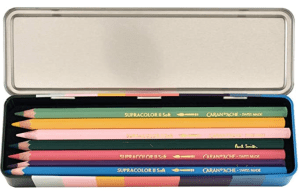
Santa bought me a matching set of colouring pencils, from the same series. I have fond memories of a set of Caran d’Ache colouring pencils from my school days, long since gone.

I spotted in the bottom of my filing cabinet the Leuchtturn1917 metallic notebook, in hardback and bronze colour. I then spotted whilst looking for something else that the brand now did A5 and A6 slim notebooks in paperback, within the same metallic series. As they were reasonably priced I ordered them. Each arrived as a set of two and came with the labels. I have used both A5 and one of the smaller ones.

As I was about to order another set of smaller ones I spotted another Leuchtturn1917, in the regular colours but in A7 size, hardback and 169 pages. Far too small for my usual use, but ideal for my handbag to add things to when I am out and about. 

Also in my supply was this lovely hardback blue and white notebook from the make of Eccolo. I vaguely recall buying this TK Max probably not long after we moved, so about four years ago. It is a large book, 26cm x 13cm, so what is B5 size. The following notebook was this one by Caroline Gardener, in the B5 size, that ran from 1 April until the end of May.
Courtesy of Amazon

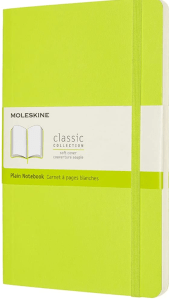
My June until the end of July notebook was this rather bright yellow/green Moleskine in softcover with plain paper.  When I purchased it I was not overly wowed with it and it sat on the top of my desk for several months, but it was actually a great notebook to work with, especially as I could roll the cover back.

Courtesy of Amazon

My notebook from the beginning of May until June was one that came recommended to me.

This is by the make of Emshoi, who produced a fabulous notebook. This is in the B5 size (19 cm x 25cm), ruled, with a pen loop. The paper is 100gsm and available in a series of colours as you can see from the image. There is a back pocket and this comes with some divider sticky notes and has two bookmarks. There is a contents page at the front. The paper is in a lovely smooth ivory. I have done a pen test and there is ghosting with some of the heavy pens, even Sharpie pens are ok with this notebook.
Copyright – Julie Goucher, June 2022

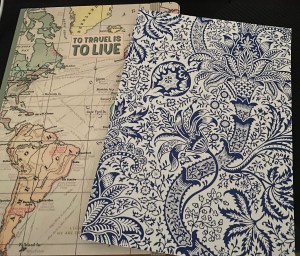
Two recent additions, which were gifts – from a friend who knows my notebook obsession. The book on the left is similar size to the Caroline Gardner book above and the other, A5 part of the Victoria and Albert collection of William Morris notebooks. It is paperback, no bells and whistles of book marks or back pockets, and will last me about a month, hopefully.

Posted in General Stationery, Stationery Box, Stationery, Filofax, Journals & Notebooks | 2 Comments

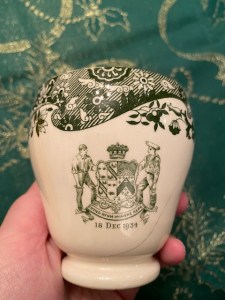
Motto – Kynd Kyn Knawe Kepe

Copyright – Julie Goucher, June 2022

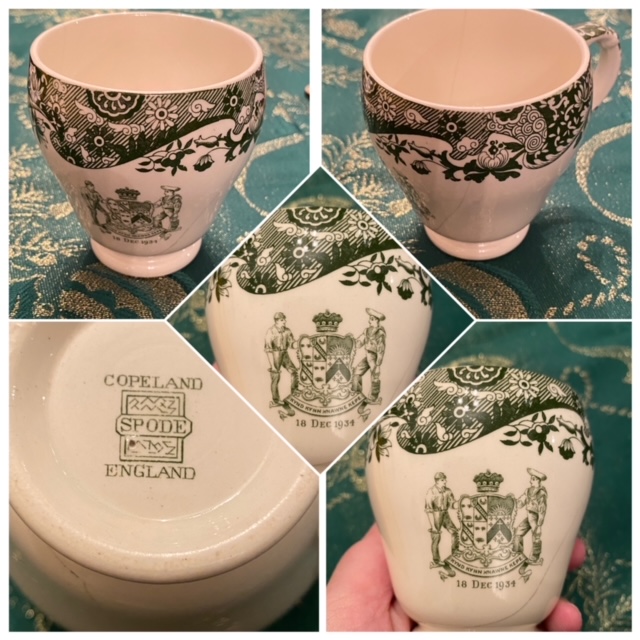
About 20 years ago I purchased this mug from an antique store in Devon. I was drawn to it for several reasons, the colours, the commemorative features and the date – 18 December was the date of my Grandmother’s birthday, though she was born way before 1934.

I was convinced that there was a link to mining and Cornwall. I decided to take to Twitter #AncestryHour (@ancestryhour & associated website) and wondered what genealogical colleagues would suggest. I was not disappointed, within a few minutes I had received some really useful suggestions and comments.

Copyright – Julie Goucher, June 2022

Firstly, I was alerted to the motto on the china, which bizarrely I had never noticed. How could I have missed that?

Whilst a number of weeks have passed I have not managed to spend anytime researching this further. What follows is the list of suggestions & hints, all centred around the motto, which I had not noticed!

  • Spode Museum Trust
  • Gawthorpe Hall
  • Article in Daily Mirror newspaper 19 December 1934
  • Article in Lancashire Evening News 19 December 1934
  • Lord Lieutenant of Lancashire, and President of the County Territorial Association whose coat of arms shows a shuttle, a weaver, and a seaman with a ship’s lantern.
  • Family motto is Kynd Kyn Knawe Kepe
  • Kay Family Association who are members of the Guild of One-Name Studies

I have added the mug research to my winter to do list.

Assistance from @mharkusAurelius, @MCgirl73, @Janciletti, @Janetspink1 & @MusicHallJane and @chiddickstree – thanks so much.

Copyright – Julie Goucher, June 2022

Posted in Commemoratives, Ephemera, Postcards & Stamps, Genealogy, History | Leave a comment

Surname Distribution Maps and Migration

Surname distribution maps add a new and different dimension to a One-Name study.

A surname may well have it’s origins in one Country, and a map can provide an interesting insight to how migration can influence the geographic spread of a surname. Going a step further, historical events can influence migration which in turn can be identified using a distribution map.

Especially those of us researching European surnames, a map can be used to identify where to start. In Europe, excluding UK and Ireland, events are recorded in the town & village in which they occur. If you are researching and find a Census or passenger list which simply lists the Country of origin as the place of birth, that is helpful, but not going to break those brick walls down.

Virciglio

courtesy of Gens.info

In my Italian family I have the surname of Virciglio. This map from Gens.info shows where the surname appears in Italy and the Islands. As you can see it is not a name that is widespread, although it is reasonably popular in “my” bit of Sicily.

We know, because history tells us, that there was significant peaks of migration from Italy and in particular south of the mainland and the islands. Famine was widespread, the only way of having a reasonable life was to migrate to other Countries and one of those countries was the United States.

Virciglio USA

Courtesy of Gens.info

Using another map from the same site shows the distribution for the same surname across the United States. This is especially helpful for the United States because, like Italy, records are held at local level, so I can discount all the states where there is no colour, at least initially.

Do surname distribution maps provide all the answers? – No, but they do provide scope for further research and considerations.

orlando Map

Courtesy of Gens.info

That said, when I insert my Italian study surname into the Gens.info website, the map looks like this which does not tell you anything beyond it is a popular surname and especially in the South and in Sicily.

There are a number of other surname distribution sites covering a number of other European Countries and there is a very useful Facebook Group too.

Don’t think that this site is not worth exploring if you are researching British surnames, a quick search of two Guild registered surnames, Butcher and Howes both produced a map, and whilst not the colour explosion of the Orlando map, certainly of interest nonetheless.

More details and information is covered in the Pharos Introduction to One-Name Studies course.

Posted in Genealogy, One-Name Studies, Virciglio | Leave a comment