European Ancestors – Understanding France (16) The New Regime Phase 2

Courtesy of Wikipedia
Flag adopted 15 Feb 1794

This post is part of a series about genealogy in France. You can read the complete series HERE.

  • From September 1792 through to April 1793, Belgium, Rhineland, Savoy, and the County of Nice were occupied by French armies.
  • The National Convention was divided into
    • Girondins who wanted to organise a bourgeois (middle class) republic across France and for it to spread across Europe.
    • Montagnards (Mountain men) who wanted to give a greater share of political and economical power to the lower classes.
    • Despite the efforts of the Girondins, Louis XVI was judged and condemned to death for treason and executed on 21 January 1793, with Marie-Antoinette guillotined in the September of the same year.
Posted in European Ancestors, France, Understanding France Series | Leave a comment

European Ancestors – Understanding France (15) The New Regime Phase 1

Courtesy of Wikipedia
Flag adopted 15 Feb 1794

This post is part of a series about genealogy in France. You can read the complete series HERE.

  • France declared war against Austria on 20 April 1792.
  • During the timeframe of April-September 1792, France suffered defeats.
  • In July 1792, Prussia joined the war with an army rapidly moving towards Paris.
  • Maria-Antoinette was born in Austria, and began encouraging her brother, Holy Roman Emperor Leopold II to invade France.
  • As a counter measure, Revolutionaries occupied Tuileries Palace where Louis XVI was living, with the Royal family held in the temple.
  • September 1792, a number of nobles and clergy were massacred.
  • People in France were inspired by the wave of Nationalism.
  • French military checked Prussians on 20 September 1792 at Valmy which was also the day the New Assembly met.
  • On 21 September  1792, the Assembly, now called The National Convention proclaimed the abolition of monarchy, and the establishment of the Republic.
Posted in European Ancestors, France, Understanding France Series | Leave a comment

European Ancestors – Understanding France (14) The New Regime

Courtesy of Wikipedia
Flag adopted 15 Feb 1794

This post is part of a series about genealogy in France. You can read the complete series HERE.

The new regime in France looked like this:

  1. Complete abolishment of feudalism.
  2. Suppression of previous orders.
  3. Establishment of equality amongst man, though slavery remained in the French colonies.
  4. More the half the male population were now entitled to vote.
  5. Naturalisation of lands of the Roman Catholic church in France in order to pay off public debt, leading to
    1. Widespread distribution of property
    2. The middle classes and peasant landowners gained the most, and some peasant workers were able to buy land.
      1. Land transfers were made though sale of assignats, which were paper bonds issued as currency in France between 1789 and 1796. Bonds issues by the National Constituent Assembly, were retired once transfer of property was complete and were guaranteed by value of church lands.
  6. An undertaking to reorganise the Church, enacting the Civil Constitution of the clergy, which was rejected by Pope Pius VI and many French clergy.
  7. Structure of administration of France, divided into
    1. Departements
    2. Districts
    3. Cantons
    4. Communes

Louis XVI tried to flee France on 20 June 1791, but was brought back to Paris. The events in France were unfolding, inspiring other nations, such as Belgium and Switzerland. Those that wanted change in England, Ireland, States across Germany, Austria and Italy looked on at the Revolution sympathetically and perhaps with a little envy.

The Principality of the Papal area of Avignon reunited with France on 13 September 1791. The King was hopeful that the War would strengthen his position, or even allow the military of other nations to rescue him.

Posted in European Ancestors, France, Understanding France Series | Leave a comment

European Ancestors – Understanding France (13) Foundation for Revolution

Courtesy of Wikipedia
Flag adopted 15 Feb 1794

This post is part of a series about genealogy in France. You can read the complete series HERE.

The foundation for the Revolution began in February 1787 when the controller of finances arranged for the assembly of those who were deemed as “notables”, essentially great noblemen and some representatives of the middle classes.

The proposed reforms were an attempt to remove a budget deficit by taxation increases of the privileged classes. The assembly refused to agree to the reforms, suggesting that the Estate Generals which represented the Clergy, the Aristocracy and the Third Estate (Commoners).

who had not met since 1664, should have. The fiscal reforms, despite not being supported were enforced, leading to a “revolt” of the aristocratic bodies (Parliaments – important courts of Justice) whose powers were restricted by the Edict of May 1788.

In 1788, there was more unrest, King Louis XVI reappointed a reform-minded finance minister and promised to convene the Estate General on 5 May 1789. He also granted “Freedom of the Press”, and soon France was flooded with publications relaying the message of reconstruction of the state.

There were elections between January to April 1789 for the Estate-General which coincided with disturbances following the failure of the harvest of 1788. There were no exclusions from voting:

  • 600 deputies of the Third Estate (the Commoners)
  • 300 for the Nobility
  • 300 for the Clergy

The Estate Generals met on 5 May 1789 and immediately they could not agree on:

  1. Vote by individual – essentially, one head, one vote which gave advantage to the commoners
  2. Vote by the Estate – the privileged orders might be outvoted

On 17 June 1789, the struggle led to the Commoners (Third Estate) declared themselves the National Assembly, saying they would proceed without the other two orders, if necessary. There was support from many parish Priests who were outnumbered by the Upper Clergy of aristocratic.

Royal Officials locked the church deputies out of their usual meeting place on 20 June. The meeting moved to the King’s indoor tennis course with the oath, stating they would not move until a new Constitution was given to France.

The King urged the nobles and remaining clergy to join the assembly. On 9 July, the assembly took the name of National Constituent Assembly though the King also began moves to gather the military to remove it. Rumours began to circle The Third Estate, of them being overthrown, an aristocratic conspiracy, leading to what is known as the Great Fear of July 1789.

This led to the peasants rising against their Lords and on 4 August 1789 it seemed the only way out was to abolish the feudal system. On 26 August the Declaration of the Rights of Man and of the Citizen, proclaiming Liberty, Equality and the Inviolability of Property, and the right to resist oppression.

The King refused to agree. There was a growth of newspapers, all keeping citizens informed of the developments. Public ceremonies promoted the planting of “Liberty Trees” in villages and a Festival of Federations was held in Paris in 1790.

Posted in European Ancestors, France, Understanding France Series | Leave a comment

European Ancestors – Understanding France (32) Resources

Courtesy of Wikipedia
Flag adopted 15 Feb 1794

This post is part of a series about genealogy in France. You can read the complete series HERE.

The following are some useful resources for researching in France, & French Ancestors:

Posted in European Ancestors, France, Understanding France Series | Leave a comment

European Ancestors – Understanding France (20) Territories outside of France

Courtesy of Wikipedia
Flag adopted 15 Feb 1794

This post is part of a series about genealogy in France. You can read the complete series HERE.

France, like many nations in Europe controlled lands outside of the country, such as:

  • Martinique
  • Reunion Island
  • Wallis & Fortuna
  • Guadeloupe – located in the archipelago in the Caribbean and consists of six inhabited islands
    • Basse-Terre
    • Grande-Terre
    • Marie-Galante
    • La Desirade
    • Iles des Saintes
    • other inhabited islands
  • French Guiana – bordering Brazil and the Republic of Suriname
  • New Caledonia
  • French Polynesia
    • Society Islands
    • Marquesas Islands
    • Austral Islands (scattered)
    • Tuamotu Islands (scattered)
  • Mayotte – Located in the Indian Ocean and became a departmental region of France in 2011 following a referendum in 2009
  • Crozet Islands
  • Kerguelen
  • Amsterdam and St Paul
  • St Pierre and Miquelon
  • Saint Martin & St Barth – Saint Martin is an island shared with the Netherlands – More information found HERE

Courtesy of Wikipedia

Some of these locations have records included at FamilySearch.

Posted in European Ancestors, Europeans beyond Europe, France, Understanding France Series | 1 Comment

European Ancestors – Understanding France (27) DNA

Courtesy of Wikipedia
Flag adopted 15 Feb 1794

This post is part of a series about genealogy in France. You can read the complete series HERE.

French Bioethical Law states that DNA testing is only allowed for specific purposes – Medical, Scientific or Judicial reasons.

There is a significant concern relating to paternity and medical tests, with tests being undertaken with supervision, which includes DNA tests.

France remains steadfast in its view, that DNA tests remain illegal, and France is the only country in Europe which takes that view.

Posted in European Ancestors, France, Understanding France Series | Leave a comment

European Ancestors – Understanding France (11) Calendar

Courtesy of Wikipedia
Flag adopted 15 Feb 1794

This post is part of a series about genealogy in France. You can read the complete series HERE.

The period from 1792 until 1806 is challenging for genealogists researching in France. During this period two things happened

  1. “Revolutionary” calendar introduced
  2. Some town names changed

The calendar was created in October 1793, but set to begin 22 September 1792, which was the day the French Republic was created. Napoleon stopped this and the calendar reverted to “normal” on 1 January 1806.

The year was divided into four seasons, with each of the months within a particular season having different endings:

  • SPRING – ending in al
  • SUMMER – ending in dor
  • AUTUMN – ending in aire
  • WINTER – ending in ose

All months were 30 days long, but that did not make a full year, so there was an additional 5 days to include, or 6 in leap years.

In records, Revoluntary dates are written in full letters. When the dates are written as numbers, Roman Numerals are used for the year.

A tool has been made available by the Archives of Pas de Calais which converts the Gregorian calendar to the Revolutionary calendar, you can access this HERE.

A reverse tool, converting Revolutionary calendar back to the Gregorian calendar can be found HERE

During this period some communes changed their name, removing any signs of Royalty, Nobility or religion. New names were selected based on the principles of the Republic or on geographical features. There is a list of communes that changed their name on Wikipedia, which can be found HERE. Most towns reverted to their original name in 1814, but even so it can be problematic to researchers.

Posted in European Ancestors, France, Understanding France Series | Leave a comment

European Ancestors – Understanding France 30 year War (9)

Courtesy of Wikipedia
Flag adopted 15 Feb 1794

This post is part of a series about genealogy in France. You can read the complete series HERE.

 The Thirty Year War spanned 1618-1648.

Conflict in France commenced in 1635, and battles took place in the north east of France, mostly centred in the Alsace and Lorraine region. Lorraine lost 60% of its inhabitants during this period.

The decisions by the Duke of Lorraine and the King of France from 1660 was to repopulate the region and rebuild the destroyed villages of Boismont, Lorraine and Wadgassen German Village.

Stonemason and builders from other regions of France, in particular Picordie and Savoie took the opportunity to access employment, as did many from Austria.

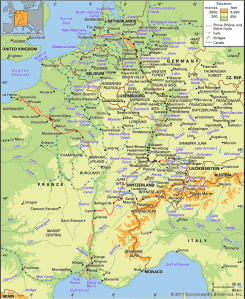
The map below is from Encyclopaedia Britannica (accessed 20 March 2022) and shows the changes in territory at the conclusion of the war.

Posted in European Ancestors, France, Understanding France Series | Leave a comment

European Ancestors – Understanding France (8) (Divorce)

Courtesy of Wikipedia
Flag adopted 15 Feb 1794

This post is part of a series about genealogy in France. You can read the complete series HERE.

Divorce was allowed in France during:

  • Revolutionary period 20 September 1792 – 8 May 1816
  • Reinstated in 1884

Divorce records are usually found in the registers as Marriages.

Divorce Certificate (acte de divorce)

Divorce Certificates are obtained from the Office of the Mayor (La Mairie) where the divorce took place. The request must include:

  • Date of the divorce;
  • Full names of the two persons involved. The request must be accompanied by a self-addressed stamped envelope.

There is not normally a charge for a copy of a divorce certificate.

Divorce Decree (jugement de divorce)

Divorce judgments are obtained from the Greffe du Tribunal Civil where the judgment was
pronounced.

The request must include:

  • Date of the divorce
  • Full names of the two persons involved

The request must be accompanied by a self-addressed stamped envelope. There is not normally a charge for a copy of a divorce judgment

Posted in European Ancestors, France, Understanding France Series | Leave a comment