Census, People and Genealogy – 1851 Census

Created by Julie Goucher, 2021 using Wordscloud

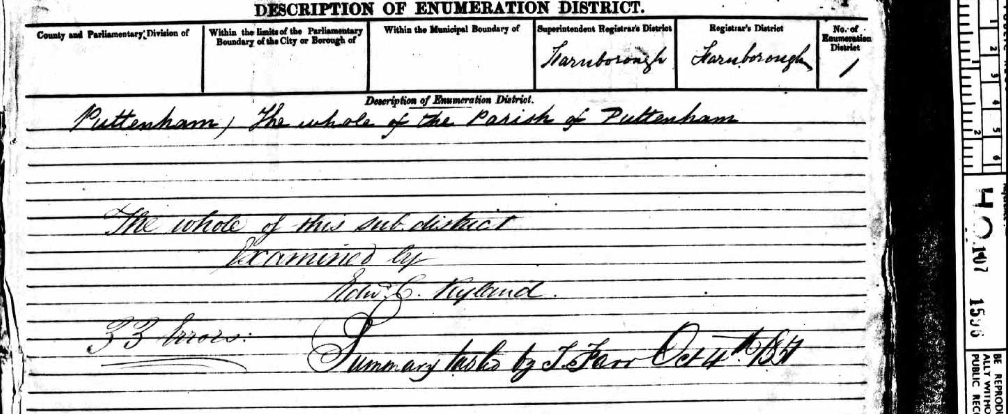
The 1851 Census moved on from the questions asked in the 1841 Census. As we can see, there is not much improvement in the description of the parish recorded at the start of the 1851 Census.

Census Returns of England and Wales, 1851.

There was additional questions asked of parishioners in the 1851 Census.

Census Returns of England and Wales, 1851.

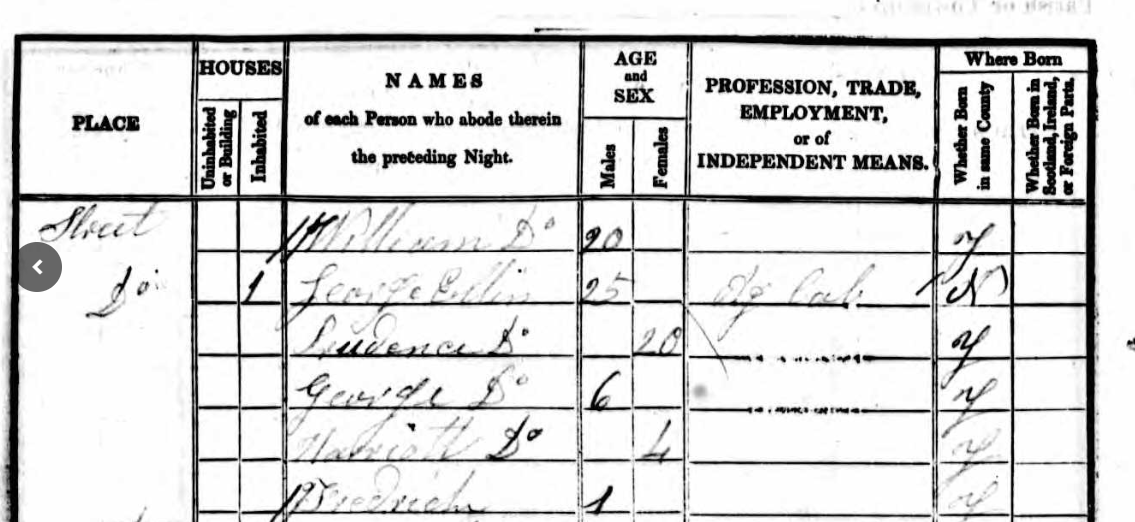
The family we met yesterday in 1841 are now featured here, indicated by the * (red astrix). The family are listed as they were in 1841, although the family is a bit bigger, with the addition of three children, including my great great Grandmother Caroline who was born in 1844.

  • Place – in this case it is recorded as “the street”
  • Houses – this is either uninhabited or a building, or the second option is inhabited which this one is
  • Names of those who were inhabiting the property on the night of the census
    • George Ellis
    • Prudence Ellis
    • George Ellis
    • Harriott Ellis
    • Frederick Ellis
    • Caroline Ellis
    • MaryAnne Ellis
    • Edward Ellis
  • Age and sex (gender) – the age the enumerator was provided was “accurate” age – what he was told, which may or may not be accurate.
  • Profession, or trade – in this case, George is described as an “ag lab”
  • Where born –
  • Whether born blind, or deaf and dumb

In terms of data consistency, George in 1841 was shown as born outside the county of Surrey. In 1851 George was reported as being born in Dover Barracks, Kent.

The line indicated by a yellow arrow is pointing to the line below the family. It that household there was just one individual, Richard Budd who is recorded as married and aged 78 years of age. The household is recorded as number 23 on the schedule which is the same as the Ellis family, although Richard’s home is referenced as one house. I took this to mean that whilst the Ellis and Budd’s were living on the same plot of land, they were residing in two distinct properties. Richard Budd was Prudence’s father.

Posted in Budd, Census, People and Genealogy, Ellis, Genealogy, One-Place Studies, Puttenham & Wanborough, UK & Ireland (Eire) Genealogy Series | Leave a comment

Census, People and Genealogy – 1841 Census

Created by Julie Goucher, 2021 using Wordscloud

As we sit to search for our family members on the various census it can be quite easy to scroll through, not looking at anything but the surnames, but at the beginning of the Census for each location there is a description box, such as this one shown below. As they go, the description of the village of Puttenham is significantly on the light side, and that very much depends on the enumerator of the day.

Puttenham Census 1841 – Surrey History Centre SRY HO107/1073/8

The image you can see below is from the 1841 Census for the village of Puttenham in Surrey. It details my great, great, great Grandparents – George Ellis and Prudence Budd.

Puttenham Census 1841 – Surrey History Centre SRY HO107/1073/8

As you can see, the data recorded (from left to right) is:

  • Place – in this case it is recorded as “the street”
  • Houses – this is either uninhabited or a building, or the second option is inhabited which this one is
  • Names of those who were inhabiting the property on the night of the census
    • George Ellis
    • Prudence Ellis
    • George Ellis
    • Harriott Ellis
    • Frederick Ellis
  • Age and sex (gender) – the age was a rounded number, so 14 was rounded to 15, but in this instance, the enumerator provided the “accurate” age – what he was told, which may or may not be accurate.
  • Profession, or trade – in this case, George is described as an “ag lab”
  • Where born – in county or Scotland, Ireland or foreign parts. In this case, George Ellis is recorded as being born outside of the Country of Surrey.

Whilst the 1841 Census is limited in data, it is the first time we see family groups recorded by household. Tomorrow, we look at the 1851 Census and follow George, Prudence and their family.

Posted in Budd, Census, People and Genealogy, Ellis, Genealogy, One-Place Studies, Puttenham & Wanborough, Surnames, UK & Ireland (Eire) Genealogy Series | Leave a comment

Census, People and Genealogy – Growth of a Village 1801-1831

Created by Julie Goucher, 2021 using Wordscloud

Over the last few days we have seen the details of Compton. We have seen how the village might have expanded and this post is to crunch the numbers, examining what they actually tell us.

At first glance the numbers are showing a gradual increase, in terms of property and families. That makes sense, if you grow your population they need somewhere to live, though there was minimal growth between 1801 and 1811; just 3 properties. No additional properties were built between 1811 and 1821 and then this significant growth between 1821 and 1831.

1801 1811 1821 1831 1841
46 49 49 88 96 Houses
58 74 81 95 Families
145 183 212 229 Males
125 150 211 226 Females
280 333 423 455 513 Totals

Despite the minimal property grown between 1801 and 1811, there was a population of 15 additional families, and that figure remains showing some growth. The gender split is not something that can be biologically determined at this point – essentially couples had no idea what sex their baby was to be until the point of delivery. To delve deeper into the numbers, around family groups and then how genders are reflected I need to spend time examining the baptisms, marriages and deaths.

Something else I want to look at is a map of the village and how that changed – did the village expand naturally or did the parish expand because of boundary changes? In addition to a map, I want to take a look at the Tithe Map – who owned the land in the parish?

Posted in Census, People and Genealogy, Compton, Surrey, England, Genealogy, UK & Ireland (Eire) Genealogy Series | Leave a comment

Census, People and Genealogy – 1831 Census

Created by Julie Goucher, 2021 using Wordscloud

The census for 1831 in Compton showed there had been significant house building as the number of houses had grown from 49 in 1821 to 88 in 1831. The population though, showed minimal growth.

I considered the alternatives to building and wondered if there had been a boundary change, therefore incorporating properties that were previously been in another parish, though I have not had chance to research this.

Compton Parish Records – Surrey History Centre; Woking, Surrey, England; Surrey Church of England Parish Registers; Reference: COM/1/2

Posted in Census, People and Genealogy, Genealogy, UK & Ireland (Eire) Genealogy Series | Leave a comment

Census, People and Genealogy – 1821 Census

Created by Julie Goucher, 2021 using Wordscloud

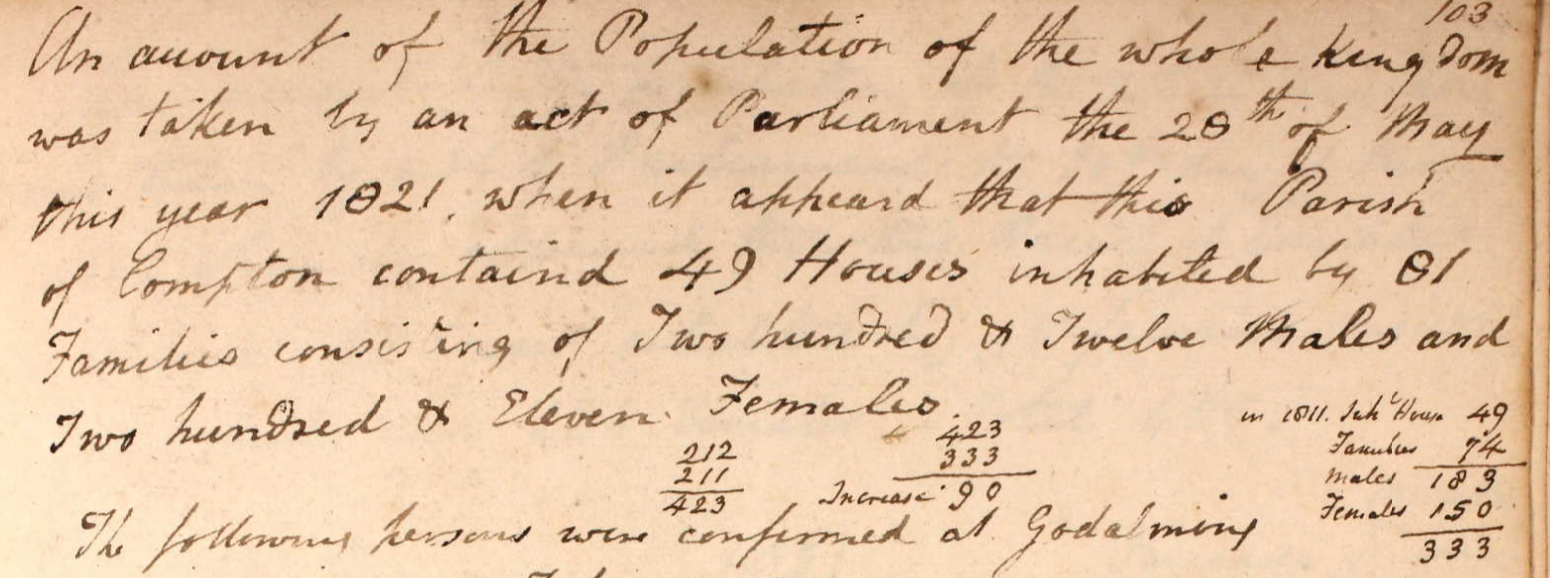
As another Census dawned, the information of the 1821 Census was added to the parish registers for Compton.

When compared to the 1811 figures there had been some changes.

There were:

  • 49 houses
  • 81 families
  • 212 males
  • 211 females

Compton Parish Records – Surrey History Centre; Woking, Surrey, England; Surrey Church of England Parish Registers; Reference: COM/1/2

Posted in Census, People and Genealogy, Compton, Surrey, England | Leave a comment

Census, People and Genealogy – 1811 Census

Created by Julie Goucher, 2021 using wordscloud

As with the 1801 census, Compton a pretty parish in west Surrey, documented the details of the population of the village in 1811 in the parish registers. In this case, the register used was the same as was used in 1801.

This register was used for all three events – births, marriages and deaths. For those of you who read the post about the 1801 census will notice the citation is the same, indicating the register took over a decade to fill. From 1813 there was a specific register for each of the births, marriages and deaths.

Surrey History Centre; Woking, Surrey, England; Surrey Church of England Parish Registers; Reference: COM/1/2

Posted in Census, People and Genealogy, Compton, Surrey, England | Leave a comment

Census, People and Genealogy – 1801 Census

Created by Julie Goucher, 2021 using wordscloud

We are familiar with the census form structures for 1841 onwards, and each decade the form undergoes changes.

The parish were sent copies of the parliamentary act and the schedule. This made it’s way to the Overseer of the Poor and then subsequently to the Officiating minister of the parish who was tasked with providing the number of births, marriages and deaths. Having made the official submissions, it depends on the incumbent if a copy or the details was retained.

The image below is from the Surrey parish of Compton. The page is from the parish register, where there are entries for births, marriages and deaths, and where the officiating clergy retained the information relating to the  1801 census – you can see a better copy of this below:

Compton Parish Records – Surrey History Centre; Woking, Surrey, England; Surrey Church of England Parish Registers; Reference: COM/1/2

Surrey History Centre; Woking, Surrey, England; Surrey Church of England Parish Registers; Reference: COM/1/2

As you can see, there is no individual specific data, but the information there is, enables us to have a snapshot of the village, which is replicated across subsequent census.

At first glance, it seems quite random that the rector would have chosen to have kept the information in this register,  until you understand the context of the questions asked and the individuals charged with providing the information, which we looked at in the first post in this series.

Posted in Census, People and Genealogy, Compton, Surrey, England, Genealogy, UK & Ireland (Eire) Genealogy Series | Leave a comment

Census, People and Genealogy

Created by Julie Goucher, 2021 using Wordscloud

One of the things that has been on my to do list for a while, is a series of blog posts about the census. Over the next few posts I am going to share about each of the census from 1801 up until the release of the 1921 census.

A census has taken place in the British Isles every decade since 1801 – You can see a full list of the census dates and associated information HERE.

The purpose of a census is generally speaking, a people count of those who are living in the country and where they are living.

That information and the breakdown of demographical facts enable several important factors to be established, here are a few of them:

  • Of the population, how many are suitable candidates should there be a war
  • Of the population, how many are candidates for the payment of taxes.
  • Of the population in the location, was there growth?

The census questions between 1801 and 1831 was effectively in two parts and made up of six questions:

  1. First three questions were to be addressed by the Overseers of the poor (or other substantial individual) and centred around the current population – the number of homes in the parish, along with if they were inhabited or not, the number of families and then the number of males and females. There was also a question about occupation, loosely divided into agriculture, manufacturing, commerce and lastly handicrafts.
  2. The latter three questions were to be addressed by the clergy of the parish – based upon the births, marriages and deaths within the parish and recorded in the parish registers.

Over time, the questions asked of those in the household on the specified night changed as the government sought to find out specific demographical information from the population.

Each time the Government wished to undertake a census; it was required to be approved by Parliament who then approved the legislation which outlined the details of a specific census. This happened from 1801 with the Population Act 1800, every decade until 1920, when the Census Act made it possible for the Government to hold a census at any time, but not within five years of the previous census.

The census is a key document as we pursue our family history. It is also a significant resource for those undertaking a one-name study and one-place study.

A census enables us to identify one, or more persons and to follow them through the subsequent census returns, using the key identification measures, such as approximate age, place of birth, perhaps spouse or parents and children or siblings; even if you might need a little scope for those factors.

Those undertaking a specific study, as outlined above can also benefit from using census material.

With a place, especially a village or property, it is relatively easy to extract the entire location, across each census, building a portfolio of the demographical group of the location for example. Many years ago, I did an complete extraction of the census, from 1841-1891 for the village of Puttenham in Surrey printing the census at the archives.

For a surname, it is similar, and many genealogists working on a surname project start their data gathering with a census, building on a family group, over the decade. Although for my surname projects and One-Name Studies, I don’t start from a census, but with a marriage as I reconstruct families. I do use census returns, but not immediately. I have written before on this and you can read that post HERE, although I think I probably need to write on the topic again.

Over the coming days I am going to meander through the decades, with particular focus on the census returns, though the broad statement is, census material for 1801-1831 has limited value to family historians as there is not any specific individual data; and that in 1904, the records were largely destroyed, although a some examples have survived, as we shall see….

Posted in Census, People and Genealogy, Compton, Surrey, England, Genealogy, UK & Ireland (Eire) Genealogy Series | Leave a comment

Surnames – Setting the Global Stage

Copyright  – Julie Goucher, 2018

As we head into 2022, I celebrate my 20th anniversary as a Guild of One-Name Studies member, and my fascination with surnames. Back in October, I began looking at surname posts for the forthcoming year, all of which have a global theme.

The one thing that is a foundational step, is understanding the context that our surnames existed in, the migration patterns and the causes for those migrations, which might have continued across various time periods and across country borders.

The surnames that I have registered with the Guild, are those of my parents. The surnames are different in origin, one is a British surname that is an occupational name, the other is a Patronymic Italian surname. Whilst there is significant differences, there are also similarities, one of which is migration.

All surname posts will be placed in the category of Surnames Series 2022 and will also appear on the surname research menu.

Posted in Genealogy, Surnames Series 2022 | Leave a comment

Christmas Post 2021

Merry Christmas image – from the collection of Julie Goucher, 2021

I am writing this a few days before Christmas and we still live in strange times, so what is okay today might not be by Christmas Day, but irrespective of all that.

I wish all my readers and subscribers a lovely Christmas or lovely holiday period, however you spend it. I will be back shortly after the festive period, so stay tuned.

Posted in Miscellaneous | Leave a comment