Census, People and Genealogy – 1801 Census

Created by Julie Goucher, 2021 using wordscloud

We are familiar with the census form structures for 1841 onwards, and each decade the form undergoes changes.

The parish were sent copies of the parliamentary act and the schedule. This made it’s way to the Overseer of the Poor and then subsequently to the Officiating minister of the parish who was tasked with providing the number of births, marriages and deaths. Having made the official submissions, it depends on the incumbent if a copy or the details was retained.

The image below is from the Surrey parish of Compton. The page is from the parish register, where there are entries for births, marriages and deaths, and where the officiating clergy retained the information relating to the  1801 census – you can see a better copy of this below:

Compton Parish Records – Surrey History Centre; Woking, Surrey, England; Surrey Church of England Parish Registers; Reference: COM/1/2

Surrey History Centre; Woking, Surrey, England; Surrey Church of England Parish Registers; Reference: COM/1/2

As you can see, there is no individual specific data, but the information there is, enables us to have a snapshot of the village, which is replicated across subsequent census.

At first glance, it seems quite random that the rector would have chosen to have kept the information in this register,  until you understand the context of the questions asked and the individuals charged with providing the information, which we looked at in the first post in this series.

Posted in Census, People and Genealogy, Compton, Surrey, England, Genealogy, UK & Ireland (Eire) Genealogy Series | Leave a comment

Census, People and Genealogy

Created by Julie Goucher, 2021 using Wordscloud

One of the things that has been on my to do list for a while, is a series of blog posts about the census. Over the next few posts I am going to share about each of the census from 1801 up until the release of the 1921 census.

A census has taken place in the British Isles every decade since 1801 – You can see a full list of the census dates and associated information HERE.

The purpose of a census is generally speaking, a people count of those who are living in the country and where they are living.

That information and the breakdown of demographical facts enable several important factors to be established, here are a few of them:

  • Of the population, how many are suitable candidates should there be a war
  • Of the population, how many are candidates for the payment of taxes.
  • Of the population in the location, was there growth?

The census questions between 1801 and 1831 was effectively in two parts and made up of six questions:

  1. First three questions were to be addressed by the Overseers of the poor (or other substantial individual) and centred around the current population – the number of homes in the parish, along with if they were inhabited or not, the number of families and then the number of males and females. There was also a question about occupation, loosely divided into agriculture, manufacturing, commerce and lastly handicrafts.
  2. The latter three questions were to be addressed by the clergy of the parish – based upon the births, marriages and deaths within the parish and recorded in the parish registers.

Over time, the questions asked of those in the household on the specified night changed as the government sought to find out specific demographical information from the population.

Each time the Government wished to undertake a census; it was required to be approved by Parliament who then approved the legislation which outlined the details of a specific census. This happened from 1801 with the Population Act 1800, every decade until 1920, when the Census Act made it possible for the Government to hold a census at any time, but not within five years of the previous census.

The census is a key document as we pursue our family history. It is also a significant resource for those undertaking a one-name study and one-place study.

A census enables us to identify one, or more persons and to follow them through the subsequent census returns, using the key identification measures, such as approximate age, place of birth, perhaps spouse or parents and children or siblings; even if you might need a little scope for those factors.

Those undertaking a specific study, as outlined above can also benefit from using census material.

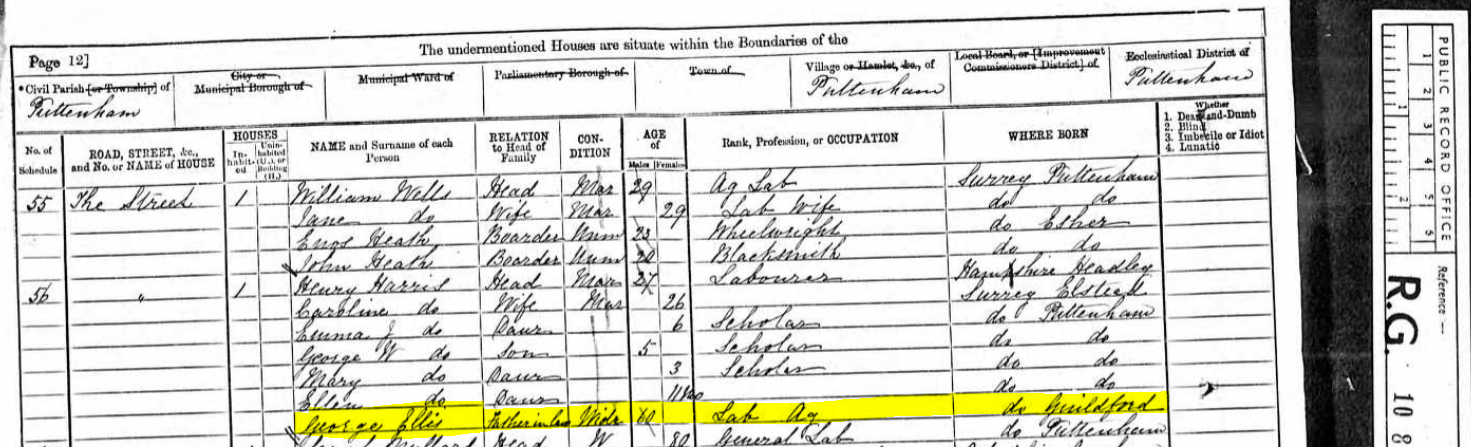
With a place, especially a village or property, it is relatively easy to extract the entire location, across each census, building a portfolio of the demographical group of the location for example. Many years ago, I did an complete extraction of the census, from 1841-1891 for the village of Puttenham in Surrey printing the census at the archives.

For a surname, it is similar, and many genealogists working on a surname project start their data gathering with a census, building on a family group, over the decade. Although for my surname projects and One-Name Studies, I don’t start from a census, but with a marriage as I reconstruct families. I do use census returns, but not immediately. I have written before on this and you can read that post HERE, although I think I probably need to write on the topic again.

Over the coming days I am going to meander through the decades, with particular focus on the census returns, though the broad statement is, census material for 1801-1831 has limited value to family historians as there is not any specific individual data; and that in 1904, the records were largely destroyed, although a some examples have survived, as we shall see….

Posted in Census, People and Genealogy, Compton, Surrey, England, Genealogy, UK & Ireland (Eire) Genealogy Series | Leave a comment

Surnames – Setting the Global Stage

Copyright  – Julie Goucher, 2018

As we head into 2022, I celebrate my 20th anniversary as a Guild of One-Name Studies member, and my fascination with surnames. Back in October, I began looking at surname posts for the forthcoming year, all of which have a global theme.

The one thing that is a foundational step, is understanding the context that our surnames existed in, the migration patterns and the causes for those migrations, which might have continued across various time periods and across country borders.

The surnames that I have registered with the Guild, are those of my parents. The surnames are different in origin, one is a British surname that is an occupational name, the other is a Patronymic Italian surname. Whilst there is significant differences, there are also similarities, one of which is migration.

All surname posts will be placed in the category of Surnames Series 2022 and will also appear on the surname research menu.

Posted in Genealogy, Surnames Series 2022 | Leave a comment

Christmas Post 2021

Merry Christmas image – from the collection of Julie Goucher, 2021

I am writing this a few days before Christmas and we still live in strange times, so what is okay today might not be by Christmas Day, but irrespective of all that.

I wish all my readers and subscribers a lovely Christmas or lovely holiday period, however you spend it. I will be back shortly after the festive period, so stay tuned.

Posted in Miscellaneous | Leave a comment

Local History Along the Wall #HW1900

Official image for the 1900 Hadrian’s Wall Festival – used with permission 2021

Marking the 1900th Anniversary of Hadrian’s Wall (AD 122-2022)

The 24 January 2022 marks the 1900th anniversary of the commencement of the building of Hadrian’s Wall. The anniversary celebrations conclude, on 23rd December 2022 which is the final day of the Festival of Saturnalia.

A relatively recent relocation into the northeast of England and being almost a stone’s throw of part of Hadrian’s Wall, this is a great opportunity for us to explore part of the wall and the heritage sites that exist along the wall.

It will enable us to research the fundamentals of those who lived and worked within the broad Roman Empire, and within the Frontier. These explorations will enable us to add some context to the archaeology and heritage of the Roman Empire as well as any artefacts that were left behind and have survived the test of time.

Some of the questions we will be exploring and answering are:

  • Why the Wall
  • Where the Romans came from and where they went
  • Why they came and why they left
  • Naming of People and Places
    • Tria Nomina
      • Phaenomen
      • Nomen
      • Cognomen
  • People and Places – what was important to the people of the time
    • Festival of Saturnalia

© Julie Goucher, September 2020 – Chesters Roman Fort

As we explore Romans along the wall, we will visit properties and sites looked after by a combination of English Heritage, National Trust, and various other organisations:

  • Chesters Roman Fort
  • Housesteads Roman Fort
  • Benwell Roman Temple
  • Birdoswald Roman Fort
  • Denton Hall Turret
  • Birdoswald Roman Fort
  • Walltown Crags
  • Corbridge Roman Fort
    • Corbridge Hoard
    • Corbridge Collection
  • Lanercost Priory
  • Poltross Burn Milecastle which is a river location
  • Willowfort wall, turrets, and bridge
  • Harrows Sear Milecastle and wall
  • Roman Vindolanda Fort and Museum
  • Roman Army Museum
  • Arbeia South Shields
  • Segedurium Roman Fort
  • Vindolanda Trust
  • Senhouse Roman Museum

Moving Forward:

  • Reading about Romans
  • Key Resources

The list is not exhaustive and over the course of the year, we shall be exploring and sharing our researching and readings, along with any illustrations and photographs online. There is likely to be other material we come across, and we will shared this also. This is going to be a fascinating project and we are looking forward to being able to take part.

The posts will be suitable for all age groups, and they  will be shared via social media and will each contain the hashtag #HW1900.

All published posts will be listed and linked from the main menu above. They can also be found using the category of 1900 Years of Hadrian’s Wall, and the full link for the series of posts is https://anglersrest.net/genealogical-research/hadrians-wall/

If you want to see who else is taking part in celebrating this amazing anniversary, or want to participate then please visit the main website the for the event HERE. You can read my entry HERE.

Posted in 1900 Years of Hadrian’s Wall, Genealogy, History, Local History | Leave a comment

Fascinations in the Parish Registers – Compton,Surrey

Created by Julie Goucher, 2021 using Wordscloud

In 1990 I was looking at the parish register for Compton in Surrey. Tucked away in the register was some additional bits of information, I made a few notes and carried on. Fast forward to 2019, I came across my earlier notes and planned to revisit the material.

This additional information was either written on blank pages within the parish register, but sometimes on loose papers. Most of the papers were in date order, but some were not. The vicar of the parish choose to use the register for this additional information which held baptisms, marriages and deaths for the period of 1639-1812. The register is at the Surrey History Centre under reference PSH/COM/1/2 and has been digitised by Ancestry and it was the digitised records that I looked at recently when I looked at what I was going to do with my notes from 1990.

I thought this was worth sharing, especially as some relates to the early 19th Century census which broadly speaking has few examples that are known to have survived, and for those that have survived there is restricted data available. I pulled the census material together for a quick series of posts, Census, People and Genealogy which will be published in January. (I had planned for December, but got a little side tracked by something else!), but there was more….

In the same register was other interesting sets of materials:

  • Several lists of those vaccinated for Cowpox in Compton from 1810
  • A list of those that were Confirmed at Godalming in 1821
  • Several lists of those Confirmed at Godalming, various dates post 1821
  • A note about the building of a school room at Compton in 1840
  • A small note about the gallery in Compton Church in 1842
  • List of Compton Charities
  • Details of a sermon given at Compton Church 1843
  • A note about the Chancel at Compton Church 1859
  • Details about the roof of the Church at Compton 1869
  • A small list of those from Compton confirmed at Puttenham (Surrey) in 1869 (an earlier confirmation by the Bishop of Winchester was deemed invalid)
  • A narrative about the murder of Joseph Hollis which took place in 1809 in Compton
  • A pedigree of Fullam family – those that had events that occurred in Compton were identified and with page numbers given. This identified that there were two vicars from the same family, one of which was vicar for 55 years – illustrated below.

Compton Parish Register – Surrey History Centre, Woking, Surrey  PSH/COM/1/2  accessed via Ancestry

This illustrates how fascinating our parish registers are and how their remit may well go far and wide beyond the recording of births, marriages and deaths. Have you found other material in parish records you have looked at?

Posted in Compton, Surrey, England, Genealogy, One-Place Studies, Puttenham & Wanborough | Leave a comment

Spotlight on….Genealogy the Next Generation Webinar


Genealogy the Next Generation making the genealogy community a welcoming space for all age groups.

Dr Janet Few is shining the spotlight on Why we need to make the genealogy community more inclusive, with particular reference to age. What are the current barriers? What needs to be done? The important part of this session will be the discussion afterwards.

What will people learn? What problems/difficulties might it help with? Why young people current feel excluded/unwelcome. What can be done by individuals, societies and institutions to overcome this? 

Dr Janet Few is President of the Family History Federation and long-time Guild member who was once (many decades ago) a young genealogist. Passionate advocate for young people’s genealogy.

This is something everyone needs to address, so why not join us in an extended Guild of One-Name Studies webinar, lasting around 90 minutes which will include not only hearing from Janet, but also include discussion. The webinar will take place at:

7pm GMT on 16 December 2021 It is FREE to attend and we welcome the wider genealogical community, please register HERE.

This webinar has concluded, and is available on the Guild of One-Name Studies website HERE


Posted in Genealogy | Leave a comment

Getting to know Sutera – An Overview

Sutera circa 1930 - from the personal collection of Julie Goucher

Rising 600 meters above sea level, some 100 km from Palmero is Sutera, in Sicily. Now a town of 1223 people (May 2021), it has a fascinating history. Sutera is a rural community, defined by feudal estates and cereal cultivation which has evolved through a community of peasants – indentured servants, craftsman  – carpenters, masons and bakers, and professionals in the modern age undertaking the roles of medics, pharmacists and lawyers.

The Arabs reigned between the 9th and 11th Centuries and founded a settlement in Sutera around 860 AD. The urban centre of Sutera is made up of three districts, Rabatto, Rabatello and Giadinell.

Rabatto has many typical features of an Arabian village, narrow streets, terraces and plaster walls, though many of the surviving features are hidden behind a succession of layers, in an attempt to modernise, but the area is still reminiscent of the period. It is here, that the living Nativity scene is set each year. The roads wind their way around the mountain of San Paolino.

A mosque was built in 875 AD and was the largest religious building. In 1370 it was demolished and replaced with a church, Santa Maria Assunta. There is also a 15th Century ruin, Salamone Palace. The church of Maria Santissima de Carmelo, built in 1185, and rebuilt in 1934, alongside a small convent that was built in 1664, which now fittingly houses the Museum of Rural Life, An Ethno Anthropological Museum reflecting the culture and community of Sutera across hundreds of years.

In 1545 the church was rebuilt and became the mother church, which is still standing, on the archaeological site of San Marco. The church houses a handcrafted organ, dating to 1600.

San Paolino is a lovely church, located on the top of the mountain in Sutera, which is 812 metres high. The church is located next door to the small 18th Century convent of the Philippine Fathers. It is here, at San Paolino, that the reclics of the Patron Saints of Sutera are found, San Paolino, Sant’Onofrio and Sant’Archileone.

Posted in Genealogy, Local History, One-Name Studies, One-Place Studies, Orlando One-Name Study, Specialised Studies, Sutera, Sicily | Leave a comment

Researching Ancestors in Continental Europe (Pharos Course)

Part of the European Ancestors Series

For much of the last year, I have been writing and updating my Researching Ancestors in Continental Europe material. The final tweaks have been done, and now the Pharos course is available to book – HERE.

Europe is a complex Continent, spanning more than 50 modern Countries. Europe has seen a huge amount of change, forced religious changes, border changes, war, mass displacement and much more.

During the course we will explore the similarities and differences across Europe and encourage the consideration of some practical factors when conducting your research. There are a great many resources that can be used to assist your research. This course is about creating a solid foundation to research in continental Europe.

We will look at defining Europe and what countries are in Europe (it is not always as obvious as you might think!) We look further at the European Empires and the impact on migration to and from the continent. We look too at the borderlines and unifications. The course explores the standard resources across Europe, key websites, reading material and much more, providing the building blocks for robust and solid foundation research in Europe.

We will consider the reasons for migration, e.g. work opportunities, emigration schemes, persecution, internment and following military service, in the context of historical events. We will also look the culture that the migrants brought with them from their native land, keeping those links alive. Sometimes, it is following those links that actually helps with your research.

So, who is going to join me, for what I hope is going to be an enlightening and fascinating course? You can book the course HERE.

Posted in European Ancestors, Genealogy | Leave a comment

Webinar – Zotero: A Versatile Research Tool for Genealogists

Copyright Guild of ONS Used with permissionThe Guild of One-Name Studies was lucky enough to welcome Patti Lee Hobbs yesterday, who delivered a very interesting webinar, Zotero: A Versatile Research Tool for Genealogists.

Patti Lee Hobbs spoke about Zotero, open-source software developed specifically for researchers—is noted for its easy ability to capture source information to use in citations whether from websites, books, or electronic files. It’s as easy as a click of a button or adding an ISBN. But it does more. Extensive notes for each source can be created and files or links to files can be attached. Zotero will even automatically outline component parts of electronic files making it easy to find specific information easily. Electronic files can be “checked out” to a reading device and checked back in importing all highlighting and notes added by the reader. This webinar will demonstrate the research advantages Zotero offers genealogists.

The webinar is available to be viewed by the public for 30 days; with the associated handout also available on the same page, which is found HERE.

The webinar was very interesting and those who are considering undertaking the Pharos course, Practicalities of a One-Name Study, might find it interesting to watch.

Posted in Genealogical Resources, Genealogy, Practicalities of a One-Name Studies (Pharos Course 903) | 1 Comment