Q & A – How do I set up an eBay search for my Surname?

Q & A

Created by Julie Goucher – Feb 2020 Using Wordclouds.com

Following my article in Family Tree Magazine, where I mentioned setting up an eBay alert for a surname, I received a few questions on how to set it up. I thought I would also answer that here, in a step by step format, in case others had the same question.

  1. Log in to your eBay account
  2. In the search box at the top of the page insert what you want to search for, making any selection as to the category Just before the search results, there are three headers – All listings, Auction, Buy it now and just below that, is a heart symbol and the words Save this search
  3. Click on Save this search and each day you should receive an email alerting you to what is available on eBay relevant to your search request.

Be mindful that some surnames and place names might yield a lot of search results. You can filter them to be more specific, but the risk is you might not see something that is relevant.

Certainly with my two studies, for BUTCHER and ORLANDO they are a troublesome search, I have selected the categories of collectables, meaning that I exclude items for sale that relate to Butcher shops, Butcher blocks etc, though I do still see post cards of Butcher shops, and personally I would prefer to see them and discount them rather than not see them at all.

You can see what searches you have set up once you have logged into your eBay account https://www.ebay.co.uk/myb/SavedSearches?MyeBay&CurrentPage=MyeBayFavoriteSearches

There is opportunity to exclude specific words associated with a surname or place, which would look like Butcher -block – shop or Orlando – Florida.

The eBay approach varies hugely between members, depending on the name being studied. Members of the Guild can access the presentation given by Guild member, Alan Moorhouse about using eBay in his Farmery One-Name Study, at the Name of the Game seminar in 2017 (members’ need to be logged in to view).

Dwerryhouse PostcardThis is the purchase I made recently, which is shown in the latest Family Tree Magazine article (March 2020 issue) for the surname of DWERRYHOUSE.

There are other sites which might yield results, such as Invaluable, although I have not had much success, personally, with this site.

Posted in Dwerryhouse, Genealogy, One-Name Studies, One-Place Studies, Q & A | 1 Comment

Genealogy Blog Party – We ❤️ February – actually no, I don’t! #GOONSblogchallenge – Post 6

GBPFeb20_PIN

Copyright of Elizabeth O’Neal

Taking part in the Genealogy Blog Party, hosted by Elizabeth at MyDescendantsAncestors.com.

February, and in particular Valentine’s day is now a subdued day. The day in 2020 marks the 6th year since my Mum passed away, just two days before her 67th birthday.

As each year passes, it does not get easier, but I do find myself reflecting on my own family and finding the good in that, as opposed to the depressed view that is easier to display.

I wasn’t sure quite what to write for this post and wrote several times over the last week or so, each time deleting and starting again. I then looked at a selection of photographs and this one is something that showed the love shining through.

A picture is worth a thousands words and I thought that I would share two such photos.
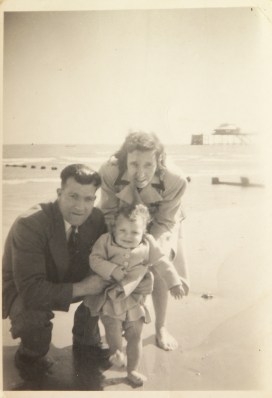
Mum and Grandparents

Family collection of Julie Goucher

First up is this one, taken at Southend, Essex around 1948, my late Mum with my Grandparents.

My Grandmother, was a no nonsense sort who had a lovely and infectious sense of humour. The whole concept of motherhood was something that happened and I cannot quite imagine my Grandmother in her young years. My Grandfather was fairly similar to my Grandmother, in so much as he dotted on my Mum and had a tormenting sense of humour.

By this point, my Grandparents would have been married, almost a decade, having married in November 1939. There are no wedding photographs of their happy day. My grandmother hated with a passion her photograph being taken and I suspect and can hear her now, saying “George, let’s not bother”. I do so wish that someone had bothered.

At the point of their marriage, my Grandfather was aged 31 years and was living with his both of his parents at Manor Farm, Guildford and a number of siblings with their spouses. My grandmother, aged 26, was living with her sister and brother in law and their growing family, at Guildford, Surrey, as her parents had died in the 1930’s – her father in 1931 and mother in 1937. In 1940 my Grandfather enlisted in the Army and was posted to Sierre Leone until December 1943. He spent some time on home turf, before heading to France, Belgium and the Netherlands. He was demobbed from the Army in 1946 and returned to his former job, at Guildford working for the diary, Unigate, formerly Lymposs Smee where he remained until he retired after more than 30 years service.

My Grandmother, spent the war years working at Guildford laundry. She hated ironing right up until she died and told me the work was hard and hot. The laundry dealt with the washing of military clothes and bedding. She also had at least two evacuees for the duration, one of which remained as close friends up until that 14 year old evacuee passed away about a decade ago. Out of the time of war, something great was forged and carried on another two generations.

Having been demobbed in 1946 and resuming his paid work, my Grandmother I guess reverted to being a housewife. Mum was born 16 February 1947 which was known as the deep freeze. Her birth registered at Guildford on 19th February 1947. It was brutal, freezing cold, rations continuing and their were frequent power cuts. Mum was wrapped and place in a drawer of the chest of drawers to keep snug and safe.

Each summer my Grandparents would head off to Southend to visit my Grandfather’s sister and her husband. Those visits carried on for decades only ceasing when my Aunt died in the mid 1980’s having outlived her brother and husband. This photo is one of close to a hundred or so that exist showing the family at the farm, Southend or even Devon where they holidayed.

ef4fe-mum

Family collection of Julie Goucher

The second photograph is one that long time readers may well have seen previously. It is though my absolute favourite of Mum. My Grandmother was functional. She was not the sort to have used ribbons and bows. If something was not quite right, she would say “oh, blow it, let’s not worry about X”, whatever X was. This photograph therefore speaks volumes to me, Mum is wearing the pretty blue dress with matching bow and the dainty shoes. She is standing in such a petite way. A diva for sure.

The photograph at some point before I inherited it became torn. There are no markings to tell where it was taken, but I suspect Guildford at a photograph called Donnivan Box as that matches with several others from around the same time. The bow is with me now, although the dress has not survived.

When Mum was just four and a half she contracted Polio. She spent 10 days at home, with the Doctor believing Mum had flu. The delay in a formal diagnosis undoubtedly saved her from declining further. She was admitted to hospital, just outside of Woking, Surrey where she spent six months seeing her parents through a glass window, just once a week, long before the days when paediatric wards existed in the way we know of them now. Before the days when nurses wore uniforms with teddy bears on and provided space for parents to stay by their child’s side. Mum was discharged just before Christmas and embarked upon more than a decade of visits to the hospital. Her only obvious sign of the polio was the lack of a calf muscle in the left leg, she avoided both calipers and having to be in an iron lung.

Mum retained a deep routed fear of hospitals up until she died. She was like my Grandmother in so many ways and I see myself sharing a great number of those characteristics. Stubborn, potentially argumentative, independent and very loyal.

We owe so much to those that walk before us and perhaps that it was right that, someone who was so loved should leave us on Valentine’s Day.

In loving memory of my Grandparents George Butcher (1908-1974) and Lilian Edith Butcher nee Matthews (1912-1995) and my Mum, Christine Joyce Butcher (1947-2014).

#guildblogchallenge

Posted in #GuildBlogChallenge, Butcher One-Name Study, Genealogy Blog Party, One-Name Studies, Polio, Surnames | 8 Comments

Family Tree Magazine – How to Start a One-Name Study.

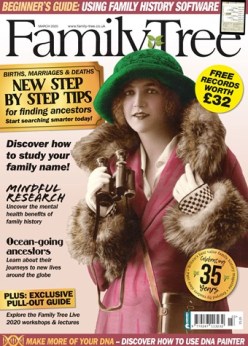
FTM March 2020The launch of my 2020 series on surnames has begun in Family Tree Magazine, March issue and on sale now.

This article four page article, How to Start a One-Name Study is demonstrating the starting of a study and setting the scene. I selected the surname of DWERRYHOUSE and have commenced the building of that study. We focus on choosing a surname, registering the name with the Guild, getting a feel for the origins of a surname. We chat about the global aspect and keeping study material organised. We conclude with final reading.

I also do a step by step guide to search and download the results from FreeBMD. Even if you are a reader living outside of the UK and researching a non-British surname, it would be relevant to search FreeBMD and gather the material, to work upon at some point.

I also share that a One-Name study is not a Olympic race, it is more akin to a gentle stroll in a park – a study evolves over time.

IMG_1710My final comment is this header picture, which will change each quarter, hopefully reflective of the evolution of a study.
Family Tree Magazine is available in paper and digital format from the magazine.

In the June issue we look at growing a One-Name Study.

Posted in Family Tree Magazine (UK) Surname Series (2020/21), Genealogy, One-Name Studies | Leave a comment

DNA Ethnicity Estimates and the Vircigilo Surname #GOONSblogchallenge – Post 5

Ethnicity Estimates Feb 2020

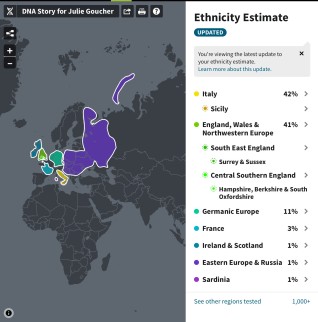
Ethnicity estimates for Julie Goucher Ancestry Feb 2020

Over the weekend I spotted that Ancestry had updated the Ethnicity estimate page on my DNA test. I thought nothing more of it, until I scrolled down and noticed that there now showed a line for Sardinia which was not there previously.

By coincidence, just last week I shared post number four in the Guild Blog Challenge (#guildblogchallenge) where I talked about the surname of my paternal great Grandmother, Virciglio. If you did not see it, you can read that post HERE.

In that post I shared that having looked at the surname distribution map, the nearest locations to Sicily for the surname was in Sardinia and Lazio, although, the frequency of the surname outside of Sicily was in fact Piedmont.

The ethnicity element is hardly an exact science, yet, mine has previously been fairly accurate. I am 50% English, with the majority of my maternal line hailing from the south east of England – Surrey and Sussex and Hampshire which is classed as central southern England. I am also 50% Sicilian, so perhaps I might therefore treat my ethnicity as a pointer in the direction for more research.

Is your ethnicity estimate fairly accurate compared to what you know? or is it wildly inaccurate?

#guildblogchallenge

Posted in #GuildBlogChallenge, DNA & Surname Projects, Genealogy, One-Name Studies, Orlando One-Name Study, Virciglio | Leave a comment

Working on a Global Surname Project , for a Geographically Concentrated Surname

Typically surnames will have a hotbed presence, even the most common surnames. In those instances, it will often be personal to the researcher. In the case of my own Butcher ancestors, Surrey is a particular hotbed for me, followed by Sussex and London with my own family groups migrating across the seas at varying times to Canada and Australia.

butcher-surname-atlas

Distribution Map using Surname Atlas, based upon the 1881 Census for England and Wales

From my study though, Butcher appears as a widespread surname, but as we can see from this image, concentrations appear in some Counties more than others.

The darker the colour the more instances of the surname. My native Surrey comes out the most, as does Kent, Essex, Middlesex and Suffolk. If we look at Sussex there are few instances there. In Scotland, there are the least instances of the name, as far north as Moray, Angus and Perth.

Butchers - surname atlas

Distribution Map using Surname Atlas, based upon the 1881 Census for England and Wales


If I look at the map for the variant of Butchers, the spread of the surname is very different. The disparity between the numbers, could be for a variety of reasons, but probably pronunciation and the adjustments of the name over time – essentially loosing the “s” at the end of the name.

Guild members, upon registering a surname agree to the commitment to research the surname globally and this does mean to go beyond the members own family. There is no constraints as to when you go global, just that you do.

Quite recently someone remarked to me that they had not registered their study, because the research shows that the surname in question had not undertaken significant migration. There is a difference between a surname not organically migrating and a member choosing to not pursue a surname on a global scale and they are not the same thing. It is hardly the members’ fault if their surname has not migrated on a global scale, so why restrict yourself to the benefits that undoubtedly come from surname registration?

Many surnames are regionally featured. I can think of a few, all registered with the Guild and listed below. To find about them, visit the Guild’s website and insert the name into the surname search box:

  • Daglish (hotbed is in the north east of England)
  • Tickle (hotbed is Devon and north east of England)
  • Tresise (hotbed is Cornwall)
  • Featherstone (hotbed is in part of Yorkshire and north east of England)
  • Keough (hotbed is Ireland and Lancashire)
  • Orlando (hotbed is Italy)

What I find interesting is the reasons for the migration from one region to another, one country to another. That is why, global is important because otherwise you cannot be sure that you have captured all individuals with that name, irrespective of the country of origin or time frame.

Context is very important, that is how the study holders of some of the studies above will be able to establish the cause of movement of individuals bearing those surnames. In these cases, mining may well be the cause.

In terms of families working in the mining industries, whether you are mining tin or coal is neither here or there. It is the skill involved that is key. People with a skill and the bravery to migrate may well have caused the name to become global, even if the name started out regionally. In the case of mining, I can think of movement from the north east to counties in the midlands, Wales to Patagonia, Sicily to part of the United States.

It is material such as this that can be explored as part of a one-name study and is covered in the Advanced One-Name Studies course.

Posted in Advanced One-Name Studies (Pharos Course 902), Butcher One-Name Study, Genealogy, Introduction to One-Name Studies (Pharos course 901), One-Name Studies, Practicalities of a One-Name Studies (Pharos Course 903) | Leave a comment

Desk Ramblings (27)

Desk Ramblings

Created by Julie Goucher, July 2019

Research resources are just about everywhere. They always were, but the internet has made them so much more visible and accessible.

Of course, the downside at least in part, is the closures of some archives as they struggle with budgets and austerity. The internet has also provided a false view that “everything” is online. It is not and there is nothing quite like being in an archive/heritage centre/museum or library.

Museums, libraries, heritage centres and collections of papers are all great to search for names and places which litter our personal genealogies and our specialised studies.

Research Resources

Created by Julie Goucher, Feb 2020. using Wordclouds.com

I spent some time today, doing a little genealogical website (this one!) housekeeping. Merging some of the categories, deleting others and created a new image. I have a tendency to be very blue and green focused, so I opted with a burst of yellow, on what is frankly a dull and dismal day weather wise.

Having done that, I set about selecting a list of libraries that will potentially feature in the workshop that I am hosting at #FamilyTreeLive. Of course, the list is three times (at least) as long as I have time for at the show, so a good number of those libraries will be cut from the discussion. The work won’t go to waste though, as I expect I shall write about a good many of them here, especially if they are good name rich material.

The latest Pharos course is now underway, with the course closing to new participants on Monday, so this is the last call!  The next Introduction course will be in early June, so plenty of time, between now and then to read the contents of the Surname Research tab at the top!

Posted in Desk Ramblings! | Leave a comment

Interview at Organize Your Family History

Organise Your Family History

Copyright Janine Adams of Organise your Family History.

A few weeks ago I was approached by professional Organiser and family historian, Janine Adams who asked if she could interview me for the “How They Do It” column.

I agreed, and the interview went live a few days ago on Janine’s website. You can read what I had to say HERE.

Posted in Genealogy, Organisation & Structure | Leave a comment

Q & A – Frank, Anton and Anna Hunt – Württemberg, Germany

Q & A

Created by Julie Goucher – Feb 2020 Using Wordclouds.com

Before Christmas I gave a webinar to a genealogical group in the United States. I was forwarded a question, but noted some weeks later that the email was without the address of the genealogist. I therefore through I would reply, via this site, replacing the name with the initials of the originator. Any questions can be found under the Q & A category.

I have a 2X great-grandfather that came to the US.  First record I have of him is Feb 1880 when he marries my 2X great-grandmother.  His Americanized name was Frank Hunt.  He lists his place of birth as Württemberg, Germany and that he is 24.  He lists his parents as Anton and Anna Hunt.  On the 1880 census, he states his parents were born in Germany.  I do I even begin to figure out what his given name was or any other information?
Any tips would be greatly appreciated.
S.S

There can be a variety of reasons why a migrant might change their name. What I am going to do here, is to provide a few things that might be worth considering or exploring.

In the first instance, I would go back to the original census you have located him on, which is 1880 and the marriage to your great great Grandmother and see if he signed his name – essentially could he read and write? Those that could not were not in a position to see if their name was spelt incorrectly or not, so the name could have been changed over time.

The other initial focal point would be to have a look into the place he was from, in this case, Württemberg, Germany. Look on a map to see exactly where this is. What was Germany in 1880 might not be Germany now, and was perhaps part of the wider empire. The other thing to consider is what was the occupation given as? Very often migrants settle where there are others, people they knew or knew via others, or those from the same place or working the same job or sharing the same religion.

See if you can locate a naturalisation record. The chances are he was naturalised under his “Americanised” name (if he Naturalised), but the other information might provide clues to his origins. I would also do a wide search online for the name he assumed, or even the place he was from. At the time of the First World War, he would have been in his 50’s but he might have had children who would have been seen as enemy aliens, in which case, if the father or descendants were interned, it might provide a clue in the records.

The German Genealogy Group have a very interesting website, whilst you do not say where the family were at the time of the marriage or census, the indexes and material of the group might be worth exploring.

I hope this helps and if you are the researcher who asked this question, please do contact me.

Posted in Genealogy, Q & A | Leave a comment

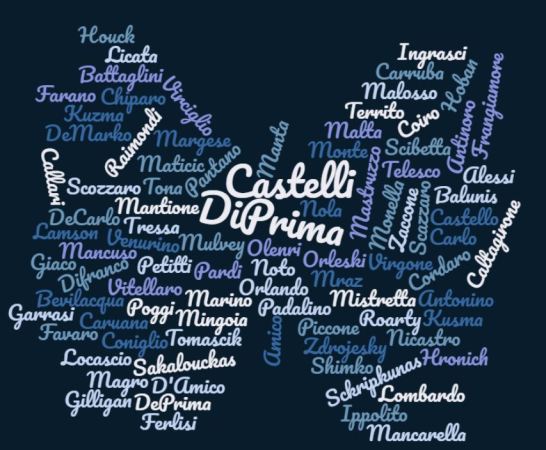
Surname Vircigilo – #GOONSblogchallenge – Post 4

Paternal Line

Designed by Julie Goucher 2018, using Wordclouds.com

There is no secret that I love surnames and the heritage & history that each one portrays. This image, here is reflective of my paternal line, which is predominately in Sicily, but there are lines that have migrated elsewhere, some that ping-ponged their way across the Atlantic or English Channel.

Vircigilo DistributionThe surname of my Great Grandmother, VIRCIGILO, can be found predominately in Sicily as this distribution map, from Gens.info shows, but there are occurrences elsewhere, including Sardinia.

My own family is from a village in the dark pink area of Sicily on the map, but try as I might, I cannot find the birth record for my Great Grandmother, Calogera Maria Vircigilo.

Whilst as genealogists we deal with evidence and facts, sometimes you can only hypothesise and use reasoning to move forward and hope that you do indeed find some proof to either prove or disprove the hypothesis. In this case, given the family tendency to use traditional naming patterns I have begun the quest to locate the father of Calogera with the view that this might yield a positive response.

The traditional naming patterns are, first son is named after the paternal Grandfather, second son named after the maternal Grandfather, first daughter is named after the paternal Grandmother and then the second daughter is named after the maternal Grandmother.

Calogera married Giuseppe Orlando, in Sutera, Sicily on 2nd May 1883, together they had ten children:

  1. Pietro Orlando born 1884 and who died in 1887, just aged 3 years.
  2. Salvatore born in 1886 and given the name Salvatore. He survived until adulthood, passing away in 1937.
  3. Pietro Orlando born and died in 1890
  4. Maria Giuseppina born 1891
  5. Pietro Orlando born 1893
  6. Vincenza Orlando 1896-1911
  7. Carmela Orlando born 1897 and died 1898
  8. Rosa Orlando born 1899
  9. Antonio Orlando born 1901 and died 1902
  10. Giuseppe Antonio Orlando born 1903 – My line of descent.

Giuseppe Orlando - Death 1918Church records are more comprehensive that those found in England and Wales. This document is the death record for my Great Grandfather, Giuseppe Orlando, Calogera’s husband.

The document, in fact this true for all vital records, declares both the parents and spouse. So this is a vital clue to her parentage. I still have to locate the record though. In this document, Giuseppe is the son of Pietro Orlando which is stated in the body of the document and in the right hand side column and Maria Giuseppina Magro Malosso. The document also says that his wife is Calogera Virciglio daughter of Antonino Vircigilo.

Despite this, I still do not have a document to prove the parentage of Calogera. I find that I am drawn to consider Sardinia as a potential location for links with the family, though as you can see the other location on the map highlights Piedmont as a more common area than Sardinia. Lazio is also a possibility given it’s proximity.

Vircigilo is not a very common name. A quick search of FreeBMD reveals very few in England and Wales and there are none prior to Second World War, which is reasonably significant. According to Forebears.io, the occurrences of the surname in 2014 appears like:

Italy 146, Croatia, 1, Switzerland 7, France 48 which includes French Guiana, Germany 2, England 72 and United States 72. The site does allow you to drill down further as per the various regions, Sicily is at the top, with 85. In England the most occurrences are in Surrey with 16. Again, something fairly telling in line with what I already know.

After the Second World War, the south of the mainland and Sicily were poor, though that was nothing especially new, but following the war, things were much harder and many looked elsewhere to find a way to survive. Much of Europe needing to be rebuilt, there was scope for low paid jobs in a variety of Countries, including England.

Surrey was a County that welcomed migrants. Not all were Italian, some were from Poland and Latvia, both Countries under now Russian control and therefore they were concerns of recriminations. The Italian community at Woking grew to become a 4,000 strong community. Mass is still given in Italian at the local Catholic church.

At this point, I am gathering every occurrence of the surname I come across. If there is any link to Sutera in Sicily then there is a high probability of a connection to my own family.

#GOONSblogchallenge

Posted in #GuildBlogChallenge, Genealogy, One-Name Studies, Orlando One-Name Study, Surnames, Sutera, Sicily, Virciglio | Leave a comment

Introduction to One-Name Studies (901)

Pharos Logo

Copyright – Pharos Tutors

**Disclaimer**  Any views shared here are my own and do not form or imply any official view point of Pharos Tutors or the Guild of One-Name Studies.

As a Pharos tutor, one of the things I enjoy most is inspiring others to fully understand the entire strategic thinking of a surname project & One-Name Study.

The introduction course is the first course in the suite of One-Name study courses. Focus is on the history of surnames, understanding what a one-name study is, collecting records & gathering records, making sense of the records collected and then practical aspects of such a study. You can read more HERE and you can read any of the extensive posts on the topic of surnames via the surname research link.

Each week there is a lesson and a chat session. The forum provides a platform to get to know fellow classmates and to share answers to the exercise questions, or to ask questions etc. The course is aimed at those researching in England and Wales, Scotland and Ireland, but not exclusively so. I have taught a number of students residing across the globe and a number of students who are researching a surname whose origins are elsewhere.

I am a Trustee of the Guild, and have been since 2015, though that is not entwined with my role as a tutor with Pharos.

The next course begins 4th February 2020 and there are still a few places available. The following intake of this introduction course will be early June 2020.

Posted in Genealogy, Introduction to One-Name Studies (Pharos course 901), One-Name Studies | Leave a comment