A-Z Challenge 2020 – Specialised Studies I is for Instrument Makers

Specialised Studies

Created by Julie Goucher using wordclouds.com March 2020

When I began researching my Grandmother’s family, and in particular her ELSTONE line, I encountered my Grandmother’s maternal Aunt, Eliza Elstone. Eliza married Joseph PARSLOW and they emigrated to Canada.

Indeed they did emigrate, but did not like it, so after having three of their four children there, they returned to England, settling in Woking, Surrey where Joseph established himself as an antique dealer.

Over time, I looked at the Parslow family and eventually established that the family were quite well known in the Kingston-Upon-Thames area of Surrey and that one of Joseph’s relatives was a banjo maker.

silver-plate-giving-the-name-of-the-maker-as-j-parslow-kingston_202573874_o

Back in 2006, I received an email from eBay confirming that something had been listed for sale on the auction site. Usually I have a quick glance and then delete the email. I still receive these daily emails, but nothing of late has yielded any success.

However, in one instance, there was confirmation of a listing for a Banjo, made by Parslow. I certainly did not want the Banjo, but I was intrigued and asked the seller if I could download the photographs. I was interested in the link to my branch of the Parslow family. The seller was obliging and I downloaded the photos. Meanwhile, I had mentioned to a fellow Parslow researcher that a Parslow Banjo was for sale and they indeed did purchase the Banjo.

Below is the complete set of Parslow Banjo photographs. In the coming months I really must get the Parslow papers into my database and upload the material to my website.

When I first joined the Guild of One-Name Studies, in 2002, the surname was registered with the Guild, but I note today that this is no longer the case.

Here are a few links which might be of interest:

You will also likely find mention of individuals in trade or street directories.

For those interested in Clock and Watch makers there are a few suitable bits of information, though this is by means a complete list.

  • Clock and Watch Research – UK and Ireland (fee payable site)*
  • Watchmakers and Clockmakers of the world by G.H.Baillie

In this book, Baillie shows hundreds of watchmakers from about 1550 – 1830 and provides some interesting cross-references such as:

– member of the watchmaker association
– master letter reached
– date of birth and death (as far as known)
– locations of famous watches

There are some early examples of European watch and clock makers, but it is no where near being a comprehensive reference in this regard.

Taking part in the A-Z Challenge for 2020

(*I am not associated with the site, other than as a consumer of the information provided. I do recommend the site as a research resource.)

Posted in A-Z Challenge 2020 - Specialised Studies, Genealogy, One-Name Studies, One-Place Studies | 2 Comments

A-Z Challenge 2020 – Specialised Studies H is for Health

Specialised Studies

Created by Julie Goucher using wordclouds.com March 2020

In these days of modern medicine you would probably expect that the majority of support and knowledge came from Doctors or Health Professional. I have been qualified in my allied health profession for 30 years, but it has always been portrayed in a proactive manner? Even in the current Corona Virus epidemic the role that pharmacy teams play has been hugely under estimated and acknowledged. As someone who has worked across the relevant fields, community, hospital, learning environments and statutory bodies, I see that all are under valued, but leading that way are the community pharmacy teams.

Today’s post is not about the shortcomings of a profession, (I might save that for another day!), but about the focus on health conditions that might lead to a specialised study, and might lead to such a study for a variety of reasons.

I have long pondered the thought that Thyroid conditions are hereditary and I have written about it numerous times, though I should write a more up to date post.  I tend to keep an archive of articles that I come across, including a printed archive of material and numerous books. I do the same for Polio, for interest relating to my late Mum.

Today’s post is about material that can help us with a quest for either information about specific conditions, the impact of them in a genealogical sense or the history of the various condition themselves. What follows below is a list of links that you might find useful as you research:

We are living in unprecedented times. Our lives impacted by something that is dangerous and yet invisible. Just months ago, this invisible destroyer was unknown to us and now sets us challenges. Any notes that we make, recordings we undertake on our smart phones, provides and opportunity for the next generation to explore these challenges. In much the same way as we ask what people did in the War, Our next generations could potentially ask what we did about Covid 19.

Examining the cause of death on death certificates is very interesting. You can see if a pattern of conditions forms. Though the death certificate will confirm what actually caused the fatality. Sometimes, the cause of death is not explanatory of other conditions that assisted in the patient passing away.

Whilst someone’s passing is a sad loss, it also provides time for us as genealogists to record the facts, and to add notes and context relating to the conditions. It may offer us insight into our individual family genetics and enable us to research with understanding.

Taking part in the A-Z Challenge for 2020

Posted in A-Z Challenge 2020 - Specialised Studies, Genealogy, Health | Leave a comment

A-Z Challenge 2020 – Specialised Studies G is for Games and their History

Specialised Studies

Created by Julie Goucher using wordclouds.com March 2020

For today’s post I am sharing some back story, leading to my interest, in cricket, for which I am a very unlikely candidate!

Having traced my maternal Grandfather’s family back to Puttenham in Surrey, where I was introduced to the Budd family by researching in the parish and poor law records, I found a further reference to them in the Manuscripts of Rev Charles Kerry which I wrote about HERE. Charles Kerry wrote on the Pedigree, “first of the Budds” which implied that like me he had looked back through the parish records and found no trace of them prior to 1724. In those early records, it was as if Henry Budd and his wife Martha had relocated to the village and began raising their family there. Martha had originally been living in Chobham, Surrey but Henry, he was no where to be found.

I began searching the records of nearby villages, both those in Surrey and across the border in Hampshire. Then I had a small breakthrough. Firstly I attended the funeral of Great Aunt. She was buried with her husband, my uncle in Shackleford, Surrey. A small parish joined with the parish of Peper Harrow. As we drove to the Church along the Country roads, it was easy to see how folk of previous generations could arrive in a parish, Peper Harrow was merely 3 miles from Puttenham. I made a mental note to research in that parish again, making an assumption, from memory that I had already searched there. I got home and checked my notes. The parish records of Peper Harrow had not survived in detail. I then came across a file, published by the Sussex Family History Group, of Sussex men married in Surrey and there, in 1704 was this entry:

Surrey, Peper Harow, Parish Record Transcripts, 1704 15 September BUDD, Daniel, Ssx, Lurgashall, WILLSON, Alice

Two things jumped at me, to be a transcript there must have been a record at some time and secondly, the parish of Lurgashall where I already had family members and I wrote about Lurgashall in an earlier A-Z post (A in the 2020 series)

I revisited the records for the Peper Harrow (Harow), little had survived, but I worked on a hypothesis that Daniel and my Henry could be related. Daniel would have been born circa 1683 or so, whereas Henry was likely to have been born around 1699, they could have been brothers, or cousins.

As I began working on the never ending trawl of Surrey records for Henry and Daniel, I came across the website for the village for Peper Harrow where it recorded:

A report of one of the earliest cricket matches ever recorded in England, played in 1727, the rules of that match which formed the basis of the modern cricket rules we know today. Source Info

As I read the details, which comprised of this:

The Articles of Agreement by and between His Grace the Duke of Richmond and Mr Brodrick (for two cricket matches) concluded the 11th of July 1727………

And then this, in the last paragraph:

…….Who scored the notches we do not know, but in the Duke’s team his groom Thomas Waymark was the outstanding all-rounder. Described as ‘the father of all professionals’, he was perhaps the best cricketer in England at that time. Other good players employed by the Duke included Stephen Dingate – who was also a barber – Joseph Budd, Pye and Green.

Alas, we do not even know who won the game, though it would be safe to say that the Duke had the stronger side.

I do not know the first thing about Cricket, but from an historical context and a genealogical one, this was fascinating. Joseph Budd was employed by the Duke of Richmond, there was a further opportunity to research. Was Joseph a connection to Daniel? or to Henry? or both? or none?

I will likely write more on the topic of Daniel and Henry Budd, but before I close, here are a selection of sport databases that might assist genealogists or those pursuing a One-Name Study:

Taking part in the A-Z Challenge for 2020

Posted in A-Z Challenge 2020 - Specialised Studies, Budd, Genealogy, One-Name Studies, One-Place Studies, Specialised Studies | 1 Comment

European Ancestors – Romanian Research

Romania Flag

Flag of Romania courtesy of Wikipedia

At the point of the outbreak of the Second World War, in 1939, there were approximately 750,000 individuals who were of the Jewish faith. Yet fewer than half survived the war, despite the fact the Germany did not occupy the country. Clearly, though, there was influence from the Nazi Germany regime.

Most of the Jewish were killed by fellow Romanians in Pograms and shootings, coupled with starvation, disease and cold in the ghetto’s, after being deported to Transnistra. Transnistra  is now located in the Pridnestrovian Moldavian Republic, which occupies a thin strip of land between the River Dniester and the border with Ukraine. It is internationally recognised as part of Moldovia.

In addition, 6,000 Romanian Jews died of heat stroke in the summer of 1941 in deportations on the “death trains” following the last Pogrom.

To start researching, I would recommend visiting JewishGen. Register for a free account and search the databases. I do not have any Jewish ancestry, but have found both Butcher and Orlando examples for my One-Name Study.

Posted in European Ancestors, Jewish Genealogy & Research, Romania | 2 Comments

A-Z Challenge 2020 – Specialised Studies F is for Fairgrounds, Fun & Travellers

Specialised Studies

Created by Julie Goucher using wordclouds.com March 2020

I have talked previously about researching travellers and Gypsy research, during my Oral History Series, 

On revisiting some notes made about 10 years ago and then verifying those details, I can confirm the Drakeley family who were involved in the fairgrounds, coal merchants and canals of the Midlands, descend from Abraham Drakeley who was the brother of John. I descend from John whose Great Grand daughter, Bethsheba married John Matthews. The link is a fair way back (no pun intended!) and I so wish my Grandmother was here to tell her.

In the course of that research, I have gathered bits and pieces relating to DRAKELEY (DRAKLEY) Fairs. Whilst they did exist, the amount of material available is limited, though I have gathered material about the Fairs in general. The fairgrounds make a fascinating specialised study.

There are a number of useful research materials and sites, and exploring those can give a sense of context to our research. Today I am sharing some of those sites:

Taking part in the A-Z Challenge for 2020

Posted in A-Z Challenge 2020 - Specialised Studies, Drakeley (Drakely), Genealogy, Matthews, One-Name Studies, One-Place Studies, Specialised Studies | Leave a comment

A-Z Challenge 2020 – Specialised Studies E is for Emigration Schemes

Specialised Studies

Created by Julie Goucher using wordclouds.com March 2020

The British Empire, along with those of other European countries wanted to populate their respective lands on other Continents. In order to make that proposition seem more appealing there were various emigration schemes which enticed those from the shores of the United Kingdom to far away lands.

I wonder though, in a country where education was largely a simple affair, just how much our forebears realised that when they agreed to go, whether they really knew how far away it was and that they would never see loved ones again.

Just to clarify though, these schemes were not transportation, where convicts were transported to the United States or later, to Australia. Nor are they the flawed thinking of migrating children as Home Children. Some children did migrate with various groups and did so with success, not experiencing abuse or ill treatment.

There were several ways  of embarking on an various emigration schemes:

  • The passage was paid by the state or an intermediary
  • The passage was paid by the individual themselves

I do not plan on providing information on all the schemes, but the suggestion is if you have “lost” someone during your research do consider the emigration schemes.

The Petworth Emigration Scheme took place 1832-1837. The Committee began their work in 1832 to address the issues of rural and urban poverty and was largely a collaboration of parish officials, government and private individuals coming together to address these matters.

A key individual was Lord Egremont who was prepared to subsidise some individuals, but not the 1800 that expressed an interest initially, this forced the government to become involved and the parish officials, largely those from West Sussex, though there were others, from Hampshire, Surrey, East Sussex

The Officials in Canada wanted to population growth, but equally they wanted those individuals to thrive as best they could. Upon arriveal in Canada they were provided with temporary five acres of land and a log cabin house. These provisions were near towns that were already growing and would offer employment to the immigrants, who were largely labourers, who had the support of families who had migrated with them.

Assisting Emigration To Upper Canada: The Petworth Project 1832-1837 is a significant body of work, published in two books by Wendy Cameron and Mary McDougall.

  • Part one – focus on the work of the Emigration Committee
  • Part two – provides a complete list of the emigrants including some background details and family reconstructions. The website provides a list of migrants HERE

With ancestors that came from within 30 miles or so of Petworth and across the border into Surrey, I explored the scheme at length. More recently, I notice a Butcher family for my one-name study.

emigrationOften posters would entice specific groups of people. In this poster, (copy of an original) which I have had for about 25 years the scheme is seeking families or single women.


At the start of migration to Tasmania, the inhabitants were the wife and children of ticket-o- leave-prisoners, who were given free passage. The hope was that if there families were there, providing a level of stability, the former prisoners would not re-offend.

Though there were other, migrants that were accepted to migrate at their own expense. One of my Butcher ancestors did just that in 1815.

Some of the emigration schemes were almost ruthless by today’s compassionate standards. Wiltshire was a county that took advantage of the parish paying the fare for those that were destitute, therefore if the poverty was an a lack of work and care, subsequently to repeat, the individuals were now the problem of somewhere else.

One such couple from my Butcher one-name study who resided in Wiltshire had the fair paid for by the parish.

James Jennings married Mary Butcher by banns on 3 May 1815 at Warminster, Wiltshire. James signed his name, whilst Mary signed with a X. The witness to the marriage were John White and Betty Pierce X. (Parish Records for Warminster, Wiltshire)

The couple had a son, James who was baptised at the Independent Chapel at Warminster (RG4/Piece 3276/Folio 42). James was born 19 November 1816 and Baptised 27 April 1817.

The Longbridge Devrill Vestry Minutes 1020/55 show that the parish had paid the sum of £10 to pay for James Jenning to migrate

The muster list of the Weymouth, the ship on which James and Mary Jennings, along with their son James, was to sail on reported that James Jennings was sent ashore to Haslar hospital at Gosport. He died there on 6 January 1820. His widow, Mary Jennings and her son carried onto the Cape.

You can not help but feel for Mary. A recent mother, with a small child had to leave her husband and sail on. My hypothesis is that whilst James had passed away the grief that Mary must have felt would have been too much. Yet, despite this, she continued on, perhaps believing that the passage had been paid and if she did not go, life would be harsh in England and she might not get the chance to go again. A tough decision to make whilst in a period of grief.

Below are a number of worthy research points:

Taking part in the A-Z Challenge for 2020

Posted in A-Z Challenge 2020 - Specialised Studies, Genealogy, One-Name Studies, Specialised Studies | 2 Comments

Naming Patterns

Naming Patterns

Created by Julie Goucher April 2020 Using Wordclouds.com

Naming patterns across Europe tend to following this pattern. In England this happens less though. It is however common for parents to name offspring after themselves.

  • 1st son – after the paternal Grandfather
  • 2nd son – after the maternal Grandfather
  • 1st daughter – after the paternal Grandmother
  • 2nd daughter – after the maternal Grandmother

Certainly in Italy it is very important to adhere to this and therefore, you sometimes see the names repeating, perhaps as a second given name to a sibling.

It is also common to find those of the Catholic faith giving second given names to children to use the name Maria for baby boys!

Posted in European Ancestors, Genealogy, Given Names & Naming Patterns, Naming Patterns & Given Names | 2 Comments

A-Z Challenge 2020 – Specialised Studies D is for Domestic Living

Specialised Studies

Created by Julie Goucher using wordclouds.com March 2020

The most useful record that covers the broad term of “domestic living” is probably the census. In the UK these have been taken every ten years since 1801, though there is limited scope of usefulness for genealogists for the early decades of 1801-1831 with most of these not surviving. If they have survived they are likely to be just a head count at best.

The Census themselves is a snapshot of an existence, for individuals and the record tells us some useful information. The 1841 Census provided a name, age rounded to the nearest five years, so someone aged 43 would likely be recorded as 45. For place of birth, the question was recorded as born in the County Yes/No, and of course the address.

From 1851 the information was expanded to include the address where someone was living, how old they were, their marital status, their occupation, where they were born and if they were subject to any conditions, such as being deaf for example.

The 1911 Census expanded further again, to include how many years a couple had been married and how many children they had and how many were still living. The 1921 Census will be available in January 2022.

The 1931 Census was destroyed by fire and there was 1941 Census due to the second world war. The next Census is 1951 which will be available in 2055, unless there is a change in the legislation. The gap between 1931 and 1951 is addressed by the 1939 Register which is very valuable.

Questions, Answers,Research

Designed by Julie Goucher – March 2020 Using Wordclouds.com

A census is a starting point for researching individuals and from there we can seek to locate information by asking the important questions of:

Who, What, Where, When, How and Why

In answering those questions, or at least attempting to, we unravel the lives of our ancestors. We establish what they did for work, where they lived, how old they were, who they lived with, when they lived where, what work they did when and so forth.

The question of how, though is much more subjective and requires us to look beyond the census document and to build a profile of their existence. In doing so, we can explore not just a wide variety of documents but materials in a wide variety of locations, not necessarily genealogical, with an equally wide scope. In some cases we can be creative of where we look and the questions we ask.

Here are some examples of where we can look:

In the modern era, most will likely have a presence online and depending on their operational level, a catalogue. I have linked most of the examples here to at least one facility. I have tried to be global, but the point is be creative on your search and if you are working on a One-Name Study then you will most certainly be able to pass the time with the links here.

As you research you will be able to build a time line for the person you are seeking, starting with the basic records – births, marriages and deaths, moving through Census, military records. Be creative, you never know what material you will unearth. Happy searching!

Taking part in the A-Z Challenge for 2020

Posted in A-Z Challenge 2020 - Specialised Studies, Genealogy, One-Name Studies, One-Place Studies, Specialised Studies | 6 Comments

A-Z Challenge 2020 – Specialised Studies C is for Churches and Religious Venues

Specialised Studies

Created by Julie Goucher using wordclouds.com March 2020

In terms of my own genealogical research there are several churches that feature repeatedly. Not just in terms of being used more than once, but also across the generations.

To be in a church and know that generations of my family saw the same font that I now see, or walked the same pathway into Church that I just used is very special – Linking the past and the present.

Puttenham, Surrey - Font

Copyright Julie Goucher – July 2004

This church font is from Puttenham in Surrey. It was used to baptise generations of my maternal family from 1724. The church was an important institution and part of life. It was where people would meet others, and very likely it was the only opportunity to do something other than work.

In the case of this Church, Puttenham is well recorded thanks to the dedication of a former curate, Rev Charles Kerry. Kerry spent considerable time in the parish and produced a series of manuscripts for which the originals are located in the the library of his home county, Derby and not in Surrey, although there is a series of microfilms at the Surrey Heritage Centre. You can read an earlier post about Kerry HERE

The Clergy of the Church of England Database is a useful resource, whilst focusing on former incumbents, it enables us to see who was active in the Church of our forebears and who might have produced a record of their time there. It also enables us to produce a timeline for the church if we are examining the history of the church itself.

The search feature of the database is a little clunky but nonetheless, it is a fantastic resource. The best method of searching is by browsing for the individual or the parish, although be mindful, as the database itself goes up to 1835, which misses for me the material relevant to Charles Kerry. The name search is useful for those working on a One-Name Study. I first heard of the database at a Guild of One-Name Studies seminar in Plymouth around 2005, and it might be worth Guild members looking in the members room (under past seminars) to see if there is any details there.

Here are a few sites to get started:

For those just thinking about starting to research a Church or religious venue, the starting place would be the archives for the County in which the church is located. I would always suggest that you check out if there is a local history group and archaeological society with a library and hopefully a catalogue online,  so you can begin investigations.

If the church has now been sold and turned into a residential dwelling then a letter to the property can sometime yield some fascinating information, especially if there are still headstones in the garden!

By exploring the history of the building or the details of the former incumbents of a particular church, we are adding to the context of our ancestors or the folk in our studies. In former times, the church was the centre of the parish.

Taking part in the A-Z Challenge for 2020

Posted in A-Z Challenge 2020 - Specialised Studies, Genealogy, One-Name Studies, One-Place Studies, Specialised Studies | 4 Comments

A-Z Challenge 2020 – Specialised Studies B is for Boats and Ships

Created by Julie Goucher using wordclouds.com March 2020

In the pursuit of our ancestors we may well discover they are connected in some way to boats or ships and by way of extension, researching the vessels can add something to their individual history.

A long time ago I had to write to Lloyd’s of London for some material on a ship that had taken my Ellis ancestors from England to Australia. The vessel was the James Baines and the year, 1854.

These days, unsurprisingly, the material can be found online in a variety of places and formats, but linked from the Lloyd’s website as part of their Archive and Library section. It is truly a fantastic resource for any historian or genealogist.

Sadly, not all vessels make it back to their home port. The National Archives, here in England has a useful section on their site about wrecked ships or sunk and it would be possible to also scan newspaper reports to see if that provides any useful information.

TipJust because something now does not appear to be useful, does not mean it won’t in the future, so I always record the information in my research log.

There are also other fascinating sites, but first it is useful to note the difference between the various ship classifications.

There are also numerous other websites which can add material and information to your research and I have listed some below:

Not all boats are large, in fact I wondered what the criteria was for the term of small boat as what I think of as small boat might not actually be the true definition. I did eventually establish that the register for small boats is those under 33 foot.

Then we have canal boats – this page on The National Archives site might be useful, as might this site called The Boat Index

Over the years, the Guild of One-Name Studies seminar program may well have covered some of these sites or contain material connected to the topic of boats and ships. The Sunderland Trade & Industry seminar in 2018 had a presentation on ship building. Those with access to the members room may well wish to listen to that presentation or search the numerous others available.

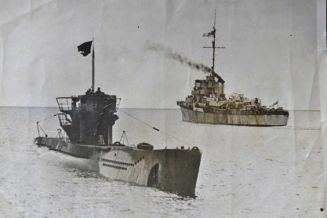
HMS Byron

HMS Byron taking the German U Boat fleet surrender at Scappa

My late father in law served in the Arctic Convoys, as part of the 21st Escort group on board HMS Byron. At the end of the war, he was on board when the ship was sailed back to the United States.

The last remaining vessel from this period, which saw service in the Arctic Convoys is docked on the Thames and available for visitors. You can read about HMS Belfast here

Taking part in the A-Z Challenge for 2020

Posted in A-Z Challenge 2020 - Specialised Studies, Genealogy, One-Name Studies, One-Place Studies, Specialised Studies | 7 Comments