Recipe written by my Great Grandmother- Annie Prudience Butcher nee Harris. Written circa 1965
Recipe – Wheat Wine
Originally uploaded by AnglersRest
Originally uploaded by AnglersRest

Recipe written by my Great Grandmother- Annie Prudience Butcher nee Harris. Written circa 1965
I was catching up with my viewing of the BBC Antiques Roadshow from last week (14th November 2010) when a rather interesting item came upon the screen.
The item was described as a ham stand, and of slickware and contained a genealogical mystery. The photo is not terribly good, although I am rather impressed with the result from a iPhone via a pause replay of a TV program!
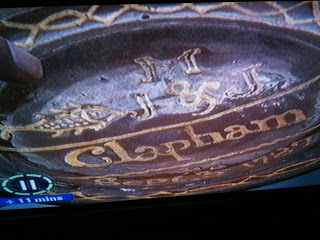
The details on the stand are as follows:
M representing the surname and both the bride and groom had the initial of J for their respective forenames. The fish symbol implies that the groom was either associated with the fishing industry or a keen fisherman. The name of Clapham refers to the location of the wedding and the date if September 3rd, 1787.
So who were J & J M and where is the Clapham refered to on the plate?
It does stand to reason that anyone who could afford a plate that would house a ham that size would come from a household of some income and thus could be an angler, rather than a fisherman living on a tiny income, but at this stage in the research I must not jump to any concluions.
Oh, the estimate given to this rather fascinating antique was between £2,500 and £3,500.
Last week I heard once again from a contact in Canada with whom I share a distant connection, through the KING & EASTWICK lines of my family.

Last Friday there was a burst water main near us, and we were without water for about 3 hours. As we have been poorly we have had heating on a bit and the pressure on our heating boiler dropped and then ceased working. The boiler refused to work until the pressure in the system was increased and that could not be increased because of the burst water main and then the subsequent reroute of the water supply. I phoned the water company – South West Water and was told I could apply for compensation and I would receive a call within 2 days.
On Monday a chap phoned me. He was deeply sorry but we were not inconvienced enough to qualify for the compensation of, drum roll please, are your ready? £20. Yes that is right the most expensive water company in the UK can not give us compensation of £20. When I asked why the chap was simply not prepared to do the right thing, he simply said “What is the right thing” my response was if he had to ask a customer then perhaps he should reflect on his manager role…..well I assume that he was a manager he did not introduce himself at the start of the conversation nor did he state his role at the water company. For all I know he was the guy digging the hole at the burst main last Friday. Anyway, it is not about the money, I’ve been known to spend more than £20 on books, for me it was about the principle of the whole event.
As I was already in a grumpy mood, I then made a telephone call to the warrenty company with whom we have a package with for our car. At the end of October we took the car for an MOT and service and a few bits needed to be done, of course! – so we had a bit of a debate with the warrenty company on the deliberate vagueness of the coverage of the package we have. We agreed on a price and I sent off the paperwork as requested on 27th Oct with a note requesting “prompt re-embursement would be appreciated”, so there I was realising that 3 weeks on I still had not had the cheque. I telephoned them and was advised that it takes 4 weeks to raise a cheque, when I challenged and said that we had received the warrenty book back after 10 days and that I didn’t understand why a cheque could simply have not been included, I was given the complex answer of “it couldn’t” I give up, in sad comprehension that for these appauling bouts of poor service I have actually paid for them.
On Monday afternoon I came across at the back of the filing cabinet in my study a pile of floppy discs, when I say pile there was about 300 of them that represent the period of 1999 – 2002 online. Copies of letters, research notes, emails and various work and professional work documents, plus all the material from my degree course. My laptop doesn’t have a floppy drive and neither does hubbys. Our desktop does and might be replaced over the next few months, so I sat on Tuesday afternoon with 300 floppy disc, a cup of tea and a pile of tissues and dropped and dragged all the data from all the discs into a folder on our external hard drive. A very boring job and I probably won’t even look at the data that was on those discs, but I can if I want to. I did come across a few bits of real interest, that I thought I had lost so perhaps it wasn’t time wasted afterall?
Over the last year or so I have looked at the Financial Times online, mainly with a view to us doing some preparation for the future. This morning I spotted an article “Pensions: a long and a happy one – but not for trustees”
This article can be found at:
http://www.ft.com/cms/s/0/6353fcca-eace-11df-b28d-00144feab49a,_i_email=y.html
The article mentioned the company that I work for, but what was especially interesting was that a barrister had ploughed through old cases to provide examples to illustrate the risk of pension scheme members living longer than expected.
The fascinating example provided was of a widow from the US called Alberta Martin who died in 2004 who had been in receipt of a war pension from her late husband who had fought in the American Civil War of 1861-1865.
Graves, Tombs & Memorials by Trevor Yorke and published by Countryside Books, 2010, £5.99. ISBN – 978 1 84674 202 6
Published as part of the Britain’s Living History Series, this slim volume, for the book contains just 64 pages, yet contains a wealth of information. Written in a clear easy to read format with photographic illustrations and broken down into chapters complete with a concluding index.
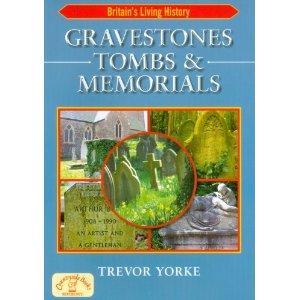 This book encourages us to delve beyond the name and dates on the headstone, and to look further at the style of the Memorial, the graphics upon it and the even the types of stone used to make it. Readers are encouraged to get out and about and explore their local churchyard using the knowledge within the book to gain further information about those commemorated upon the stones.
The book further explores the how the churchyard and cemetery evolved within our Society, the styles of stones over the ages and how burial practices have changed with a the later section of the book dedicated to understanding the various carvings and what they mean, giving further information of the person they are dedicated to.
This book is a welcome addition to any genealogist and family historian bookshelf and really does encourage us to get out their and explore.
Book Review for Federation of Family History Societies book club November 2010.
An arrest goes horribly wrong and Lindsay is being sued for not only killing a suspect who shot her but seriously hurting another suspect. While Lindsay is suspended awaiting her trial she stumbles into the crime scene of another police force and can not help herself and soon enlists the help of the Women’s Murder Club, which is now reduced in numbers following the murder of one of the members in the last book…….
Out for a morning jog Lindsay rescues a child from a burning building. The house contains 3 dead bodies, a missing baby and a missing au pair. A mystery message left at the scene of the fire leads Lindsay and the Women’s Murder club members hot on the trail of a killer or two.
The second book in the addictive series of the Women’s Murder Club, Lindsay and her friends are hot on the trail of the latest killer. What looks to be a random shooting is actually a vendetta against the police, again with twist at the end of the book.
** A life without work **
A century after a ground-breaking investigation into unemployment, the remarkable journey of one British family has been traced.
< http://www.bbc.co.uk/go/em/fr/-/news/magazine-11584487 >
This was a fascinating account of the population and work study by Rowntree in York in 1910.

The Anglers Rest blog first went online at Blogger in 2002. At the time of transfer, the counter was at 349,463.
It was moved to this site on 18th December 2015 when the counter was reset -:(
 Julie Goucher ~ Anglers Rest