Medieval European Society During 14th Century

Image from The Medievalist – Medievalists.net

One surname type is that of occupations, and these can be traced back to Medieval times across Europe.

The surname of Smith refers to someone who worked with metal. The surname Silversmith was used by someone who worked with silver. In German speaking parts of Europe, someone who worked with metal was called Schmidt, which translates to Smith.

Someone who worked with wood often had the surname of Carpenter, those who spoke French, were called Charpentier and those who were in German speaking areas, called Zimmerman. Those who made wooden furniture could were often called Joiner, which in French translates to Joignour.  You could ask why the need for a separate name, such as joiner, but the reality is that surnames began because we needed to distinguish one person from another. The diversification of joiner from carpenter, could be quite simply the use of wood in a specific way – the general carpenter, took that name in the simple form, whereas the chap who made his living making furniture selected the name joiner, because he quite simply did literally that, he joined wood.

A baker in England often had the surname of Boulanger in France, or Becker in Germany. A butcher in England often took the surname of Bouchère (female) or Boucher (male) in France, in Germany the name was Metzgerin (female) or Metzger (male); and in Italy the name translates to Macellaia (female) or Macellaio (male).

Surnames though do not exist in isolation, they represent people who were living their lives and in order to consider those people, it is useful to add some context to their lives, and the times in which they lived; essentially setting the stage.

At this period of time, the chances are, we may not be able to identify “our people”. That very much depends on their social standing, their country of origin, occupation and any other identifiable marker, that could be potentially found in historical records. For most of us they are likely to not be available, but if they are then that is a win.

In Medieval times, society was primarily comprised of three elements – Christianity, agrarian and feudal.

Christianity – Broadly speaking, it was very likely that England, France, Italy and Germany were all similar during the 14th Century.

The Church of England was no different to the State in Medieval Europe. The church was an important part of everyday life, and its functionality was that of a governing body. During 14th Century it was simply inconceivable that the Church and State were two separate entities.

The church owned a significant amount of property and coupled with business interests, and its involvement with various levels of education, the church played a significant part in the affairs in Medieval society.

The church organised the timings of festivals, and feast days, as the seasons passed – Lent for example was organised by the church when the granaries dried up and meat was a shortage. Easter was seen as a celebration of the resurrection of Christ, but the festival took place when the grains were refilled and vegetables could be harvested.

Agrarian – Every household in the 14th Century had a self sufficient vegetable garden and space for small animals. Subsistence farming had become a dominant way of life after the urban centres of the Roman Empire collapsed.

Villages followed the Open Field System, thin long strips of the field outside of village centres. The planted fields were kept for as long as possible as they were ploughed by Oxon, and later by horses. Farms gave assistance to neighbouring farms with planting, ploughing, harvesting and other agricultural measures.

The farmer took care of the crops and field rotations, enabling nitrogen in the soil to go back into the ground and the land given the time to adjust. At key times even the children assisted.

There were disputes being villagers and there are as a result of this some fascinating court documents that are able to shine a light on the nature of the disputes and how the situation was ordered to be addressed. These disputes could be things like individuals ploughing too much in their neighbours strips, or adjustments made to what was agreed to be grown.

Feudal System – This flourished during the 14th century, establishing a social hierarchy in the community. The tip of the structure was the King, with the Nobles, Earls, Vassals, Peasants all situated beneath the King, with varying levels of servitude.

The King pledged support and protection to the Nobles and granted them land and titles. The Nobles in turn vowed loyalty to the King, promising to provide military service.

Vassalage System – This was the lower ranking men who pledged their loyalty to the Nobles, and entered into a mutual obligation.

The peasants agreed with their Lords on the amount of harvest or the number of days labour and earnt the right to retain a portion of the harvest.

Medieval society was organised on a Three Estate Model, which essentially divided the community and society into three social orders:

  • Those that ruled or fought
    • Those that fought and were supposed to protect the others in the social order
  • Those that prayed
    • Those protecting humanity for committing sins
  • Those that worked (representing about 90% of the people)
    • Those that supported the members of the two groups above which together represented about 10% of the people.

Social Movement – The eldest son born into the family of the First Estate inherited the titles, lands and income of the family. By the 14th Century Nobles and landowners realised the practice of Primogeniture was the only way to retain power and legacy.

The solution to the problem was to send children to pray as Monks and Nuns. Children born into the First Estate would become part of the Second Estate and lead comfortable lives. The Clergy, Nobility and Peasantry constituted the Three Estate Model.

A typical village in the 14th Century consisted of houses, a church, and trade shops. They would be gathered together in a cluster that would be surrounded by ploughland, called the Open Field System. which followed a Three Field System, whereby two fields were planted and the third field rested, or lay fallow for the year.

Better farming methods, produced more food. In turn that meant that people had more to eat and were better able to resist illnesses and diseases, living longer and as a consequence populations grew. The more people there were, the more there was a need to expand a naming process, as we needed to be able to identify one person, from another as I have outlined in the beginning of this post.

For those who perhaps want to explore their surnames, the Introduction to One-Name Studies begins next week, details can be found HERE.

Posted in 14th Century, Historical Time Periods, History, Medieval Period, One-Name Studies, Surnames | Leave a comment

The Journey to a Specific Project (2)

Created by Julie Goucher, 2022 using Wordclouds

You can read other posts Journey to a Specific Project HERE.

Thinking back to the pre-internet days, researching our family history or a specific project was a labour of love. We worked from ourselves backward, talking to family members and friends, looking back and original documents and certificates and then we needed to access resources likely where our ancestors lived, or perhaps to order a certificate, in the hope that it was our ancestor and would shed clues to the family further back.

To order that certificate we needed to access the indexes of Births, Marriages and Deaths. These were at St Catherine’s House and prior to that Somerset House in London. Firstly, the Births were in red folders, marriages in green and deaths in black. Each book represented a quarter of the events in all the registration districts in England and Wales. So for example, my Grandfather was born on 3 March 1908, he was registered in the Guildford Registration District, and his index reference can be found in the first quarter of 1908 births. Armed with the registration district as well as the volume and page number the certificate can be ordered. It would then arrive in the post (letterbox, stamps, postman!).  So you get the idea, it was time consuming and costly.

Then we have baptisms and burials which form part of the parish records – so if I look at the church where I know my Grandfather was baptised I can find the entry. Sometimes the vicar provided the date the baby was born or individual was born – not all are baptised and if you want to marry in a church then you needed to be baptised first.

Working on a One-Name Study was even more time consuming and most people started their journey by collecting the material from the St Catherine’s indexes. One Guild of One-Name Studies member told me that it took them 10 years to collect the information for their surname and the variants. That is right, 10 years. Even then you needed to either access the original certificate or search the parish records, assuming you knew where to look.

For my Orlando study, it took three years for me to extract the Births, Marriages and Deaths in England and Wales. Today, you can download the material from FreeBMD in under 30 minutes (depending on the popularity of the surname) for events that took place from September 1837 up until 1983 (although I see today the date has extended until 1999, but is not complete).

The same process existed for marriages, and that is why the Guild of One-Name Studies member benefit of Marriage Challenges is so useful, as are the indexes. We discuss this further as part of the Introduction to One-Name Studies course and a practical element in the Practicalities of a One-Name Study course

Posted in Journey to a Specific Project, One-Name Studies, One-Place Studies | Leave a comment

The Journey to a Specific Project (1)

Created by Julie Goucher, 2022 using Wordclouds

Our individual genealogical and family history pursuits is, for a good many of us the reason we embark on specific projects of some kind, This might be  researching broadly and culturally another country, a One-Name study or a One-Place study. For some of us, a One-Name Study links with, and into a One-Place Study.

For my own research, my genealogy and family history was paramount in the beginning of my own One-Name study, developing into a One-Place Study, and generally  leading to specific research into European genealogy and family history.

Over time, our research diversifies as we grow our studies, research and interests. For some of us, our studies become personal and maybe, it is no longer enough to just gather and collect data.

Are studies with thousands of line entries in databases as valuable as those that develop studies whereby we build family groups. or undertake studies that gave a specific focus, researching in-depth those from a specific, or those holding specific jobs, or those that have gone into politics?

Those with Registered studies with the Guild of One-Name Studies undertake to make their study global, and a number of researchers cast a general view that there is not enough globalisation, though defining “enough” is not an absolute science.

The internet has revolutionised the way we research, both in breadth and depth. Advancements online mean that often a review of research is possible and a great many of us take a regular review of our research. For some, it is a case of pressing pause on gathering data, thus enabling a review to take place and data updates to happen.

Equally the amount online, whether that is a robust catalogue, digitisation of documents from small sets of data to significant collections is quite overwhelming. As I routinely advise Pharos students, develop a study the way you would eat an elephant – in bite size chunks! The nature of the bite size chunk is up to each study registrant. The way we research, establish and develop our studies, or even broad research will vary considerably, depending on a whole host of things.

Posted in Journey to a Specific Project | Leave a comment

Elstead Football Club 1911

Twice in recent weeks I have been asked if there was a better image of this picture available. There was, and I sent the images on to those that requested them.

It seemed appropriate that I should share this post again, after all, it has been almost eight years since that original post. which was part of my Guildford and District Collection

Elstead (Surrey) Football Club 1911 – From the personal collection of Julie Goucher

Standing Row – Herbert ELLIS, u/k, u/k, William BIAS, George WARNER, Alfred NOVELL, Guy BOVINGTON, Sandy TILSON, u/k, Henry ELLIS, Lewis NOVELL, u/k.

Sitting Row – first 3 u/k, Hubert HARDY, Jack BOND


Posted in Elstead, Genealogy, Guildford & District ~ A Pictorial Archive, Guildford, Surrey, England | Leave a comment

Almost Within Living Memory

I wrote this back in late October 2021, where it languished with a series of post it notes in my journal, and waited to be finished. It was not until I was working on the Census series that I recalled writing this, and on searching realised it was not finished, nor published.

Over the part of last year I began to think back to my childhood and visits to a plethora of great Aunts and Uncles. Those visits I enjoyed, and even once I had left home to study and moved on into my own home. Eventually leaving my native Surrey, having married, I maintained those visits, though not with previous regularity, until I found myself at the funeral of the last of my great Aunts.

There is something profound in the realisation that those who have gone before you, have indeed gone. My last great Aunt passed away in 2011, my Mum died in 2014, and I with that passing became the last one. The sentiment that there is more life behind you than in front is almost sobering, and a sudden realisation that I have a great many notes taken on those visits, and a great many happy memories.

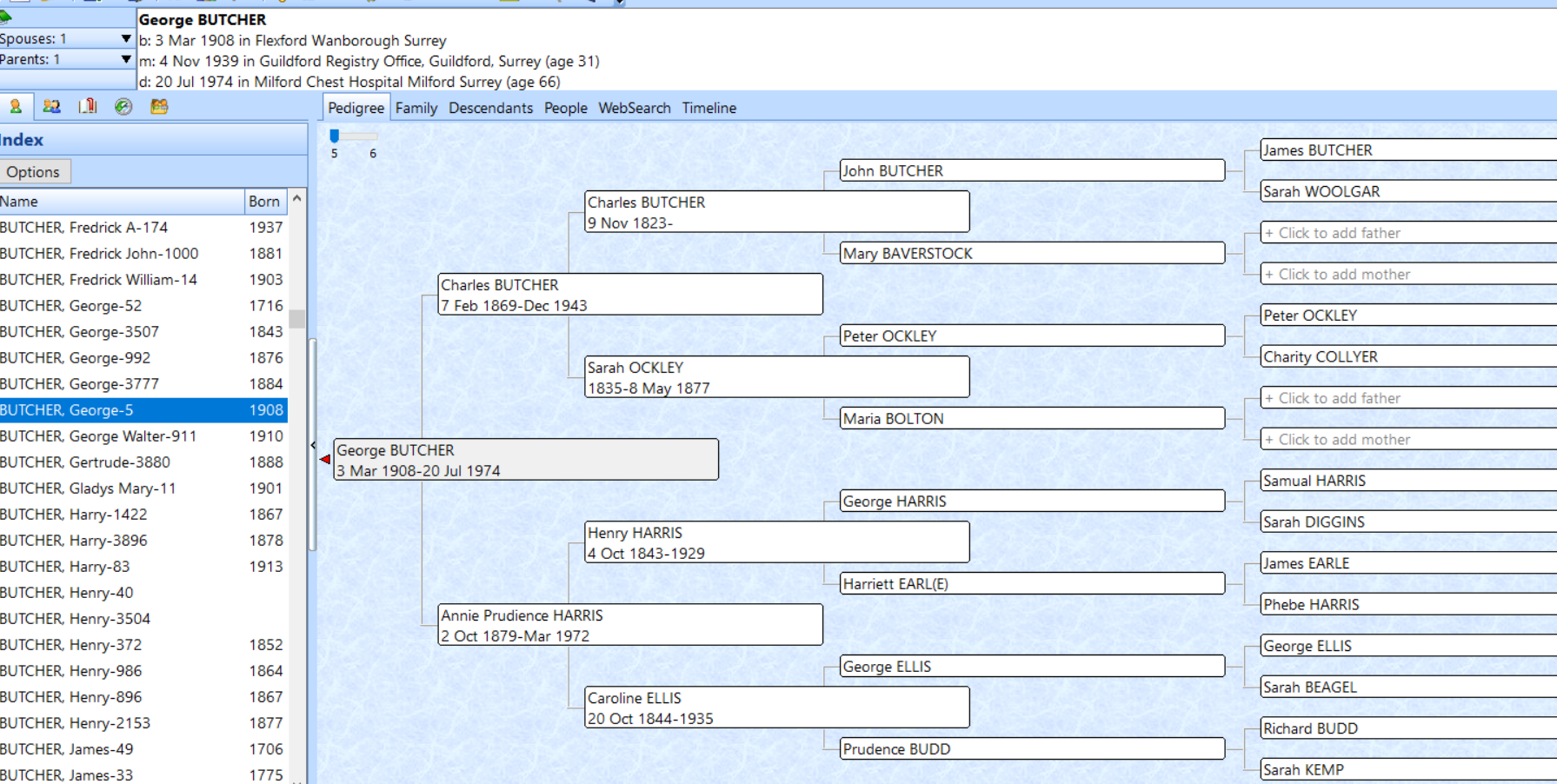
I therefore began to focus on the siblings of my great Grandmother, effectively my great, great Aunts and Uncles. My great Grandmother, Annie Prudence Harris was born in the lovely picturesque village of Puttenham in Surrey in 1879. She passed away in the early 1970’s and I remember her.

Puttenham (Surrey) Church – Copyright Julie Goucher, 2008

It was seeing Granny, as she was called by us all, in the census in 1881 that inspired me into this research. At this point, the 1881 Census was the last one available. It was seeing Granny on this census that was just magical to me; the linking of the person that I remembered to the past. In turn, that created the urge to understand, and get to know these people that I shared a genetic link to. I talked about this HERE, as part of the Census series.

Coupled with that census image, were the notes I had made of many visits to my great Aunts and Uncles I was able to bring to life the siblings of my maternal great grandmother and grandfather.

Now, post Christmas, I am sure that the winter will be a filled with cold, flu and Covid, at least in north east England, so my plan is to immerse myself in the research and the filling of gaps that exist within the lives of my great great Aunts and Uncles and the recording within my genealogical software the notes from those family visits.

My great Aunts were able to provide me with the names of my great Grandmother’s parents, who were Henry Harris and Caroline Ellis who married in 1864, AND her maternal grandparents, who were George Ellis and Prudence Budd who married in 1834. I was then able to follow the Budd line back in Puttenham to 1724,

Whilst oral history can be unreliable, I found that the information I was given was accurate when I followed the family through the parish records.

One of my special memories took place at least 30 years ago. One of my great Aunts (born in 1915) came with me to see her oldest sibling and sister who was born in 1900. We were joined by their first cousin who was born in 1911. It was fascinating to watch them interact as a group of three, and separately as sisters in the case of my Aunts. They sat chatting about the memories they shared of the villages, farms, family and other snippets. They were totally instep with one another, their recollections was truly remarkable, so much so I am sure they forgot I was in the room. This was before smart phones. I totally forgot to grab my camera, so the only recollection is my memory and the notes that I took that day.

All of us have these sort of “snapshots”, whether we have photographic support or not. It is sharing and documenting these memories that is important, which means that whilst our family members may have gone, they are not forgotten.

Posted in Budd, Ellis, Harris, Puttenham & Wanborough | Leave a comment

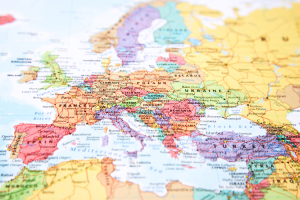
Tracing Ancestors from Continental Europe – Pharos Course

Tracing Ancestors from Continental European – Copyright Julie Goucher, 2021

Today is the launch day of my new Pharos Tutors course, Tracing Ancestors from Continental Europe.

The course takes place over five weeks and is presented as a significant foundation for researching in Europe;

Lessons are:

1 – Unfolding the history and context of Europe

2 – Reasons for migration to the British Isles

3 – The impact of the Second World War

4 – Europeans beyond Europe

5 – Moving forward with your European research project.

In addition to the lessons, with exercise questions, there is a comprehensive 112 page resource pack which will hopefully enable students to move forward with their research, having learnt about the foundation.

There is a huge amount of information in the course, which is a mere fraction of what I could have included, indeed, some was removed from the final draft. Material that did not make it into the course, is likely to be shared here, on this site.

So, if you are interested in researching ancestors who were from Continental Europe and you are stuck, or what to find out more, what are you waiting for? Visit the Pharos website.

Posted in European Ancestors, Genealogy | Leave a comment

Census, Parish and One-Place Study Resources

Created by Julie Goucher, 2021 using Wordscloud

As we undertake our genealogical research, whether that it on our own individual family history, or a specific project, such as a One-Place Study, One-Name Study, or perhaps a project undertaken as part of the Family and Community History Research Society (FACHRS); we likely use a variety of resources to aid us. This post is a few of those resources that I find useful and recommend.

Posted in Genealogical Resources, Genealogy, Local History, One-Place Studies | Leave a comment

Census, People and Genealogy – 1911 Census

Created by Julie Goucher, 2021 using Wordscloud

Continuing with the Census, People and Genealogy series – all posts can be found HERE. There is also a Census downloadable to be found HERE.

The 1911 census was more comprehensive than earlier ones. For the first time it recorded nationality. There was also expanded information relating to occupation.

Married women were also asked specific questions. This was essentially an attempt to understand why the birth rate was falling, indeed it had been since the 1870’s. The questions were:

  • Duration of the current marriage
  • Number of children born within the marriage
    • It also counted those that were still living and those that were deceased.

The 1911 Census was also the first census where the government required the original forms to be retained. Those in the Army who were serving overseas were also recorded. The Great War begin in 1914, so this census is an important marker for those researching families where there was a loss within the family.

Following on from the last census (1901) where we saw my great Grandmother (Granny, as we all called her), Annie Prudence and her husband, my great Grandfather, Charles Butcher, we are now a decade on.

Here is the family – Charles and Annie, with their children, Rose who was responsible for sharing the stories and details of my family, Gladys, Percy, Arthur, George and Ellen. George was my Grandfather and I have written quite a lot about him over the years.

Census Returns of England and Wales, 1911. Kew, Surrey, England: The National Archives of the UK (TNA) Series RG14, 1911.

Census Returns of England and Wales, 1911. Kew, Surrey, England: The National Archives of the UK (TNA) Series RG14, 1911. (Schedule)

My Grandfather, George was aged three. He had not met my Grandmother, Lilian Matthews, which he obviously did, as they married in 1939 (sadly after the 1939 Register), though my Grandmother was not born yet, she arrived in December 1912.

What has become apparent to me as I have written this series, is how little I have researched my great Aunts and Uncles, and despite taking such an interest in my family, I have missed opportunities. Over the coming weeks and months, I intend to rectify that, in addition to researching the Butcher family in Alfold which I mentioned in the 1901 post. The Alfold Butcher family do connect to my Grandmother’s family though she did not know that, and there is still a connection between the two Butcher families, but that is something to unravel another day.

Posted in Butcher One-Name Study, Census, People and Genealogy, Genealogy, Puttenham & Wanborough, UK & Ireland (Eire) Genealogy Series | Leave a comment

Presentation – What to look for that suits your (One-Name/Surname) Study

After an issue with  Zoom, wanting to install a patch to fix an update problem which prevented me from giving this talk to the Guild of One-Name Studies on Wednesday, I arranged to record the presentation (click the image below).

The accompanying Handout – What to look at that suits your study is also available.

Copyright Julie Goucher, 2021 – Slide Template by Slide Carnival

I am planning to host an online discussion in the coming weeks, so if you wish to informed when it is schedule, please leave a comment, I will also share the information on this site.

For those interested in reading about and finding more information surnames:

Posted in Genealogy, Introduction to One-Name Studies (Pharos course 901), One-Name Studies, Practicalities of a One-Name Studies (Pharos Course 903), Presentations, Software and Applications, Surnames Series 2022 | 2 Comments

Census, People and Genealogy – 1901 Census

Created by Julie Goucher, 2021 using Wordscloud

Continuing with the Census, People and Genealogy series – all posts can be found HERE. There is also a Census downloadable to be found HERE.

With the 1901 census we see a change to the questions asked on individuals on the census.

Firstly though, here is another great example of the description of the parish, demonstrating the depth of the description is variable because of the enumerators and how proceeded with their tasks of the census. The irony is that Puttenham, across the Hogs Back (A31) has more facilities and parishioners than Wanborough, of course, it could be because there was less households that the enumerators had more time to provide such details.

Wanborough Census 1901 – RG13/607/66/1 Surrey History Centre

The 1901 Census had expanded in terms of the data it sought, the new data is marked in yellow.

The first set of new questions, related to the building and whether the building was inhabited, was uninhabited yet occupied, or not occupied. The last option is indicating that the building is quite simply that, a building, perhaps a barn or similar. The option of uninhabited yet occupied could be temporary accommodation or perhaps squatters. Also, captured on the Census was the number of rooms at the property, if less than five.

The second adjustment is around age, it specifically asks, the age at the last birthday, presumably in an attempt to be more accurate regarding the ages of those included on the census.

The third adjustment was expanding the question around work. The original question was to ask if the individual work working or own account, the expanding element is to understand how many were working from home, in what could be described as “cottage industry”

As I looked at the Census for Wanborough I was in part surprised with the way the family had spread. Indeed the extended family was very much of importance.

Wanborough Census 1901 – RG13/607/66/2 Surrey History Centre

Granny, Annie Prudence is now married to my great Grandfather Charles Butcher, having married on 24 December 1898.  They are couple, with their first daughter, my late Aunt Rose who was aged one. Annie was aged 21 and Charles aged 29. Annie was born in Puttenham and Charles in Wonersh, Surrey. Also living with them is Annie’s brother, Edward Harris who was aged 23 and described as an agricultural labourer, Charles is recorded as a carter. The cottage the family were living in was one of Manor Farm Cottages. The family were connected to Manor Farm at Wanborough until 1930.

On the next page, we see Henry and Caroline Harris, living with their grand-daughter, Florrie Toller who was aged seven years old, and was the daughter of Henry of Caroline’s daughter, Ellen Harriet. Henry is still working, he is 56 years old and is a shepherd on a farm, likely Manor Farm at Wanborough.

Wanborough Census 1901 – RG13/607/66/3 Surrey History Centre

One of the things I pondered on was where Charles Butcher was in 1891. I feel that having been researching for so long, I should have known, and perhaps I had known, but forgot – who knows!  In 1891 Charles Butcher (born 1869) was living with his father, Charles and step mother Francis A, and some half siblings. They were living in Alfold, Surrey. Charles was aged 66 years old and his second wife, was aged 40.

More on Charles senior in the future, as well as the continual connections with others, and lastly, the connection with the Butcher family in Alfold, with whom there is already a connection within the family.

“Drawing” of location of occupants at Wanborough circa 1905 – Julie Goucher Collection 1990

As I looked through the census pages for Wanborough in 1901, I am recognising the surnames named by my late great Aunts, the Spicer’s, Strudwick’s, Chennel’s.

With apologies for my poor art skills. This was drawn out with the help of two Aunts, as I wanted to get a feel of who lived where. The property marked APH is where my great grandparents, Annie Prudence (Harris) and her husband, Charles Butcher.

Posted in Census, People and Genealogy, Ellis, Genealogy, Harris, Puttenham & Wanborough, Surnames, UK & Ireland (Eire) Genealogy Series | Leave a comment