European Ancestors – Understanding France (7) Marriages

Courtesy of Wikipedia
Flag adopted 15 Feb 1794

This post is part of a series about genealogy in France. You can read the complete series HERE.

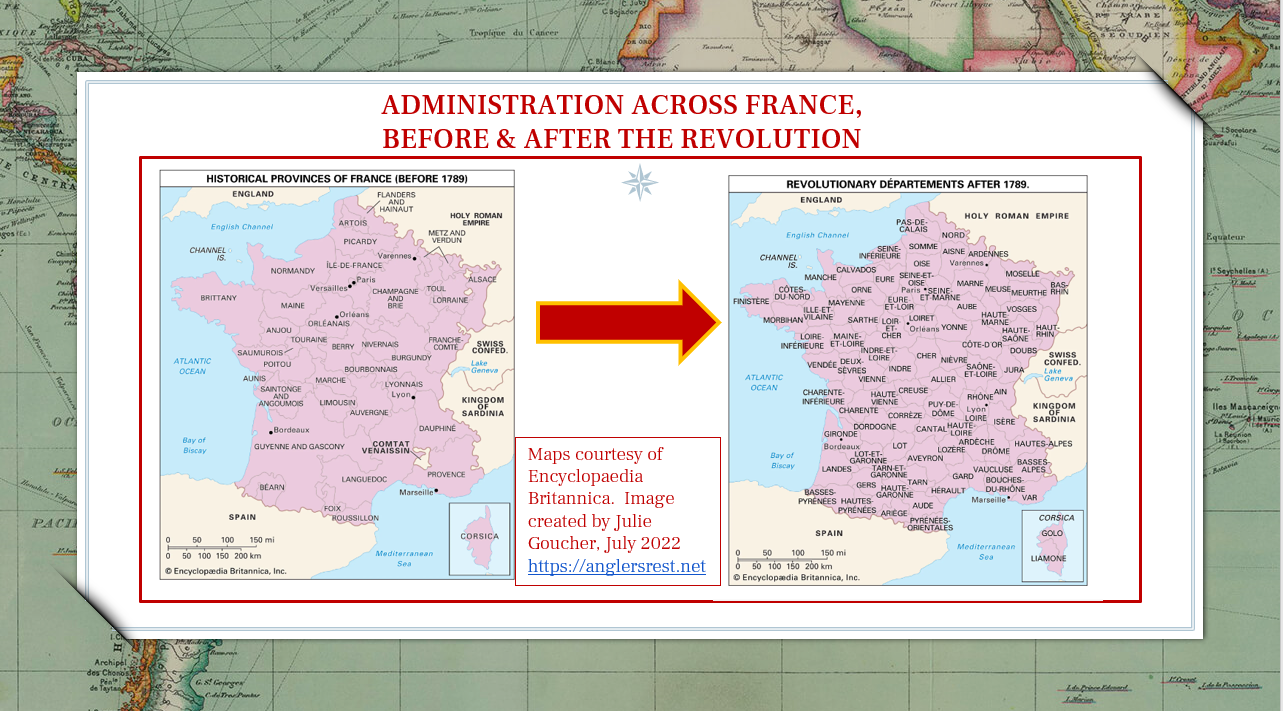
During the period of 22 September 1792 and 26 July 1800 marriages had to be celebrated in the main canton, rather than in the commune, which is where they would have expected to have taken place.

Marriages are only legal in France if they have been undertaken in the presence of a civil authoritarian. They may subsequently be followed by a religious ceremony.

The civil marriage registers give many details, such as:

  • the birth date and birthplace of the bride and groom
  • parents’ names, including mother’s maiden surname, for both bride and groom
    • if the parents have died, their death date and death place are recorded.
  • Civil marriage records may even include the same information for the grand-parents
  • Witnesses are listed, (usually four), with their age, occupation, residence, and relationship.
  • Birth information of the couple’s children who are born prior to the wedding.
  • Marriage contract information, if one was made, include the date, the name of the notary, and the town where this contract was written may be included.
  • Civil marriage records may also mention the date of the banns.

A couple was required to announce their intention to give other community members the opportunity to raise any objections to the marriage. These are known as Banns and were required to be lodged twice in the weeks prior to the marriage. Banns were lodged in the parish of both the bride and groom and usually also indicate the parish where the marriage took place, or the residence of the bride. Some registers of marriage banns before 1927 have been preserved.

Marriage Supplements were sometimes filed by the bride and groom as a way of supporting their application to marry. This often included other useful genealogical information such as:

  • Birth record extracts of the bride and groom,
  • Death certificates of the parents,
  • Divorce decree of a previous union of either party
  • The certificates of residence,
  • Information of a Marriage contract,
  • Information and acknowledgement of children,
  • Parent’s consent
  • Military status of the groom

Sometimes documentation on earlier generations may be included. In France these marriage supplements were originally kept by the clerk of the court, but on occasions they may have been given to the departmental archives.

A Marriage Contract was created for the protection of property. The certificate often showed the name and town of the notary and when it was written. These are always deposited with the departmental archives.

In 1877 a family register was created. It seems likely that the need for this came about following the fire in Paris in 1871 when all the birth, marriage and death records were destroyed for events prior to 1860.

This was given to the couple following the marriage. As children were born to the couple it was updated. This was a document held by the couple and very often these pass down the generations.

The current minimum age for marriage is 18 years.

Same sex marriage was legalised in 2013. There 10,522 registered in 2014 and 7,751 in 2015 [1]

[1] – Statista.com

Posted in European Ancestors, France, Understanding France Series | Leave a comment

Stationery Joys

Copyright – Julie Goucher, June 2022

Over the years I have shared about my notebook and writing obsessions and thought that I might share with you the ones I have enjoyed over recent months.  Some of these have been new, some extracted from my stash of notebooks and only one Moleskine! If you missed the post where I shared how it all began click HERE

This notebook was a recent addition by way of a stationery subscription box that I subscribe to. I am not a fan of these reporter style books, but I was drawn to the design and it is my current book. The pen which is a Caran d’Ache Paul Smith 3rd Edition 849 Ballpoint Pen. The pen comes in a rather lovely tin, which is the only difference, so in this case I have two, the green and the mustard colour tins, both pens are identical – there is no specific link between the pens and the notebook, they by chance compliment each other.

Santa bought me a matching set of colouring pencils, from the same series. I have fond memories of a set of Caran d’Ache colouring pencils from my school days, long since gone.

I spotted in the bottom of my filing cabinet the Leuchtturn1917 metallic notebook, in hardback and bronze colour. I then spotted whilst looking for something else that the brand now did A5 and A6 slim notebooks in paperback, within the same metallic series. As they were reasonably priced I ordered them. Each arrived as a set of two and came with the labels. I have used both A5 and one of the smaller ones.

As I was about to order another set of smaller ones I spotted another Leuchtturn1917, in the regular colours but in A7 size, hardback and 169 pages. Far too small for my usual use, but ideal for my handbag to add things to when I am out and about. 

Also in my supply was this lovely hardback blue and white notebook from the make of Eccolo. I vaguely recall buying this TK Max probably not long after we moved, so about four years ago. It is a large book, 26cm x 13cm, so what is B5 size. The following notebook was this one by Caroline Gardener, in the B5 size, that ran from 1 April until the end of May.

Courtesy of Amazon

My June until the end of July notebook was this rather bright yellow/green Moleskine in softcover with plain paper.  When I purchased it I was not overly wowed with it and it sat on the top of my desk for several months, but it was actually a great notebook to work with, especially as I could roll the cover back.

Courtesy of Amazon

My notebook from the beginning of May until June was one that came recommended to me.

This is by the make of Emshoi, who produced a fabulous notebook. This is in the B5 size (19 cm x 25cm), ruled, with a pen loop. The paper is 100gsm and available in a series of colours as you can see from the image. There is a back pocket and this comes with some divider sticky notes and has two bookmarks. There is a contents page at the front. The paper is in a lovely smooth ivory. I have done a pen test and there is ghosting with some of the heavy pens, even Sharpie pens are ok with this notebook.

Copyright – Julie Goucher, June 2022

Two recent additions, which were gifts – from a friend who knows my notebook obsession. The book on the left is similar size to the Caroline Gardner book above and the other, A5 part of the Victoria and Albert collection of William Morris notebooks. It is paperback, no bells and whistles of book marks or back pockets, and will last me about a month, hopefully.

Posted in General Stationery, Stationery Box, Stationery, Filofax, Journals & Notebooks | 2 Comments

Motto – Kynd Kyn Knawe Kepe

Copyright – Julie Goucher, June 2022

About 20 years ago I purchased this mug from an antique store in Devon. I was drawn to it for several reasons, the colours, the commemorative features and the date – 18 December was the date of my Grandmother’s birthday, though she was born way before 1934.

I was convinced that there was a link to mining and Cornwall. I decided to take to Twitter #AncestryHour (@ancestryhour & associated website) and wondered what genealogical colleagues would suggest. I was not disappointed, within a few minutes I had received some really useful suggestions and comments.

Copyright – Julie Goucher, June 2022

Firstly, I was alerted to the motto on the china, which bizarrely I had never noticed. How could I have missed that?

Whilst a number of weeks have passed I have not managed to spend anytime researching this further. What follows is the list of suggestions & hints, all centred around the motto, which I had not noticed!

  • Spode Museum Trust
  • Gawthorpe Hall
  • Article in Daily Mirror newspaper 19 December 1934
  • Article in Lancashire Evening News 19 December 1934
  • Lord Lieutenant of Lancashire, and President of the County Territorial Association whose coat of arms shows a shuttle, a weaver, and a seaman with a ship’s lantern.
  • Family motto is Kynd Kyn Knawe Kepe
  • Kay Family Association who are members of the Guild of One-Name Studies

I have added the mug research to my winter to do list.

Assistance from @mharkusAurelius, @MCgirl73, @Janciletti, @Janetspink1 & @MusicHallJane and @chiddickstree – thanks so much.

Copyright – Julie Goucher, June 2022

Posted in Commemoratives, Ephemera, Postcards & Stamps, Genealogy, History | Leave a comment

Surname Distribution Maps and Migration

Surname distribution maps add a new and different dimension to a One-Name study.

A surname may well have it’s origins in one Country, and a map can provide an interesting insight to how migration can influence the geographic spread of a surname. Going a step further, historical events can influence migration which in turn can be identified using a distribution map.

Especially those of us researching European surnames, a map can be used to identify where to start. In Europe, excluding UK and Ireland, events are recorded in the town & village in which they occur. If you are researching and find a Census or passenger list which simply lists the Country of origin as the place of birth, that is helpful, but not going to break those brick walls down.

Virciglio

courtesy of Gens.info

In my Italian family I have the surname of Virciglio. This map from Gens.info shows where the surname appears in Italy and the Islands. As you can see it is not a name that is widespread, although it is reasonably popular in “my” bit of Sicily.

We know, because history tells us, that there was significant peaks of migration from Italy and in particular south of the mainland and the islands. Famine was widespread, the only way of having a reasonable life was to migrate to other Countries and one of those countries was the United States.

Virciglio USA

Courtesy of Gens.info

Using another map from the same site shows the distribution for the same surname across the United States. This is especially helpful for the United States because, like Italy, records are held at local level, so I can discount all the states where there is no colour, at least initially.

Do surname distribution maps provide all the answers? – No, but they do provide scope for further research and considerations.

orlando Map

Courtesy of Gens.info

That said, when I insert my Italian study surname into the Gens.info website, the map looks like this which does not tell you anything beyond it is a popular surname and especially in the South and in Sicily.

There are a number of other surname distribution sites covering a number of other European Countries and there is a very useful Facebook Group too.

Don’t think that this site is not worth exploring if you are researching British surnames, a quick search of two Guild registered surnames, Butcher and Howes both produced a map, and whilst not the colour explosion of the Orlando map, certainly of interest nonetheless.

More details and information is covered in the Pharos Introduction to One-Name Studies course.

Posted in Genealogy, One-Name Studies, Virciglio | Leave a comment

How Big is my One-Name (Surname) Study?

Image courtesy of Unsplash

As the image here might suggest, you are going to need to think and write notes relating to the size of your potential One-Name Study, it is nothing complicated, I promise!

Not all surnames are equal and understanding the frequency of the surname will be determining factor. The more frequent a surname appears, then the bigger the study is going to be and the more time it will take to collect, analyse and organise. Now that does not mean it is out of your reach, it is simply a case of being aware of a variety of factors.

Whilst a large study is a challenge, they are, in the modern era very achievable. A fellow member of the Guild of One-Name Studies told me that it took him 10 years to collect all the instances of his surname from the General Registration Office indexes, that were originally held at St Catherine’s house in London. Now, thanks to sites like FreeBMD it is possible to download the data in a matter of minutes. You can access the indexes, but they are restricted to about six sites across England and Wales.

The study I mention has gone on to create a large database of about 77,000 instances of that particular surname, which is the Featherstone One-Name Study which began in the 1990’s. Another large study is that of the Howes One-Name Study, which began about 10 years ago and has circa 190,000 individuals in reconstructed families.

For a moment, lets turn our attention to surnames whose origins are England and Wales. To determine the frequency of those names, we would look see how many instances of the name occur in the 1881 Census.

  • 1-30 Tiny study
  • 30-300 Small study
  • 300 – 3,000 Medium study
  • 3,000 – 30,000 Large study
  • 30,000 – 300,000 Extra large study
  • >300,000 are huge studies such as Jones and Smith

For my Orlando One-Name Study, there are less than 300 in England and Wales, so that appears to be a small study, but the surname is an Italian one, with huge peaks of migration to other Countries. Look at the distribution map that I mentioned a few days ago.

Distribution of Surnames 2014 for Orlando and Butcher – Copyright Julie Goucher, 2020

For surnames in the United States turn to Ancestry and check the frequency of the surname there.

There are other considerations too, in the case of European surnames there will be peaks of mass migration caused by important aspects of European history.

There is a useful page on the Guild of One-Name Studies website about choosing a surname and about the size of a study. In fact you can see the numbers relating to the Orlando, Featherstone and Howes studies, so it is worth reading and you can do so here.

Why not consider the surnames of your four Grandparents – would they be suitable as One-Name Studies? And if not, why not? – Go on, leave a comment or write about it on you own blog and leave the URL below.

More details and information is covered in the Pharos Introduction to One-Name Studies course.

Posted in Introduction to One-Name Studies (Pharos course 901), One-Name Studies | Leave a comment

Why have a One-Name (Surname) Study?

Image created Julie Goucher, 2020 using wordclouds.com

As any genealogist or family historian will tell you there are always more questions than answers and always a burning obsession to find out more, even if the odds are against a successful search.

There are a variety of reasons for researching a surname, here are just a few:

  • General curiosity about a specific surname.
  • General curiosity about surnames in general, or surnames from a specific region
  • Where does the surname come from?
  • My name is “foreign”, how, when and why did it get here?
  • Spellings of different surnames and are they related?
  • An attempt to demolish a genealogical brick wall.
  • By collecting all the references to a given name, it means that you do not necessarily miss your elusive ancestor.
  • …….the list is endless; and there is no right or wrong answers.

More than likely you will have already started your surname research before you become aware of the concept and before you have considered the basic foundations for a study.

What are the foundations? well here are a few things to consider:

  • Seek to understand the history of the surname
    • Where did it come from?
    • Why did it come here (wherever here is)?
    • What does it mean?
    • How big might my study be?
  • What do you want to achieve by undertaking your study?
    • It doesn’t matter if you don’t have a firm idea, but begin thinking about it.

More details and information is covered in the Pharos Introduction to One-Name Studies course.

Posted in Introduction to One-Name Studies (Pharos course 901), One-Name Studies | Leave a comment

What is a One-Name or Surname Study?

Created by Julie Goucher 2019

The next Pharos Introduction to One-Name Studies course will begin on 31 May 2022 and won’t run again this year.

I thought that  some people might be wondering what a One-Name study is.

Essentially it is a project which focus’ on a single surname, regardless of any connection between people bearing the same name. If the surname is registered with the Guild of One-Name Studies then there is a commitment to aspire to research the surname globally.

Over the years, a number of people have said they find that too challenging, and I have a number of things to reassure. The Guild does not assert any pressure on the study registrant – there is no time span, you work on your study at your own pace.

Global Considerations:

  • Depend on the size of the study
  • Access to records – not everything is online
  • Time commitment from the registrant

I have three studies registered, one I am about to pass to my husband as that relates to his family. That is fairly small, even on a global scale. Certainly in England and Wales it is very regional – predominately in the Counties of Suffolk, Norfolk, Cambridgeshire, Essex and Yorkshire. Even in the United States there appears to be relatively few instances of the surname.

My two studies that relate to my own family represent the surnames of my parents. One is an occupational name and it is a medium to large study, the other is for an Italian surname. From an assessment of English records, it appears to be a reasonably small study. I said appears to be, because the reality is, in Italy and not surprising the United States the surname is very popular and that means it is another medium to large study.

So I have essentially two large studies that represent my parental families. Over the coming months I will share bits about the studies but the reality is, the few items I have listed above will influence how quick you leave one Country and move to another. If you start your research in the United States it might take you ten years to leave the US because of the availability of records or the amount of records or perhaps both of those elements come into play.

Have a look at the website Forebears and insert your surname of interest and your email address and a map of the world will populate and that will give you an idea of where your surname appears.

Here is the map for the distribution for my two One-Name Studies – Butcher and Orlando. This is based on data for 2014 as that was the only year where both surnames were illustrated clearly.

Distribution of Surnames 2014 for Orlando and Butcher – Copyright Julie Goucher 2020

Both studies are definitely global with the majority for:

ORLANDO name appearing in: Italy, Argentina, Australia, United States, Canada, India and through parts of Europe.

BUTCHER name appearing in the UK, Australia, Canada, New Zealand, United States and parts of South America, parts of Europe including Russia.

Apart from being a surname research project, it is a wonderfully interesting way to add dimension to your family history and genealogical pursuits.

For more details, and to register please visit the Introduction to One-Name Studies course page on the Pharos website

Posted in Genealogy, Introduction to One-Name Studies (Pharos course 901), One-Name Studies | Leave a comment

Guild of One-Name Studies Regional Meeting – Spring 2022

Created by Julie Goucher using wordclouds.com

Announcing Regional Reps Spring meeting for the Guild of One-Name Studies. Each quarter there will be two meeting choices which hopefully enables Reps from various parts of the globe to join.

Meeting 1 – Saturday 28th May 2022 at 10am London UK time

Meeting 2 – Monday 30th May 2022 at 7pm London UK time

The link for the meeting has been sent to Reps via email.

Posted in One-Name Studies | Leave a comment

Non-British Surnames – Finnish Surnames

Courtesy of Wikipedia

Those coming from the west of Finland typically have Swedish-Finnish surnames, with those coming from the east of the country have origins inline with Latvian or Estonian descent.

Finland gained independence from Russia in 1917 and it was in 1921 that legislation directed everyone to have a surname. Up until then people just used their given name as their communities were generally small.

Once mandatory surnames was introduced, many chose surnames that were occupational names. For example, Suutari is Shoemaker.

There are also plenty of Topographical surnames, generally indicative of where someone was living, for example – Aarnio means pristine forest. As many people chose this option the use of suffixes and prefixes became necessary. Those that lived higher in a community (up a hill for an example) added Yia or Yli to the end of the name. Those that lived lower down the hill or valley added Ala or Ali

The most common suffix is that of nen, originally indicating someone was from the east of Finland. It quite literally means small, though sometimes it is used to mean son, for example – Hanninen, Small son of Jonannes. On occasions the name refers to the place the family originated from, for example Ahonen means small forest glade or clearing.

The second most common name in Finland is Virtanen meaning small stream or river, and was often used by families whose settlement was literally near a river. Further exploration could be to explore the rivers in Finland to gain an understanding of where those rivers were, the topographical details of those places and then to drill down further to see if the place is a reasonable starting point for research.

Hamalainen was the surname adopted by those who came from the Hame district of south west Finland, north of Helsinki – a Topographical name. The surname of Heikkinen is means son of Heikki which is the equivalent name to Harry, meaning ruler of the estate, or household.  The potential is for this to be the Finnish equivalent to the son of the Lord of the Manor –  a Patronymic name. The name of Jarvinen which means a small lake indicating a family that lived close to a lake. It might be a tall order establishing which lake, Finland has 188,000 lakes! Again this is a Topographical surname. Laine is the Finnish word for wave or ocean, suggesting a family originated from a coastal area – a Topographical surname. An alternative could be a Characteristic surname – of someone who laid back, essentially going with the flow. It is a different spin on the surname, and whilst I would not discount it, I would opt for the first meaning.

There are approximately 24,000 surnames in Finland with a population of 5.5 million. The image below is a population density map which is identifying the spread of the population across the country. The darker the colour the more population there is living in the area. Whilst it is not an absolute way of working on your Finnish ancestry, it gives you an idea of the location of places in Finland and how densely populated a place was, thus providing context to your research.

Courtesy of Wikipedia

A-ZChallenge.com – used with permission

This post is part of the A-Z Challenge. It is also part of my Surname Series 2022 and for those want to focus on Non-British Surnames click HERE. You can also find more surname posts HERE.

Posted in A-Z Challenge 2022 - Non-British Surnames, Finland, Non-British Surnames, One-Name Studies | 3 Comments

Non-British Surnames – Ecuadorian Surnames

Courtesy of Wikipedia

Following the arrival of the Spanish, the culture of Ecuador consolidated and moved towards Roman Catholic conversion.

Somewhere between 40-50% of the population is identified at MESTIZC, which is a blend of Indigenous and Spanish genes.

The official language is Spanish and there are two significant indigenous languages:

  1. QUECHUA – The language of the Inca’s which was prevalent in Ecuador prior to the Spanish settling.
  2. SHUAR – The language of the Indigenous people of Peru and Ecuador, members of the JIVAROAN who are an Amazonian tribe.

Surnames in Ecuador have a mix of origins – Spanish, Basque, Latin, Greek, Arabic, Italian and even Gaelic. In the rest of this post I will share some examples:

Name Surname Type Information,  Details or Meaning Origin
Alvarez Patronymic Son of Alvaro Spanish
Aguilor Occupational Hunter of eagles Basque
Castro Topographical Castle Latin
Cruz Topographical Cross Latin
Figueroa Occupational Seller and creator of statuettes Spanish
Hernadez Patronymic Son of Hernan Spanish
Herrera Topographical Iron mine Spanish
Lema Characteristic Eye Arabic
Molina Topographical Mill Latin
Molina Occupational Mill Latin
Mora Characteristic Dark skin Latin
Moran More Gaelic
Palma Topographical Someone from Palma Italian
Perez Patronymic Son of Pero Spanish
Ruiz Patronymic Son of Roderick Spanish
Sarmiento Occupational Grapevine Spanish
Sarmiento Topographical Grapevine (or someone from the town of the same name in Argentina Spanish
Vega Topographical Lives on the plain Spanish
Vaca Occupational Means cow Spanish

The range of surname types is consistent with other countries, likely the most common is Patronymic, indicating the son of…. In the case of illegitimate children, the child often takes the Patronymic format of his maternal grandfather.

Some surnames are in surname groups where it is easy to establish the type, if we look at the examples above there are some obvious Topographical ones, such as, Palma, Vega and Molina. Yet, some surnames are perhaps a reference to a location and another surname type. In this instance, Molina could also be an Occupational name, in this case, Mill is actually a reference to a Miller.

Traditionally in Ecuador, a father’s last name is taken as an individuals first last name and then uses their mother’s last name as the second last name, thus connecting the child to both parents and their cultural heritage.

A-ZChallenge.com – used with permission

This post is part of the A-Z Challenge. It is also part of my Surname Series 2022 and for those want to focus on Non-British Surnames click HERE. You can also find more surname posts HERE.

Posted in A-Z Challenge 2022 - Non-British Surnames, Non-British Surnames, One-Name Studies, Spain | Leave a comment