Remembrance Day Photo Collage – Round Up!

Over the last two weeks I have shared fourteen photographs, one each day of someone who I thought should be acknowledged for the contribution they made in respect of King (and Queen) and Country.

We started out at the beginning with these two collage pictures, which I have merged into one collage – a collage within a collage!

I hope you enjoyed the individual posts. I am in the midst of planning and structuring my posts for 2014, given that we commemorate the beginning of the War to end all Wars.
Tagged , | 2 Comments

Remembrance Day Photo Collage – Day Fourteen

This photograph was among some family photos that I acquired through the late cousin of my Grandfather, Ivy Sheffield. She had several of William Arthur West in South Africa during the Boer War, including one of him with another unknown and young soldier.
I know nothing of this young man, not his name, his regiment or from where he came from. It seems rather fitting to end this two week Remembrance event with an unknown soldier, representing the many men who died with no known grave.

Tagged | Leave a comment

Remembrance Day Photo Collage – Day Thirteen

I have been to Canberra and the Canberra War Memorial several time. I last visited in October 2012 and you can read about that HERE

This is a photograph of the wall of rememberance. The N.L. Ludlow is of interest. He is the brother to my Cousin’s maternal Grandmother.

Whilst there is no family connection between me and Norman Lachlan Ludlow, over the time I have spent in Australia I have got to know my Cousin’s grandmother, known as Grandma, although I have always called her by her Christian name. As she is still living she I shall refer to her as F.

Image taken from Norman’s Service
Record at The National Archives
of Australia

As luck would have it, Norman’s service record is on line at the National Archives of Australia. Norman was 21years old when he enlisted in 1940 in New South Wales. Sadly, Norman did not make it home, he died, a Prisoner of War in Thailand of disease recorded as Dysentery or Malaria in July 1943.

This is somewhat interesting, given that I spent quite a while in the section of the Museum relating to the service personnel who were Prisoners of War of the Japanese during this period.

Even though many years have passed. His details were shared with his Great neice and his great great niece and his sister still has a photograph on display.

Tagged , , | Leave a comment

Should be a Tuesday’s Tip! – Google Plus and Blogger

A few days ago someone commented to me via a blog post that by upgrading Blogger profiles to Google profiles it meant that some people who had chosen no to do that could not leave comments on blogs. Judy Webster very kindly checked for me and she was right. I was a little irritated as I do not want to stop people who choose not to alter their Blogger profile from leaving comments. I value those comments & the friendships that have been formed from blogging.

I need to dig around a bit more and find a way around this issue, if there is a way, but in the meantime, I have opened up my blog commenting to everyone including anonymous and switched on moderate comments. It is not perfect, but does sort the problem in the immediate future.

Meanwhile, I came across this, initially shared by
http://www.plusyourbusiness.com/beginners-guide-google-plus/


It caused me to ponder,  is Google really as scary as people think? And do the benefits outweigh the negative issues? It strikes me that Google want to have users embracing interaction and collaboration, yet are in some ways being short sighted.

I can only talk from my perspective. I like Google and their products, I like the way they are attempting to really push collaboration, interaction, engagement and development, because in this age of technology there really is no excuse to not be informed, involved and part of something our ancestors could not have, and probably didn’t comprehend.

I am going to be really general here – people got on boats, either as free migrants and maybe they waved to friends and family as the boat/ship started to leave the waters of the homeland. Perhaps those people got on the boat wearing shackles and was terrified at what was to happen to them.

Either way, they got on a boat and sailed off to a new life, miles from their homeland. Knowing, in the main that communicating with their family and friends was no longer (or probably not) going to be possible. There was no email, phones, letters perhaps if they could write, then it took months to arrive. If it arrived, perhaps someone had to be found who could read the letter to them, someone had to help compose of a response.  You get the picture.

I have just taken part in the monthly hangout for the Guild of One Name Studies (www.one-name.org) the on line meeting was free (apart from our time) and was represented by members from USA, Canada, England, Spain. All possible with the technology of Mr (or Mrs) Google.

The initial thread is located HERE at Genealogy Leftovers – If people do want to merge the accounts, you can un-merge them, as long as you do it within the specified time limited – from memory 60 or 90 days, but Google does tell you at the point of merging!

Final points.

We are naturally programmed to interact with people we know, either we have met them in real life or we have interacted with them either via blogging or mailing lists.  We have a whole set of memories (probably) being told “do not talk to strangers”.

Google+ focuses on the people we DO NOT know, but we might benefit from knowing based upon our common interest(s). The people that we have a common interest with, such as genealogy are placed into circles. I am not sure if that is obvious or not, but thought it worth mentioning. Thus I share my genealogical data, comments, interesting posts and so forth with my genealogy circle and my Guild of One Name Studies circle, pharmacy with the pharmacy circle, books with the book circle. I have at least four people in all three of those circles! So people in more than one circle is okay too!

I am not an expert, but I learnt and embraced Google based upon hints and tips from another Google girl (+Tessa Keough) so by way of paying forward if someone want assistance of has a question drop me a message, email or leave a comment.

Tagged , | 7 Comments

Book of Me, Written by You, Prompt 12

Today is week 12 of what is going to be a 15 month project. Each Saturday, at around 12.30am UK time I will release the prompt for that week’s Book of Me, Written by You.

If you are new here, welcome! The details, background flyer and Face Book link to the Book of Me can be found HERE

This week’s prompt is –  The year you were born

  • What happened
  •  Historical
  • Films
  • Music
  • Books
  • Television
  • Or use any other historical (well known or otherwise) event
This week’s video is over at the YouTube Channel

Tagged | 3 Comments

Remembrance Day Photo Collage – Day Twelve

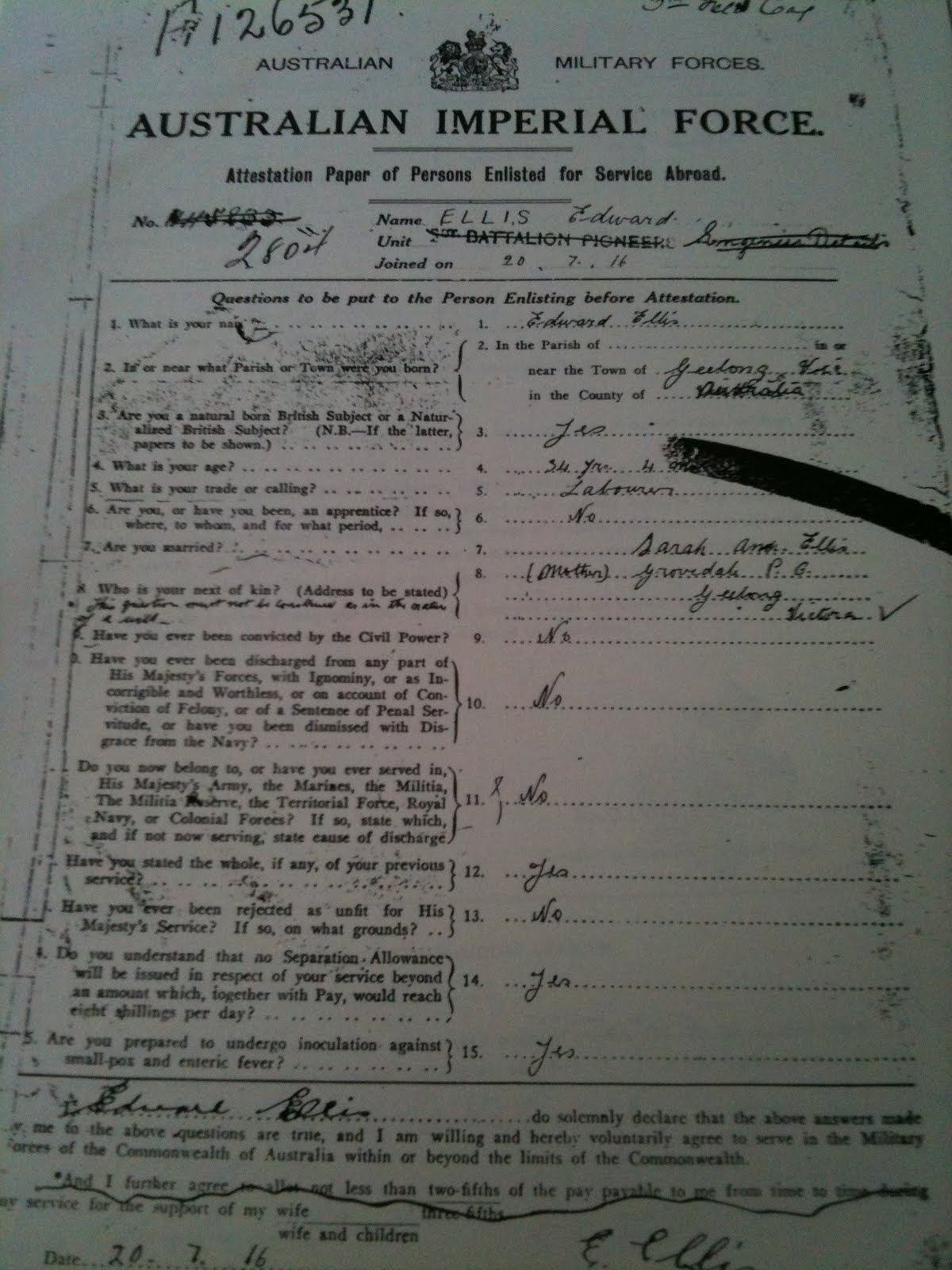
This is the document that relates to Edward Ellis, born in Geelong Victoria Australia the son of Frederick Ellis (1845 – 1914) and Sarah Ann Newton (1851 – 1923) on 3rd March 1882 and was one of 14 children.  All of Edward’s siblings were born in Australia, but his father, Frederick had been born in Elstead Surrey in 1846 and was 8 years old when his parents migrated as free settlers to Geelong in 1854 on board the James Baines.


As I typed the above I realised that I really didn’t know too much about Edward and my family history software had not been updated, so I pulled out the Ellis folder. Back in 1991, I had located various bits of information about Edward and here are those details:
  • Born at Mount Duneed 3rd March 1882 and Baptised at the Wesleyan Church in Geelong 6 June 1884.
  • A tuber player in Geelong Harbour Trust Band circa 1913.
  • He enlisted at Cootamundra, New South Wales on 20th July 1916 and left Australia on 9th November 1916 on board The Benalla. (Service number 2804)
  • He disembarked in Devonport (Plymouth Devon England) on 9th January 1917.
  • He proceeded to France on 30th September 1917 and was wounded in action (left leg) at Rouelles in August 1918. 
  • He was discharged in England in January 1919 and returned to Australia on board The Karoa.
Having read the above in the file some obvious questions sprang to mind:

Questions:
  1. What was the significance of the Wesleyan Church? Why not a C of E Church?
  2. What further details could I establish about the Harbour Trust Band
  3. Why did he enlist in Cootamundra? It is some distance from Geelong, but is mainly farming territory. Ironically, I have been to both Geelong and Cootamundra!I spent about a week in Geelong last year and visited the various graves at Mount Duneed.
  4. He was disembarked in Devonport, only about an hour from here in the car. What other records exist in the UK?
  5. Locate Rouelles in France
  6. Did he know of or remember his English heritage and roots? Did he venture to Surrey to meet any of the family?
  7. Where did his life take him upon his return to Australia? 
Tagged , , , | Leave a comment

The In-Depth Genealogist – Digital Magazine – Issue 10 – OUT NOW!

Picture
The next issue of the free digital magazine is available NOW!

//e.issuu.com/embed.js

You can read my Introduction post HERE and you can follow the column by visiting The In-Depth Genealogist website and subscribing via email or via twitter and Facebook.

This month’s Across the Pond column is about The Great War.

Happy reading & researching!

Tagged , | 1 Comment

Remembrance Day Photo Collage – Day Eleven

Today’s picture is staying with my late father in-law.

Yesterday we saw his recognition for taking part in the Arctic Convoys during the second world war. We know from his medals that he was in Palestine in 1949.

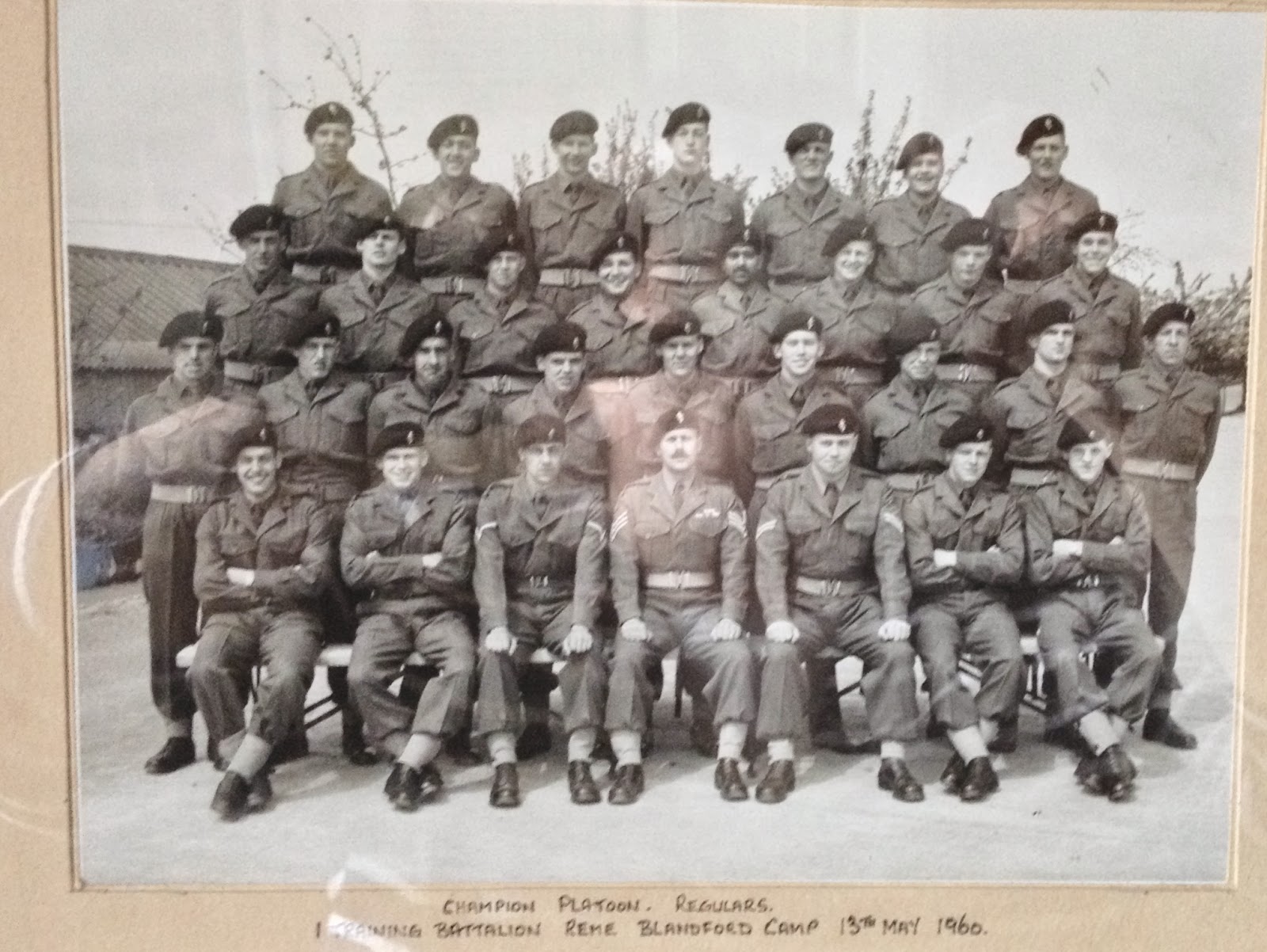
By 1960 he was a sergeant in British Army. The first picture here gives us the date. There is no date on the second photograph.

These are actually hanging in my mother in-laws hall and therefore I can not tell if there is any details on the reverse of the photograph. 

There would have been hysterics had I suggested we look at the back! 

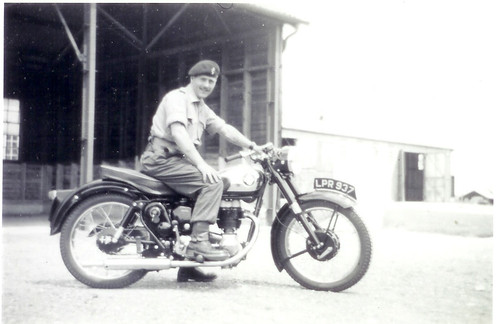
We can date his army dates to at least two years earlier, 1958 because we have this photographDerek Goucher June 1958


My father in-law on his BSA motorcycle, when he was stationed at Blandford Camp in Dorset in June 1958. He bought the motorcycle for £250.00.


By the time my father in-law marries my mother in-law in 1971 he has left the army. We have no idea of his service record for the army and the Ministry of Defense have confirmed that he will have two separate numbers, one for his navy service and one for the army service and the two records never join.

As I unravel his military service I shall share the information. One day next week I shall explain how to call (and pay for) a request for second world war military records.
Tagged , , | Leave a comment

GenChat – 13th November 2013

Yesterday Jen over at Conference Keeper hosted another fascinating round of #GenChat at Twitter This time the discussion point was geography.

Now there were a series of questions and I might not have noted them all down in the order they were presented. Apologies for my slackness, I was trying to keep up with the Tweets!

What is Geography?

When I went to school geography was about exploring places and what happens there, why and how and when. All those key questions that really we are, or at least should be applying to genealogy. Geography gives us an opportunity to explore the location of our ancestors, how they lived and worked. It enables us to break through those lists of names and dates and drill down to a depth of more detail.

Understanding Border Changes over time

This is really important. It might be a simple case of a town essentially being in a County. I have a family member who lived in Stony Stratford in Buckinghamshire. The town has also been in Oxfordshire. That border change might influence our ancestors lives for lots of reasons. In some cases, towns on the borders of various Countries can overnight find themselves in another Country – look at Countries such as Italy and Switzerland.

At this point there were various resources listed and therefore I am simply going to present them here, at this point I have not had chance to explore them all


Using Gazetteers

There are various opportunities to access these here are a few ideas
  • Google Books
  • Local Museums and Archives
  • Historical Associations
  • Archaeological Societies
  • Specific archives – mining might have some general information
  • GENUKI – UK
  • The Phillimore Atlas and Index of Parish Registers – fabulous, but expensive!
  • Centennia
  • Ordnance Survey
  • Animaps
  • Google Maps

What else can you do to understand changes?

Again this is about getting down to the basic roots of a specific place. 
  • What sort of trade was there? 
    • Industrial
    • Rural/Farming
    • Mining – coal, tin
    • Canals
  • Transportation – railway town?

Do you use Timelines to understand your geography?
  • When did events happen?
    • National, 
    • Local
    • Global
  • This enables researchers to get a sense of time and place within their geographical research area – this could be things like
    • Religious changes/Persecutions of religious groups = migration pattens
    • Results of wars
      • First World War
      • Second World War
      • Post Second World War – Israel, Palestine, Korea, Vietnam for example
      • Yugoslavia
  • Monarchy/Presidency
  • Economy

Researching at County level
  • Understanding terminology – Hamlet, village, town, township, county, state etc
    • Wikipedia
    • Family Search Wiki
    • Local Societies
    • Tourist information centers and resources

Political Boundaries – based on natural elements
  • Flood plains
  • Rivers
  • Earthquakes
  • Typhoons
  • Bush fires
  • Other Disasters
    • Perhaps a disaster has left a monument  – example – Lockerbie Bombing 1991 This event created not only the monument, and a link between Scotland and the US, but Lockerbie has changed as a result.
Look at the location through the eyes of your ancestor
  • Transportation  – no highways – walked across the fields
  • Who did they work for?
    • Who owned the land – deeds, land records, tithe maps
    • Some agricultural labours moved location because of the land owner
Accessing copies of archives? Have you just visited with no agenda?
  • Can you obtain copies easily of material?
  • Is there a catalog
    • Is it reliable or hidden gems!
Other references
Khan Academy
Using GenChat
I have to say I rather like GenChat – tweeting for an hour, in sort bursts and this can create a 21st Century conversation! – sharing of information and URLS. This event was held at 4pm UK time which is brilliant, and I hope that more UK participants join in and share ideas and resources.

Here is the GenChat Schedule so you don’t miss out on the fun!

Tagged , | 4 Comments

Sepia Saturday – 203

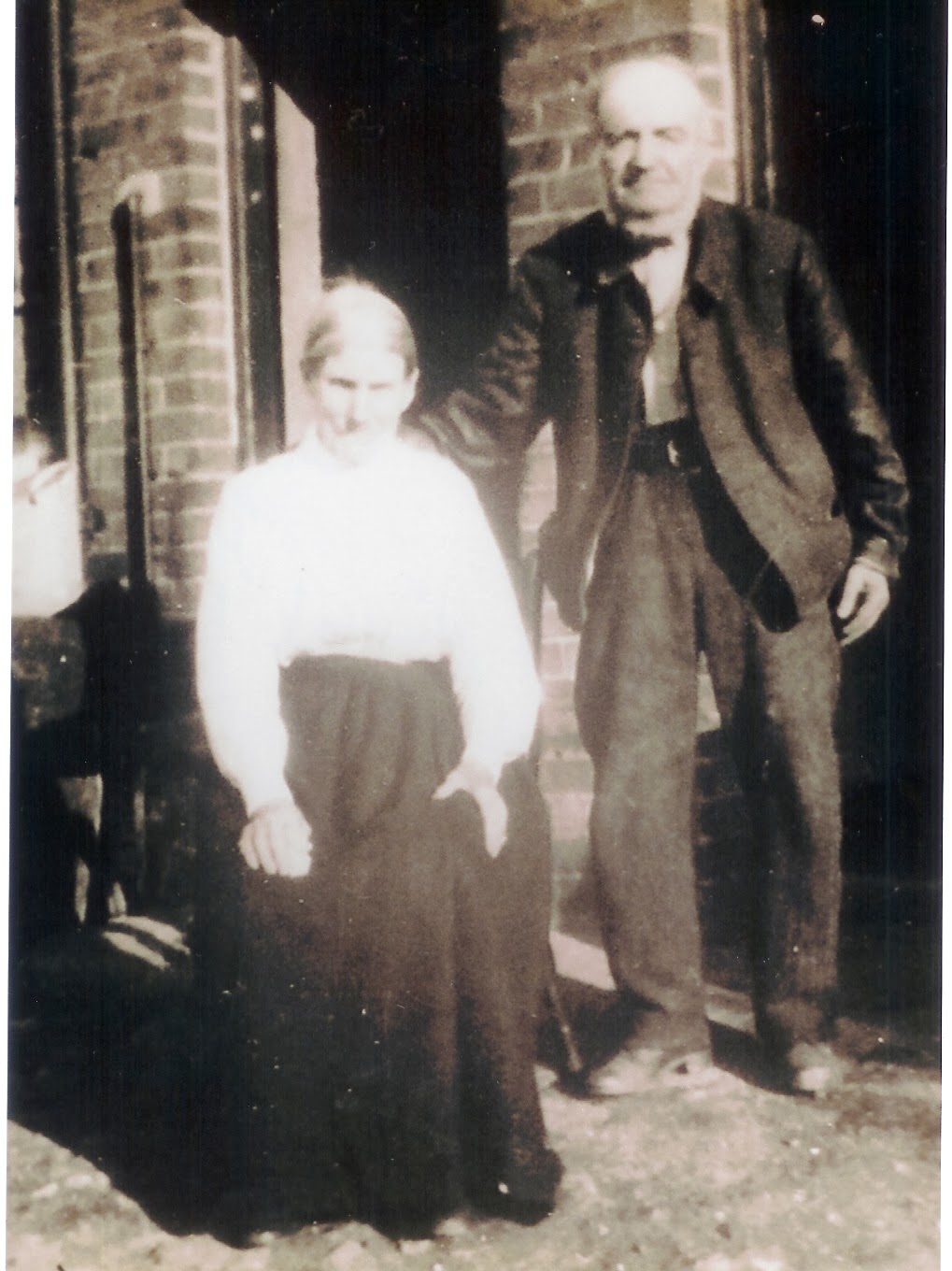
For this week’s visionary prompt of standing in doorways, I thought I would share this image

The picture is of my Great, Great Grandparents Henry Harris (1843-1929) and Caroline Harris nee Ellis (1844 -1935). This photograph was taken on the occasion of their 60th Wedding Anniversary in 1924 and was taken at Wanborough Surrey. 
The photographer was my late Great Aunt, Rose Marshall nee Butcher (1900 – 1994). Caroline was apparently a bit of a stickler and though nothing of smacking her Grandchildren if they misbehaved, whilst Henry was a “sweet old thing” according to my Aunt. I asked if she could recall an example. This is from my journal what she told me back in 1990 –
 “Old Sam Marshall came across to tell Mum (Annie Prudence Butcher nee Harris) that the Boys (Dick, George (my Grandfather), Arthur & Harry) had been scrumping again from the apple tree.”

When I asked what happened to the boys – 
The boys came home, all sweetness and light and Mum asked where they had been? They were vague and said the fields. When Mum asked if they had been over to Sam Marshall’s they said they might have been. Mum, was not deterred. I wish you boys wouldn’t. Do it again and you will get what for. What did you do with the apples? Oh we ate them was the reply, then one of the boys said, why do you want us to get you some? I don’t recall which of them said that, but they were all sent outside. Later they came in for tea and Harry said he was sore, when Mum asked why he said Granny. Old Grandpa was listening in, he shook his head and said but those apples are nice, aren’t they?”

The background is the Sam Marshall was a local farmer, and was in fact related to Caroline through marriage. Her sister Maryanne married Jim Marshall, the added complication was that the Marshall family were already connected to the family prior to that marriage and things were further complicated when in 1931 Rose married Maryanne’s Grandson Ernest.  Something that Caroline disapproved of and my Aunt always vehemently denied.

Taking part in Sepia Saturday

Tagged , , , | 16 Comments