A-Z Challenge 2018 – Aims of a One-Name Study & Surname Research

a2z-h-smallAs with any research project it is important to have the aims of the project.

Members of the Guild of One-Name Studies will be familiar with the requirements that all studies must be eventually global and that a member must respond to all enquiries.

As someone who has two studies, I have the same aims for both, but essentially someone embarking on such a project should consider the aims before commencing. Of course in a perfect world that is what I would have done when I started back in the late 1980’s, but I didn’t and truth be told I had not actually realised that I was undertaking a One-Name Study.

As I say to all students on the Pharos Introduction to One-Name Studies course, decide where you want your study to be. There is no point collecting references to your surname on card indexes if you want to eventually host a website on your surname.

I am very envious of people starting their study now. Being in the digital age it is much easier to begin a large study. There is likely to be reduced amounts of paper records in the study and the use of genealogical software to record data means that family reconstruction is much easier.

Broadly put:

  • If you simply want to collect material then a spreadsheet works well but this is a simplistic approach, even for a large study.
  • If the aim is to reconstruct families without “fuss” then a family history programme is the way to go.
  • If you know that you want a website for the study and want to get your material and your study out there, then you need a programme that has the ability to produce a GEDCOM file.

So take the time to establish your aims. Choose the right product for the task and remember that in the digital age it is much easier to gather material for a study and it is much easier to publish and share your study.

If you share your study with others using the internet then you are likely to find that others with interest in the surname will come to you and want to either share what information they have or ask questions and see information, and perhaps they will do both.

I wrote an earlier post about the Aims of a One-Name study and we talk more about a number of these points in the Pharos Introduction to One-Name Studies course.


Posted in A-Z Challenge, A-Z Challenge 2018 - Surname Research Series, Introduction to One-Name Studies (Pharos course 901), One-Name Studies | 4 Comments

A-Z Challenge 2018 – Surname Research & One-Name Studies

a2z-h-smallIt has been a few years since I took part in the A-Z challenge, but thought that I would again this year.

This year I plan to focus my efforts on the genealogical concept of a One-Name Study or surname research.

Each day, from 1st April until 30th April I shall write linked into the letter of the alphabet. Sunday’s will be missed with the exception of 1st April.

In order to give some context, I am going to explain what a One-Name Study or surname research project is. Quite simply it the tracking of a single surname, across all time spans and across all Countries. Members of the Guild of One-Name Studies agree to make their study global and there is no time constrains on the globalisation of the project. Simply put, it takes as long as it takes.

So, with that in mind I will be back tomorrow with A is for…… and you can read other posts about Surname research HERE.


Posted in A-Z Challenge, A-Z Challenge 2018 - Surname Research Series, Introduction to One-Name Studies (Pharos course 901), One-Name Studies | Leave a comment

Book of Me Prompts – April 2018

Book of Me2018

© 2017 Julie Goucher

Welcome to the fourth set of prompts for the 2018 Series of the Book of Me. You can read when the prompts are published and about the few changes at my earlier post HERE

There are five prompts each month and you can undertake as many or as few as you wish to.

  • Using adjectives describe yourself
  • What do you think are your essentials in life
  • What are your challenges
  • Are you right or left handed? And, does that reflect you?
  • Describe something you created.

If you have any questions or want to share thoughts or a blog link, if you decide to share via a blog (remember to, that you don’t have to share to take part in the series) then please leave a comment. Further discussion is also happening in the closed Facebook Group.

Posted in Book of Me, Book of Me - Series 3 Getting to Know You (2018) | Tagged | Leave a comment

Favourite Book(s) #13 – Paralysed with fear by Gareth Williams

Paralysed with FearAs a child I remember having my polio drops on sugar. Later when I was in my early twenties I went off travelling and was recommended to have a variety of vaccinations to prevent contracting diseases which afflict some parts of the world.
I also recall as a child being “force” to play with Cousins and friends who had contracted a variety of childhood illnesses, I thought it was unfair and was often uncooperative and through my childhood vision could not quite understand what the fuss was about. It was only as I entered my teenage years that I realised that it was my Mum’s worse fear that I not contract these childhood illnesses.

The irony of it all is that I never contracted a single childhood illness and was in my early twenties and recently qualified that I picked up Chickenpox. Over the years I have often wondered why I hadn’t and do have a working theory, but that is a story for another day.

My Mum contracted Polio in 1953 aged around 4. She told me years later that she had complained of feeling unwell and my Grandparents put it down to a cold. When the doctor was called, in those days they did house visits! he said Mum had the flu and that my Grandparents should take her away, as they had planned to Essex to visit her Aunt and Uncle. On the morning of the holiday, Mum was got out of bed and suddenly could not hold her own weight and fell to the floor. The doctor was called again and it was diagnosed that Mum had Polio. She spent the next 10 months in hospital, being looked at by my Grandparents as they were not allowed to touch her. How frightening that must have been for a child, suddenly wretched from the family life that you knew.

This book was published in 2013 and sits as part of a Polio collection of books in my office. I wanted to understand the social aspects of the disease and give my family research some context. Just as not all conditions are visible, not all effects are visible. In 1997, some 44 years after having Polio Mum was diagnosed with Post Polio Syndrome (PPS). It is a silent condition, it is exhausting and is a debilitating illness. The medical fraternity are in some ways in denial that this condition exists and very patient will experience different effects of PPS. In many ways, this book is a harsh view of Polio and yet we need to understand that it is possible to succumb to PPS years later and what it means to those patients.

Mum she had Polio, but what saved her from worse effects was the failure to diagnose her earlier on. Mum never experienced an iron lung, never had a caliper. She was shaped by the fear of ending up in a wheelchair. She remained fiercely independent and stubborn up to the day she died and her life was so much harder because we have a generation of medical practitioners who fail to fully comprehend Post Polio Syndrome.


Posted in Books, Favourite Book(s), Health, Polio | 1 Comment

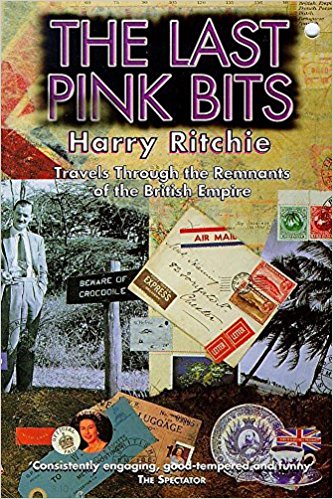
Favourite Book(s) #12 – The Last Pink Bits by Harry Ritchie

This is an interesting book and personally one that I find reflective and at times I am actually ashamed to be British.  The British Empire, one in which the sun never set had so many possibilities and yet we seemed to get it so very wrong in places.

Ritchie’s task with this book was to set out and explore the some of the locations, he restricted himself to only inhabited territories, deeming Pitcairn Island as being too inaccessible, and limiting himself to only one of the Caribbean territories, he sets out on a grand tour of Bermuda, Ascension Island, The Falkland Islands, Gibraltar, The Turks and Caicos Islands, Tristan da Cunha, and St. Helena.

Written in a chatty style I found that I was wanting more and yet that does not detract from what the book offers to readers. Isn’t that the point of reading, that we read, understand, reflect and read more and expand our knowledge. Sure he could have visited any number of places within the scope of Empire and perhaps the intention was to produce another book in a series. As far as I am aware, he did not.

Posted in Books, Favourite Book(s) | Leave a comment

Favourite Book(s) #11 – Happy by Fern Cotton

This week I am cheating by talking about two books that are linked, but can be read independently of each other.

I purchased a copy of Happy when it was on pre-order at Amazon last year. When my copy arrived I read it cover to cover over a few weeks and then undertook a period of reflection.

This book is about Fern Cotton’s journey with depression, but that is not all it is about. There are some great illustrations, great reflective statements and exercises to be undertaken with space to do those exercises. I am from a generation which does not advocate writing in books, so my copy is full of post it notes and references to the page in my notebook where I have undertaken the exercises.


The second book is Happy The Journal. Each day is covered by an a task that can be undertaken and there is adequate space in the book for it to become a place to share your thoughts and responses. There is no hard and fast rule on when you start the journal, but I waited for 1 Jan to roll round then began to use the journal. That said, I do not write in my book, instead I use my notebook which I complete my Artist Way exercises.

Posted in Books, Favourite Book(s) | Leave a comment

What do you want your One-Name Study to be?

What is a ONS to be.It wasn’t until I heard Paul Howes, Chairman of the Guild of One-Name Studies say recently in a webinar that he treated his Howes One-Name Study like a business that I considered the question

What do I want my One-Name study to be?

I want my study to do a multitude of things, both to me and other people. I want it to be:

  • A mechanism to share with others
  • An archive
  • A way of connecting with others
  • A resource for others researching the same name to use.

That is of course all achievable, but it won’t happen overnight and I tackled my study in the same way I would any work task – in order of priority AND quick wins.

What a genealogical quick wins?

  • Build up a body of data in several of the locations where your surname appears. I wrote about that earlier in this series and you can see that post HERE
  • Create a Facebook group for your study – let people come to you and share. It maybe that you do not have much to share at the start and that is OK – a One-Name Study is a gentle stroll, it is not a marathon!

Library CatalogueDecide how you are going to build up an archive of material and share with others. My personal view is, as lovely as this image of a library catalogue system is, there is no point in spending decades collecting material if it is stored in a filing cabinet, folders or in boxes – share your knowledge, get it out there! I have had many success finds by browsing catalogues such as these, but sadly they are becoming a thing of the past.

So here are a few considerations, and do not worry if you don’t get it right first time, I didn’t and I wasted a great deal of time procrastinating. My advise, for what that is worth is, just go for it! None of us know what is around the corner and the longer the study sits in a filing cabinet the more opportunity for it to be wasted.

So what are those considerations?:

  • Select your software – I keep material in two places:
    • Raw data, such as Births, Marriage and Deaths etc. in spreadsheets when I create a family the individuals remain the spreadsheet which is annotated and they then move to a
    • Genealogical Program – I use Roots Magic, but any of the big three – Roots Magic, Legacy or Family Historian have the ability to store people who are unconnected to each other. I know that is an issue for some One-Namers because I originally had the same issue and the way I over come the issue is that I start with marriages and enter the person with my study name first, followed by spouse = reconstruction of family. I then proceed through their births and the births of their children. I check the Census too at this point. What I find in the Census will influence where I go next, but it is usually the Census.
  • How are you going to share your findings?
    • Blog – WordPress have an option of a free one such as this, but you can pay for other enhancements and I shall do that at some point. There are other providers, and those who have followed this blog for a while will know I moved from Blogger to WordPress. You can share stories about the folks in your study or share your journey of working on your study.
    • Website 
      • Domain name
      • Hosting service
      • Cost to hose
      • How much space? – oh boy such a lot of questions. I have had a domain for one of my studies for years. It is a co.uk site and does not to me indicate the study is global – sadly at the time the .com and .info was not available. I still pay for that domain name and point the server to my website. I opted to take advantage of the Members Website Project, which is a members benefit for the Guild. As a Guild member I was given, free of charge – but donations accepted, a
        • a domain name on the Guild server
        • a website to host my study and no restriction on space – I opted to use TNG, I paid for the license, and the Guild volunteers loaded the TNG onto the site and got my website set up. All I had to do was upload a GEDCOM from my genealogical database. I can upload a new GEDCOM as often as I would like. To me it is a no brainer! There are options to have other types of sites, HTML or a WordPress site – you can see the range HERE I personally didn’t like the idea of WordPress linking to a TNG site, so I decided to retain my blog on WordPress, but I download the blog contents and make regular backups of the data.
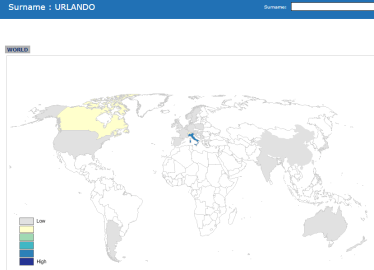
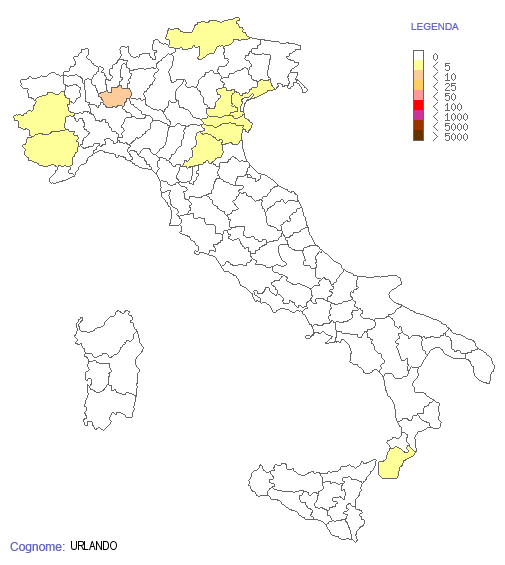
    • Articles in magazines and journals – I have written quite a lot about my Italian One-Name Study, both in the Journal of One-Name Studies, Family Tree Magazine (UK) and a number of Legacy Family Tree blog posts and numerous others. –  I had more interaction with my Italian study in the last 18 months than in the previous decade, probably because it was “out there”.
    • Social media – Share about your study, share other studies information – be active on social media. It takes time. In much the same way Coca-Cola evolved, they established their branding and “worked it” I have a friend who always says it is not Christmas until she has heard the synopsis Coca-Cola advert with the santa on. In fact, it was only as wrote this, did I realise that the Coca-Cola truck is real and does actually go to a number of locations – I must live under a rock because I had no idea!

Why did I choose to use the Guild to host my study?

That was simple and I was truly quite relieved when I finally made the decision. There is zero cost to me as a member. The Guild volunteer members were fabulous in not only setting my site up so it was ready to go, but for answering any questions, even the ones that vague because I didn’t quite know how to verbalise the issue or question. If I join my ancestors tomorrow the GEDCOM(s) that is uploaded will be preserved and should someone else come along and want to register the surname they will be invited to take over a copy of the website and all the associated papers (I have left instructions for those as part of my will). If I had chosen to host elsewhere, when I eventually shuffled off and joined my ancestors the domain name costs and website hosting bill won’t be paid and the vanishes. Do you see what I mean by no brainer!

There is a preconceived notion that:

  • the GEDCOM has to be a huge one – wrong! None of us started with a huge volume of data, it grew and evolved just like we do.
  • You can only have one GEDCOM – wrong! I have two (and sometimes more) GEDCOM’s on my TNG site – one that represents my family and the other that represents my One-Name Study.

All of our studies begin with just one person who arouses our curiosity and has the surname you are studying – remember, big trees grow from small acorns!

You can read other posts in my One-Name Study series HERE

Posted in Genealogy, Introduction to One-Name Studies (Pharos course 901), One-Name Studies | 2 Comments

Aims of a One-Name Study

Courtesy of wordclouds.com

The latest Pharos introduction to One-Name Studies course is almost at an end and if you missed the opportunity, a new course begins in May!

As we embarked on the first week, one of the questions that was asked of the course participants was about Organisation. The way we keep our study may differ from that of our own family history research.

As I responded to a question I simply commented that it was important to look at the aims of your study. What followed, was that my fingers travelled across the keyboard at a fairly rapid rate and before I knew where I was I had written a very lengthy post. I then cut and pasted that into a document. That was four weeks ago and since then I have realigned the document along with my thoughts and further comments and created an article for the Journal of One-Name Studies.

How we organise our material will depend on what our aims are for our studies. Are you simply wanting to:

  • Collect instances of the surname
  • Reconstruct families
  • Do you going to want a website to share and preserve your material?

This is not a case of collect or reconstruct, as a number of members, me included do both. The key thing is, if a website is on your horizon, but you have elected to keep your material on index cards then you are going to have to do a whole lot of work and retyping to turn the contents of the index cards into a means used to create a website.

There is nothing wrong with the index card approach, and I use them, but they are not my only means.  I did a review of my aims and methods a year or two ago and decided that I was going to computerise my entire research, digitise 25 years of papers and insert the scrappy bits of paper drawn trees into my software programme and ensure that I had the evidences to support the tree. I also knew I wanted to use TNG and opted to sign up for the Members Website Project, which is a members benefit and enables me to use a website on the Guild’s server AND to preserve my work, whilst still allowing me to update and continue working on my study. I get to the website and TNG from my computerised study by means of a GEDCOM and the ability to add what is referred to a “media” which is images, documents and a number of other elements.

My GEDCOM is not perfect because I have 25 years of work in the filing cabinet and numerous computer files – it remains as a work in progress, as I ensure that I have source citations and so forth all appropriately identified. Over the course of the coming weeks I am going to share how I made the jump from paper to my database.

So, what are your aims for your One-Name Study, where do you want your study to be?

Posted in Introduction to One-Name Studies (Pharos course 901), One-Name Studies | 3 Comments

BBC – Murder, Mystery and My Family Series

Murder, Mystery and My Family

Screen capture from the BBC website

Just last week I was alerted to this BBC series by a fellow Guild of One-Name Studies member. Since then I have binge watched pretty much the entire series. It is fascinating and the BBC get a well done here!

Here is how it works – two legal Barristers review an old case where the person, or persons were determined as guilty and subsequently hanged. We have to accept that not all persons who received this punishment were guilty and that is for a variety of reasons.

A living family member of the deceased “guilty” party are involved in the programme. They are looking at the family element of the case. Meanwhile the Barristers revisit the case files, and review the evidence. They talk to professionals in the various fields, looking at blood splatter and other forensic elements. One of the Barristers addresses the case from the angle of the prosecution and the other of the defence. They they present their findings to a judge and the judge decides whether the verdict already passed down and carried out was safe one. Where it is determined that the verdict was unsafe it begins a legal process which looks to pardon posthumously.

This is an excellent series and my one criticism of the BBC is that this was broadcast in the morning, so around 9 am London time – I was able to record it and view later, and it is available on BBC iPlayer to those in the UK and with the ability to login to a free iPlayer account. This should have been on in prime time, say 7 -9 pm. I do hope those of you outside the UK are able to see this series, it is fascinating. There is a write up on WDYTYA? website under the news section.

Just as I was watching one of the later episode’s, number 8 possibly, which was set in the Manchester region of the UK and centred around a crime committed in the 1930’s they set the scene on why there was such a “crime wave” and desperation – the financial market and depression, leading to people doing what they could to survive. They used the image on the screen reinforcing that there was significant unemployment and desperation, although it was actually part of a film and I was able to live pause the screen and capture the image below.

Murder Mystery and My Family - episode 8

Why is the image important? Well it has the name Henry Butcher and the Butcher One-Name study is registered with the Guild.

Have you been watching the series? leave a comment below.

Posted in Genealogy, History | Leave a comment

Favourite Book(s) #10 – Guide to DNA Testing and Genetic Genealogy by Blaine T Bettinger

DNA - Blaine BettingerThis week’s book is a fascinating one and one that is close to my desk as I attempt to understand my DNA matches.

The book covers the three available DNA tests; following the male genetic line, the female genetic line which both males and females can take and the Autosomal test which is known as Family Finder.

My copy of the book has a number of those little sticky flags you can use in books to identify key pages. This book share resources, identifies ethical considerations and fully explains third party tools such as GenMatch.

This is my go to book for all things DNA and is a real favourite – I recommend it!


Posted in Books, DNA & Surname Projects, Favourite Book(s), Genealogy | 1 Comment