#Museum Week – Faces of Auschwitz

logoMWOne of the organisations I have spotted during #MuseumWeek is the site Faces of Auschwitz.

Anyone who has been reading this site over the last few weeks will know that I recently established that at least three Orlando’s had perished at Dachau Concentration Camp.

We know the horrors of the Second World War, but I had not considered it in the concept of my One-Name Study. Just looking at the tweets from the Faces of Auschwitz and their re-tweets you can see the scale of things. One of the things that I found very poignant, was this tweet and the selection of images that Faces of Auschwitz retweeted from Auschwitz Museum & Memorial. The tweet relates to  a group of Jewish women who had been deported from Hungary. They left their names and other personal information on a wall of the disinfection barracks at Auschwitz II-Birkenau BIa sector – part of the female camp.


Posted in #MuseumWeek, Genealogy, Introduction to One-Name Studies (Pharos course 901), One-Name Studies, One-Place Studies, Research Resources | Leave a comment

A-Z Challenge 2018 – Thinking about Surnames

a2z-h-smallOver the next two days we are going to be thinking about surnames. In many ways, T & U are not only linked together, but also to S for Synthesis.

The main question is What does my surname mean? There are a number of key surnames and where they originate can determine what kind of surname they are. You can read an earlier post HERE.

I have two studies, one for the surname of Butcher which is an occupational name. The other is for the surname of Orlando which suggests it is a Patronymic surname with links to Roland and Rowland. I am not entirely happy with the conclusions that I have drawn about this surname, but over the coming weeks I will discuss it more here. Incidentally, both of my One-Name Studies sites are deep under construction, I have 25 years of paper to process!

My husband has a study for the surname of Worship which was the maiden name of his paternal grandmother, I have always felt that the surname was very much linked to either a post holder name, someone who was connected with the church in some way and, having searched the Clergy of the Church of England Database there are a number of Worship entries as you can see below and some of them are quite early.

By thinking about your surname you are building up a profile about the surname, it’s origins and focus. Those factors give a One-Name study a good grounding and are these are discussed in the Pharos introduction to One-Name Studies course and in the Guild publication, Seven Pillars of Wisdom, the Art of a One-Name Study, available from the Guild or Amazon.

I’ll be back to tomorrow talking about….see you tomorrow!

Posted in A-Z Challenge, A-Z Challenge 2018 - Surname Research Series, Introduction to One-Name Studies (Pharos course 901), One-Name Studies | Leave a comment

#MuseumWeek – Launch of Museum Week 23-29 April 2018

logoMWThe power of social media means that organisations can band together in the spirit of unity and promote a common cause.

Having just got to the end of Family History Week #FHWeek which I didn’t really manage to share via this site (but I will do), and almost at the end of A-Z Challenge, I stumbled across #MuseumWeek and you can read about it at the special website.

I thought that I would perhaps take opportunity to discuss some museum sites which might be of interest to those of us undertaking a One-Name Study but to be honest, any genealogical pursuit would benefit.

So over the next week I will share some of the sites I have encountered and hope you enjoy them and can see how those sites can benefit your genealogical pursuits.

Posted in #MuseumWeek, Genealogy, Introduction to One-Name Studies (Pharos course 901), One-Name Studies, One-Place Studies | Leave a comment

Favourite Book(s) #16 – Floating Brothel by Sian Rees

Floating BrothelI have read my copy of this book so often that the cover is looking a bit tatty and the glue that holds the paperback cover in place is a bit loose.

The book is based upon the true historical events of 18th Century ship and the female convicts that were transported to Botany Bay.  The title does suggest that that the contents are “racey” but it is not especially so.

This is the  very readable account of the transportation of women on board the vessel Lady Julian. 

At the back of my mind, I am sure there was talk of this being made into a film, but it appears nothing came of that, either that, or I am dreaming!

Posted in Books, Favourite Book(s) | Leave a comment

A-Z Challenge 2018 – Synthesis and what it means for a One-Name Study

a2z-h-smallThose of you who have been reading this site for a while may well recognise the image I shared a few days ago of the Seven steps of a One-Name Study. The third step is Synthesis and today we are going to explore what that means.

Synthesis is essentially taking the results of analysis and going a stage further, by giving some substance to your data, drawing conclusions about your surname.

You can do this by

  • Exploring the meaning of your surname.
  • Looking at the geographical origin of your surname – you might look at surname distribution maps for this stage.
  • How and where possible variants to your surname came from.
  • Looking at patterns of distribution – considering patterns of emigration and immigration, what caused those patterns of migration and was the migration permanent.

All these are discussed in the Pharos introduction to One-Name Studies course and in the Guild publication, Seven Pillars of Wisdom, the Art of a One-Name Study, available from the Guild or Amazon.

Over the next two days we are going to be thinking and understanding surnames in more depth, so I do hope you will continue to read along and perhaps share any instances that you have come across and your thoughts.

Posted in A-Z Challenge, A-Z Challenge 2018 - Surname Research Series, Introduction to One-Name Studies (Pharos course 901), One-Name Studies | Leave a comment

A-Z Challenge 2018 – Reviewing Data

a2z-h-smallMaterial is coming online at a phenomenal rate and yet what is online is only a fraction of what is available. Just as with our own genealogical research, with a One-Name Study you should review material:

  • What material you already have
    • Including what the material tells you in terms of
      • other people
      • their address
      • their relationship to your ancestor
  • What you are requiring
  • Has the material you are requiring, but do not have yet been made available?
  • Is there any new material that might help you confirm or disprove what you are hypothesising?

I keep an active workbook which has two worksheets:

  • Research Log
    • What I looked at and where I looked at it
    • What did I find and what did I NOT find which is just as important
  • To Do List
    • What do I need to look at next
    • Who does the material relate to. There is not point saying to look for Salvatore Orlando in New Orleans in 1930 if he has a son also called Salvatore, so I usually put the year of birth in brackets so I can distinguish one from other.
  • As part of this workbook I also keep a notes sheet. This is where I might write a note, perhaps which does not relate to what or who I am looking for, but I want to capture the thought before I vanishes as soon as it arrives!

How often you review data will be up to you, perhaps you do it:

  • When you see an announcement of the release of a data set online.
  • Perhaps when you are working through your to do list.
  • Perhaps as a result of an enquiry from another researcher.
  • Perhaps in preparation of a pending research trip.

There is no hard and fast rule and I would recommend that you record when you search for material on your log, because it could be the case that you have searched over a period to time to find the material is not online, anywhere despite multiple searches and you perhaps need to engage the services of a genealogist to assist you. It might also be the case that the material you seek is simply not available and has been destroyed either as a deliberate act or it was created (or not) too long ago. There is also the possibility that the material is in an unsuspecting place.

Posted in A-Z Challenge, A-Z Challenge 2018 - Surname Research Series, Introduction to One-Name Studies (Pharos course 901), One-Name Studies | Leave a comment

A-Z Challenge 2018 – Questions

a2z-h-smallJust with our own genealogy, there will be those people who are part of our studies with whom we develop an attachment with, for reasons that we cannot explain. Perhaps they were females, ahead of their time, or living in an unusual place, pursuing an interesting career. The list is endless.

These people sit within our surname studies and we find ourselves exploring the life they lead and want to expand it more and more. On occasions I have to remind myself that there are not “my people”, but they share the surname that I am researching.  Equally, there will be folk who sit within the study, a line on a spreadsheet and they remain there, as part of my methodology until they researched and they become more than one line on a spreadsheet. At that point, they enter my database.

My current why’s are these, and they all relate to my Orlando study. I am very keen to get stuck into some research about them and because of what I know about them, they deserve to be more than a line on a spreadsheet:

  • Renato ORLANDO born 12 Jan 1915 Carrara. Last residence via Cariona 316, Carrara. Prisoner #67 885. Protective custody, Italian. Arrived 10 May 1944 at Dachau Concentration Camp. Died 18 January 1945. (source Jewish Gen)
  • Stefano ORLANDO born 27 April 1914 Varesa, Last residence Genua, Passo Moretto. Prisoner # 113 433 Protective custody, Italian. Arrived 9 October 1944 at Dachau Concentration Camp. Died 28 November 1944. (source Jewish Gen)
  • Umberto ORLANDO born 25 December 1913 Angri, Last residence Angri. Prisoner # 54 634 Protective custody, Italian, Arrived 29 September 1943. Dachau Concentration Camp. Died 31 October 1943. (source Jewish Gen)

For reasons I totally cannot explain, I feel that I simply must explore their lives, military service and how they died.

Initial observations is that:

  • Umberto and Stefano died very soon after arriving at the camp, they were there between 4-8 weeks.
  • Renato was at the camp 9 months, he was also the last to arrive of the three of them, arriving May 1944 and dying in Jan 1945.
  • Umberto arrived and died in 1943.
  • Stefano arrived and died in 1944.

Questions?

  • Are those dates significant?
  • Did they die from disease or other methods?
  • What details can be found about Dachau?
  • Expand the individual family lines for these three men

Dachau was established in 1933 and was not a death camp, but conditions were severely harsh. It was liberated on 29th April 1945 and contained around 206,000 prisoners from all over Europe, Jews and non Jews. There are amongst the records recovered by the allies 31,000 deaths recorded, but many thousands more were not recorded at all.

Of the prisoners liberated there were substantial numbers of Italians, Lithuanians, Czech’s, Belgian and Slovenes. The largest number were from the former Soviet Union, Poland, Hungary, Germany and France. Many Soviet prisoners were simply shot and others endured experiments.

From the limited research I have undertaken thus far, I suspect that these three Orlando’s all died from the harsh conditions at the camp and more research is needed to confirm or deny that hypothesis. One thing we do need to consider is that research might unearth material that we do not like and we find unpalatable. In those instances we need to continue to research and attempt to emotionally untangle ourselves from the data.

Posted in A-Z Challenge, A-Z Challenge 2018 - Surname Research Series, Introduction to One-Name Studies (Pharos course 901), One-Name Studies | Leave a comment

A-Z Challenge 2018 – Profiles for a One-Name Study

a2z-h-smallEvery member of the Guild of One-Name Studies with a registered study has a profile page on the main Guild website.

The advantage of this is that when someone searches for the surname, if it is registered, the profile page is displayed. Some members have added lots of information about their study, the origins of the surname, the geographical spread. There are links to the website of the study and DNA project, if applicable.

I have written profiles for both of my studies, Orlando and Butcher both profiles are different in terms of content and depth. The Butcher profile is more of a work in progress and I should get this just how I want it sometime later this month (hopefully!).

The profile page is the shop window to your study. It enables people researching your surname to find you and the more details you add to your profile the more chance you have of receiving contact from others.

The webmaster gave a presentation at the February 2017 Guild seminar, which as titled a walk run around the website and there was time given to explaining how easy it was to produce and use member’s benefit. Members will find the recording in the members area under seminars and those undertaking the Pharos Introduction to One-Name Studies will see the link in their course material.

Once you have searched for a surname, using the search box on the right hand side of the Guild website and profile appears (if the surname is registered), if you look towards the bottom the website also lists the instances where the surname appears in the Guild indexes. Try doing a search for Butcher and see how many instances there are.

Posted in A-Z Challenge, A-Z Challenge 2018 - Surname Research Series, Introduction to One-Name Studies (Pharos course 901), One-Name Studies | Leave a comment

A-Z Challenge 2018 – Observations and Analysing your One-Name Study Data

Seven Pillars Higher Res

courtesy of the Guild of One-Name Studies one-name.org

I love tha2z-h-smallis image of the Seven Steps of a One-Name Study. The reason I like it so much is that it shows the seven key principles of a study and today’s post is about analysing material and what we observe.

One of the key elements as you commence or think of commencing a study is to look at the numbers. How big is your study going to be?

It is not simply a case of how big the study is, but how big the study is going to be in a specific genealogical location. My Orlando study is small in the UK, but across the English Channel and head to Italy and the surname is common. The surname occurs in other areas of Europe to. Then look to other locations, South America, Australia, New Zealand and the United States.

As we analyse the numbers I consider the driving factors of why the number might be higher in one country over another. I expected my Italian distribution map to show Orlando “everywhere” and I was not disappointed. I wrote about this earlier and you can read that post HERE the third map on the page shows the spread of Orlando’s.

When I compare the map to similar maps, such as for the United States, I can see the increase of the surname in certain states and then when I look at the history of Italy and in particular the south of the country I can see what perhaps drove the migration from those areas to the United States.

As part of analysing and observing, I could draw an initial conclusion that:

  • Migration from a financially poor Italy, especially in the south was because there there was the hope of a better life in the USA.
  • Some states, such as Alabama and Louisiana might have a surge in migrant populations because of the decrease in enslaved people and a deficit of people to do menial and hard labour work.
  • Religion might also draw an increase in migration, so those from a devout Catholic country might choose to migrate to similar countries, Argentina and Brazil for example.
  • The reduction in availability of migration to the United States might have driven an increase to other countries such as England and Australia.
  • Sicily was famous for the incredibly hard work of sulphur mining, in fact in the 19th Century, 90% of the world’s sulphur mining came from Sicily. As the work decreased did this influence where the Sicilians migrated to?

All of these elements bring together our thought processes as we observe our findings and analyse them. If we give some context to the size of the study that builds a sounder approach to a study and adds a dimension to it.

For those who want to read more on the size of a study you could read this earlier post here and I promise to write a post about some of my observations and see if my hypothesis holds water!


Posted in A-Z Challenge, A-Z Challenge 2018 - Surname Research Series, Introduction to One-Name Studies (Pharos course 901), One-Name Studies | 1 Comment

A-Z Challenge 2018 – Notations & Citations for a One-Name Study

a2z-h-smallI had to be a little creative with this one and instead of citations went with notations and citations.

Google gives this definition for notations:

“annotation, jotting, inscription, comment, footnote, entry, minute, record, item, memo, gloss, explanation, explication, elucidation, marginalia, exegesis, rare scholium

We cite our sources so that we can:

  • Document our research
  • Show our research has a sound and integrity as it’s base
  • As a way of supporting our theory and assertions
  • To show our sources are realiable

It is important to have consistent citations, but any citation is better than no citation. If your citations are not perfect, go back and correct them at some point. As long as you provide a trail for someone else to follow that will be sufficient in the short term.

A good source citation will tell you the answers to these questions:
  • Who – Who is the source referring to?
  • What- What does the source document?
  • When – When was the event, and when was the source created?
  • Where – Where is the source located (which repository or archive)
  • Where – Where did you access it? (On Ancestry.com, online, at the library, etc.)

Some links for further reading:

My personal view with citations for my One-Name study is to document where the information came from. So for a US Census I would cite it as NARA and then say where I accessed the material.

For material from The National Archives (TNA) at Kew I would give the Census year, the RG reference and then say where I accessed the information. I do this because most organisations who enter into an arrangement with Ancestry, FindmyPast or The Genealogists will do so for a period of time. That means that at some point, material on Ancestry might switch to another provider. There are documents in my files where I saw the material at a repository which no longer exists as a single establishment, but is now part of another, large organisation and I have subsequently seem the same material in more than one place.

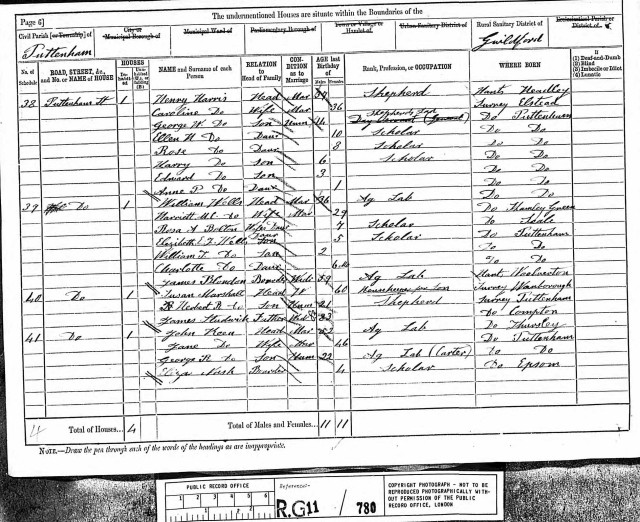
An example of this is the image below, the 1881 Census for my Great Grandmother, Annie Prudence Harris, then aged 1 year and living in Puttenham Surrey with her parents and siblings.
SRYRG11_778_782-0558

Annie Prudence Harris (married name Butcher) – 1881 Census, Puttenham Surrey  – Class: RG11; Piece: 780; Folio: 91; Page: 6; GSU roll: 1341183 – The National Archives (Kew) and accessed 15 March 2018 via Ancestry

  • I first saw the document on a microfilm in the summer of 1989 at Guildford local studies library
  • I later saw the document on a microfilm in 2003 at the Surrey History Centre, Woking
  • I have a complete set of the Census material in my filing cabinet in my office as part of my Puttenham and Wanborough One-Place Study
  • I have seen the image via Ancestry
  • The source citation is actually Class: RG11; Piece: 780; Folio: 91; Page: 6; GSU roll: 1341183

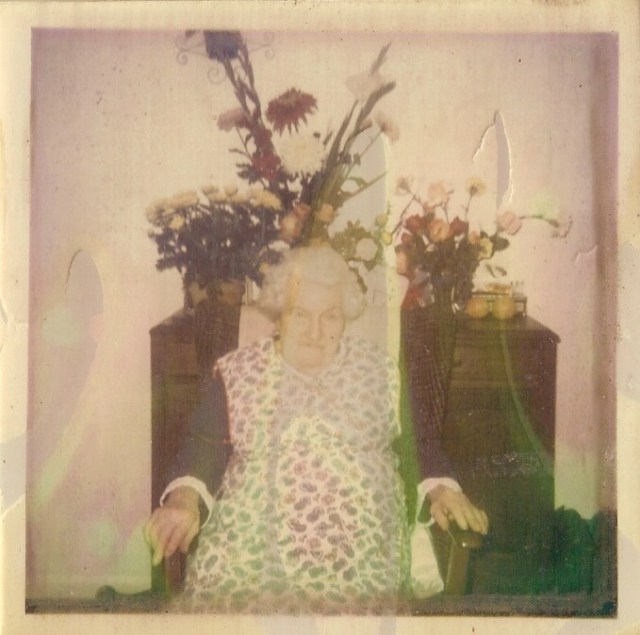
And the photograph below is how I remember her,from when I was about 2 or 3 years old, living in Guildford, with my Great Aunt. One of my earliest memories is snuggling with her on the bed, when she was an very elderly lady smelling of lavender. The day I saw her on the 1881 Census as a child, was a really special moment and from then I was hooked!
Annie Prudence Butcher nee Harris

Annie Prudence Butcher (nee Harris) 1880-1972 – image owned by Julie Goucher

This photograph sits within my Butcher One-Name Study and by the time this photograph was taken, Annie had been widowed between 25-27 years. Her husband, my maternal Great Grandfather Charles Butcher died in 1943.
Posted in A-Z Challenge, A-Z Challenge 2018 - Surname Research Series, Introduction to One-Name Studies (Pharos course 901), One-Name Studies | Leave a comment