Why Volunteering Matters

Firstly, this is a post written by me and does not reflect the views of any of the genealogical or other groups that I maybe associated with.

This post has been in draft waiting to be published for more than a couple of months. I hesitated to post because it seemed to be a moaning and whining post. This morning, having got up early, with the first thought related to my Trusteeship of an organisation I decided to post, having written this first paragraph which I have inserted.

As many readers know I am the Trustee of the Guild of One-Name Studies, in fact I am currently the Chairman. I became a Trustee in 2015, and a decade ago we had a flush of volunteers. Yes, we did have vacancies, but not as many as we have today. The situation has got worse since the pandemic and this is not a situation isolated to the Guild, it affects many genealogical (and others) groups.

As members of genealogical societies we pay our subscription, read the journals and access the website, hopefully taking full advantage of our membership benefits. What we perhaps do not consider is that those membership benefits that are free to members, are not free to offer. The society has to pay for website hosting, domain name purchases and many other things that enables the society to visually function.

What we do not see, is the volunteering that enables that functioning visibility. Where there are vacancies the Trustees fill the gap to ensure that we can continue to be the best organisation we can be for the benefit of members and the public. So what is the reason for this post?

In the summer, I received an email from someone who wrote to tell me that they had written to me the day before and I had not responded. The reason for my delayed response of 24 hours was the occasion of my 30th wedding anniversary. The content of the email is irrelevant, other than to say it was not an emergency note. I wrote back, apologising for the delay and explained why I had not replied sooner. I answered their question and directed them to the relevant information, ending with the invitation to contact me if they had further questions. No further email was received. No acknowledgement, no thank you, simply silence.

As I said earlier, my first waking thought this morning related to a Trustee matter. I looked at my phone, the time was 4.35am. Alas, the moment I wake up is when my brain switches on, I very rarely go back to sleep, and today was no exception.

Volunteering matters because it shares the workload, and reduces volunteer burnout.

It means that volunteers that serve as Trustees and Committee members can slot in actions and tasks relating to volunteering, around other matters, rather than other matters taking a back seat to volunteering.

The next time your genealogical society calls out for volunteers consider if you can help. The adage of many hands make light work has never been more important.

Posted in Miscellaneous | 1 Comment

Pharos Tutors® are having a BLACK FRIDAY SALE – Ends 2 December

Copyright Pharos Tutors 2023, and used with permission.

Use Discount Code FRIDAY15 at checkout to get 15% off ALL of our courses, both assessed AND non-assessed, between now and the end of Monday 2nd December

That’s right, ALL of our family history, local history, genetic genealogy, one place and one name study courses, including the non-assessed and assessed options of any course currently available on our website.*

Text – Pharos Tutors Blog Post (accessed 27 November 2024) where you can find the terms and conditions.

Posted in Genealogy | Leave a comment

Practicalities of a One-Name Studies course

The next running of the Practicalities of a One-Name Study course (903) is about to get underway – 10 September 2024. It is always a popular course and as those working with a study look at and consider the practical elements of keeping a study.

I usually get a geographical mix of students and this course is no exception, with students from the UK, Australia, Canada and United States.

There are a few spaces left for the current course. The next course begins in 2025. For more details, confirmation of the forthcoming dates and to book please visit the information page HERE.

Posted in One-Name Studies, Practicalities of a One-Name Studies (Pharos Course 903) | Leave a comment

Journaling Your Place Workshop – 7 August 2024

I am delivering a workshop to the Society of Genealogists on Wednesday 7 August 7pm BST for two hours. The session will not be recorded. There are still spaces available. To join the workshop please visit the SOG for more details and to book – CLICK HERE
It is possible to book the presentation for your Society – you can read more on my Talks List – Found HERE, and if you have any questions, or to book the talk please contact me

Posted in Genealogy, Presentations | Leave a comment

Introduction to One-Name Studies Course

The next running of the Introduction to One-Name Studies course (901) is about to get underway – 9 July 2024 It is always a popular course and it is very interesting to see the surnames that everyone is interested in.

I usually get a geographical mix of students and this course is no exception, with students from the UK, Australia, Canada and United States.

There are a few spaces left for the current course The next course will be for early 2025.. For more details, confirmation of the forthcoming dates and to book please visit the information page HERE.

Posted in Introduction to One-Name Studies (Pharos course 901), One-Name Studies | Leave a comment

George Butcher, (1908-1974) – Military Service, Into Europe

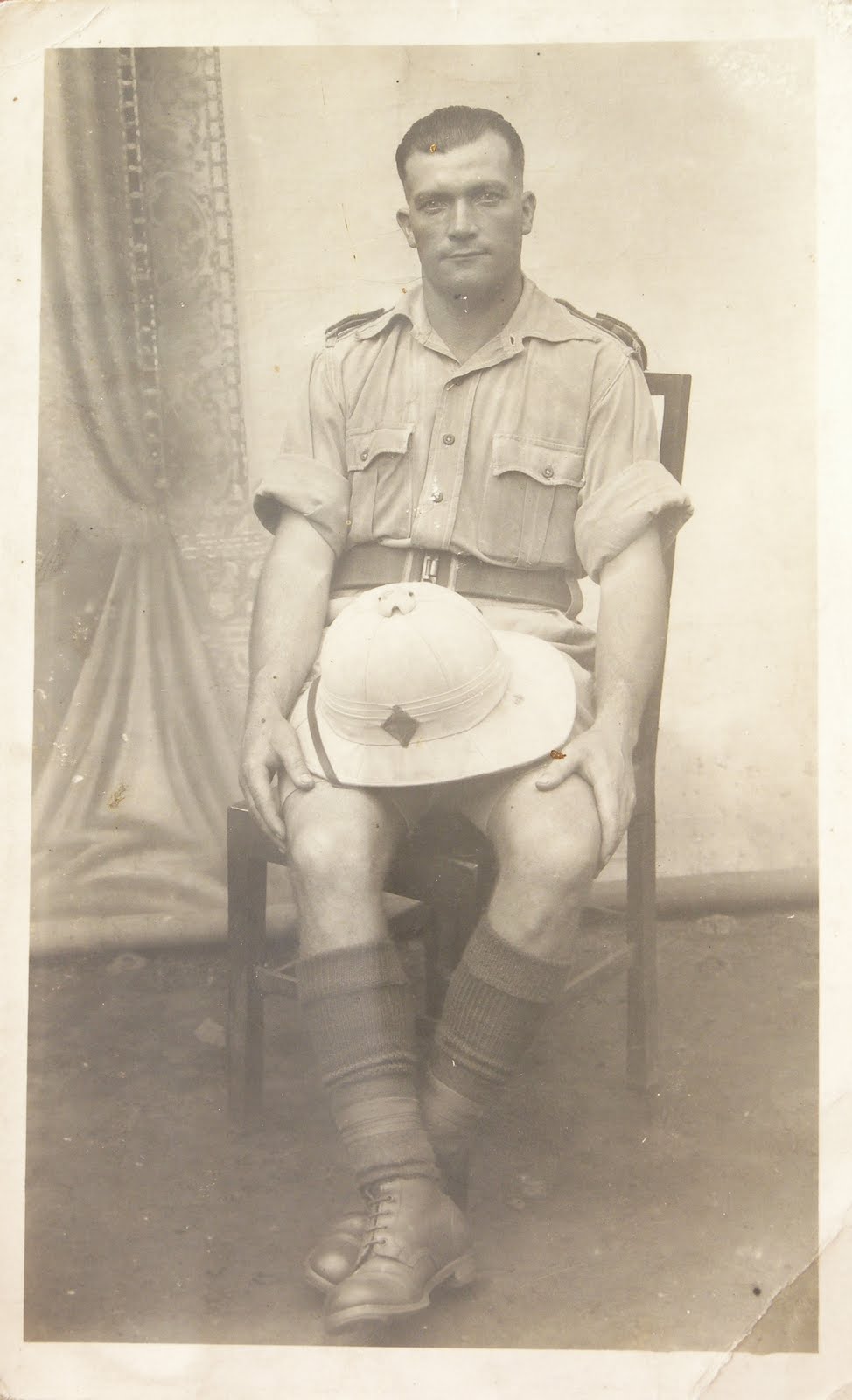
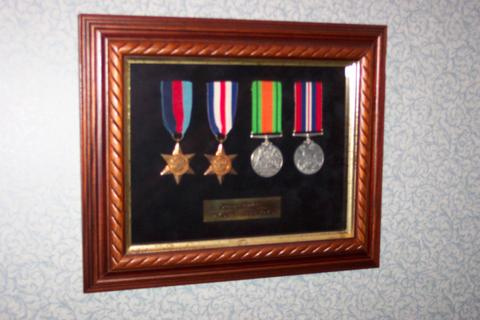
One of the tasks on my never-ending to do list, is to follow my maternal Grandfather’s time in Europe during the Second World War.

In the lead up to the D-Day 80th Celebration, I wanted to focus on where he was in the days prior to 6th June 1944.

I knew as a child he had been in Holland, as when I was about 4 he gave me a small leather pouch, which contained inside a small square coin. About 10 years ago, perhaps longer, I asked the curator at Guildford museum if he knew anything about the coin. He advised me that this was a coin that was issued during the time of the allies in France – more on that another day.

Having called for his military service record I was able to identify that he was assigned to the Royal Artillery. Following training he was shipped to Sierra Leone on 7 May 1941 where he was posted to the 16 Coastal Regiment, which was part of the West African Force. He remained in Sierra Leone until 7 November 1943. On arrival in England he was granted six weeks leave.

He was posted to 81 Field Regiment, unit 403, on 1 February 1943. On 18 July 1944 he embarked a vessel in England and disembarked on 25 July 1944. I have been able to identify where the regiment was until May 1945, which are as follows:

  • June 1944 – Normandy, France
  • September 1944 – Lille, France
  • October 1944 – Nijmegen, Holland
  • January 1945 – Eindhoven, Holland
  • February 1945 – Goch, Germany
  • May 1945 – River Elbe, Germany.

Sources & References

Whilst my Grandfather did not go over to Europe in that initial push on 6 June 1944, he played his part in liberating France, Holland and Germany.

Posted in George's War | Leave a comment

Guild of One-Name Studies Webinar – May 2024

Image from Who Do You Think You Are Magazine, May 2024 Issue.

The lovely people @wdytyamagazine highlighted the Guild of One-Name Studies May 2024 webinar Where there is a will, there is a lawyer.

 The webinar will be recorded and available for a week after the event. The webinar is FREE to attend, but registration is essential. one-name.org/solicitorrecorPlease feel free to share the above details.

Posted in Genealogy | Leave a comment

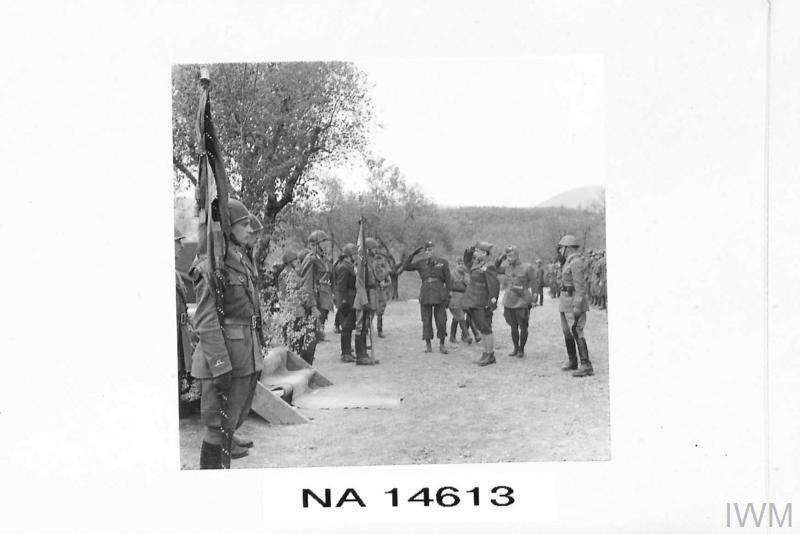
General Taddeo Orlando (1885-1950) Italian Corps Liberation – IWM Photo

ITALIAN MINISTER OF WAR VISITS ITALIAN CORPS OF LIBERATION (NA 14613) Original wartime caption: General Orlando salutes the flags of the infantry and artillery, paraded in front of the presentation platform. Copyright: © IWM. Original Source: http://www.iwm.org.uk/collections/item/object/205529288

Success of the Orlando search earlier this month, which I wrote here. I did another search of the Imperial War Museum material, to see if there were any other instances of the ORLANDO surname for my One-Name Study, I was not disappointed.

This image, is quite small considering the size of the card it is mounted on, nonetheless, it identifies General Orlando saluting the flag of the Italian infantry and artillery who were in front of the platform.

Here is the timeline of his Italian Military Service:

Taddeo Orlando was born in Gaeta, a city in the  province of Latina, in Lazio, Southern Italy on 23 June 1885. He died in Rome on 1 September 1950.

  • 1899 November 1 – A student of the Military College of Naples 
  • 1903 September 30 – A student of the Military Academy.
  • 1906 July 29 – Appointed Second Lieutenant of Artillery
  • 1908 – Received rank of Lieutenant in the 3rd Fortress Artillery Regiment, and subsequently assigned to the 10th Regiment and saw action in the Italian-Turkish War, which took place between 29 September 1911 and 18 October 1912.
  • Orlando was promoted to the rank of Captain and saw military service in the First World War. He obtained the rank of Major with command roles in the Artillery. He was then transferred to the General Staff Corps.
  • 1918 – Having been transferred to the General Staff Corp, he obtained the rank of Lieutenant Colonel following promotion.
  • 1930 November 20 – Promoted to the rank of Colonel he was posted to Tripolitania (Libya)
  • 1937 – Promoted to the rank of Brigadier General and remained in Libya.
  • 1938 – Assigned to the General Staff position.
  • 1940 March 1 – Appointed to the Commander of the “Granatieri di Sardegna” Infantry Division
  • 1941 May 31 – Orlando was promoted to General of Division and saw military service in the Second World War.
  • 1943 April 15 – appointed General of the Army Corps for war merit, with the role of Commander of the XX Army Corps 
  • 1944 June 18 – Minister of War.
  • 1944 July 21 – Appointed General Commander of the Royal Carabinieri, a post he held until 6 March 1945
  • 1947 November 30 –  General Secretary for the Ministry of Defence – Army, a post he held until 20 September 1948

He received a number of military medals and honours:

  • Officer’s Cross of the Order Military of Savoy which was the highest honour awarded to him 
  • Silver Medal
  • Bronze Medals x2 for Military Valour

The IWM image is used here under non-commercial-licence  https://www.iwm.org.uk/corporate/policies/non-commercial-licence and the direct link to the photograph is https://www.iwm.org.uk/collections/item/object/205529288

Posted in Orlando One-Name Study | Leave a comment

European Ancestors – Migration into, and out of Prussia (6)

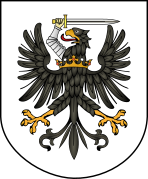
Coat of arms of Royal Prussia. From 1772 coat of arms of West Prussia – Source Wikipedia

Not all Germans who had made their home in the newly acquired land fled into the central area of Germany. Some hoped that having land annexed to Soviet Lithuania would mean that Lithuanians would be safe. Alas, Stalin Russia did not distinguish between Germans and Lithuanians, with Stalin taking this view on the back of Lithuanian males serving with the German military. The reality was this was not a choice.

In the latter part of 1944 and the early part of 1945 there was a significant number of beggars from East Prussia in the western part of Soviet Lithuania, comprised of mainly women, children and the elderly.

Many spoke Lithuanian, but some only had a limited knowledge of the language, that was further impinged by the Russian government forbidding citizens to help, though some did. The Soviets rounded up adults which were then deported to Germany or Siberia where the majority died. Women left their children to be raised by Lithuanian families. As time has marched on, those children have grown into adulthood and are now just beginning to exploring their ancestry.

The authorities in Russia populated East Prussia with Russians, especially those from Smolensk, Voronezh and a few other locations. By December 1946 some 12,000 families had relocated and by 1988 that number had risen to 800,000 people who were mainly Russian.

The Great Soviet Encyclopaedia, published in 1953 stated that East Prussia had been a Russian or Slavic land which was inaccurate. The authorities amended the names of places, making Prussian names more Russian – Cities, Towns, Villages were frequently named after Bolshevik leaders, military personnel, even Czarist generals. Going a step further, the names of rivers, streams, lakes, ponds, swamps, marshes, seas and oceans was also changed.

Lithuanian place names, which had been Germanised, initially partially, and only completely in 1938, were now Russified. None of the old Lithuania, or the very least Baltic names were left unchanged. Cultural heritage was ignored, meaning that records relating to citizens who had lived in this region for centuries was destroyed.

Incidentally, Poland partially followed suit, by changing some of the Lithuanian or Baltic names in the Polish part of what was East Prussia.

Posted in Prussia | Leave a comment

European Ancestors – Migration into, and out of Prussia (5)

Coat of arms of Royal Prussia. From 1772 coat of arms of West Prussia – Source Wikipedia

In the last post I mentioned the Potsdam Agreement. This was an incredibly important element to the planning of post war Europe. As we have seen over recent days, the movement of people, plans of nations and restitution of countries has not been linear.

The Potsdam Agreement was the last of a series of three conferences that took place in the final two years of the war. We are going to look in more detail in a forthcoming post series, but this post will focus on this specific agreement.

The Potsdam Agreement specified that:

  1. Redefined the borders of Central Europe
    1. approved the expulsion of ethnic Germans from the territories that had been taken over as German and would now be transferred to:
      1. Poland
      2. Russia
      3. Czechoslovakia
  2. Approval of German Civilians that enabled them to be sent to:
      1. internment and labour camps in Eastern Europe and
      2. used as forced labour as part of German repatriations to Countries in Eastern Europe

These expulsions were completed in 1950 when it was established that the total of people with German ancestry still living in central and Eastern Europe ranged from 700,000 to 2.7 million.

Posted in Prussia | Leave a comment