The Angel of the North – #50Before50

A month or so ago we visited The Angel of the North. By coincidence, it happened to be the Angel’s 21st birthday. At the bottom of the Angel is a sign providing details about it’s history and so forth. The cost of the Angel when it was first designed, made and then erected was £800,000; that is an astronomical amount. It is certainly an icon of the North East and it was nice to see it, especially so on a nice Spring day.

Posted in #50Before50, Up North! | 2 Comments

A-Z Challenge 2019 – J is for Just how big is my study going to be?

AtoZ2019JOne of the key things with starting a One-Name Study is how big is it going to be?
Not all surnames are equal and understanding the frequency of the surname will be determining factor. The more frequency a surname appears, then the bigger the study is going to be and the more time it will take to collect, analyse and organise.

Whilst a large study is a challenge, they are, in the modern era very achievable. A fellow member of the Guild of One-Name Studies told me that it took him 10 years to collect all the instances of his surname from the General Registration Office (GRO) indexes. Now, thanks to sites like FreeBMD it is possible to download the data in a matter of minutes. That study has gone on to create a large database of about 77,000 instances of the surname. That study is the Featherstone One-Name Study which began in the 1990’s. Another large study is that of the Howes One-Name Study, which began about 10 years ago and has circa 130,000 individuals in reconstructed families.

For a moment, lets turn our attention to surnames whose origins are England and Wales. To determine the frequency of those names, we would look see how many instances of the name occur in the 1881 Census.

  • 1-30 Tiny study
  • 30-300 Small study
  • 300 – 3,000 Medium study
  • 3,000 – 30,000 Large study
  • 30,000 – 300,000 Extra large study
  • >300,000 are huge studies such as Jones Smith

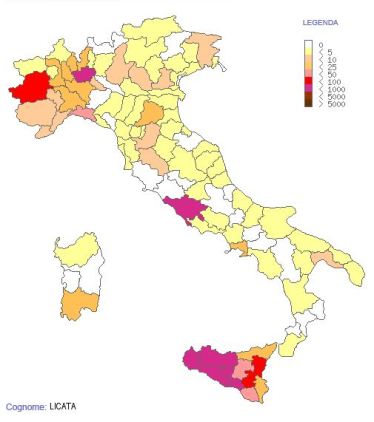
For my Orlando One-Name Study, there are less than 300 in England and Wales, so that appears to be a small study, but the surname is an Italian one, with huge peaks of migration to other Countries – I have previously written about the Surname Profiler Map

For surnames in the United States turn to Ancestry and check the frequency of the surname there.

There are other considerations too, in the case of European surnames there will be peaks of mass migration caused by important aspects of European history.

There is a useful page on the Guild of One-Name Studies website about choosing a surname and about the size of a study. In fact you can see the numbers relating to the Orlando, Featherstone and Howes studies, so it is worth reading and you can do so here

Try out Tip – using the surnames of your four grandparents, would they be suitable as One-Name Studies? And if no, why not? – Go on, leave a comment or write about it on you own blog and leave the URL below.

More details and information is covered in the Pharos Introduction to One-Name Studies course.

Posted in A-Z Challenge 2019 - Tips, Tools & Starting Surname Research Series, Introduction to One-Name Studies (Pharos course 901), One-Name Studies | Leave a comment

A-Z Challenge 2019 – I is for Indexes

AtoZ2019IWhen I first joined the Guild of One-Name Studies back in 2002 I immediately registered my Orlando One-Name Study. As time passed the Guild began building up a set of indexes for the use of Guild members and I began to contribute. Other members contributed material from their own studies, marriage challenges and their own family history.
Fast forward to 2016 and the world of genealogy had changed. Now there were significant amounts of records online, not just with the Guild but also with the commercial based companies. Having registered the surname Butcher in 2016 I trawled the indexes held by the Guild to see if I could make additions to the Butcher marriages, the focus being that other members had likely submitted requests for their own study to the members who had volunteered to work on a marriage challenge. As there are more than 37,000 Butcher marriages in FreeBMD and that only includes dates up to 1983 it made sense that some of those requests from other members had spouses whose surname was Butcher. That meant that I could use the indexes to expand my England and Wales core data set, which was Butcher.

The Guild indexes are one of my favourite member benefits and they really advocate the ethos of members helping members.

There are two indexes that are available to non-members, the first, an newspaper obituary index was donated by myself in memory of my late Mum and the other is a new index, Marriages of the World and already that over 100,000 entries contained therein. Currently I have not added many marriages from my own study and that is something that I plan to do over the course of the next year. You can access those indexes HERE.

Posted in A-Z Challenge 2019 - Tips, Tools & Starting Surname Research Series, Introduction to One-Name Studies (Pharos course 901), One-Place Studies | 2 Comments

A-Z Challenge 2019 – H is for History & Origins of a Surname

AtoZ2019HI have written a lot previously about One-Name Studies (If you are new here, welcome! – you can read all the posts about researching surnames HERE).
One of the fascinating things about a Surname Study that I love is the history and origins of a surname.

Understanding the history of surnames is important and they do vary depending on which country you are researching in. In some cases, such as Ireland the introduction of surnames goes back to the 10th Century, yet Turkey only introduced surnames as late as 1934. In Iceland names are organised by first name.

In England surnames were introduced by the Normans from 1066. By 1250, landed families had surnames and by 1450 most families had surnames, but it was adopted around 100 years later in the north of the country.

In Scotland, from about 1300 landed families had surnames and from 1500’s the Scots residing in the lowlands took surnames. By the mid 1700 surnames were fixed in the Highlands and by 19th Century they were adopted by the Northern Isles.

In Wales, surnames were adopted after the Acts of Union in 1536 and 1543. They developed a Patronymic system which was still in use during the 19th century in rural areas. From 1837 we begin to see surnames being systematically used and much more stable following the introduction of Civil Registration.

Second names are also of importance and can give us as research vital clues as to the origins of the family. Second names are typically dependent on both the culture and geography. In the highlands of Scotland, second names were not recognised or used until the 17th century yet in Ireland the process began in the 10th Century.

In Italy many surnames are variations of the root names and ending in either ini, inu, etti, etto and illo all meaning little, or ucci meaning a descendant of di as a prefix meaning of or from. Broadly speaking those that end in O come from the south and those ending in I come from the north.

There is also the fascinating of something called a Detto, which is a second surname. This is added to distinguish one branch of the family from another and this moves down the generations. I have the fascinating surname in my own family of Magro Malosso. I wrote a bit about this surname HERE

As with much of Europe, women retain their maiden name after marriage and one thing to remember is that surnames can change overtime, through being written incorrectly and people not knowing that something was spelt incorrectly, accents caused the name to be written incorrectly and in parts of our history those who were of descent that they felt was problematic sought to “anglicanise” their surname in order to fit in and be less foreign.

The history of our surnames is, in essence the foundations of a surname study.

Try out Tip

  • What does your surname mean?
  • What are the Origins?
  • Does it reflect your heritage?


Posted in A-Z Challenge 2019 - Tips, Tools & Starting Surname Research Series, Introduction to One-Name Studies (Pharos course 901), Italian Surname Series, One-Name Studies | 8 Comments

A-Z Challenge 2019 – G is for Genealogical Proof Standard

AtoZ2019GI have written a lot previously about One-Name Studies (If you are new here, welcome! – you can read all the posts about researching surnames HERE)

The genealogical proof standard has essentially five elements to it –

a) Reasonably exhaustive research has been conducted.
b) Each statement of fact has a complete and accurate source citation.
c) The evidence is reliable and has been skill-fully correlated and interpreted.
d) Any contradictory evidence has been resolved.
e) The conclusion has been soundly reasoned and coherently written

It is much easier to follow this standard if undertaking reconstruction of families. I follow the same process as my personal genealogy as I do with my One-Name Studies, only entering material into my database when I am sure that the facts are pertaining to the specific individual.

I hand draw out trees, just on scrap paper or in my notebook, it helps me think and I always date the tree and always note if this is because I have material to confirm the tree or if the tree is based upon a hypothetical basis. At the same time as drawing a tree I am able to construct my to do list, identifying what information I need to locate.

Ultimately, the purpose of the genealogical proof standard is a way of confirming if the evidence we have relating to a particular person, is indeed correct and can you justify your thinking and conclusion with evidence.

I have already shared several examples when primary source material can be incorrect – here and here.

References for Genealogical Proof Standard:

  • Genealogical Proof Standard by Thomas W. Jones
  • Genealogical Standards (50th Anniversary edition) by Board for Certification of Genealogists
  • Webinars by the Board of Certification of Genealogists, hosted by Legacy Webinars (you may need to have access to a subscription)
  • Genealogy: Essential Research Methods by Helen Osborn
  • Mastering Genealogical Documentation by Thomas Jones
  • Standards & Good Practice – Society of Genealogists (London England)
  • National Genealogical Society (NGS), US organisation – NGS Guidelines

All the books listed above, with the exception of the one by Helen Osborn are written from a US perspective, but that should not dissuade you from considering to purchase. I own the two by Jones in Kindle format and the Osborn book in both Kindle and hardback. The Society of Genealogists and NGS have some material available freely accessible.

Disclaimer – I have not financially benefited from naming nor recommending these books. I purchased the books myself and all comments and opinions are my own.

Posted in A-Z Challenge 2019 - Tips, Tools & Starting Surname Research Series, Introduction to One-Name Studies (Pharos course 901), One-Name Studies | 3 Comments

Six Degrees of Separation from How to Be Both to……

The #6Degrees meme occurs on the 1st of the month over at the blog, Books are my Favourite and Best which is written by Kate.

51622kbKVxL._SX322_BO1,204,203,200_We start this thread with How to be both by Ali Smith. I read this a few years ago as part of a book group and could not make heads or tails of it. After four chapters I gave up – life is too short to read books that you don’t like. I always feel guilty with that stance though.

The book has won a number of awards and I too struggle with that.  In my experience books that tend to win awards are books that I cannot make sense of and I am often left wondering Why?

The story line of this book is that it switches between two worlds, 15th Century and 21st Century and I am using this as the link to my next book.

Outlander Series

image courtesy of Amazon.

The Outlander series by Diana Gabaldon. The image here shows the first eight books in the series which I love. When I was first introduced to this series I was not sure. It seemed fanciful, but I thought I would give it a try. I absolutely loved them. I have read all but the last two books I think. When the books were made into a series, I sat down to watch the first series to see my husband equally engrossed.

The setting is between the period following the second world war and the mid 1700’s. Following the war years apart, Clare and her spouse have to get to know one another again. They holiday in Scotland, just after the war and one morning Clare goes for a walk. She touches standing stones and suddenly finds herself in the period before the Battle of Culloden. I won’t go one with the details, except to say that Clare finds herself married in both time periods, gives birth to a daughter, conceived in the 18th Century and born in the twentieth. Clare returns to the modern time, to her husband and raises her daughter in the United States where she trains to be a doctor, having spent her war years, as a nurse in the field. The series is a great one and whilst fanciful, it is tremendously researched and there is a twist in the tale….I recommend the series.

I will now introduce my next book. By coincidence, equally as fanciful perhaps, depending on your point of view. I have had this book for years, probably close to twenty. It has sat on my bookshelves and survived several culls and I do find it fascinating.

0749912464.01._SX142_SY224_SCLZZZZZZZ_

Yesterday’s Children by Jenny Cockell is set around the belief that Jenny had lived before, as a woman named Mary in Ireland. Mary died 21 years before Jenny was born leaving a number of children. In this book Jenny worries about those children and wants to find out what happened and does so through much of the research that we undertake as genealogists. Jenny also underwent hypnotism, she visited Ireland to the town that Mary came from and some amazing reunions took place. I found the book fascinating when I first purchased it back in the mid 1990’s, and since then I have read it at least on another two further occasions. If anyone else has read the book I would be especially interested to hear your thoughts – please leave a comment!

51+dQRxuWNL._SX326_BO1,204,203,200_Using the tenuous link of the mind and the ability that our minds have. I took a diploma in Counselling course a number of years ago and this book was on our reading list; Love, Medicine and Miracles by Bernie Siegel. Our task was to read the book and consider the basic principle of mind over matter. Could patients genuinely heal themselves? I won’t share my answers with you, but I was fascinated by this book and subsequently read another by the same author (Peace, Love and Healing).

41tBwFafbqL._AC_UL436_Moving on through the thread, I am following the medicine theme with this next book which I purchased to aid myself. Heal your pain now by Joe Tatta is an excellent read and I have seen a number of presentations he has done. Considering I trained in a profession whose focus is on medications, I take the personal view that pain is always going to be difficult to deal with and is there a way to do so without totally relying on prescribed medication, especially if there is no cure for the condition?

Tatta’s book focuses on the elements of pain caused by something we can control, foods we eat and the effect they have on us. Effectively doing a self examination of our lives and the fuel we give our bodies and does that fuel in some way contribute or cause the pain.

1784162817.01._SX142_SY224_SCLZZZZZZZ_Now my link is that having lived we are each going to die. My next book is only recently published in paperback and is All that remains – A life in Death by Sue Black. Sue Black is an anatomist and forensic anthropologist at Dundee University, she is also a Professor and a Dame, so clearly at the top of her field and well respected for it.

At this point I have flicked through the book and it tells a varied story. The author has placed a personal spin on dying and speaks of her mother’s death and their relationship. Then she speaks of attending court and only looking at the people in the court setting asking the questions. It is a very varied book and I am glad I purchased it.

0806312548.01._SX142_SY224_SCLZZZZZZZ_My last book in the chain is this one Family Diseases by Myra Vanderpool Gormley. The book was published in 2009 and is one of those books that dates quite easily. That said, it was interesting to read through the various diseases listed.

From my list this month, it does look as though I am thinking solid of death – I am not, but it is the one certainty in life beyond taxation! From a genealogical perspective we record the details of when someone dies, where and perhaps even how. We treat that as a primary source document, yet it might not tell you the full story. Look at the death certificate of one of your nearest & dearest. You likely know some, if not all of their health issues. Does the death certificate mirror that knowledge?

I am doing some work in this and will likely reveal it in the coming weeks for those that are interested.

I hope to play along in May and will try not to make the books so depressing!

Posted in #6Degrees Meme, Books | 5 Comments

A-Z Challenge 2019 – F is for Framework

AtoZ2019FI have written a lot previously about One-Name Studies (If you are new here, welcome! – you can read all the posts about researching surnames HERE)

As with any project, you need to sit down and scope out your plan and what you want to achieve from the project.

A surname project or One-Name Study is no different. Perhaps though, what is different is when the researcher started their research and that might have a direct correlation to how the project progresses and how the material is kept.

  1. What project do you want to undertake? – What is it that makes X fascinating to you that you want to explore more in-depth? This could be a One-Name Study or a One-Place Study. Researching a house,business, school etc.
  2. How are you going to achieve your quest? – How many hours do you have available to undertake the project? It does not need to be a lot, you might be working full time with a family and still want to undertake a project of this kind. Or you might be retired and have an abundance of time available. Perhaps consider working with others who share the same interest, or maybe you already have a body of work that you are using as your basis for the project.
  3. Plan the Structure of your Project – This will likely depend on what your project is and your starting data. You might be researching a Surname that you know originates in Ireland and you reside in the United States. Establish how big the surname is, look at migration points – where folk migrated to and how they did. Look at what material is available online and with easy access. Bear in mind that only a fraction of what is available is online. Given that the fact that Northern Ireland and the Republic of Ireland was one Country until 1922, you might find that records exist in both the archives of Northern Ireland and Republic of Ireland. Given that and the geographical distance from Ireland to England, you could look at FreeBMD and search for your surname. How many are there? You might also consider HOW you are going to keep data that you find? – input directly into a genealogical programme or downloaded to a hard drive or copied into a note book or even create a spreadsheet. FreeBMD data can be exported as a CSV file and imported directly into Excel.
  4. Focus on the elements of a project – This might include the distribution of the surname, using a mapping site such as public profiler or Surname Atlas. It might include the origin of the surname and the type of surname it is. For each element I recommend a plan to be written. It does not have to be fancy, just a note of what you plan to do.
  5. Create & Maintain a Research Log – This is really important as it enables you to track what you have looked at and what you have found, so be sure to record positive AND negative results.
  6. Managing Research Results is important, otherwise you will drown in data. Decide how you are going to process your data – enter it straight into a family history programme, or an Excel file. You could add to Evernote or One-Note. There is no right or wrong way, find what is best for you. Make sure that you record the citations of the information you find, perhaps this is a newspaper article, or information from a parish record, the purpose of a citation is essentially to share with others where you saw the information, so that they, if they wish can follow your research.
  7. Connecting with others – This is really important. Firstly you get to share your journey with others and you can connect with others who might share the same interest. You could set up a Facebook Group (or Page, although I prefer Groups). You might use a Twitter account, you might join organisations such as the Guild of One-Name Studies or Society of One-Place Studies, you could add your place to the Register for One-Place Studies. Another avenue to explore is the facilities of archives, libraries or museums – if your surname “hotbed” or place is located in a particular County check out the archives, include local museums and share your interest with them. They might help you connect with others with the same interest.
  8. Bring your data together – in this element we are concerned with family reconstruction, essentially putting families together, using primary source material. You can also draw out an individual timeline, such as I described HERE that way you can see what your individual was doing at a particular time and you can see what is missing and then consider where you could look for that data.
  9. Share Material – Having worked really hard to gather and expand your collected data, I would recommend enabling others to see it. You can do this in a variety of ways, write a blog, have a website, write articles, share stories via Facebook.
  10. Preserve Your Work – If you are a member of the Guild of One-Name Studies with a registered surname, you can signup to a Members Website Project. That enables you to advertise your study, display it for others and preserve it, all the while working on your project.

A frame work for this kind of project is not clear cut and it does not need to be. The one consistent & important thing is that you set the perimeters for your study. You choose your starting place and then do the hardest thing….start. If the way you have started does not feel right or comfortable then stop and look at what is not working and what is then carry on.

When the Guild for formed in 1979 the only way to collect material was by visiting St Catherine’s in London and extract by hand the appearance of your surname, quarter by quarter. It was fairly hefty work and laborious, but people kept going. In the modern days it is easier to go to FreeBMD, but that even does not necessarily contain all the references.

The only way to reconstruct family groups was to work through the registration districts and then each venue in turn. A Guild member said to me once, that there was no point in collecting those, as they were nothing more than an index and in part they are correct, but that time consuming process was undertaken by a generation of genealogists and is very much woven into the history of one-name studies.

Try out Tip – Look at the surnames in your family. Which one lends itself to a Surname Project or One-Name study? If you were going to embark on such a project what would you do first to get going and why?

Posted in A-Z Challenge, A-Z Challenge 2019 - Tips, Tools & Starting Surname Research Series, Introduction to One-Name Studies (Pharos course 901), One-Name Studies | 1 Comment

A-Z Challenge 2019 – E is for Education

I have written a lot previously about One-Name Studies (If you are new here, welcome! – you can read all the posts about researching surnames HERE)

The Guild of One-Name Studies is a registered Charity in England and Wales. Part of our charitable requirements is that we have an educational remit, and educate the public in addition to members.

Education comes in a variety of guises, and members can tap into the ones that appeal when it suits them. We have a proactive seminar team who arrange seminars four times a year, across England. Scotland, Ireland and Wales are not excluded, but as an organisation that runs on volunteers the focus does tend to be on the areas that have the most members and when someone steps forward to run a seminar. Equally we have a conference each year, linked in with our Annual General Meeting (AGM). We try to record both sessions at conferences and seminars and these are available to members. Both seminars and conference is available to non-members.

We have webinars, and again these are available to non-members for a week before becoming a members only benefit. Our members using a variety of communication channels share their knowledge, experience and suggestions.

The Guild’s book, Seven Pillars of Wisdom,the Art of a One-Name study is a useful book and guides members through the hints and tips of running a successful One-Name Study. The Pharos course of which I teach the introduction course is another useful tool to have and not all new members of the Guild take the course. There are often long serving members too and I will talk about the course in a bit more depth later in this A-Z series.

As with anything, taking with existing members, reading material from members will enable those new to the subject to develop a great study and to work in a way that works for you.

Posted in A-Z Challenge, A-Z Challenge 2019 - Tips, Tools & Starting Surname Research Series, Introduction to One-Name Studies (Pharos course 901), One-Name Studies | 2 Comments

A-Z Challenge 2019 – D is for DNA

AtoZ2019DI have written a lot previously about One-Name Studies (If you are new here, welcome! – you can read all the posts about researching surnames HERE).

A number of members of the Guild of One-Name Studies have an associated DNA project that runs alongside their study. I am no exception and have a study with Family Tree DNA (FTDNA) that runs alongside my Orlando One-Name Study. FTDNA are the only company that offers these types of projects, There are also projects based upon geographical regions – Polish and Italian for example and there are also projects that are aligned to those that have Jewish ancestry.

The Orlando project has the Guild logo along side the project name as the following image shows. The link to the Orlando Project can be found HERE

Orlando DNA

There is also a list of other projects where the surname appears, such as Malta and Prussia. The FTDNA Projects mainly focuses on Y-DNA which is passed from father to son. You can also undertake a Family Finder test, which I have done which instead of going back in a father to son method,it goes back and round, effectively its outreach is wider – Cousins etc.

There are also tests available from Ancestry and likewise I have tested there too. Whilst not everyone has a DNA project with their study,many members do. It enables members to reach out to others with an interest in a particular surname.

Try out Tip – Visit the FTDNA website and scroll half way down the the page to the search surname box. Insert your family surnames and see if there is a DNA Project available. Have you undertaken a DNA test? If not would you? If you are particularly interested in the surname of Orlando, I would be delighted to hear from you.

Posted in A-Z Challenge, A-Z Challenge 2019 - Tips, Tools & Starting Surname Research Series, DNA & Surname Projects, Introduction to One-Name Studies (Pharos course 901), One-Name Studies | 1 Comment

A-Z Challenge 2019 – C is for Citations & Sources

AtoZ2019C

I have written a lot previously about One-Name Studies (If you are new here, welcome! – you can read all the posts about researching surnames HERE).

Firstly, if you are completely new to the concept of a One-Name Study, a little background. It is essentially a project whereby someone attempts to record, track and reconstruct families of the same surname, where ever they may geographically appear and across all time frames. In the United States these are frequently referred to single surname studies.

A couple of months ago did a short series on Citations and Sources which you can find HERE. Like anything, quality research is only as good as the methods used, knowledge held and the ability to document where the material can be found. A one-name study is no different. I would rather opt for a simple citation than none.

It is very important to be able to show a pathway of information, so that someone walking behind you in the future, or indeed yourself can find the information that you have stated. I gave an example in the original series that even primary source material can be incorrect. My christening for example appears in the parish records of the church where the event took place. My late Mum was given a certificate as a commemorative of that event, although sadly the incorrect middle name is cited on the certificate. I have the original certificate now, I also have my birth certificate which is correct, I appear in the General Registration Office indexes with the correct name, but the certificate of my Christening is incorrect. On my own record in my database I have noted that error, so that someone in the future will know that I am aware of the error and my thoughts on how the error occurred.

Quality research is important to other own research and to our studies. A citation can be complex or can be simple as this – a birth of John Bloggs occurred in this place and at this time. It enables others to then work back through the information so they too can identify the record and then concur with the initial research. Now if they disagree, they can too show why they disagree in their database.

More of this will be covered on the Pharos Introduction course to One-Name Studies.

Posted in A-Z Challenge, A-Z Challenge 2019 - Tips, Tools & Starting Surname Research Series, Introduction to One-Name Studies (Pharos course 901), One-Name Studies, One-Place Studies | 3 Comments