European Ancestors – Italian Bibliography

Italian Flag

Courtesy of Wikipedia

Transferred from the European Ancestors site is my Italian-bibliography which was created from a series of scraps of paper, post it notes and a typed list of books. I  merged the details together into the document linked above.

The list of books is not exhaustive. It is reflective on books titles that I have come across; and are either  general research guides in terms of Italians or Catholics, or about specific areas.

My own particular interest is in Italian migration to Surrey post Second World War and in the Sicilian village of Sutera. This might even be out of date, as I have added more to my Italian collection; I will update the document when I have a chance.

Posted in European Ancestors, Italy | Leave a comment

Family Tree Magazine 2019 – Surname Research Series

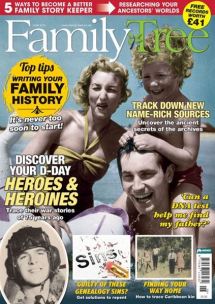
FTM June 2019In the May 2019 issue, the surname series continues with us looking at using a Non-British surname as the basis for a One-Name Study.
Readers of this blog will know that I am half Sicilian and have the Italian surname Orlando registered with the Guild of One-Name Studies.

Even though the Pharos Introduction course to One-Name Studies tends to have the majority of focus on surnames with a British background I am finding that more and more people are sharing their European genealogy and registering those surnames.

Meanwhile, I am still recovering from the backlog which built up whilst I was at #FamilyTreeLive and have a number of posts to share in the coming week.

Posted in Family Tree Magazine (UK) Surname Series (2019), Genealogy, One-Name Studies | Leave a comment

Introduction to Surname Research and One-Name Studies #FamilyTreeLive

Intro to ONS - Slide ImageHas it really been a week since #FamilyTreeLive? where does the time go?

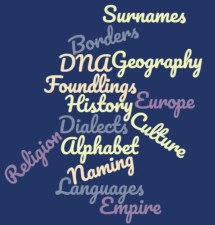
My part of the show kicked off with a session on the Society of Genealogy help desk, I then held a workshop focusing on researching in Europe titled Routes into Europe where we focused in a short and concise manner the issues of researching in Continental Europe. My talk at the Society of Genealogists in a few weeks will go into more detail. If you are interested, please click HERE.European Wordcloud

My copyrighted slides and handout will be available on the Family Tree Magazine website in the next few days, but in the meantime, as promised, I have emailed them to the people that attended the lecture and asked me to email them.

The workshop delegates already have their copies, but I have also made them available via Family Tree Magazine.

I shall be back later with some thoughts from the event itself.

Posted in #FamilyHistoryLive, Genealogy, Introduction to One-Name Studies (Pharos course 901), One-Name Studies, Presentations | Leave a comment

Society of Genealogists – Half day lecture – Tracing your European Ancestors: East & West

halfday-278x178

Image courtesy of the Society of Genealogists, London

I will be at the Society of Genealogists in London talking about Tracing European Ancestors: East and West on Saturday 18th May 2019.

The history of Britain is full of stories about people arriving from Europe. Often they came as refugees, with few possessions. So, many of us face the challenges of tracing our ancestors back across a continent, frequently riven with war, famine and revolution.

Session 1: In this session I deliver a broad overview of research in Europe. A continent spanning more than 30 countries, subjected to wars, political unrest and border changes. Europe is a Continent with many languages, cultures and religions, all of which play a part in family history research.

I focus on:

  • The obstacles and pitfalls you may encounter;
  • The major historical events that have had a marked effect on family history, especially the impact of the world wars and regional conflicts, border changes and movements of populations;
  • The concept of researching European surnames and how it might link into European DNA projects.

Session 2: In this session I describe the key resources, some well-known and others less so, for researching European ancestry. They enable you to explore ancestral and family history sites. But they are also great resources for embracing the cultural, social, economic and political lives of your European ancestors.

I will cover:

  • How to research in the historical context of the time;
  • How to put your people in their place in their time;
  • Why this is vital to your successful European research;
  • How to bring your ancestors to life so that they become more than just names.

There are still some spaces left and you can book HERE

Posted in European Ancestors, Genealogy, Presentations | Leave a comment

European Ancestors

European AncestorsOver the course of the last few months I have been pondering on some genealogical housekeeping. That includes my blogging platform and website. I have already gradually merged another blog into this one and as that was relatively painless, I have decided to merge into this blog my European Ancestor posts from their current site to a category on this site, which you can find HERE.

The material will stay online at the old site, but the domain name which I will retain will point to the European Ancestors Category. Over the next few weeks you will therefore see a small flurry of material posted as that migration takes place.

Once the migration is complete there will be more frequent posts as I share additional material and European research material.


Posted in Books, DNA & Surname Projects, European Ancestors, Genealogy, Introduction to One-Name Studies (Pharos course 901), One-Name Studies, One-Place Studies, Presentations | Leave a comment

A-Z Challenge 2019 – Websites & Online Study Presence

AtoZ2019WBefore the internet those researching a specific study largely did so via a series of written methods. As we entered into a digital modern age websites were for large organisations. Over time the scope for websites and online presence expanded and expanded and as a result a good many Guild of One-Name Studies members have some form of online presence.

Initially, those that joined the Guild could have a profile page and that was akin to a website presence. It enabled members to have a platform that advertised and shared information about their study. Profile pages, like studies themselves come in all shapes and sizes. Some members have very detailed profiles, such as this one for the Baldacchino Study and personally I would like to see all members aspire to this level of detail, myself included! The Orlando Profile is HERE and the Butcher Profile is HERE.

Members are limited by only their imaginations for the scope of the material that can be included on the surname profile. If you look at both of my profile pages above you will see there is a difference between my own studies. At some point in the coming weeks I will write a few posts about creating a Profile page and how those profile pages will evolve over time.

The Members’ Website Project is one of the Guild benefit’s that I adore! These sites are hosted on the Guild website, as a way of preserving, publishing and sharing information about a study. Anyone who has undertaken the Pharos course in the last few years will know that I love the benefit offered to Guild members, at no cost (unless a member opts for a TNG site in which case the licence is around $33 USD) providing a website and yet still enabling the member to work upon their study and achieve the material at the same time. It does not matter how much material you have already, in fact I personally think it is better to have little rather than be in my position and have almost three decades of material to digitise.

Other options are for Facebook groups and pages for a study, or a Twitter feed. Some members opt for a blog structure and a number of members have all of the above! Whatever method you choose be sure to consider all the options. Top Tip – Don’t leave it until the last minute to start a website. The more paper and files you have the harder it will be to get going!

Posted in A-Z Challenge 2019 - Tips, Tools & Starting Surname Research Series, Genealogy, Introduction to One-Name Studies (Pharos course 901), One-Name Studies | Leave a comment

A-Z Challenge 2019 – V is for Variants

AtoZ2019VSurnames are curious things, despite us all having one. A variant is deviation from the surname you are interested in. A number of members of the Guild of One-Name Studies have relatively few variants, others have a phenomenal amount.

For my studies, I have relatively few variants:

  • Orlando – variants are Orlanda and Orlande
  • Butcher – variant is Butchers

For those that heard me speak last week at #FamilyTreeLive will perhaps recall my mentioning the surname of Urlando. I have certainly mentioned it here previously and I have not made a further decisions on whether this a likely variant or not. I expect to though in the coming year.

Variants likely occur because of accents, the inability to know whether a name was spelt incorrectly or not.

I go into detail more during the Pharos introduction to One-Name Studies course and I also discuss the concept of a deviant surname.

Posted in A-Z Challenge 2019 - Tips, Tools & Starting Surname Research Series, Genealogy, Introduction to One-Name Studies (Pharos course 901), One-Name Studies | Leave a comment

A-Z Challenge 2019 – U is for Understanding of a study and the necessity to AIM for globalisation

AtoZ2019UWhenever I teach the Pharos course in One-Name Studies one of the things that comes up either via email or via the online discussion forum is the concern of being global with a study.

One of the principles of a Guild of One-Name Studies registered study is that the study should AIM to be global.  No one expects a member to register a surname with material from every Country on the planet!

When the Guild first started, back in 1979 the phrase was a “substantial body of data” and even that means something quite different in the internet age. A substantial body of data is very easily achieved in the modern internet age, compared to when the founder members of the Guild were working on their study. I took three years to extract the index references for the birth, marriages & deaths in England and Wales for the surname of Orlando, compared to about three minutes using FreeBMD. Times change. Nor do we have the volunteers to check when your study went global or when you plan to do so!

The commitment is to aim to be global. If you are living in the United States and you want to undertake a One-Name study you likely start on home turf – you might choose to start with the State you reside in, the state where you know your ancestors lived, the state that has the most occurrences of the surname, or you may choose to work though each State, alphabetically, extracting and gathering what material you can, depending on the availability of records. Whatever your choice, it might, depending on surname take you a decade to leave the United States. That does not mean you are not global, just that you are working on your plan. Very few of us can spend every waking moment on our studies,even if it appears that we do or we want to!

What is the point of global?

We live in a world where migration, short and long term is easily achieved and that is not new; migration has been going on for centuries. All that has changed is the speed in which the migration takes place. Migration from England to Australia or Botany Bay took months in the transportation era, yet the last time I flew it was, from my former home in south west England to mid New South Wales a mere 39 hours (inclusive of waiting for the various checks, boarding, or other tedious matters).

Global, allows us as researchers to find people we actually did not know we had “lost”. Looking at my own paternal Grandmother’s family. She was the youngest of four and the only one to remain living in Sutera, Sicily. Her brother and two sisters migrated to the United States and thanks to the amount of material online and the enumerator who listened and wrote what he heard and the individual being specific, I was able to trace the brother with ease.

Now, I am not studying Licata as a One-Name Study, but if I was I would be able to identify the family and look to what happened to them in the future. I could then focus on our Countries too, such as Canada as getting into the United States from Canada was often easier. Alternatively Australia, because when the United States began restricting migration in 1919 following the First World War and then later with the  financial crash in the early 1930’s migrants began looking to other options. There were only two. Stay where you were which for some was not an option or to look to migrate somewhere that was taking in those from other countries.

So whatever the surname, the chances are there are folk who have migrated as a way of avoiding persecution on the grounds of politics or religion, Displacement following war. Transportation to the United States or later Australia, or ten pound Poms as a plan to populate other parts of the “Empire”. Or perhaps due to working in the military, or East India Company.

Of course, there are plenty of people who work on a study in small segments. I was talking to a Guild member recently, who is working on a surname that is very common and happens to appear in my family. I promised to send them some material and during the course of the discussion we talked about where we started our research, how we kept it, both in terms of spreadsheets &/or genealogical software and also did we have more than one tree on our TNG sites. For those of us working on big studies, especially those with a huge presence in England and Wales it makes sense to start by County or by groups of counties, but sooner or later there will be migration whether that is from Cornwall to Cumbria, Devon to Derbyshire, Surrey to Sterling, Perthshire to Powys or anywhere else that takes your fancy on a global scale!

Whatever surname you are working on, go global at some point, otherwise how will you be able to reconstruct family groups or know what happened to someone in your study?

Posted in A-Z Challenge 2019 - Tips, Tools & Starting Surname Research Series, Genealogy, Introduction to One-Name Studies (Pharos course 901), One-Name Studies | Leave a comment

A-Z Challenge 2019 – T is for Timelines

AtoZ2019TI love timelines. They enable us to tell us what information we hold about an individual, whether that is our own ancestor or someone from our studies. A timeline also enables us to see what we DO NOT know and that is sometimes more useful!

I wrote about an individual Genealogical Timeline HERE where the focus was on my fifth times great Grandfather, Daniel Butcher (1720-1787).

As I process individuals I document every piece of information, occupation, address, age (because as we all know our ancestors were not always consistent in the declaration of their age!). I also record on the side of timeline sheet, if there was any lodgers, visitors and random others with the family. Sometimes they are exactly what they report they are, lodgers and other times they are, or go on to be additions to a family. Other information is also noted, such as if they are recorded in other documents or they witnessed a marriage. All the individual facets of people’s lives noted on a two page spread in a notebook is very basic and yet can be totally revealing and or thought provoking.

Top Tip – why not do your own timeline and see just how much information there is; or perhaps do that of a parent and see what you know and what you don’t know.

In my view a timeline is a useful tool to include in genealogical research and it is analysis of that timeline that might go on to be the baseline information for another piece of genealogical work.

Posted in A-Z Challenge 2019 - Tips, Tools & Starting Surname Research Series, Genealogy, Introduction to One-Name Studies (Pharos course 901), One-Name Studies, One-Place Studies, Strategy for a Genealogical Project | 1 Comment

A-Z Challenge 2019 – S is for Structure of a Study

AtoZ2019SEvery member of the Guild of One-Name Studies structures their studies differently. Some members enter their data straight into a genealogical database, others extract data from various sources and they analyse the data. Some collect data and have done since the concept of a study was first considered and is entirely paper based with the thought of making the data available electronically overwhelming because of the need to enter the data into a programme.

There is no right or wrong way to work on a study, merely your way. There is always scope for “improvement” or change. I personally changed my way at least three times before I found the way that was comfortable for me. It is really akin to buying a car, none of us buy the first we see, we take them for a spin first then evaluate. Working on a study is no different.

What I would always recommend is evaluate what you want to do with your study. Do you want a website and to exhibit family reconstructions? Do you want to “collect” and gather material and go no further?

The internet age enables so much more of our studies. It enables us to connect with others quicker on a global scale. It enables us to gather data quicker on a global scale and to display that data for all to see.

As someone who gathered the indexes from St Catherine’s decades ago which took three years to achieve for a “foreign” surname I was able to download the material from FreeBMD in a matter of minutes. I then cut and pasted the data into a workbook in Excel.

The internet has enabled me to create a website and to share the material on that site in almost piecemeal fashion using the marriage index from FreeBMD. I described that process a bit earlier in this series. I also used the Guild indexes which are typically a members’ benefit; that works especially well for a common typically English surname and enables me to at least identify spouses for some of the 37,000 Butcher marriages from 1837-1983 in England and Wales. Having identified the individuals from the marriage, including the names of the respective father’s I can build the family group, their children and their subsequent marriages, the parents and siblings. I use the Census and record every factor as an event as that enables me to build a timeline in the life of an individual.

However you use choose to do your study, enjoy it, use the benefits the Guild offers to it’s members (and the public in the cases of two indexes). Connect with members and engage with them, whether that it sharing information on a marriage between your studies or at a seminar.

One thing I would stress is don’t get into data overload! If you download material have a file in the cloud where you can put the information, record it in your research log and then come back to it in the future.

Do what you enjoy!

Posted in A-Z Challenge 2019 - Tips, Tools & Starting Surname Research Series, Genealogy, Introduction to One-Name Studies (Pharos course 901), One-Name Studies | Leave a comment