Family Tree Magazine 2019 – Surname Research Series

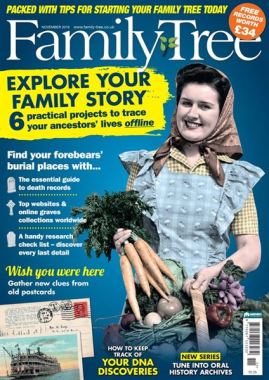
FTM Nov 2019The November issue of Family Tree Magazine has recently been published, and the surname series continues, with us looking at preserving and publishing your One-Name Study.

There is a good deal of overlap between the publishing and preserving elements of the Seven Pillars and as I don’t have a lot of space in the column, I will be writing a bit more about the seven pillars and focusing on several of the questions that I find I am asked by those at the start of their One-Name Study journey. If you don’t want to wait for those posts you can read my numerous surname research posts HERE

Family Tree Magazine (UK) is available from magazine themselves as a print or digital version.

The Pharos Introduction course to One-Name Studies starts at the beginning of November, and whilst the majority of focus tends to be on surnames with a British background I am finding that more and more people are sharing their European genealogy and registering those surnames. Either way, if you are wanting to explore the depth of a study and to make sense of it, do consider joining us.

Posted in Family Tree Magazine (UK) Surname Series (2019), Genealogy, Introduction to One-Name Studies (Pharos course 901), One-Name Studies | Leave a comment

Red Hills – The Pitman’s Parliament

IMG_1635

Copyright Julie Goucher, September 2019

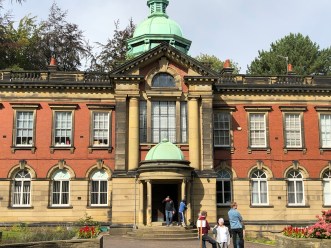
I recently had opportunity to visit Red Hills – The Pitman’s Parliament in the city of Durham. The home of the Durham Miner’s Association, the venue is usually closed to the public, open otherwise by appointment. I managed to attend during Heritage Week.

So what is Pitman’s Parliament? It is the name given to the building in Durham that represented the mining population in the County. For those with mining ancestors, it is an opportunity to gain some context to the backbreaking work that was undertaken by thousands of men, and in some cases children, in the north east of England. That said, if you are reading this from outside of the UK, there were other areas of the UK that had a mining workforce, but more on them another day.

The Durham Mining Association was a formal Trade Union, founded in 1869. It was though more than that to the workforce and it established itself as a powerful force with the mining community, indeed, the union of Durham mines formed a welfare system to support the workforce long before the Labour party did in 1945. Miners and their families benefited from accommodation for elderly or infirm miners, education for the younger generation, hospital provisions, a sick pay and unemployment benefit. The welfare halls were the centre of the communities and they provided a venue for events.

The building itself was opened in 1915 and is now not in the best of shape. That said, it is the home of what was a fascinating period of north east history and how this occupation was perceived in the County (and other areas) and how the community embraced the harshness of the work and times. When the venue opened in 1915 there was 120,000 members of the Durham Mining Association and they were organised into what are referred to as lodges, and there were 200 of them.

Inside there are a number of rooms that could be viewed and there were volunteers on hand to answer any questions or to point out things of particular interest.
IMG_1640

Copyright Julie Goucher ,September 2019

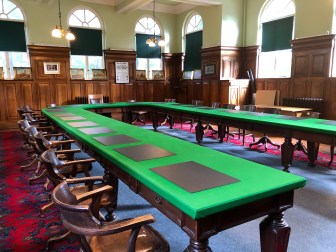
The Committee Room was a space where the meetings of the Executive were held. This room was closed to the public from its inception until the 1970’s when the it was opened by a wave of forward thinking, embracing a democratic principle.

Located in this room was two genealogical gems, the maps representing the mines across the County as a whole and the mines into their established geographical groups. Voting for the union officials, the people who sit in this room was not allowed until the 1960’s and the only voting undertaken by the members was for the agents. It was in this room that the discussions and decision took place for the Durham miners to participate in the National Miners Strike of 1984 and 1985.

Below are other photographs from this room:

This slideshow requires JavaScript.

The Muniment Room was the room where the records and documents were kept. The room has a series of photographs of the former leaders, men loss in the various mining disasters and the only photograph of women – those who ventured to Russia in the early 1920’s.

The Pitman’s Parliament This the most impressive room in the building and it is here that you get a true sense of the context and layers of administration in looking after the welfare of the average and regular miner.

IMG_1648IMG_1649

This room is where the debating occurred between the men that represented each lodge. The men at the mines would appoint someone who would represent them. That person would sit in this room and would sit in the exact same seat each time they attended. There are about 200 seats in the lower level and higher level were for the public and press, although both groups were not always allowed, it depended on what was being debated.

Also on the lower level were the seats for the associated members, such as boiler men and engineers. As I walked about the room I spotted underneath the seats (which are like the folding ones that you find in cinema’s) a metal disc. The discs represent those commemorated at a specific mine or lodge. The date that was chosen was the 1951 record of lodges as there would be people who would recall those folk within living memory. If you had a family member who worked at a specific pit you could pay the donated amount of £100 and you would be presented with a disc in a presentation box and a copy of the disc which is for placing on the underside of the seat. The wording on the disc is chosen by the person making the donation, so it can be personalised.

On talking with the volunteer in this room there was a true and genuine sense of togetherness and community. The information provided and shared with me gave me a real sense of context. My husband has mining ancestors, the majority in Durham and some in Derbyshire. I know that they were represented by the man who sat in the relevant seats for Usworth and Washington. That man, did the best he could for the men and their families.

A story was relayed to me of a miner whose wife had died. He had no money to bury her with and was full of despair. The man who represented his pit went to a meeting the following day and shared the details with the men who sat in the Parliament room. That man left later that day with £400 by way of support. The man who shared that story with me did so to demonstrate the way of life and as he did so, his eyes fill with tears. It is very different to the scenes on the news that I recall from the time of the strike and suddenly I realise that it was not just news, it was something that certainly affected the lives of my husband’s ancestors and relatives, some of whom were still working in the mines during that time.

All images are the copyright of Julie Goucher, September 2019
Posted in Genealogy, History, Miners and Mining, Up North! | 1 Comment

Family Tree Magazine 2019 – Surname Research Series

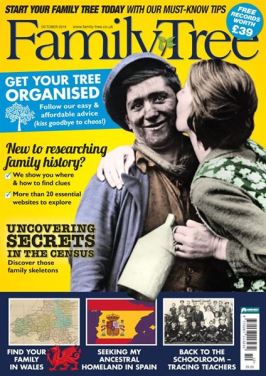
FTM October 2019The October issue of Family Tree Magazine has recently been published, and the surname series continues, with us looking at the  fundamental principles of a study, as defined by the Guild of One-Name Studies, the Seven Pillars.
This issue focuses on analysing and synthesising data relating to a One-Name Study. As I don’t have a lot of space in the column, I will be writing a bit more about the seven pillars and focusing on several of the questions that I find I am asked by those at the start of their One-Name Study journey. If you don’t want to wait for those posts you can read my numerous surname research posts HERE

Family Tree Magazine (UK) is available from magazine themselves as a print or digital version.

The Pharos Introduction course to One-Name Studies starts at the beginning of November, and whilst the majority of focus tends to be on surnames with a British background I am finding that more and more people are sharing their European genealogy and registering those surnames. Either way, if you are wanting to explore the depth of a study and to make sense of it, do consider joining us.

Posted in Family Tree Magazine (UK) Surname Series (2019), Genealogy, Introduction to One-Name Studies (Pharos course 901), One-Name Studies | Leave a comment

Virtual Genealogical Association 2019 Conference

A few weeks ago I was asked to share the promote the following conference which is to be hosted by the Virtual Genealogical Association. It takes place in early November 2019. I will be speaking, although not live. My presentation is, “How European Surnames Can Help In Genealogical Research”. It looks a fascinating conference. If there are any questions, then please do contact me and I will look to incorporating the answers either in the presentation or via this site.

0

Posted in Genealogy, Introduction to One-Name Studies (Pharos course 901), One-Name Studies, Presentations, Surnames | Leave a comment

1491 – The Untold Story of the Americas before Columbus

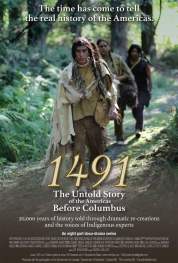
1491Launched daily from 9th August 2019 is this fascinating series commemorating the UN International Day of the World’s Indigenous Peoples.

Each episode is free to watch. Once the entire series has been shared via the series Facebook page, it is available to view via subscription, at the very reasonable price of $14.91 USD for the entire year. That equates to about £11.80. The website can be found HERE

I am not associated with the series, but have just watched the first two episodes and plan on watching the series. The writers, cast and directors were totally Indigenous.

Charles C MannBased on the book by Charles. C. Mann, the second edition was published in 2006.

Posted in Genealogy, History | Leave a comment

RootsTech London 2019 Competition Closes and Winner Selected!

LondonBadges_1200x717pxAmbassadorAs a RootsTech London Ambassador I have the opportunity to host a give away for the event of a complimentary three day pass (worth £149). There was no restrictions on how I choose to host the give away.
I chose to ask those who entered to do one of two things – send me something for one of my studies or comment about a surname in their own family they were curious about.

My husband, Mr G was kind enough to dip his hand into a wicker basket that had been collecting the submissions and extract the winner. The winner is Janine Long – Congratulations Janine!

In the meantime, thanks to everyone who took part. I received several Butcher references for my study and those will be added to my database and I shall be in touch via email as I want to reference those researches as the source of the information. It was very interesting to read the comments and the surnames, so much so that I have decided that I am going to respond to those comments via this blog so please keep reading!

RootsTech London will take place 24-26 October 2019 at the Excel Centre, London.

IMG_1105

I shall be personally talking on Delving Deep into Migration, to and from the British Isles on Thursday.

The RootsTech website, for more information can be found HERE and the schedule is also available HERE.

Once again, thanks everyone for entering and sharing their surname queries.

Posted in RootsTech London 2019 | Leave a comment

Family Tree Magazine 2019 – Surname Research Series

Surname Series - 10The September issue of Family Tree Magazine has just been published, and the surname series continues, with us looking at the  fundamental principles of a study, as defined by the Guild of One-Name Studies, the Seven Pillars. I usually put a image of the magazine here, but for a change I have used the image from the article.

This issue focuses on collecting data relating to a One-Name Study. As I don’t have a lot of space in the column, I plan to give further details between now and September, when I will be writing a bit more about the seven pillars and focusing on several of the questions that I find I am asked by those at the start of their One-Name Study journey. If you don’t want to wait for those posts you can read my numerous surname research posts HERE

Family Tree Magazine (UK) is available from magazine themselves as a print or digital version.

The Pharos Introduction course to One-Name Studies starts at the beginning of November, and whilst the majority of focus tends to be on surnames with a British background I am finding that more and more people are sharing their European genealogy and registering those surnames. Either way, if you are wanting to explore the depth of a study and to make sense of it, do consider joining us.

Posted in Family Tree Magazine (UK) Surname Series (2019), Introduction to One-Name Studies (Pharos course 901), One-Name Studies, Seven Steps of One-Name Studies | Leave a comment

One-Name Studies & Seven Pillars: Collect (1)

Collections

Created January 2015 by Julie Goucher using Wordle

Five years or so ago, I wrote a series about the general features and decisions to be made when someone gathers a collection, irrespective of what that collection might be of. A few weeks ago a reader of this blog contacted me, having read that original series and asked if I had considered updating it. I hadn’t at the time, but promised to look into it. As I did so, I realised that whilst I wrote originally with a view to ephemera, that we might gather to illustrate the places where our ancestors lived or similar, that actually the same questions could be said of the first stage of undertaking a One-Name or surname study. Indeed, it was reasonably timely, as I was about to go into further details of the Seven Steps of a One-Name Study to coincide with my Family Tree Magazine Series.

According to Christopher Bart in “Industrial firms and the power of mission” Industrial Marketing Management 26 (4) pp 371 – 383 there are three key elements.

  1. Key Market – Who is the chosen item aimed at?
  2. Contribution – What does the chosen item provide to the wider audience?
  3. Distinction – What makes the chosen item unique over others?

These three elements do not exactly fit a collection or a One-Name study, but they go some way to present a suitable structure of key indicators. In my experience as a family and local historian, a collection forms as a natural stage of research. I do not believe that any of us make a conscious decision to collect every postcard of X, every piece of pottery made by X or every occurrence of a name in a location or of every instance of every name in a location.

A collection quite simply happens, a result of a catalyst. In which case why did it happen and how are you going to deal with it in the future? There might also be overlap between one collection and another or even more than one.

Things to consider and undertake:
  • How do you recognise a collection?
  • How did the collection come to be created and by whom?
  • Who is it created for and why? and has that changed over time?
  • How will it be maintained or grow?
  • How will it be accessed by others?
    • Does it need to be?
  • How will you advertise your collection?
  • How do you ensure the longevity of your collection?
  • How is the collection kept?
  • How will you ensure copyright and ownership issues are protected and addressed?
  • Do others have any investment in the collection? (investment does not necessarily mean financial)
  • Is the collection unique?

Indeed, those questions and the answers are part of the history of the collection and mean something to the person who collated it, but what about future generations? Will they know why such a collection exists? They may have a guess, but they won’t necessarily know, that is unless you tell them, either directly or indirectly.

So over the coming week or so I am going to be answering some of the points above and exploring the seven steps in more details. So I am going to leave today’s post with this image of the Seven Steps so you can be ready to follow along.

Seven Pillars Higher Res

Courtesy of the Guild of One-Name Studies – One-Name.org

Posted in One-Name Studies, Seven Steps of One-Name Studies | Leave a comment

Podcasts – Extreme Genes Radio

Extreme Genes

Courtesy of Extreme Genes

Firstly this is not a Podcast. I have filed it with the podcasts for easiness.

I each week listen to the host, Fisher on Extreme Genes discusses a variety of genealogical topics. He is joined by David Allen Lambert from the New England Historical and Genealogical Society (NEHGS) and Tom Perry who is the preservation Guru! This is a special episode, as it is six years since the show started.

As part of the segment from David Allen Lambert, each week a blogger is featured and yesterday, in episode 291 this blog got a mention – thanks guys!

I especially liked yesterday’s show. CeCe Moore was interviewed regarding the complexities of a cold criminal case where DNA was used. GedMatch was discussed and the value of adding in.

It’s a tricky situation. Those of us who have tested with DNA companies have done so with the hope of connecting with family members. Therefore the spirit in which the DNA was given has been broken. My view is, having thought further about it, and sitting on the fence for a bit, is, I do believe that if we can get those who have committed crimes off our streets, whether that is in the US, UK or elsewhere, then that surely has to be a good thing? I know the situation is not great, and some might say the relationship is now not in a place of trust, but the situation occurred with the best of intentions. I am no DNA guru, that is obvious, by I today tweaked my GedMatch account to opt in.

As I said it was a good episode and you can listen to this episode and more via ExtremeGenes.

Thanks Fisher and David!

Posted in Genealogy, Podcasts | 1 Comment

Ramblings from my Desk….. (24)

c5492-deskramblingsIt has been a considerable time since I sat and did a general chatty post, but the last year has been busy and there always seems other posts and material to be written.

Those of you who are subscribed to receive post via email are likely to have been surprised yesterday when I shared two posts that were actually two years old and not genealogy related. The reason is the British Library are archiving this site and I wanted to consolidate several other sites into this one for the purpose of preservation. It also provided me with an opportunity to review some work that has been in progress for way too long and to make some decisions relating to that.

We have had a challenging month or so. My Mum in law was firstly hospitalised awaiting a diagnosis. Since then we have moved, sadly rather swiftly, through from diagnosis to her passing away and then the funeral; quite literally the space of one calendar month. We since then have been unravelling her life and clearing her home. My thoughts have therefore been reflective on the situation and the facets of life.

At the end of the week when we sad farewell to my mother in law, we celebrated our 25th Wedding anniversary. In the scheme of things it was low key and I am glad it was so.

I am currently busy with the writing and scoping out of my next Family Tree Magazine series for 2020 and a new potential course to the existing One-Name Studies courses offered by Pharos. The current course has another couple of weeks, with the final course for the year starting in early November.  I am currently running a competition to win a complimentary pass to the three day genealogical extravaganza. You can enter HERE and the closing date is 31 July. I shall be speaking at RootsTech about Diving Deep into migration to and from the British Isles.

Posted in Desk Ramblings! | 4 Comments