Practicalities of a One-Name Study

spreadsheetWe have just got to the end of week one of the new Pharos course, Practicalities of a One-Name Study

The first week looks at, as you might have guessed, spreadsheets and how they can be used in a One-Name study and used for the right task.

Anyone who has read this blog, attended a surname research based lecture or took the Introduction to One-Name Studies course, will know how I use spreadsheets, what my starting point is and so forth.

One thing I do not use them for, is for designing genealogical trees and whilst some do use a spreadsheet for this purpose, I am way to impatient to be one of those researchers and I admire those that do indeed have the patience.

That said, I do use spreadsheets for some interesting tasks and over the coming weeks I may well share them here! If you are interested in taking this course in the future, please click the Enquire about this course feature from the bottom of the course link. No other dates are listed as yet, but I expect to agree some later on, once the first course completes, once I have reviewed the comments and feedback.

Posted in One-Name Studies, Practicalities of a One-Name Studies (Pharos Course 903) | Leave a comment

Q & A – Consistency in Recording Place Names

Q & A

Created by Julie Goucher – Feb 2020 Using Wordclouds.com

For researchers not use to researching in England and Wales it is worth pointing our some inconsistencies when researching and recording place names

Firstly, in England and Wales births, marriages and deaths were recorded from September 1837. They were recorded in quarters – March, June, September and December. (Births that took place in December could in fact miss the recording and appear in the March quarter of the previous year.)

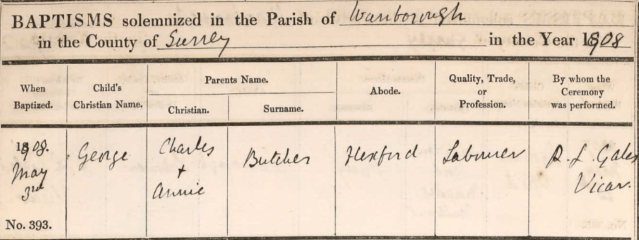
The recordings, in their quarters were done in district orders. My maternal Grandfather for example was born 3rd March 1908. I have this information from his birth certificate. His baptism took place in Flexford, which was a Hamlet next to Wanborough Surrey, some four miles from Guildford, Surrey, England.

Meanwhile, he was baptised when he was two months old at Wanborough Church, Wanborough in Surrey.

George Butcher - Baptism 1908

Baptism Record, Wanborough, Surrey, England – George Butcher May 1908

His entry in the General Registrar Office of Births reads as this:

Name: George Butcher
Registration Year: 1908
Registration Quarter: Apr-May-Jun
Registration district: Guildford
Parishes for this Registration District: View Ecclesiastical Parishes associated with this Registration District
Inferred County: Surrey
Volume: 2a
Page: 111

The Ecclesiastical parishes include these parishes:

Albury, Guildford St Nicholas, Ripley, Merrow, Send, Godalming, East and West Horsley, Guildford Holy Trinity, Wisley, Pirbright, Compton, Woking, Wanborough, Stoke and Worplesdon.

(courtesy of Ancestry)

The only way to identify the actual event is to order the birth certificate and pay the fee of around £11. Alternatively, trawl through the parish records for the various parishes and hopefully finding the information. Of course, these days it is relatively easy to login to Ancestry, use the search filters as I have done here and locate the actual venue. Back in 1990, I did the search the hard way, working through the parishes.

In my database, the event is recorded twice:

  1. Baptism, St Bartholomew Church, Wanborough Surrey, England – 3rd May 1909
  2. Birth, Guildford Registration District, General Registrar Office,  England & Wales June Quarter 1908, Volume 2a and page 111

This postcard is of St Bartholomew Church, Wanborough, Surrey, England circa 1910 From the personal collection of Julie Goucher.

It is very important to record the venue and list the County and Country because a number of places in the UK have the same name and going a step further, a great many places outside of the UK also have the same name. By using consistent recording of locations, it is much easier to retrace your steps should you or anyone else need to.

Posted in England, Genealogy, One-Name Studies, Q & A, UK & Ireland (Eire) Genealogy Series, Wales | Leave a comment

More on Variants

Variants & Deviants

Designed by Julie Goucher using wordclouds.com ~ March 2020

The latest Introduction to One-Name Studies course has just officially finished, though I shall arrange one more chat with those students. One of the things I love about teaching the courses, is the questions posed over the duration of the course. Those questions are always answered during the course, but often, I bring the question here, either in the format I have used today, or by addressing the question in narrative.

This is an abridged questions posed by student, (JS)  which I have adjusted slightly, as otherwise, it would be possible to identify the student.

However I think there may be a large number of variants.
How do you know how far the variants should extend.
Also what are the dangers with such small numbers.

Here is a slightly tweaked response:

I think the way to look at variants is to be guided by the records you locate.

When I registered Butcher, I did so with no variants. I did however, record instances of Butchers. For about a year they remained as completely separate databases, then I looked at the divorce records on Ancestry. There were several Butcher records, as I read one of them, it transpired that the divorce was recorded as a Butcher because that was how the marriage was registered, but the man was actually a Butchers.

The divorce record provided the marriage certificate and that confirmed that the marriage was recorded as a Butcher rather than a Butchers. I immediately merged the GRO Marriages for Butchers into the Butcher spreadsheet and did the same with the GEDCOM, merBefore adding any variant to a study I would recommend assessing the numbers that might be involved.ging Butchers with the Butcher file. I then recognised that the study would reflect both names and noted the fact that the instances of Butchers was in actual decline, likely that the name dropped the S on the end, becoming Butcher.

Small numbers might show varying things:

1. Define the geographical spread for small numbers – Orlando is small in England and Wales but not the case in Italy and the US.

2. Small numbers might be indicative of migration. One student who had a reference to the surname of Ganselem in the family stated that there was no instances in any of the origins books. In my reply to that I said the surname sounded Jewish, based upon nothing more than a hunch. I then looked at JewishGen and did a search for the surname which did reveal some instances.

3, Small numbers can only identify a surname in decline. It might therefore be useful to conduct an assessment of births, are there high mortality numbers? are their large numbers of females born who largely change their surname upon marriage?

Knowing the origins will perhaps influence, and in some regard. depend on your search options and those parameters.

Ganselem Distribution

Ganselem distribution from Forebears.io

As I pulled together this post I had a quick look at Forebears to see what their distribution map showed, there was one patch identified, as Mongolia with 245 individuals in 2014.

There are a couple of points:

  1. The surname has a representation according to Forebears, as given name.
  2. What has driven the only instance of the surname to show Mongolia

The Introduction to One-Name Studies course (901) is set to begin on 2 June 2020.

Posted in Genealogy, One-Name Studies | 2 Comments

The Genealogy Blog Party: Celebrating Women’s History Month

56957-caroline2526girls

Caroline Harris (nee Ellis) with four of her daughters – from the personal collection of Julie Goucher

This photograph is one of my most treasured photographs. The lady sitting down is my Great Great Grandmother, Caroline Harris nee Ellis. According to my great Aunts, who were Caroline’s grandchildren she was a formidable lady. She did not suffer fools gladly and took no nonsense from anyone.

Caroline was born in 1844 to George Ellis and Prudence Budd. She was baptised in Puttenham as indeed were generations of my family on 20 October 1844. On the Census records from 1861 until 1891, Caroline repeatedly states she was born in neighbouring Elstead, which is entirely plausible given the proximity to Puttenham and there were a great many Ellis families in the immediate area.

Caroline was one of a eight children born to George and Prudence, who had married on 16 October 1834. Her mother died in 1855 aged 37 years when her youngest brother, James was just three years old. To date I have not established if indeed her father remarried and I should do so.  Caroline married Henry Harris on 3 December 1864 and together they had ten children born between 1864 and 1885. The first was Emma Jane, born just before her parents marriage and baptised in November that same year. Henry died in 1929 aged 86 years and Caroline in 1935 aged 91 years.

To return to focus on the photograph. The women behind Caroline are four of her daughters, some of whom equally were known for their longevity. The lady on the left is my Great Grandmother, Annie Prudence Harris (1879-1972). I am lucky to remember my Great Grandmother, who is affectionately known as APH in my own notebooks. Of course by the time I recall her she was a very elderly lady, largely confined to bed and living with her eldest daughter, my Grandfather’s sister.

I remember being allowed to walk up the stairs, which of course seemed very steep to me as a three year old. My Grandfather on some occasions carried me from the bottom of the stairs, on other occasions, he picked me up when he sensed that my little legs were getting tired. On those visits, I was placed on the bed, next to APH and allowed to snuggle in, she smelt of lavender and always gave me the biggest hug and cuddle that any three year old could want. Her hair tied back in a bun, grey with faint strands falling from it. APH loved pineapple and no visit was every made without one!

By this time, APH had been a widow since 1943, almost 30 years which seems tragic. It is hard to imagine her as a young women courting and eventually marrying my Great Grandfather, Charles Butcher. They married on Christmas Eve 1898 at Puttenham, having 12 children between 1900 and 1917, although just nine lived to adulthood. The youngest daughter, Marjorie was just 35 when she died in 1952 leaving behind a husband and daughter. Three others died as infants. Charles Harry was born blind and lived just five months in 1902,  Frederick William was stillborn in 1903 and then Elsie was born in 1912 and lived just two months, she sadly died of convulsions. There is a resilience that runs deep here and a determination to stand strong. Those strengths have continued to the modern generations, including to a certain former three year old!

The other three women in the photograph were Caroline’s daughters, Mabel, Rose and Kate. The closeness that the photograph exudes was fairly strong, the strengths of determination and even stubbornness ran deep despite the miles that separated the siblings, despite the second world war and other tragic circumstances. In writing this post, I note that there are a few outstanding pieces of research that I need to update into my genealogical software.

Mabel married and had a son and three daughters, all the daughters lived into their 90’s including the daughter who gave me this photograph. The son however, worked on the London docks and died as a result of an work related accident. Rose married and had two children, and not too much is known of her life, although I do know the family moved to the south coast. Kate, also married and had one child. She lived in the later years with the family at Manor Farm Guildford and died in 1958 after being hit by a car, crossing the main A3.

Having put this post together, it has highlighted that I have numerous omissions in my research, some still to undertake, others to incorporate from research visits. The sad thing is this is within living memory and unless it is recorded now, it will fade, like we will, into the past.

Taking part in the Genealogy Blog Party

Posted in Butcher One-Name Study, Genealogy Blog Party, Harris | 1 Comment

Scottish Highlands & Islands

UK and Ireland Series

Created using Wordclouds.com by Julie Goucher January 2020

Amazingly, there are 790 Scottish Islands, divided into four groups

  • Shetland
  • Orkney
  • Herbrides
    • Inner
    • Outer

As I researched this section I was astounded that there are so many islands. Then I pondered on the practical aspects, such as post and deliveries. No daily Amazon deliveries for sure!

There were also some quite amazing snippets that I came across.

  • The Island of Jura is in the Inner Hebrides and in the 2011 Census, there was 196 residents.
  • The Island of Rum, also in the Inner Hebrides has no “Indigenous residents“. The population of 22, are largely employees of Scottish Natural Heritage, who have owned the Island since 1957.
  • Farne Islands is located 200 miles north of Scotland and is an autonomous territory of Denmark.
  • Island of Rockall was declared by of Scotland by the Island of Rockall Act 1972. The legality of it is disputed by the Republic of Ireland, Denmark and Iceland which is likely to be unenforceable in International Law.
  • Flannan Isles was the location where three lighthouse keepers vanished in December 1900. I am fairly sure that I saw a film about this not too long ago, which used some degree of artistic license, since we do not actually know the fate of the three men who vanished.
  • Isle of Muck is a small island on the west coast and together with Eigg, Rum and Canna, forms the Small Isles. Muck measures 2 miles long by 1 mile wide and the island is home to approximately 40 people. The Island has been occupied since the Bronze Age. In 1821, the population was 320, fifteen years later many of the population had migrated to other parts of Scotland or emigrated completely to other countries. In 1836, sheep were introduced to the island, possibly in an attempt to provide work and food to the island. There is no mains electricity even today.

The Highland and Islands Emigration Society records have been released and are FREE to view on the ScotlandsPeople site HERE, though you do need to login (or create an account) to see the records. You can read some background reading, including all the Record Guide HERE

Posted in Scotland, Scottish Highlands and Islands, UK & Ireland (Eire) Genealogy Series | Leave a comment

George Butcher #GOONSblogchallenge – Post 8

706c2-georgebutcherwwii

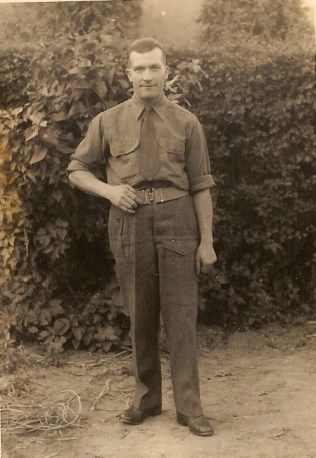
George Butcher 1908-1974 – From the personal collection of Julie Goucher

Today is the 112th birthday of my maternal Grandfather, George Butcher.

Born in 1908 in Wanborough, Surrey, he was one of 9 children who survived into adulthood from a family of 12.

At the time of the Second World War he was working for a local Dairy called Lymposs & Smee at Guildford, which later became Unigate Dairies.  His three brothers and oldest sister Rose, who was married was living at Manor Farm Guildford. Two of his other sisters were living in nearby in the villages of Shackleford & Hurtmore and the second eldest was living in Essex with her husband who was a military man.

This photograph was taken at Manor Farm, Guildford, likely  before his first posting, which happened to be Sierra Leone in West Africa, where he was stationed from midway through 1941 until December 1943. At this point my Grandfather was aged 32 and had been married just over a year. My Grandparents spent a lot of time with my Grandfather’s family and my Grandmother’s sister Elsie. My Grandmother’s brother married to my Grandfather’s sister and was living as I said, in Hurtmore. The families were connected and associated with each other and maintained a fairly good communication stream regardless of the absence of the social media platforms of today. Letters and cards were always sent either through the postal services or via family members.

According to his Pay Book, my Grandfather was granted 28 days leave 9 November 1943, he was then granted a further week from 12 December 1943. His father had been unwell and died on 10th December 1943 according to his death certificate, with his death registered by my late Great Aunt who was the eldest, on 13 December.

Charles Butcher (1869-1943)

Death Registration – Charles Butcher 1943

The pay book shows no further annual leave after December 1943, meaning that he remained on active service until he was demobbed in 1946.

Turning to look at the service record, the document shows that upon enlistment in Dec 1940 he spent 146 days on home soil. He was sent off to West Africa on 7 May 1941 where he spent 2 years and 186 days. He then spent time again on home soil and then was sent off to north west Europe from July 1944 where remained until March 1946.

Sitting on my to do list for far too long has been a detailed assessment of his time in West Africa and during his time in Europe and how that matches up with other key dates.

George Butcher (1908 - 1974)My Grandfather was awarded four medals which hang in my living room, alongside a tapestry which he worked on to kill some time whilst he was stationed in Sierra Leone.

My Grandparents were happily married for almost 35 years. After my Grandfather’s death in 1974, she remained a widow, living another 21 years.

Posted in #GuildBlogChallenge, Butcher One-Name Study, Puttenham & Wanborough | Leave a comment

GENUKI – Genealogy UK and Ireland

UK and Ireland Series

Created using Wordclouds.com by Julie Goucher January 2020

I mentioned in a recent post that I would be sharing a variety of material that was previous published, or going to be published in the now defunct, online genealogy Magazine, In-Depth Genealogy where I had a column called Across the Pond. This is the first of those pieces.

Regardless of where  you live, be that within the United Kingdom or elsewhere, if you are beginning your journey of researching in the UK and Ireland, then the first port of call, should be to the very useful site of GENUKI

The site describes itself as

“GENUKI provides a virtual reference library of genealogical information of particular relevance to the UK and Ireland. It is a non-commercial service, maintained by a charitable trust and a group of volunteers.”

The site is free to all users, of course the costs is the time of the trustees and volunteers who strive to make the site user friendly and worthy for the genealogical community. As it is volunteer run, each county or regional page varies in the depth of the material. Two counties that immediately spring to mind for the amount of engagement is Devon and Durham, whereas, my home county of Surrey is not overly engaged.  Nonetheless, wandering through the pages is a worthy one and I certainly recommend it.

The GENUKI site is an excellent starting point, to get your genealogical bearings within the regional structure of England, Scotland, Wales which makes up Great Britain. England, Scotland, Wales and Northern Ireland make up the United Kingdom and of course the Republic of Ireland is the majority of the island of Ireland, with the six counties in the north are Northern Ireland.

Whilst the regional areas are distinct, there is a great deal of “free flow” across the borders of the regional centres, including Ireland and Republic of Ireland in much the same way as movement across the counties. GENUKI has a great many links to provisions and a very useful map which shows the counties, making identification of neighbouring counties easily identifiable.

For those searching for surnames for their one-name study, depending on the surname, you might find it useful to have an idea of where your surname is the most prevalent. I wrote quite recently about the Butcher study here where I showed the distribution of the surname across England and Wales. As I said in that post “my native Surrey comes out the most, as does Kent, Essex, Middlesex and Suffolk.” therefore those Counties were the ones that I looked at first on the GENUKI pages. Even though I have been researching a long time, I always find something that I have not seen previously on the site.

For those wondering about citations following finding material that will sit in your One-Name Study. I decided to look at the County of Suffolk and selected a transcription of Pigot’s Directory for 1823-1824. There were four BUTCHER references which are provided in the format of Name, Occupation and location in the County:

Butcher, John Hatter Ipswich
Butcher, John Fish Curer Lowestoft
Butcher, Mary Anne Straw Hat Maker Debenham
Butcher, Robert Wine & Spirit Merchant Bungay

The citation that I have used is:

Pigot’s Directory of Suffolk 1823-1824, Index provided by David Kolle, Melbourne, Australia 1994, Accessed 1 March 2020 link via GENUKI Suffolk pages (https://www.genuki.org.uk/big/eng/SFK/sfka_e)

Go on, grab a beverage, sit and explore! In closing, I should point out that the word GENUKI is a registered trademark and further details about the structure and “ownership” of the pages can be found HERE

Posted in UK & Ireland (Eire) Genealogy Series | 1 Comment

Launch – UK and Ireland Genealogy Series

UK and Ireland Series

Created using Wordclouds.com by Julie Goucher January 2020

Following the demise of The In-Depth Genealogist online magazine last year, I have a rather large pile of articles, that were published either on the In-Depth genealogist blog or in my monthly column, Across the Pond ,that I thought worthy of sharing here.

In addition there are some random ideas and rough drafts of material that I thought I would add to the pile.

My plan is to create a UK and Ireland series on this blog and the posts will publish randomly, so if you don’t want to miss any then please subscribe.  Now, for the purpose of this series I have simply used the term Ireland, which will likely then break down into the categories of Northern Ireland and Republic of Ireland. Also remember that for many elements, the same might be applicable for the Island of Ireland.


Posted in Genealogy, UK & Ireland (Eire) Genealogy Series | Leave a comment

Researching Females in a One-Name Study

Female SymbolA frequent question that pops up on the Introduction to One-Name Studies course is about researching women, especially if the female marries out of the surname.

It varies, depending on the person undertaking the study. Some carry on, including the individual, others do a couple of generations and some do not carry on, with the individual ceasing in the study the moment the female marries out.

There is no right or wrong way and the Guild of One-Name Studies, leaves that up to the individual member to decide.

Personally I follow the female for at least two further generations in my study, so effectively the children and grandchildren. If the female connects to my personal family then I continue on beyond the two generations. If the female marries into another study then I swap the information with the other study holder. On occasions I do carry on for another generation or so if I am doing other elements of investigations for example multiple births.

If you have a One-Name Study what do you do? please leave a comment!

Posted in Genealogy, Introduction to One-Name Studies (Pharos course 901), One-Name Studies | 2 Comments

Sicilian Sulphur Mining #GOONSblogchallenge – Post 7

Sulphur from San Cataldo Mine

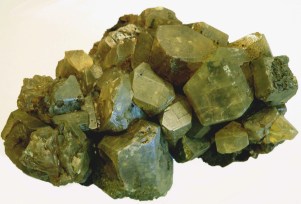
Sulphur from the mine at San Cataldo – Mindat.org

Caltanissetta is located in the centre of Sicily, dominating the Salso River. From the beginning of the 19th Century, Caltanissetta became a mining centre following the discovery of huge sulphur deposits.

Between 1830-1835, according to the General Statistics of Sulphur Mines, Sicily doubled the production of sulphur from 350,000 to 660,000 Cantari (on estimations, 1 Cantaro equals 79.34 kg), which outmatched both Great Britain and France and classified itself as the worlds biggest region in Sulphur exportation.

Between the mid 19th Century until 20th Century, there were some 40,000 workers employed as sulphur miners, amongst them many, many children known as Carusi.

At the beginning, mines had small spiral staircases that met the heart of the mine and prevented the mine from collapsing. The pathways were very narrow, and subsequently they were impassable by adults, therefore only could be accessed by children, who walked the treacherous pathway several times each day.
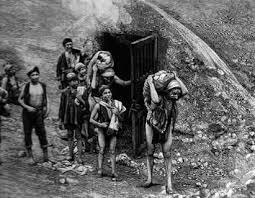
Sulphur Mining in Sicily

Carusi at Sulphur Mines in Sicily.

The head of the mines approached the families to recruit the children. Poverty prevailed in Sicily and families were very large, therefore the parents entrusted their children into the miners care in exchange for financial reward. The families believed that once the debt had been repaid the children would be returned to them, sadly the miners often would alter the children’s names and would exchange the children for those with other miners, making the children unrecognisable to the family. The children did not know any better, and through ignorance and exhaustion that prevented the children from developing their individual identities. They therefore remained a Carusi for life.

The feeling of a love and hate relationship with the mines was based upon the numerous misfortunes beneath the earth. One example is a blast triggered by fire damp at Gessolungo where over 60 miners died. Later, in 1952 there was an blast at the Tumminelli mine, where six people died. Word got out that the rescue teams had remained under the collapse. It was impossible to control public order with thousands flocking to the mine from the towns to look for relatives. The chief engineer of the workers, police commissioner and the prefect met and gave the order to suspend the rescue mission, three of the men who were involved were still alive at this point.

The mines remained prosperous until 1906 when the Anglo-Sicilian sulphur company stopped activity following the discovery in the United States of a new technique to extract sulphur, known as the Frasch method.

After the end of the Korean war, the request for sulphur declined dramatically which in turn triggered a crisis throughout the Sicilian mining industry. Sulphur was produced at a prohibitive cost, almost six times higher than obtained overseas from the fractional distillation of petroleum. At the end of five years, which had previously been envisaged as the period of recovery by a reorganisation plan, the majority of sulphur dealerships defaulted. In 1964 the region of Sicily revoked the mining concession for individuals, entrusting them to the mining Sicilian body, later to the regional Sicilian chemical mining society.

After the Second World War sulphur miners fought for the passage of the mines to be held in public administration, demanding better work conditions, the end of the feudal mentality in the management of the sulphur mines and a shift within the mining sector with a cycle of production and chemical transformation in the Sicilian territory, but the political stance was very different.

Sulphur mining was an important part of Sicilian life, giving culture, economy and deep roots to the whole of Sicily, not just the three provinces of Enna, Caltanissetta and Agrigento, which had nurtured 840 mines until the early 20th century, producing 90% of the world sulphur.

Of that period nothing remains, but abandoned mines, landscapes spoilt by crumbling asbestos filled buildings and memories of a financial viable business built upon the exploitation of a poverty stricken population.

#guildblogchallenge

Posted in #GuildBlogChallenge, Genealogy, Miners and Mining, Orlando One-Name Study, Sutera, Sicily, Virciglio | 3 Comments