A-Z Challenge 2020 – Specialised Studies E is for Emigration Schemes

Specialised Studies

Created by Julie Goucher using wordclouds.com March 2020

The British Empire, along with those of other European countries wanted to populate their respective lands on other Continents. In order to make that proposition seem more appealing there were various emigration schemes which enticed those from the shores of the United Kingdom to far away lands.

I wonder though, in a country where education was largely a simple affair, just how much our forebears realised that when they agreed to go, whether they really knew how far away it was and that they would never see loved ones again.

Just to clarify though, these schemes were not transportation, where convicts were transported to the United States or later, to Australia. Nor are they the flawed thinking of migrating children as Home Children. Some children did migrate with various groups and did so with success, not experiencing abuse or ill treatment.

There were several ways  of embarking on an various emigration schemes:

  • The passage was paid by the state or an intermediary
  • The passage was paid by the individual themselves

I do not plan on providing information on all the schemes, but the suggestion is if you have “lost” someone during your research do consider the emigration schemes.

The Petworth Emigration Scheme took place 1832-1837. The Committee began their work in 1832 to address the issues of rural and urban poverty and was largely a collaboration of parish officials, government and private individuals coming together to address these matters.

A key individual was Lord Egremont who was prepared to subsidise some individuals, but not the 1800 that expressed an interest initially, this forced the government to become involved and the parish officials, largely those from West Sussex, though there were others, from Hampshire, Surrey, East Sussex

The Officials in Canada wanted to population growth, but equally they wanted those individuals to thrive as best they could. Upon arriveal in Canada they were provided with temporary five acres of land and a log cabin house. These provisions were near towns that were already growing and would offer employment to the immigrants, who were largely labourers, who had the support of families who had migrated with them.

Assisting Emigration To Upper Canada: The Petworth Project 1832-1837 is a significant body of work, published in two books by Wendy Cameron and Mary McDougall.

  • Part one – focus on the work of the Emigration Committee
  • Part two – provides a complete list of the emigrants including some background details and family reconstructions. The website provides a list of migrants HERE

With ancestors that came from within 30 miles or so of Petworth and across the border into Surrey, I explored the scheme at length. More recently, I notice a Butcher family for my one-name study.

emigrationOften posters would entice specific groups of people. In this poster, (copy of an original) which I have had for about 25 years the scheme is seeking families or single women.

At the start of migration to Tasmania, the inhabitants were the wife and children of ticket-o- leave-prisoners, who were given free passage. The hope was that if there families were there, providing a level of stability, the former prisoners would not re-offend.

Though there were other, migrants that were accepted to migrate at their own expense. One of my Butcher ancestors did just that in 1815.

Some of the emigration schemes were almost ruthless by today’s compassionate standards. Wiltshire was a county that took advantage of the parish paying the fare for those that were destitute, therefore if the poverty was an a lack of work and care, subsequently to repeat, the individuals were now the problem of somewhere else.

One such couple from my Butcher one-name study who resided in Wiltshire had the fair paid for by the parish.

James Jennings married Mary Butcher by banns on 3 May 1815 at Warminster, Wiltshire. James signed his name, whilst Mary signed with a X. The witness to the marriage were John White and Betty Pierce X. (Parish Records for Warminster, Wiltshire)

The couple had a son, James who was baptised at the Independent Chapel at Warminster (RG4/Piece 3276/Folio 42). James was born 19 November 1816 and Baptised 27 April 1817.

The Longbridge Devrill Vestry Minutes 1020/55 show that the parish had paid the sum of £10 to pay for James Jenning to migrate

The muster list of the Weymouth, the ship on which James and Mary Jennings, along with their son James, was to sail on reported that James Jennings was sent ashore to Haslar hospital at Gosport. He died there on 6 January 1820. His widow, Mary Jennings and her son carried onto the Cape.

You can not help but feel for Mary. A recent mother, with a small child had to leave her husband and sail on. My hypothesis is that whilst James had passed away the grief that Mary must have felt would have been too much. Yet, despite this, she continued on, perhaps believing that the passage had been paid and if she did not go, life would be harsh in England and she might not get the chance to go again. A tough decision to make whilst in a period of grief.

Below are a number of worthy research points:

Taking part in the A-Z Challenge for 2020

Posted in A-Z Challenge 2020 - Specialised Studies, Genealogy, One-Name Studies, Specialised Studies | 2 Comments

Naming Patterns

Naming Patterns

Created by Julie Goucher April 2020 Using Wordclouds.com

Naming patterns across Europe tend to following this pattern. In England this happens less though. It is however common for parents to name offspring after themselves.

  • 1st son – after the paternal Grandfather
  • 2nd son – after the maternal Grandfather
  • 1st daughter – after the paternal Grandmother
  • 2nd daughter – after the maternal Grandmother

Certainly in Italy it is very important to adhere to this and therefore, you sometimes see the names repeating, perhaps as a second given name to a sibling.

It is also common to find those of the Catholic faith giving second given names to children to use the name Maria for baby boys!

Posted in European Ancestors, Genealogy, Given Names & Naming Patterns, Naming Patterns & Given Names | 2 Comments

A-Z Challenge 2020 – Specialised Studies D is for Domestic Living

Specialised Studies

Created by Julie Goucher using wordclouds.com March 2020

The most useful record that covers the broad term of “domestic living” is probably the census. In the UK these have been taken every ten years since 1801, though there is limited scope of usefulness for genealogists for the early decades of 1801-1831 with most of these not surviving. If they have survived they are likely to be just a head count at best.

The Census themselves is a snapshot of an existence, for individuals and the record tells us some useful information. The 1841 Census provided a name, age rounded to the nearest five years, so someone aged 43 would likely be recorded as 45. For place of birth, the question was recorded as born in the County Yes/No, and of course the address.

From 1851 the information was expanded to include the address where someone was living, how old they were, their marital status, their occupation, where they were born and if they were subject to any conditions, such as being deaf for example.

The 1911 Census expanded further again, to include how many years a couple had been married and how many children they had and how many were still living. The 1921 Census will be available in January 2022.

The 1931 Census was destroyed by fire and there was 1941 Census due to the second world war. The next Census is 1951 which will be available in 2055, unless there is a change in the legislation. The gap between 1931 and 1951 is addressed by the 1939 Register which is very valuable.

Questions, Answers,Research

Designed by Julie Goucher – March 2020 Using Wordclouds.com

A census is a starting point for researching individuals and from there we can seek to locate information by asking the important questions of:

Who, What, Where, When, How and Why

In answering those questions, or at least attempting to, we unravel the lives of our ancestors. We establish what they did for work, where they lived, how old they were, who they lived with, when they lived where, what work they did when and so forth.

The question of how, though is much more subjective and requires us to look beyond the census document and to build a profile of their existence. In doing so, we can explore not just a wide variety of documents but materials in a wide variety of locations, not necessarily genealogical, with an equally wide scope. In some cases we can be creative of where we look and the questions we ask.

Here are some examples of where we can look:

In the modern era, most will likely have a presence online and depending on their operational level, a catalogue. I have linked most of the examples here to at least one facility. I have tried to be global, but the point is be creative on your search and if you are working on a One-Name Study then you will most certainly be able to pass the time with the links here.

As you research you will be able to build a time line for the person you are seeking, starting with the basic records – births, marriages and deaths, moving through Census, military records. Be creative, you never know what material you will unearth. Happy searching!

Taking part in the A-Z Challenge for 2020

Posted in A-Z Challenge 2020 - Specialised Studies, Genealogy, One-Name Studies, One-Place Studies, Specialised Studies | 6 Comments

A-Z Challenge 2020 – Specialised Studies C is for Churches and Religious Venues

Specialised Studies

Created by Julie Goucher using wordclouds.com March 2020

In terms of my own genealogical research there are several churches that feature repeatedly. Not just in terms of being used more than once, but also across the generations.

To be in a church and know that generations of my family saw the same font that I now see, or walked the same pathway into Church that I just used is very special – Linking the past and the present.

Puttenham, Surrey - Font

Copyright Julie Goucher – July 2004

This church font is from Puttenham in Surrey. It was used to baptise generations of my maternal family from 1724. The church was an important institution and part of life. It was where people would meet others, and very likely it was the only opportunity to do something other than work.

In the case of this Church, Puttenham is well recorded thanks to the dedication of a former curate, Rev Charles Kerry. Kerry spent considerable time in the parish and produced a series of manuscripts for which the originals are located in the the library of his home county, Derby and not in Surrey, although there is a series of microfilms at the Surrey Heritage Centre. You can read an earlier post about Kerry HERE

The Clergy of the Church of England Database is a useful resource, whilst focusing on former incumbents, it enables us to see who was active in the Church of our forebears and who might have produced a record of their time there. It also enables us to produce a timeline for the church if we are examining the history of the church itself.

The search feature of the database is a little clunky but nonetheless, it is a fantastic resource. The best method of searching is by browsing for the individual or the parish, although be mindful, as the database itself goes up to 1835, which misses for me the material relevant to Charles Kerry. The name search is useful for those working on a One-Name Study. I first heard of the database at a Guild of One-Name Studies seminar in Plymouth around 2005, and it might be worth Guild members looking in the members room (under past seminars) to see if there is any details there.

Here are a few sites to get started:

For those just thinking about starting to research a Church or religious venue, the starting place would be the archives for the County in which the church is located. I would always suggest that you check out if there is a local history group and archaeological society with a library and hopefully a catalogue online,  so you can begin investigations.

If the church has now been sold and turned into a residential dwelling then a letter to the property can sometime yield some fascinating information, especially if there are still headstones in the garden!

By exploring the history of the building or the details of the former incumbents of a particular church, we are adding to the context of our ancestors or the folk in our studies. In former times, the church was the centre of the parish.

Taking part in the A-Z Challenge for 2020

Posted in A-Z Challenge 2020 - Specialised Studies, Genealogy, One-Name Studies, One-Place Studies, Specialised Studies | 4 Comments

A-Z Challenge 2020 – Specialised Studies B is for Boats and Ships

Created by Julie Goucher using wordclouds.com March 2020

In the pursuit of our ancestors we may well discover they are connected in some way to boats or ships and by way of extension, researching the vessels can add something to their individual history.

A long time ago I had to write to Lloyd’s of London for some material on a ship that had taken my Ellis ancestors from England to Australia. The vessel was the James Baines and the year, 1854.

These days, unsurprisingly, the material can be found online in a variety of places and formats, but linked from the Lloyd’s website as part of their Archive and Library section. It is truly a fantastic resource for any historian or genealogist.

Sadly, not all vessels make it back to their home port. The National Archives, here in England has a useful section on their site about wrecked ships or sunk and it would be possible to also scan newspaper reports to see if that provides any useful information.

TipJust because something now does not appear to be useful, does not mean it won’t in the future, so I always record the information in my research log.

There are also other fascinating sites, but first it is useful to note the difference between the various ship classifications.

There are also numerous other websites which can add material and information to your research and I have listed some below:

Not all boats are large, in fact I wondered what the criteria was for the term of small boat as what I think of as small boat might not actually be the true definition. I did eventually establish that the register for small boats is those under 33 foot.

Then we have canal boats – this page on The National Archives site might be useful, as might this site called The Boat Index

Over the years, the Guild of One-Name Studies seminar program may well have covered some of these sites or contain material connected to the topic of boats and ships. The Sunderland Trade & Industry seminar in 2018 had a presentation on ship building. Those with access to the members room may well wish to listen to that presentation or search the numerous others available.

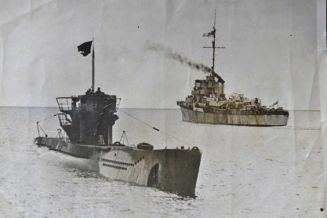
HMS Byron

HMS Byron taking the German U Boat fleet surrender at Scappa

My late father in law served in the Arctic Convoys, as part of the 21st Escort group on board HMS Byron. At the end of the war, he was on board when the ship was sailed back to the United States.

The last remaining vessel from this period, which saw service in the Arctic Convoys is docked on the Thames and available for visitors. You can read about HMS Belfast here

Taking part in the A-Z Challenge for 2020

Posted in A-Z Challenge 2020 - Specialised Studies, Genealogy, One-Name Studies, One-Place Studies, Specialised Studies | 7 Comments

A-Z Challenge 2020 – Specialised Studies A is for Agriculture and Farms

Specialised Studies

Created by Julie Goucher using wordclouds.com March 2020

A great many genealogists have agricultural labourers in their families; and the same can be said of those with a One-Name study.  The focus is not going to be on the individuals necessarily, but opportunities to research the employment of the labourers and their methods of working. You might be researching the Farms themselves or just wanting to add context to the lives of our ancestors and their peers.

The British Agricultural History Society has a very informative website and if you look under the menu of search and then scroll to the bottom to find rural museums you are presented with a list of venues to visit with a link to their websites. The option of searching for other societies also provides more links, including one site that is about carrots!

I am from the south east of England as were the majority of my maternal family going back generations. One such venue, linked from the venue’s list above, was Gilbert White’s House and Gardens at Selbourne which is relatively close to the villages on the Surrey and Hampshire border where my Harris, Holt, Elstone, Budd and Bridger families lived, some of whom worked and owned a paper mill and did not work the land.

(As I was writing this post I noticed that Gilbert’s wife had Holt as her maiden name, so that is now added to my to do list!).

Natural History of Selborne

Gilbert White is also well known for his book, The Natural History of Selbourne which was published in 1798. The copy shown here is with the most recent cover by Penguin, my copy is around 30 years old and has a different cover. The book itself though can be read and downloaded online from HERE, free of charge.

The Museum of English Rural Life which is part of the University of Reading is also an interesting place to visit in the physical sense but to explore online too with the search and browse feature of the collection. There is also material on the Women’s Land Army from the Second World War which can be located here.

I was educated in the south east of England and one venue that was a frequent destination for school trips was an open museum. Originally it was known as Singleton open air museum, though now it is known as Weald and Downland Museum. I had not been back for years, though we organised a visit about five years or so ago. The reason for the visit was to see the watermill in particular.

The watermill was originally located at Lurgashall in Sussex, which was the very place my great, great Grandmother, Mary Elstone, nee Denyer (1838-1913) was born and lived in. She would have, without a doubt, seen this exact mill in operation. To stand in front of something that she would have seen in operation as she went about her activities in the village was something very special and I was very glad to have made the journey. The museum has a library and the catalogue can be searched HERE and you can also see the museum magazines online.

The museum has a Farming and Livestock section on their website, so it is possible to see a glimpse of what farm work was like in the time of our ancestors. If you would like to see a map of the museum, you can do so here and the watermill is located at C9

There are lots of opportunities to undertake specialised studies – farms, places and even perhaps water mills! By working on a specialised study, even in the short term, means we can explore the history and context of the places, farm, work etc of our ancestors, thereby adding some flesh to the bones of our people.

Taking part in the A-Z Challenge for 2020

Posted in A-Z Challenge 2020 - Specialised Studies, Genealogy, One-Name Studies, One-Place Studies, Specialised Studies | 9 Comments

Q & A – Citations and Repositories

Q & A

Created by Julie Goucher – Feb 2020 Using Wordclouds.com

Hi Julie, I enjoyed the online Chat and just read the evening one so have ordered the book mentioned.

I’ve managed to get RootsMagic to work on my Mac – I don’t think it will link to anything online but. For the time being I will use this to start inputting my X records.

So, a question for you please? downloaded a lot from Durham Records Online so want to credit them with the information, is that what I should be doing? I really want to get source information right from the start but am puzzling about how to add the following to RootsMagic.

I have removed the identifying details from this part of the email I received. I have already answered, but though that I would share the response here in case it was of interest.

The majority of software, which includes Roots Magic is that the pre-loaded information is referring to material from the United States. The way I navigated this issue was to use the free text information and created my own information, and in doing so was perhaps vague, but vague for a reason.

Rather than list all the possible records, so there were multiple entries for Parish Records, I record baptisms, marriages and burials as Parish Records and then use the Repository option for any details. The other reason for recording in this way is that some of my research occurred before the internet and therefore I physically went to the archives and look at the actual register or used a microfilm of the register. In some of those cases I paid for copies of entries or the page. In the modern era, we can access material online, the source stays the same, but the medium for the access has changed.

Just recently I was working on something that related to my family in Surrey. I recorded the record like this:

Puttenham, Surrey, England – Parish Records. SHC (Surrey History Centre) PSH/PUT/… accessed via Ancestry 26 March 2020, accessed via the register at Guildford Muniment Room April 1990.

Whilst Ancestry is not a repository in the strict meaning of the word, it is more relevant to record it as that, than as a source. Ancestry (and any of the other providers) do not own the documents, what they have is a license to digitise them and in some cases the license may be revoked or not be renewed and switch to another provider, simply in the course of normal business practice rather than because of anything inappropriate.

I am of the view that I would rather a brief citation than no citation. I have a bit of citation tidying to do, which I hope to achieve later this year. Like with anything, it is always good to reflect on practice and see if a change is required. I wrote earlier about Citations and Sources and you can find those posts HERE

Posted in Genealogy, Q & A, Sources & Citations Series | Leave a comment

Introducing A-Z Challenge 2020

Specialised Studies

Commencing 1st April, subscribers and readers will be seeing posts every day (apart from Sunday) about Specialised Studies.

A specialised study is a project or study based upon something specific. Each of the posts will be based upon the loose theme of genealogy and local history, each one accompanied by at least one resource that you might find useful, whether or not you are focusing on the actual study shown. For those working on a One-Name Study you should find the series useful as it will give you further opportunities to search for individuals!

Over the course of the month, we shall meander through the alphabet, starting with A on 1st and ending with Z on 30th, by which time I shall likely be in need of a rest!

I hope you enjoy the series and please, do comment!

Posted in A-Z Challenge 2020 - Specialised Studies, Genealogy, One-Name Studies, One-Place Studies, Specialised Studies | 4 Comments

Q & A – Study Starting Point

Q & A

Created by Julie Goucher – Feb 2020 Using Wordclouds.com

Hi Julie, I have collected some Census information, Marriages and Cemetery Records for my one name study. I would like to start entering individuals into Roots Magic. The marriages have spouses and marriage dates but no age or parents for the early marriages.

Would you suggest I begin with Census, marriage, or cemetery records? Once I enter an individual or married couple should I enter all of the information I can find about this person/couple from all my sources? Or stick to one set of data at a time and add all the individuals in that source before adding other information from other sources? I’m itching to begin playing with Roots Magic.

This was a question posted to me via email. I have removed the individual’s name, so they cannot be identified and whilst I did answer the question privately I thought I would also share it here. Firstly, there is NO right or wrong way to start entering data into your program of choice.

I responded by saying that I would start with a marriage of an individual. I then went on and said that I would likely continue with marriages, but sometimes it is useful to flesh the married couple out further, either as individuals or as a couple. Regardless on the method you choose, sometimes there are individuals whether in your own family or not, study or not, who are just interesting for whatever reason and then you want to flesh out their lives using material across a variety of data-sets.

As long as you keep a log of what you have done, you will not waste time or repeat work.

I also commented to try both methods, so enter a few marriages then switch to entering a couple where you flesh out their details. Which way seems the most natural to you? Once you know the answer to that then you will be off to a flying start. Remember though, you can change your methodology when it suits you. Just remember to cite sources and make notes in your research log and your to do list.

Posted in Introduction to One-Name Studies (Pharos course 901), One-Name Studies, Practicalities of a One-Name Studies (Pharos Course 903), Q & A | Leave a comment

Desk Ramblings (28)

Desk Ramblings

Created by Julie Goucher, July 2019

I am not planning on turning this post into a discussion on COVID-19 because discussions are everywhere; and not all of it accurate.

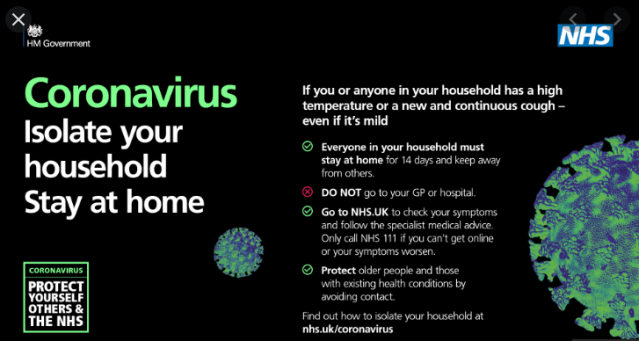
I am a news junkie, so I watched the news very frequently last week. Because of a health condition I am classed as “vulnerable” as is my  husband, so we were advised to practice self isolation and if we did go out to practice social distancing. By the end of last week the situation had changed and the Country was told that individuals should stay home, only venturing out for essentials. Then, over the weekend, we went a stage further. It was a directive to stay home. Pictures filled our news screens of jammed packed tube trains as people ignored the sensible directive to stay home.

Covid19

Courtesy  – NHS England 2019

My mind turned to the Influenza Pandemic of 1918, also known as Spanish Flu, where 500 million people were infected. I have no idea how my family felt of the situation as there is no written word in our family papers and no one is left to ask. That is of course, different to future generations of my family, because I have made numerous references in my journal.

So, whilst we are locked down, not allowed out apart from essentials and for exercise I have been keeping busy, doing an assortment of tasks and writing – rather too much of the former and less than I would like of the latter. My office is still a room in transition from when we moved here 18 months ago. I have been reorganising a few things, though I use the word reorganising rather loosely!

Carver Box

Curver Boxes 2016

It started about three weeks ago when someone wrote to me about a Butcher family in my part of Surrey. I read the email and recognised the names. I went to the filing cabinet and located the file marked Butcher.

It was bulging and there was a note, written by me, directing a future me, as the note had been written in 2016, to a Curver lidded container with a picture of a Highland Terrier, where I would find more Butcher material. I looked for the box and there it was located next to my comfy chair where I had placed a stack of folders on top and behind a stack of books for some reorganisation. I set about moving the material. After an hour, I had accessed the box, and gone through the contents. The material in the box is Butcher material to be digitised or added to my study, except the item I wanted was not in the box. After a couple of hours, after sorting a few assorted piles of paper that was awaiting filing, I had not found the paper. I was being to panic – I recalled the last day I had the paper, it was recycling day, had I put the paper in the wrong place?

At 3 am the following morning, I was up early and heading to the bathroom, when I recalled where I had put the paper. My iPad case has a slip pocket in the front and I do have a few papers in there. I tiptoed into the bedroom opened the drawer next to my side of the bed and extracted said iPad. Making my way to my office I put the light on, sat down and extracted a few sheets of paper, including the sheet I had spent considerable time seeking the day before. The moral of this story is always put away papers you get out.

“Be a filer, not a piler!”

The latest Pharos course on One-Name studies started last week, just as I shared  a day or so ago. That is going well and I am keenly awaiting feedback and comments from the first cohort of students.

The only other news is that I came across a notebook series made by Moleskine a year or so ago, smaller than the usual size and a mixture of plain and ruled paper, the latter is on the right of the notebook. It also has less pages. I ordered one and eventually began using it, finishing it at the end of last week.

Next up, is another Moleskine, and this time I have opted for the Moleskine expanded (400 pages) and in plain paper. As my planner is also Moleskine and I use the same pens as usual (Uniball Eye), I was disappointed to see the paper is a little different, in that there is ghosting on the reverse page. I am six pages in, so for 394 pages I am going to be driven crazy unless I switch pens (not going to happen!), so I had best get use to the paper & ghosting. In case anyone wants to see this, here is the option that I bought, but I notice the price has significantly increased from the £17 I paid. On further checking I see the price on Amazon mirrors that on the UK Moleskine.

I am hoping to have another post up later, after I have dealt with a few domestic chores whilst the sun is shining!

Stay safe everyone!


Posted in Desk Ramblings! | 3 Comments