Pursuing Surnames:The History of Surnames & The Benefits of a One-Name Study

logo

Courtesy of the Society of Genealogists

Sadly, due to the Covid-19 Pandemic, my Surname talks to be held at the Society of Genealogists on 16th May 2020 has been postponed. Instead, the talks will take place online on Wednesday 3rd June 2020 at 2 pm British Summer Time (BST) for the first presentation and at 5 pm (BST) for the second talk.

Here is the details from the Society of Genealogists website:

In this first presentation, Julie Goucher will deliver an overview of what a One-Name Study is and why one is of benefit to family historians. We delve into the history of surnames in general, types of surnames and any differences in relation to non-British surnames. We also explore considerations of why some surnames may change, overtime as well as variations and deviations.

In the second presentation of the day, we spend some time looking at the foundations and practicalities of building a study, collecting data, surname distribution and analysing information. We then look at the considerations in keeping a study and what you can do next to advance your quest in pursuing surnames.

You can book this first presentation HERE and the second presentation HERE.

Posted in Genealogy, One-Name Studies, Presentations | Leave a comment

European Ancestors – Researching Italian Roots

Italian Flag

Italian Flag – Courtesy of Wikipedia

I won’t pretend researching Italian and Sicilian ancestry is easy. It isn’t, but if you do your ground work in much the same way as you build a house, from solid foundations you will be off to a good start.

So here are a few top tips to consider:

  • You will need to know the exact town your Italian or Sicilian ancestors came from
  • Track those with the same surname or those that hail from the same place.
  • Remember, in Italy women use their maiden name.
  • Understand the history, economic, political and social aspects of researching in Italy & Sicily
  • Understand the part that religion plays in the lives of your Italian ancestors
  • Explore whether your place has been the focus of a thesis or other work.
  • Become familiar with naming patterns – it is not fool proof but might help!

Before you start researching in earnest start reading and discovering the country; read books about the history and culture, explore the religious festivals. By doing these things you are building your research foundations. You are exploring your ancestor’s country, their religion and what was important to them.

If your ancestor arrived in the UK, then you very likely have family members that migrated to the United States also. You perhaps know or have an idea of when your family entered the United States. Perhaps you have searched passenger lists but cannot find them. Here are a few more considerations:

  • Did they enter through Canada and travel down into the United States?
  • Did your ancestor eventually end up in the United States, but where were they previously? People do not always migrated in straight lines. That might mean they travelled as far as the money would allow and meant spending time elsewhere, prior to arriving where in the final destinations. Perhaps they never arrived in the intended destinations – perhaps they fell in love or changed their mind because of other circumstances.
  • Look at the surname, is that the surname that left the homeland with? Yes, on occasions names changed in the new country. Play with the name. The sister of my grandmother, Rosanna Licata entered the US under her maiden name, despite being married to Giralomo Mancarella who was often recorded as Mangarella or Mancarelli. Explore the possibilities and record your positive and negative results.
    • Look at the surname distribution site gens.info – where does the surname appear?

      Torella

      Distribution Map from Gens.Info for the surname for Torella

  • Perhaps the passenger list has your ancestor but the place of residence is simply recorded as Italy. What now? Look at others on the vessel. Whilst it is not absolute, it was common for people to travel together from a town rather than travel alone. Perhaps there was a migration scheme and a number of people from the same town went together.
  • Be mindful that our ancestors might have sailed from the cheapest port, rather than the nearest port.
  • Once you have found them on the passenger list look to see who the person was they named as a contact. They are probably a relative or a friend of another relative. Remember Italians are all about family!

In the First World War, Italy was an allied nation, meaning that Italians were called to arms, whether that meant joining the military in the United Kingdom, United States or even returning to Italy – you can read about the way Italy commemorated those that died as a result of the First World War HERE.

I have frequently mentioned the place my family hailed from, a small place called Sutera in Caltanissetta. Sutera is a rural community which meant the pool of people that an individual could marry was pretty small. What I found is that the same surnames kept popping up as individuals married and upon researching further I would discover the same surnames appearing in my research. Ironically my maternal line does something very similar in England!  Marrying family members or marrying into the family of in laws meant that what assets there were could be retained within an extended family group.

Over a decade ago I discovered that Sutera had been the focus of a thesis by an academic in the United States. I ordered the book and eventually it arrived. I also contacted the author and asked her for any insights and did she have any material that had not made it into the published works. She did and since then we have corresponded several times. Explore that possibility. While Sutera is not large, it has been included in a number of books. Explore every possibility.

The biggest challenge is the language unless of course you are fluent. I find researching my Sicilian ancestry takes me three times as long as my English research, but I also yield more information from records. FamilySearch has done a sterling job of getting records online, for some I cannot see the actual record, but a transcription. I can then search for the record on other sites and read it, using the established transcription as a way of checking and double checking my reading.  I have been reasonably lucky and between three sites I can often research and fill in the gaps.

Important sites for Italian and Sicilian research include:

  • FamilySearch – and there is also some great material in the learning center.
  • Ancestry – this is linked to the Italian site, but I find also searching the complete Ancestry suite of sites especially helpful. I located a Licata relative in the US before I had actually any proof he had migrated because I searched by removing the surname completely and inserting Sutera. The relative was located because I specified Sutera, he was actually recorded as a Licata.
  • Ancestors – Archives for Master Search – this is an amazing site and has material from 51 Italian state archives. It has many of the records that are on FamilySearch for Caltanissetta.

For my own research I regularly move between the data on FamilySearch, Ancestry and the material located at Ancestors. The Ancestors site does have variable material depending on the region in Italy.

Reach out to others that are either researching the same names or the same places or both. You never know where an email conversation will take you. Also consider a DNA test. Does a project exist? While surname DNA projects only exist at FamilyTree DNA (FTDNA) explore your options. Upload the results to Gedmatch. Italians are not especially interested in DNA, so it is not going to be a quick win, but test, because you never know!

Look for a naturalisation record. Sometimes they can be a font of information. The naturalisation record for Giralomo Mancarella confirmed that his wife, Rosanna died in New York in 1922, despite Rosanna death being recorded in Sutera. From that information I was able to send for her death certificate.

Here are a few of my favourite resources:

Good luck getting started!


Posted in European Ancestors, Genealogy, Italy | 2 Comments

A-Z Challenge 2020 – Specialised Studies Z is for Zoology

Specialised Studies

Created by Julie Goucher using wordclouds.com March 2020

I am sure there are a number of genealogists out there pondering how zoology could be linked to genealogy. I was curious too.

One of my Butcher ancestors, migrated from Surrey in 1814, selling the family home and most of the assets and migrated to Tasmania. My initial question was, what was the catalyst that drove that huge move? What inspired the family?

I decided to focus on what I did not know, and turned my attention to the various gaps that were in my genealogical database. The first gap related to the wife of this particular ancestor.

John Hunt Butcher married Sarah Burchell in London in 1808. I clearly had John’s wife, but I had not, at that point established her parents. When I did, I could clearly see the driving force. I then spotted that John’s sister, Suskey married Sarah’s brother, George Matthew Burchell in 1810.

Sarah and George Matthew Burchell were the two youngest siblings of a family of 9. The oldest, William John Burchell (born in 1781) was known as an explorer and botanist. He had been working at Kew Gardens before embarking on his expedition in 1805.

I have undertaken quite a bit of research on the family. William maintained quite a collection of exhibits he had collected, he wrote journals, papers and was a talented painter, especially in watercolours. Several of his siblings migrated to South Africa in addition to his sister Sarah and her husband going to Tasmania.

4ad41-sapoa-burchell-s-zebra-national-animal-of-botswanaSo, the link to Zoology?

Well, there is a Zebra named Burchell’s Zebra which has been featured on stamps, this one is from Botswana. I also have a post card. I figure they are cheaper than buying a zebra to illustrate my genealogical research!

Posted in A-Z Challenge 2020 - Specialised Studies, Butcher One-Name Study, Ephemera, Postcards & Stamps, Genealogy | 2 Comments

European Ancestors – Andorra

Andorra Flag

Flag of Andorra courtesy of Wikipedia

Andorra is a tiny country within the Continent of Europe, located in western Europe and sharing borders with Spain and France.

The official language spoken is Catalan, but also Spanish, French and Portuguese is spoken. The country is not within the EU, but the Euro is the currency of use.

The flag shown here was standardised in 1993 just after the country joined the United Nations, but variations of the flag have existed since it was created in 1866.

Andorra has 7 parishes

  • Andorra La Vella
  • Canillo
  • Encamp
  • Escaldes-Engordany
  • La Massana
  • Ordino
  • Sant Julia de Loria

In 1900 the population was recorded as just 5,000 and by 2014 had risen to 85,458 according to the World Fact Book.

The main religion is Catholicism with a small Jewish population and a small Muslim community, which comprises of people mainly from north Africa.

The following are some useful links for researching in the Country:

And one last link, which is new to me, Free Surname Search which appears to have gems from across Europe, with many seemingly linking to https://geneanet.org. I have only explored this a little, so if you do find anything not appropriate or inaccurate please drop me a note.

Posted in Andorra, European Ancestors, Genealogy | Leave a comment

A-Z Challenge 2020 – Specialised Studies Y is for Your Family

Specialised Studies

Created by Julie Goucher using wordclouds.com March 2020

As genealogists we work back, from ourselves, through our parents and their generation, to our grandparents and great grandparents, but in addition to that, we are surely also part of the narrative.

We are part of our family and that includes any such research we undertake. In the years ahead, descendants will want to know about you and how that written version of you connects with the summary and assessment you have made of your ancestors. That opinion formed by research, notes, heirlooms and photographs.  It is as we work on our own family that we encounter something in their life that fascinates us so much we develop our own focal point and establish a specialised study. Our trigger to that study will vary. It might be a shared interest, or something more random.

For me, I developed several such studies – largely that connect to the towns and places where my ancestors lived but so too have I considered a few other matters, all health related. Does my Endocrine issue stem back to my generics? I encountered over the years several individuals who descend from my Butcher family. The common ancestors are my three times great Grandparents John Butcher (Woolgar) 1795-1877 and his wife Mary Baverstock. One cousin, like me descends through John’s son Charles born in 1823, another in Canada descends through John’s son William born in 1825 and another who descends through John’s son James born 1835. The question is

Is this a genetic issue, something that has followed the generations or is it nothing more than coincidence?

Over time, I have researched and read quite a lot concerning this and whilst I believe it is a genetic issue, that hardly makes it a scientific response. I have also explore other associated conditions and again that could be coincidence, but not necessarily. Over the coming year I hope to lay out my research further and a review of it might even be published here.

Taking part in the A-Z Challenge for 2020

Posted in A-Z Challenge 2020 - Specialised Studies, Genealogy | Leave a comment

A-Z Challenge 2020 – Specialised Studies T is for Tartans

Specialised Studies

Created by Julie Goucher using wordclouds.com March 2020

Tartans are a significant part of Scottish identity and heritage; though not every surname is represented by a tartan.

People traditionally where a tartan which reflects their surname or an associated family. Alternatively they may decide to wear the tartan representing the town in which they or their family resided in.

In the photograph here, taken by myself last December in Newton Stewart, Dumfriesshire, the pipe band are celebrating St Andrews’s Day and wearing the Stewart Tartan

St Andrews Day Newton Stewart 2019

Copyright Julie Goucher 1 December 2019 Pipe Band, Newton Stewart, Dumfriesshire St.Andrew’s Day 

Those interested in focusing on Tartans and how they may connect to a particular family line, might find these two websites useful

I have no Scottish ancestry, but one of the surnames, (Ironside) that I am researching is one that is found in Aberdeenshire, the family moved across the border into County Durham, then down to Dorset in the West Country of England and then a branch migrated north (ish) to Surrey, which is where my link pops in and connects to my Butcher family. Despite this, there is no historical tartan for the surname, but there is a tartan that was created for a specific event

Ironside Tartan

Courtesy of the Scottish Register of Tartans

3rd July 2001 – Estimated count for display purposes only. A restricted tartan created for the Golden Wedding Aniversary of John T. and Frances A. Ironside of a farming family from Methlick, Aberdeenshire.

I can see why tartans have appeal to those who are researching their heritage, it is as though there is an invisible piece of elastic linking to forebears and making that connection.

After the Battle of Culloden in 1746, the government in London passed an Act of Parliament, in which Highlanders were disarmed and the wearing of tartans outlawed. Highlanders were subject to the strict enforcement of those rules and by the time the legislation was repealed in 1785, Highlanders apparently had become accustomed to wearing usual apparel.

The revival of the wearing of tartans did not begin until 1822, when George IV suggested that everyone who was attending the formal functions should wear their respective tartans, or Clans Tartans.

Clan Tartans are appropriate for the populous to wear in the event that an individual does not have a specific tartan. Royal tartans are only permitted to be worn by members of the Royal family. There are also other restrictions, such as this one, belonging to the White House Historical Association which was created to promote the work of the Scottish stonemasons in the building of the White House in Washington DC, United States.

Other links which might be useful to explore:

Taking part in the A-Z Challenge for 2020

Posted in A-Z Challenge 2020 - Specialised Studies, Genealogy, One-Name Studies, Scotland, Tartans & Clans | Leave a comment

A-Z Challenge 2020 – Specialised Studies S is for Special Events

Specialised Studies

Created by Julie Goucher using wordclouds.com March 2020

Perhaps an unusual specialised study is focusing on special events, those around a certain theme, or events that took place during a specific time period.

A special event that is topical for the current climate, on a global scale, is around the unprecedented reaction to COVID-19.

Since the outbreak began, I have been following with interest. I have referenced it a number of times during my daily journaling and groups of archivists are battling with the approach to address the historical event the situation has created. During my daily writings I have recorded the death rates declared each day and identified that those reported are significantly less than the likely number, as they reflect those who passed away in hospital only and do not currently include those who have passed away in accommodation settings, such as residential and nursing homes or prisons.

I have also commented on the handling of the situation by the Government, both at Westminster and in the dissolved administrations in the nations making up the United Kingdom. I too have focused on the severe hotbeds of activity in other countries, such as Italy and Spain, with a hypothesis for the high numbers and how it is affected by the various population demographics.

Will my daily recordings prove to be of great historical value, yes and no – they are the personal writings of me, therefore unique in the very nature of personal journaling. As a collective with others, that would be quite interesting to review, how do my views compare with others. I too, have commented on the impact the pandemic has had on pharmacies, both hospital and community based, the impact of retired and former staff of the profession and wider, across the whole National Health Service (NHS).

Sadly, not all special events are joyous in their nature; and in the case of COVID-19 it represents what is not just unprecedented in this country, but globally and I do not believe there is one household or individual who is not affected by this event, whether that is because usual routines are changed, countries on lock down, financial assistance from a government not known for it’s public spending, or because of the community outreach.  Whatever effects it has on you and your family, please document it, because those recordings will, going forward be of value to historians.

Whatever you write, whatever your personal experiences are, I do not believe that we are all individually unaffected by this and as such even once lock down is relaxed I do not believe we will return to “normal” We have all had to make changes to our lives and whilst those changes may be for the short term, there maybe significant reflection and perhaps, just perhaps those changes will remain. Reflection is a valuable tool.

The Mass Observation Archive are encouraging people to write about the pandemic and you can read further about it HERE.

Taking part in the A-Z Challenge for 2020

Posted in A-Z Challenge 2020 - Specialised Studies, Genealogy, Health, Stationery, Filofax, Journals & Notebooks | Leave a comment

A-Z Challenge 2020 – Specialised Studies Q is for Questions

Specialised Studies

Created by Julie Goucher using wordclouds.com March 2020

As any genealogist will tell you research begins with a question, researched to find an answer and then several questions emerge and off we go again!

This roundabout of reflection, questions, learning happens of course quite seamlessly, to the point that the researcher does not realise they are happening, and  that is the element that researchers need to focus on – Awareness of the Research Process.

Research Process Image

Designed by Julie Goucher – Copyright April 2020

Stay tuned for a mini-series focusing on this, in early May.

Taking part in the A-Z Challenge for 2020

Posted in A-Z Challenge 2020 - Specialised Studies, Genealogy | Leave a comment

A-Z Challenge 2020 – Specialised Studies P is for Places – Towns, Villages and Hamlets

Specialised Studies

Created by Julie Goucher using wordclouds.com March 2020

We all call somewhere home and home might not be where we live. I lived in Devon for more than 20 years, and in the whole of that time, it never, not once felt like home. When we relocated 400 miles north, within a few weeks, our new home, did actually feel like home. Ironically it was my husband who had the hardest time readjusting and he was born in the area we relocated to.

What is home? For me, home will always be the south east of England. My family, or at least my maternal line is from there and has been for at least 300 years. Over the last 30 years, I have researched those town and places that have featured in my genealogy.  Equally though, Sutera in Sicily is also a source of interest and curiosity. It is the location of my paternal family and is very much of me as the south east of England.

When we focus on a specialised study, the websites and organisations we will explore will vary dramatically and studies might indeed reflect a variety of topics, not all of them are geographical places. With so many variations, I have elected to share a few resources with you that can be used across the globe, depending on where your study takes place.

  • eBay – In the post I wrote back in February, I explained how to set up a search for a surname. This was following my article in Family Tree Magazine. The same can be applied to a place by changing the search parameters.
  • Google Maps – This can be used irrespective of locations. This can help with identifying various locations within a place, so a church for example. It can also help with the identification of nearby places and towns.
  • Maps – Following on from the point above, nearby places can also reflect and include new locations, established as urban grown has occurred. Therefore it would be useful to have a mixture of electronic and physical maps, as that will show when urban growth has occurred.
  • Local History – identification through local reading clarifying if events that would normally have taken place in one venue, in fact took place in another. This might be because a church had restorative work and thereby events would have taken place in a nearby church.
  • Clerics – The clerics who supported our places in previous Centuries were very often the key to the recording of people in those places. I wrote HERE about two such individuals who did just that in two locations where my various family lines were located. The records written by Kerry and Laverty, which I referenced in the linked page above, left such a rich archive and resource. It is worth noting that whilst Kerry documented a Surrey parish in his manuscripts, the actual manuscripts have been deposited in his native county of Derbyshire.
  • Context – Understanding the context of places and people of previous Centuries is paramount to a successful study. It is important to understand the social, economic and political position of the locale. Those strands at local level might have been affected by something that was happening at a national or even international level.

What follows is a list of resources that might assist your study, or perhaps give you similar guidance on resources in other Countries.

  • Census Records
  • Occupational and Work opportunities
    • Mines
    • Textiles
    • Landowners
    • Retail providers
  • Birth, Marriage and Death Records
  • Burial Records
  • Cemetery Records
  • Military Records
    • Enlistment
    • Active Service (impact of War)
    • First World War – I wrote about The Italian “Golden Books” HERE which honours the Dead of the First World War
  • Organisations

Researching places, can be anything – a house, road, hamlet, village, or even in some cases large towns or regions if the area is driven by, perhaps an occupation. Where you might find material is limitless, indeed you are only limited by your imagination!

Taking part in the A-Z Challenge for 2020

Posted in A-Z Challenge 2020 - Specialised Studies, Genealogy, One-Name Studies, One-Place Studies | Leave a comment

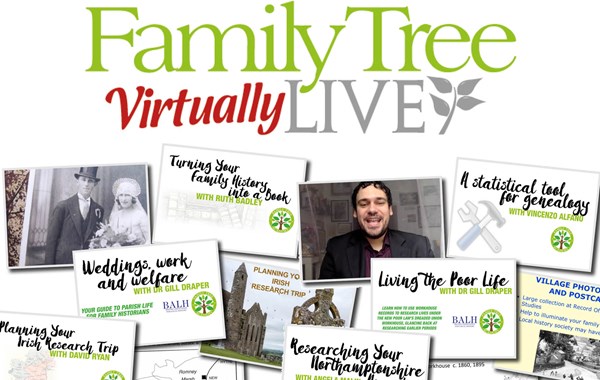
Family Tree Virtually Live 17 & 18 April 2020

FTvirtuallylive

Copyright – Family Tree Magazine (UK) & Warner Publishing 2020

Sadly, with the COVID-19 epidemic, Family Tree Live 2020 has been cancelled, but the folks at Family Tree Magazine have kept working on the event and turned the event into a virtual one, which is fantastic and means the event can be on a global scale.

The Family Tree Virtually Live event can be found HERE, free of charge. There is a mixture of presentations online, released in two batches, some on Friday and the rest of Saturday (18th April). There is a virtual goody bag also that can be downloaded.

I was due to teach two workshops, but have turned one into a shorter presentation than usual and provided two freebies to accompany the presentation – this presentation will be available from Saturday.

Image Intro to ONS

Copyright – Julie Goucher  March 2020

All videos are freely available to watch until 24 April, after which they will only be available to Family Tree magazine subscribers. The magazine has a subscriber deal available which you can see HERE. If you want to keep the conversation going or to ask questions, just send a direct message to the FTM team on Facebook or comment with the hashtag #FTVL

Posted in #FamilyHistoryLive, Advanced One-Name Studies (Pharos Course 902), Archive - Imported from Blogger, Genealogy, Introduction to One-Name Studies (Pharos course 901), One-Name Studies, Practicalities of a One-Name Studies (Pharos Course 903) | 1 Comment