Q & A – Keeping a Journal

Q & A

Created by Julie Goucher – Feb 2020 Using Wordclouds.com

One of the readers who asked about blogging, also asked about how they could journal.

Julie, I have admired over the years your posts about journalling and am amazed that you have kept a journal for decades. How do you do it?  M

I don’t have all the answers about journal keeping, but I can share a few tips and thoughts and hope they help.

  • Select a notebook and pen that you enjoy writing with.
  • Date every entry
  • Use ink if possible, of course if you are arty then you should use whatever instrument appeals
  • Number pages if the journal does not have them
  • At the beginning of the book keep a few pages for an index (hence the page numbering!)
  • List why you are keeping a journal – here are a few ideas
    • current interest
    • worries
    • obsessions – hobbies, books
    • projects
  • Decide what your journal is to include
    • All or specific things
  • Keep a pen with the journal
  • Entries do not have to be daily
  • The journal does not have to be an expensive one – just one you want to write in.
  • Decide how you are going to archive your journals

I love stationary. Nothing fills my heart with joy more (except genealogy and books) than a stationary shop. The trick is going in and leaving without purchasing – something I rarely manage. Choose a notebook you love – if you invest in selecting a book you are more likely to keep writing.

I write all sorts in my notebook – I keep a planner separately and that holds my commitments and to do list, whereas my notebook and journal is for everything else. If I look at the current (a Moleskine expanded plain) notebook, I have some entries of research from FamilySearch and Ancestry, the next page has note on a book I was reading then the following three pages are about COVID-19. In addition I have professional development material. I do have a A5 Filofax that I am using for planning blog posts. The Filofax never leaves my office, but my notebook wanders round the house with me. As I said it is a Moleskine expanded, so it.has 400 pages, I started this in March and will finish it at the end of June I expect. I also have a health and medical notebook which lives in my office and is used when I need to note things,

My journals are numbered and live in a draw in my filing cabinet along with planners from past years. Each notebook has a label on with the start and finishing date on it. The most recent notebooks – the last three are next to my desk, because they have material that I am going to share here. Eventually they will move to the filing cabinet. Research notes are transferred to my genealogical program as soon as I can.

There are positives and negatives for keeping lots of notebooks – I tend to use only one as I have described here, because otherwise I found that I would want to note something and then did not have the right notebook. That still happens for my medical notebook, but I make those notes and transfer them.

Over the years, I have switched and expanded how I keep my journal and what it contains. It is more like a “Common Place book” Here are a few useful links:

BLOG Posts ImageDon’t make keeping a journal complicated. Let it reflect you and your interests. If you want to stick bits in then do, if you want to draw, pictures or genealogical trees then do – I am no artists, but I do have genealogical trees in my notebook! (and I stick bits in!)

Your journal will be an unique as you, so enjoy it!

Happy journaling!

Posted in Q & A, Stationery, Filofax, Journals & Notebooks | 1 Comment

Q & A – Blogging Tips

Q & A

Created by Julie Goucher – Feb 2020 Using Wordclouds.com

In the last few weeks I have received several emails about blogging. Here is just one of those questions

Julie, I have been considering starting a blog for my surname study and my own genealogy. I wondered if you could recommend what I do about comments. Thanks P

Over the last year or so I have had quite a few comments and questions about blogging. In the past I have replied via email, which I have done in this case, but I am also sharing as a Q & A.

On the recent Practicalities of a One-Name Study course, there were several comments and questions about blogs and their use in publicising, publishing and preserving a One-Name Study. Firstly, the Guild of One-Name Studies have agreed to a pilot of the Guild Blog Project. The project will enable all members to have a blog which will be preserved. This also is available to those without a study.

This blog is located on the WordPress platform. I have a domain name (anglersrest.net) and I pay a small amount a year to have adverts removed. The amount payable is about £36 and then I pay for the domain name, so around £50 a year.  A blog is a great way to have a conversation with others and it takes a little while to gain followers and comments from others.

BLOG Posts ImageI have several things that I think is important and recommend to those beginning their blogging journey.
  1. Enable comments – it is very irritating to want to reply to a blog post to find the writer has turned off commenting – that is also going against the core of a blog.
  2. Enable people to receive posts by email, a great number seem to only activate posts to be read in the reader. Some I prefer to read in my email.
  3. As you post your blog, enable the facility to share those posts via Twitter and Facebook, assuming you have those social media outlets.
  4. A blog is, as the image says, a space to write your own adventure. It is your space, so write about what interests you. I write about genealogical posts mainly, either general posts, or those about surnames or European research. Just recently I had several people unsubscribe because I wrote three consecutive posts in the Farnham Papers series. I also occasionally write about books and I also  write an irregular Desk Rambling series, which is general and more chatty.
  5. Do not underestimate the time it takes to write a post. This post has taken about an hour. I frequently use the option to schedule posts, meaning I can write when I have spare time and then the post can publish when I am busy with other things.
  6. I tend to write in series – Oral History is just one of those.
  7. It is quite tempting to create blogs and keep things separate, and where I did follow that path, I have evaluated that and now, prefer to keep all the data and information within the platform of this site.
  8. You can easily import and export into WordPress from other WordPress sites and Blogger – in fact I have several hundred posts that I imported from my Blogger site and I need to place those posts into the relevant categories – that is an issue between tags on blogger and categories. I tend to find tags can become unwieldy and prefer categories.

I hope these points have helped, but if you would be interested in a Blog Series, please let me know in the comments.

Posted in Blog Writing Series, Genealogy, One-Name Studies, One-Place Studies, Practicalities of a One-Name Studies (Pharos Course 903) | 7 Comments

Maps as a Visual Addition to a One-Name Study & Genealogy

Surrey Map

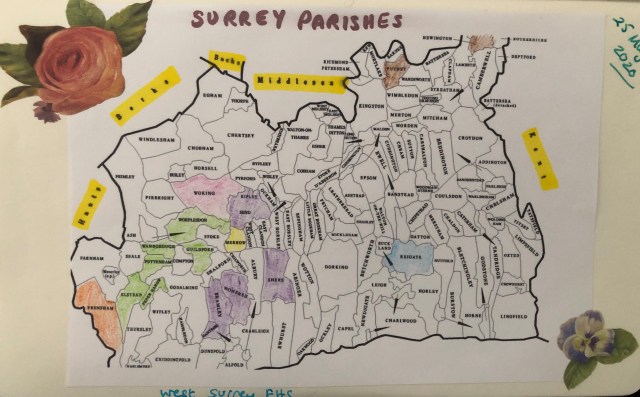
Map of Surrey parishes – Julie Goucher 2020

It is obvious that a map is a visual aid to research, but yesterday I was sitting thinking, as you do and reached for this map of the parishes within Surrey – the map is from the West Surrey Family History Society, of which I have been a long time member. The map is of course copyrighted to the Society and one of their members, June Rudman.

The map as you can see shows each of the parishes within the county and then shows the neighbouring counties, given left to right and highlighted in yellow – Hants (Hampshire), Berks (Berkshire), Bucks (Buckinghamshire), Middlesex, Kent and then at the bottom, Sussex. Given that I was thinking about my Butcher One-Name Study, from which my two lines feature in Surrey and at least one of them prior to 1705 in Sussex I wanted to see the parishes that run alongside the Surrey and Sussex border.

As the map shows, the parishes that I have coloured, with as much finesse as a three year old, my parishes are in the west of the county in the main – although this map actually features more than my Butcher lines, the pink segment is Woking which is representative of my Orlando line.

In short though, this is a back to basic step for me and how my ancestry is located in the County; and I would urge others to follow a similar pattern, if they feel the need – it was 40 minutes or so well spent (though I note my colouring has not improved!).

Even though I know the County reasonably well, it was useful to see it in black and white and to be able to focus on several locations and family groups – one example is the surname of my great great Grandmother, Sarah who had the surname of OCKLEY which happens to also be the name of a parish within the County; located on the Surrey and Sussex border.

In following back from Sarah Ockley, her parents were Peter Ockley and Maria Bolton, who married in Wonersh, which is coloured purple, Peter’s parents were Peter Ockley and Charity Collyer, they married in St Martha’s in 1773. St Martha’s does not appear on the map, but is in again in the purple bit! After they married they lived in Wonersh. Going back to the final generation I have, Peter’s father was another Peter Ockley and he married his wife, Rebecca Downer in Reigate in 1738 (Reigate is the lone parish coloured blue).

From this focus, I also noted that the use of Charity as a given name. Does that have bearings on the religious preference of her or her family? I have no notes that predate Peter Ockley and his wife Rebecca nor have I explored previously any links to the parish of Ockley.

Ockley Surname Distribution Map

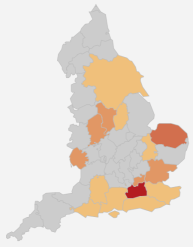
Distribution of the Ockley surname from Forebears.io

I did a search for the surname of Ockley using Forebears.io. The spread of the surname across England and Wales in 1881 is shown here with the dark red patch on the map reflecting Surrey and the next dark patch on the map is reflecting Norfolk.

Why is that the case? or is there perhaps no reasoning?

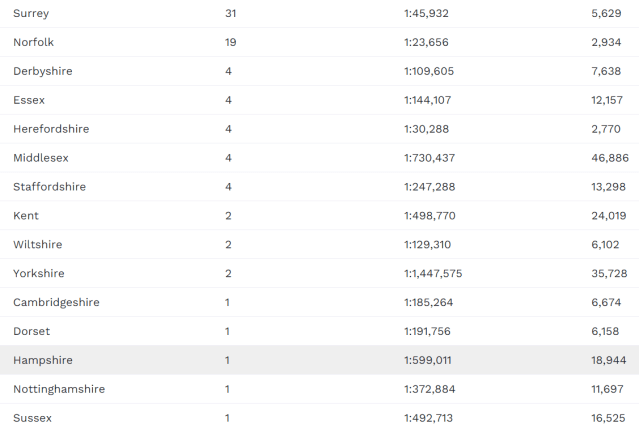
I scrolled down the page to look at the numbers reflected on the map.

Here is the results:

Ockley Numbers

The top two counties are Surrey and Norfolk, with 31 and 19 respectively. Those are significant numbers and if you look at the rest of the there is a distinct difference, between 19 and the next five counties with 4 each.

This might be something I work with whilst the next Pharos One-Name Studies course (901) is underway (starts next week!), lots to think about and mull over.


Posted in Butcher One-Name Study, Genealogy, Introduction to One-Name Studies (Pharos course 901), Ockley, One-Name Studies, Practicalities of a One-Name Studies (Pharos Course 903), Surname Distribution Maps | Leave a comment

Farnham Papers – Removal Orders (5)

Farnham Papers (3)

Created by Julie Goucher using Wordclouds.com May 2020

  • Ann PALMER, single woman to Buniton, Southampton – 8 December 1804
  • William LOVELAND Examination is for Settlement – 22 January 1805
  • Sarah KING, single woman to Windlesham, Surrey – 2 February 1805
  • Sarah CRANHAM – Note attached. Thomas ELSEY, labourer of Frimley is the father of her child – 14 February 1805
  • Thomas CROOK, from Twickenham, Middlesex – 25 February 1806
  • James LOVELOCK, Katherine his wife and children:
    • James aged 6
    • Elizabeth aged 3
    • William & Harriett both 3 weeks old – whole family to be removed to Long Sutton, Southampton
  • Ann Chandler wife of Thomas Chandler, “Thomas having run away” and children Sarah aged 3 and James aged 9 months – from Binstead, Southampton – 23 January 1808

Reference Points:

  1. Where the reference states to, that means from Farnham to that parish
  2. Where the reference states from, that means removal from that parish to Farnham.
Posted in England, Farnham Papers (October 1988), UK & Ireland (Eire) Genealogy Series | Leave a comment

Farnham Papers – Removal Orders (4)

Farnham Papers (3)

Created by Julie Goucher using Wordclouds.com May 2020

  • Sophia SMITH, single woman from Greenwich Kent – 2 April 1792
  • Charlotte GREEN aged 7 from Binstead Southampton – 5 May 1792
  • Mary BICKNELL wife or widow of William “who has not been seen or heard of for 11 years” to Binstead Southampton – 19 January 1793
  • George DENYER from Chiddingfold Surrey – 3 January 1795
  • James STONE to Egham Surrey – 21 April 1798
  • Thomas COX to Egham Surrey – 4 March 1802
  • Francis WHITE and his wife from Woodford Essex – 4 March 1802
  • Maria STOCK aged 24 an unmarried woman with child. Removal delay because of her advanced pregnancy. £13.15.6 Requested of Farnham for her keep until 22 Jan 1805 – 13 November 1804 (Reciept attached to the record)
  • Examination of Maria STOCK, John EDWARDS, Butler to Mr Sherridan the true and only father of the said bastard.

The Examination is a sworn statement made by the individual, in this case Maria, before a magistrate. The Removal Order was a warrant transferring a pauper to a place of legal settlement. The Act in 1662 enabled and indeed ordered the removal of strangers if they were likely to become chargeable on the parish. The Act of 1704/5 prohibited removal, unless the individual had become chargeable.

From this, Farnham was identified as Maria STOCK’s usual place of settlement and this was confirmed by the baptism register for St Andrews parish in Farnham where Maria was baptised on 29 June 1782, the daughter of Richard and Ann Stock (FHL Film 800470). This was further confirmed because the host parish asked for a payment from Farnham.

Reference Points:

  1. Where the reference states to, that means from Farnham to that parish
  2. Where the reference states from, that means removal from that parish to Farnham.
Posted in England, Farnham Papers (October 1988), UK & Ireland (Eire) Genealogy Series | Leave a comment

Farnham Papers – Removal Orders (3)

Farnham Papers (3)

Created by Julie Goucher using Wordclouds.com May 2020

  • Ann CROOK wife of Thomas in the Surrey Militia from Sutton, Surrey – 5 September 1781
  • William LARBY and wife Jane with their five children
    • George aged 15
    • James aged 14
    • John aged 11
    • David aged 8
    • Job aged 4 – all to be removed from Aldershot Southampton (Hampshire) – 9 September 1783
  • Elizabeth GREEN wife of David – “wandering to and fro and lodging in the open air” with children, Richard and Catherine – From Aylesbury Buckinghamshire – 25 October 1783
  • Henry BEAGLEY and Ann his wife to Seale Surrey – 26 January 1786
  • Elizabeth BEAGLEY single woman to Selbourne Southampton (Hampshire) – 14 November 1789
  • Ann BAIGENT, Single Woman aged 23 years from St Clement Danes (London) – 30 July 1790
  • George STOCK and Mary his wife from Selbourne Southampton (Hampshire) – 22 September 1791

Reference Points:

  1. Where the reference states to, that means from Farnham to that parish
  2. Where the reference states from, that means removal from that parish to Farnham.
Posted in England, Farnham Papers (October 1988), UK & Ireland (Eire) Genealogy Series | Leave a comment

Q & A – Practicalities of a One-Name Studies Course

Q & A

Created by Julie Goucher – Feb 2020 Using Wordclouds.com

Having been offline for a week or so due to being unwell, I am working through my inbox….

Hi Julie – I am considering signing up for the new course for ONS, when is the next date?

The course took a while to write and having run in early March there are a few tweaks I want to make before it runs again. Whilst there is a date provisionally scheduled, that is for 2021.

If anyone wants to register their interest with Pharos please do so and there is scope for it to run in the Autumn (fall) providing the Pharos provisions are available – to register your interest click HERE

Posted in One-Name Studies, Practicalities of a One-Name Studies (Pharos Course 903) | 3 Comments

Farnham Papers – Removal Orders (2)

Farnham Papers (3)

Created by Julie Goucher using Wordclouds.com May 2020

  • Elizabeth WINTER Single woman from Frensham – 1 April 1769
  • Sarah STENT, otherwise WICKS, Single women from St Mary’s Reading (Berkshire) – 21 July 1773
  • John BOXALL and Children
    • Daniel aged 8
    • David aged 5
    • George age 2  – all from Frensham, Surrey – 15 July 1775
  • James BRIDGER and Margaret his wife with children
    • Sarah aged 12
    • Elizabeth aged 10
    • Thomas aged 8
    • Jane aged 4
    • Lan aged 10 months  – all to Frensham Surrey – 25 September 1777
  • Ralph HARRIS and Sarah his wife with one child, Edward from Lingfield Surrey – 16 July 1778
  • Thomas BEAGLEY and Elizabeth his wife, as well as their two children, Elizabeth aged 11 and Thomas age 9. To Wield, Southampton – 21 January 1780
  • Robert BAIGENT, Ann his wife and son Robert. From Crondall – 7 November 1780
  • William HARDING to Peperharrow Surrey – 14 November 1780
  • Thomas SMITH and Joanne his wife, to Frensham – 5 April 1781

Reference Points:

  1. Where the reference states to, that means from Farnham to that parish
  2. Where the reference states from, that means removal from that parish to Farnham.
Posted in England, Farnham Papers (October 1988), UK & Ireland (Eire) Genealogy Series | Leave a comment

Farnham Papers – Removal Orders (1)

Farnham Papers (3)

Created by Julie Goucher using Wordclouds.com May 2020

  • John STOVOLD and wife (unnamed), and four children to Seale Surrey – 29 March 1694/5
  • James SPREADBOROUGH and wife (unnamed) to Dogmersfield, Southampton – 16 January 1700/1 (Dogmersfield is close to the Surrey/Hampshire Border, whilst recorded as Southampton, that is the name by which the County was known, as opposed to Hampshire)
  • John SPREADBOROUGH (aged 8), David SPREADBOROUGH (aged 5) sons of John from Stoke next Guildford – 16 May 1713
  • Sarah WEST, Quaker, to Crondall, Southampton – 1 March 1738/9
  • Mary EARLE (widow), and children:
    • Mary aged 10
    • Sarah aged 7
    • Ann aged 5
    • Thomas aged 2 1/2  all resident in Farnham and taken into care – 27 October 1742
  • Hannah STOVOLL, Single Women, Removal to Ash Surrey – 30 December 1742
  • Henry BAIGENT and Mary his wife, along with two children
    • Henry aged 4
    • George aged 2 – All to be removed to Froil Southampton – 26 November 1757
  • Judith CHITTY, Spinster and single women to Ash Surrey – 30 December 1742
  • Jane HARRIS, aged 5 a bastard of the body of Elizabeth HARRIS, single women, deceased to Crondall Southampton – 24 December 1767
  • William LARBY and Jane his wife from Frimley Surrey – 8 August 1768

Reference Points:

  1. Where the reference states to, that means from Farnham to that parish
  2. Where the reference states from, that means removal from that parish to Farnham.
Posted in England, Farnham Papers (October 1988), UK & Ireland (Eire) Genealogy Series | Leave a comment

Farnham Papers

Farnham Papers (3)

Created by Julie Goucher using Wordclouds.com May 2020

Back in 1988, I visited Farnham library. The attraction was not the rows and rows of books, but the collection of locally held material for Removal & Settlement documents. This material was of course copies, with the originals located at the Records Office.

At that time, Surrey material was held across several locations, Surrey Records Office at Kingston upon Thames, The Muniment Room at Guildford, which was located as part of the Museum and the local studies facility located at Guildford Library.

Farnham Papers 1988

Original notes taken 4 October 1988 – Julie Goucher

So, there I sat with the copies of the originals searching for a particular family. A particular family that was not easily spotted. It was not a wasted journey, because I extracted a number of other entries.

It is those entries that I am going to share, under the subject of Farnham Papers which you can access HERE. The movement of people who needed the support of their respective parish. I have glanced through the extracted entries and find that most of these entries are between towns in Surrey and Hampshire, although there are examples from parishes across London, Buckinghamshire, Sussex, Berkshire, and Essex.

These are just examples from the extractions I took and are not exhaustive. Surrey History Centre Catalogue is available HERE.

Posted in Farnham Papers (October 1988), Genealogy | Leave a comment