Blog Structure – Blog Writing Series (4)

Blogging - Spoke in genealogical wheel

Copyright Julie Goucher, May 2020

Today we are going to look at the structure of your Blog, akin to the checking out a holiday apartment – you open all the cupboards to see what is where or if this was a car, you would be under the bonnet (hood) looking at the bits!

So, what can you find under the WordPress hood?

There are a few provisions made by WordPress and what you use for your blog will depend on the physical structure you have decided upon. To help you, I am going to share what I  decided for my site. I should also point out, that adjustments can be made at any time.

Capture

The image shown here is a snapshot of my site. The individual segments are effectively “widgets” and located under the Facebook plug-in. WordPress provide the plug-in’s and widgets and they are drag and drop!

I have a search box – useful to readers and myself!. The Downloadable Documents and Links sections are similar.

The downloadable documents are those that are written by myself and uploaded to the site for readers to download if they wish. (These are uploaded into the section referred to as Media in the author control panel). Just looking at the items here, the material is in PDF format and a there is a spreadsheet all, in the form of the Research Log.

Having uploaded the items, you then extract the URL for the items, subsequently adding the URL into the Links section on the author control panel.

In the links area of the control panel, it is possible to split the links – if you look at the section below the links, marked One-Name Studies Pharos Courses, here you will find the links to those specific courses.

Just below this area you can see the Categories and Archives areas. I made the decision that I would have set categories and these are shown. The archives are listed in month order showing how many posts were published in that month.

Concluding today’s blog post – The top header image is important. It can be changed as often as you wish. You can upload your own image or use one provided by WordPress, either as a static image, or by using all the WordPress images in a randomised fashion. My own header was out of date, it must be easily more than 3 years since I changed it, which I have done today to match my Twitter header!

This is part of my Blog Writing Series. Next we are going to look at Blog posts and pages.

Posted in Blog Writing Series | Leave a comment

Communication and Sharing – Blog Writing Series (3)

Blogging - Spoke in genealogical wheel

Copyright Julie Goucher, May 2020

Blogging can be a really enjoyable pastime. It is the ability to write to the ether and a way of sharing information, whether that is sharing about books, ancestors, hobbies or keeping an online journal. One thing that is possible to do is publish posts, but at the same time keeping them private.

On the right hand side of the writing posts page there is a box marked status. Here you can choose when to publish the post, essentially you can schedule for a point in the future.

Next is the facility to publish as a public page, or a page to just admins and editors or password protected, meaning that the page would be live, but only those with a password could read it. Obviously if you chose to not share the password, then it is private and available to just you.

By definition, the concept of blogging is to share with others. As you write posts and publish them there is also the ability to link to Facebook pages and Twitter feeds. If you follow me on Twitter you will see posts that have published on this blog, you are then able to ReTweet (RT) the post which is the spirit of blogging. If you follow me on Facebook then you will hopefully be alerted to when a post is published, because it will appear in your newsfeed.

In addition to that, there is the ability to enable readers to follow this blog by the posts appearing in your email or on your blog reader.

The basic principle of blogging is to engage with others and to achieve that engagement to use social media to do so. Twitter especially has a good following of genealogists and there is the ability to connect with many others by searching the #genealogy, #familyhistory, #surnames, #AncestryHour. Ancestry Hour is an online event, taking place on Twitter between 7-8 pm (UK time). Once you have a Twitter account, you can search for the #AncestryHour and see the discussions and collaborative spirit of the genealogical world.

Comments via your blog are also welcoming and it is quite disheartening to write a post and then no one comments. Your mind fills with pondering’s – did people think it was a dreadful post, were there mistakes? STOP. Your blog will be just fine, they are easy to write, the hardest bit is just getting going!

Write, publish and share; build up a following of people and know that once it is out there the search engine’s will pick up the posts and therefore eventually appear in Google search results. Members of the Guild of One-Name Studies can add their blog to their study profile page and to the page in the wiki. For those of you reading along and wanting to get a blog set up for their study or general genalogy, you can leave a comment, let me know your name and the URL and I will find space for the list on this site and help you on the way to the genealogical ether! I have a few sites already flagged!

If you do not write about your study how will people know of you? You have nothing to loose, by trying and remember, baby steps and blogging is more like a marathon than a sprint!

This is part of my Blog Writing Series. Next we are going to look at Blog structure.

Posted in Blog Writing Series | Leave a comment

Introduction to One-Name Studies Course – Lesson One

Pharos Lessons

Copyright – Julie Goucher 2020

The first lesson of the Pharos Introduction to One-Name Studies course has just been sent to students.

I usually get a geographical mix of students and this course is no exception, with students from the UK, Australia, New Zealand and United States.

There are a few spaces left for the current course, alternatively the next and final one for 2020, takes place in October 2020. It is scheduled to run again in 2021, beginning February.

For more details, confirmation of the forthcoming dates and to book please visit the information page HERE.

Posted in Introduction to One-Name Studies (Pharos course 901), One-Name Studies | 1 Comment

Choosing a Host & Name – Blog Writing Series (2)

Blogging - Spoke in genealogical wheel

Copyright Julie Goucher, May 2020

The first task is to choose a hosting site and to choose a name for your site.

Hosting Sites

There are two main hosting sites – Blogger which is part of Google and WordPress. This blog began in 2002 on Blogger and relocated to WordPress in December 2015.

Whilst I liked Blogger, it began to feel less modern and a bit clunky, compared to the modern feel that WordPress exhibits. I liked the clean approach and feel of several of the themes and I especially liked this one, which is called “Twenty Ten”  Blogger is part of Google and WordPress provides two versions. The first WordPress.org is for those that have their own web space and use the Content Management System (CMS) approach to their website, the Guild of One-Name Studies uses this for their website. This blog is located on WordPress.com and is likely to the one you will chose for your blog, assuming you don’t want to use Blogger.

There is also a third option, though I note today they are no longer accepting new accounts and that option is TypePad, instead they are now recommended a new platform, BlueHost which seems to use the WordPress platform. TypePad and BlueHost charge a month, so I wonder what you get more than using regular WordPress?

I have mentioned previously, this site is on WordPress.com, I already had purchased a domain name from the provider 123Reg.co.uk having done that I simply point the domain to the address on the WordPress platform – you know the domain name, because you likely see it in your browser window!

I recommend that you visit the websites for the providers and see which one feels the most comfort to you to use.

Choosing a Name

Whilst the most obvious, the name of your site might actually be tricky to select. Firstly the name on the hosting platform might already be taken by someone else. Secondly, you want to choose a name that represents you or what you are going to write about.

You might decide that you are going to write about your One-Name study and might choose to select a name like XGenealogy.wordpress.com. Does this mean that you cannot write about anything else? Or you could do as I do, have one site that is reflective of your work and interests.

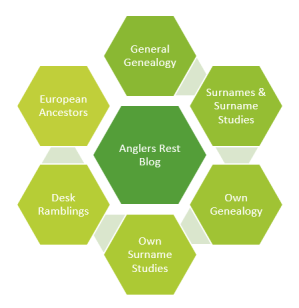
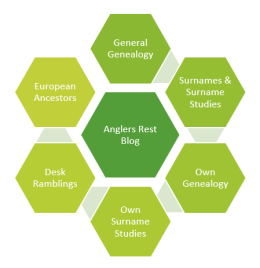
The image above is not totally complete, I do write about general genealogy, surname studies and research, my own genealogy and my own studies. I also write about European ancestors; writing and researching in Europe and lastly, Desk Ramblings, which reflects the rest of my life that I wish to share – National Trust places, holidays, cemeteries, book reviews, museums trips, stationary and anything else which appeals.

Once you have decided the name for your blog, and you have chosen a provider you can create the site. All sites vary, but some, this one included allow for a tagline. Mine is situated in the top right and reads:

Books, Genealogy, History, Surnames, Butcher & Orlando One-Name Studies, Pharos Tutor, European Ancestors, Sicilian Genealogical Research, Notebooks, Journals and Stationary etc.

I don’t see the absolute need for a tagline to a blog, but if the theme you decide to use has the provision for one, then go ahead and use it, after all, it is opportunity to say on the first page what the site is about.

This is part of my Blog Writing Series. The next instalment will be up tomorrow, when we will looking at the communication and sharing aspect of blogging.

Posted in Blog Writing Series | 3 Comments

Beginning to Blog – Blog Writing Series (1)

Blogging - Spoke in genealogical wheel

Copyright Julie Goucher, May 2020

I don’t have all the answers about blogging, but this first post will enable you, I hope, to start visualising what you want your blog to be and what you do not want it to be.

Your blog, regardless of what platform you use will need to do or think about a few things to prior to getting up and running.

  1. Copyright – what you write belongs to you. If you copy a paragraph from someone else then you are using their copyright and you should ask permission first and at the very least reference them.
  2. Copyright Statement – Have a copyright Statement, I have one on this site which you can find right at the bottom. It reads:

    The material, both written and photographic on these pages is the copyright of Julie Goucher & Anglers Rest unless stated. Material on this site may be used for personal reference only. If you wish to use any of the material on this site for other means, please seek the written permission of Julie Goucher & Anglers Rest.

    © 2002 – 2020

    If you are creating your blog, you are welcome to use this copyright notice and please link to me.

  3. Images – I recently wrote about my upcoming talk with the Society of Genealogists. I wanted an image to use and used their logo. I referenced the logo “Courtesy of the Society of Genealogists”. 
  4. Privacy – This is yours and other peoples. Rule of thumb is never share online what you would not be happy to share or have overheard at a bus stop! Keep yourself and those you mention safe online. I tend to not reference people specifically. My husband is referred to in a variety of ways, Mr AR, Hubby, S, Occasionally Stuart. I occasionally reference students in that very generic way. Occasionally they are reduced to an initial or referenced by the use of their study name, which is just the same if you looked the study up on the online register of the Guild of One-Name Studies.
  5. Comments – Respond to comments, Blogging is a two way street. It is also an opportunity to engage in dialogue with others.
  6. Spelling and punctuation – If you are not good at spelling then perhaps create your blog posts in word and then copy and paste across. That said, no matter how hard I read and re-read I often come across a typo later on, after a post has published. If you do that, you can go into the post and make an edit and republish.
  7. Layout – Always use an image, people tend to read posts with an image rather than just text. Images should be one you have created or own if it is a post card or book cover. If you have borrowed an image from someone else, then you should ask (or at the very least acknowledge them).
  8. Confident and Comfortable – Your blog will develop and grow as your confidence grows and you become more at ease with putting “out there” your posts.
  9. Writing – What are you going to write? If you look at the image that accompanies this post, you will see that I have broken down into chunks what this blog covers. My own genealogy, general genealogical material, European Ancestors material, Surname Studies, both in general and posts relating to my own studies. Have a think about what you want to include.
  10. Sharing – This is not just about sharing using social media, but sharing with others. There is nothing more disheartening to write a blog post and then publish it, to find no one acknowledges that they have read it, let alone leave a comment. Members of the Guild of One-Name Studies can share their blog with other members, there use to be a list in the Wiki, but I am happy to provide a list somewhere on this site.

This is part of my Blog Writing Series. The next instalment will be up tomorrow.

Posted in Blog Writing Series, Writing | 3 Comments

Q & A – Keeping a Journal

Q & A

Created by Julie Goucher – Feb 2020 Using Wordclouds.com

One of the readers who asked about blogging, also asked about how they could journal.

Julie, I have admired over the years your posts about journalling and am amazed that you have kept a journal for decades. How do you do it?  M

I don’t have all the answers about journal keeping, but I can share a few tips and thoughts and hope they help.

  • Select a notebook and pen that you enjoy writing with.
  • Date every entry
  • Use ink if possible, of course if you are arty then you should use whatever instrument appeals
  • Number pages if the journal does not have them
  • At the beginning of the book keep a few pages for an index (hence the page numbering!)
  • List why you are keeping a journal – here are a few ideas
    • current interest
    • worries
    • obsessions – hobbies, books
    • projects
  • Decide what your journal is to include
    • All or specific things
  • Keep a pen with the journal
  • Entries do not have to be daily
  • The journal does not have to be an expensive one – just one you want to write in.
  • Decide how you are going to archive your journals

I love stationary. Nothing fills my heart with joy more (except genealogy and books) than a stationary shop. The trick is going in and leaving without purchasing – something I rarely manage. Choose a notebook you love – if you invest in selecting a book you are more likely to keep writing.

I write all sorts in my notebook – I keep a planner separately and that holds my commitments and to do list, whereas my notebook and journal is for everything else. If I look at the current (a Moleskine expanded plain) notebook, I have some entries of research from FamilySearch and Ancestry, the next page has note on a book I was reading then the following three pages are about COVID-19. In addition I have professional development material. I do have a A5 Filofax that I am using for planning blog posts. The Filofax never leaves my office, but my notebook wanders round the house with me. As I said it is a Moleskine expanded, so it.has 400 pages, I started this in March and will finish it at the end of June I expect. I also have a health and medical notebook which lives in my office and is used when I need to note things,

My journals are numbered and live in a draw in my filing cabinet along with planners from past years. Each notebook has a label on with the start and finishing date on it. The most recent notebooks – the last three are next to my desk, because they have material that I am going to share here. Eventually they will move to the filing cabinet. Research notes are transferred to my genealogical program as soon as I can.

There are positives and negatives for keeping lots of notebooks – I tend to use only one as I have described here, because otherwise I found that I would want to note something and then did not have the right notebook. That still happens for my medical notebook, but I make those notes and transfer them.

Over the years, I have switched and expanded how I keep my journal and what it contains. It is more like a “Common Place book” Here are a few useful links:

BLOG Posts ImageDon’t make keeping a journal complicated. Let it reflect you and your interests. If you want to stick bits in then do, if you want to draw, pictures or genealogical trees then do – I am no artists, but I do have genealogical trees in my notebook! (and I stick bits in!)
Your journal will be an unique as you, so enjoy it!

Happy journaling!

Posted in Q & A, Stationery, Filofax, Journals & Notebooks | 1 Comment

Q & A – Blogging Tips

Q & A

Created by Julie Goucher – Feb 2020 Using Wordclouds.com

In the last few weeks I have received several emails about blogging. Here is just one of those questions

Julie, I have been considering starting a blog for my surname study and my own genealogy. I wondered if you could recommend what I do about comments. Thanks P

Over the last year or so I have had quite a few comments and questions about blogging. In the past I have replied via email, which I have done in this case, but I am also sharing as a Q & A.

On the recent Practicalities of a One-Name Study course, there were several comments and questions about blogs and their use in publicising, publishing and preserving a One-Name Study. Firstly, the Guild of One-Name Studies have agreed to a pilot of the Guild Blog Project. The project will enable all members to have a blog which will be preserved. This also is available to those without a study.

This blog is located on the WordPress platform. I have a domain name (anglersrest.net) and I pay a small amount a year to have adverts removed. The amount payable is about £36 and then I pay for the domain name, so around £50 a year.  A blog is a great way to have a conversation with others and it takes a little while to gain followers and comments from others.

BLOG Posts ImageI have several things that I think is important and recommend to those beginning their blogging journey.
  1. Enable comments – it is very irritating to want to reply to a blog post to find the writer has turned off commenting – that is also going against the core of a blog.
  2. Enable people to receive posts by email, a great number seem to only activate posts to be read in the reader. Some I prefer to read in my email.
  3. As you post your blog, enable the facility to share those posts via Twitter and Facebook, assuming you have those social media outlets.
  4. A blog is, as the image says, a space to write your own adventure. It is your space, so write about what interests you. I write about genealogical posts mainly, either general posts, or those about surnames or European research. Just recently I had several people unsubscribe because I wrote three consecutive posts in the Farnham Papers series. I also occasionally write about books and I also  write an irregular Desk Rambling series, which is general and more chatty.
  5. Do not underestimate the time it takes to write a post. This post has taken about an hour. I frequently use the option to schedule posts, meaning I can write when I have spare time and then the post can publish when I am busy with other things.
  6. I tend to write in series – Oral History is just one of those.
  7. It is quite tempting to create blogs and keep things separate, and where I did follow that path, I have evaluated that and now, prefer to keep all the data and information within the platform of this site.
  8. You can easily import and export into WordPress from other WordPress sites and Blogger – in fact I have several hundred posts that I imported from my Blogger site and I need to place those posts into the relevant categories – that is an issue between tags on blogger and categories. I tend to find tags can become unwieldy and prefer categories.

I hope these points have helped, but if you would be interested in a Blog Series, please let me know in the comments.

Posted in Blog Writing Series, Genealogy, One-Name Studies, One-Place Studies, Practicalities of a One-Name Studies (Pharos Course 903) | 7 Comments

Maps as a Visual Addition to a One-Name Study & Genealogy

Surrey Map

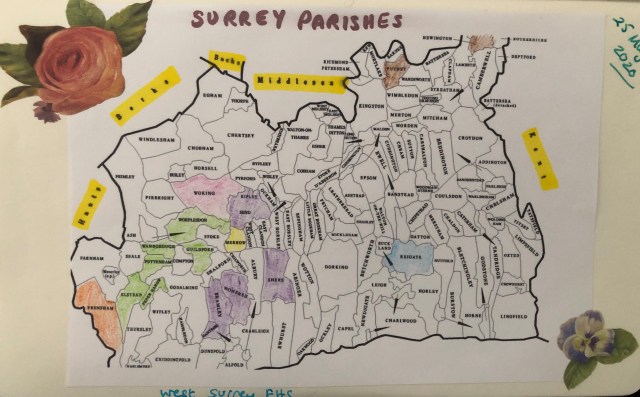
Map of Surrey parishes – Julie Goucher 2020

It is obvious that a map is a visual aid to research, but yesterday I was sitting thinking, as you do and reached for this map of the parishes within Surrey – the map is from the West Surrey Family History Society, of which I have been a long time member. The map is of course copyrighted to the Society and one of their members, June Rudman.

The map as you can see shows each of the parishes within the county and then shows the neighbouring counties, given left to right and highlighted in yellow – Hants (Hampshire), Berks (Berkshire), Bucks (Buckinghamshire), Middlesex, Kent and then at the bottom, Sussex. Given that I was thinking about my Butcher One-Name Study, from which my two lines feature in Surrey and at least one of them prior to 1705 in Sussex I wanted to see the parishes that run alongside the Surrey and Sussex border.

As the map shows, the parishes that I have coloured, with as much finesse as a three year old, my parishes are in the west of the county in the main – although this map actually features more than my Butcher lines, the pink segment is Woking which is representative of my Orlando line.

In short though, this is a back to basic step for me and how my ancestry is located in the County; and I would urge others to follow a similar pattern, if they feel the need – it was 40 minutes or so well spent (though I note my colouring has not improved!).

Even though I know the County reasonably well, it was useful to see it in black and white and to be able to focus on several locations and family groups – one example is the surname of my great great Grandmother, Sarah who had the surname of OCKLEY which happens to also be the name of a parish within the County; located on the Surrey and Sussex border.

In following back from Sarah Ockley, her parents were Peter Ockley and Maria Bolton, who married in Wonersh, which is coloured purple, Peter’s parents were Peter Ockley and Charity Collyer, they married in St Martha’s in 1773. St Martha’s does not appear on the map, but is in again in the purple bit! After they married they lived in Wonersh. Going back to the final generation I have, Peter’s father was another Peter Ockley and he married his wife, Rebecca Downer in Reigate in 1738 (Reigate is the lone parish coloured blue).

From this focus, I also noted that the use of Charity as a given name. Does that have bearings on the religious preference of her or her family? I have no notes that predate Peter Ockley and his wife Rebecca nor have I explored previously any links to the parish of Ockley.

Ockley Surname Distribution Map

Distribution of the Ockley surname from Forebears.io

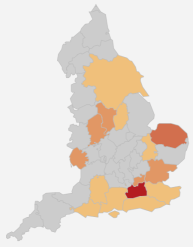
I did a search for the surname of Ockley using Forebears.io. The spread of the surname across England and Wales in 1881 is shown here with the dark red patch on the map reflecting Surrey and the next dark patch on the map is reflecting Norfolk.

Why is that the case? or is there perhaps no reasoning?

I scrolled down the page to look at the numbers reflected on the map.

Here is the results:

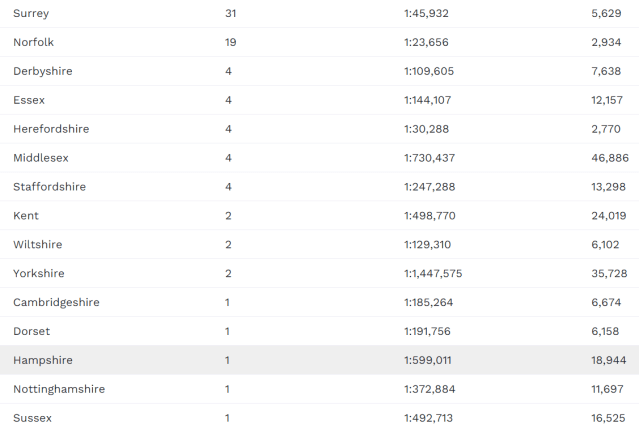
Ockley Numbers

The top two counties are Surrey and Norfolk, with 31 and 19 respectively. Those are significant numbers and if you look at the rest of the there is a distinct difference, between 19 and the next five counties with 4 each.

This might be something I work with whilst the next Pharos One-Name Studies course (901) is underway (starts next week!), lots to think about and mull over.


Posted in Butcher One-Name Study, Genealogy, Introduction to One-Name Studies (Pharos course 901), Ockley, One-Name Studies, Practicalities of a One-Name Studies (Pharos Course 903), Surname Distribution Maps | Leave a comment

Farnham Papers – Removal Orders (5)

Farnham Papers (3)

Created by Julie Goucher using Wordclouds.com May 2020

  • Ann PALMER, single woman to Buniton, Southampton – 8 December 1804
  • William LOVELAND Examination is for Settlement – 22 January 1805
  • Sarah KING, single woman to Windlesham, Surrey – 2 February 1805
  • Sarah CRANHAM – Note attached. Thomas ELSEY, labourer of Frimley is the father of her child – 14 February 1805
  • Thomas CROOK, from Twickenham, Middlesex – 25 February 1806
  • James LOVELOCK, Katherine his wife and children:
    • James aged 6
    • Elizabeth aged 3
    • William & Harriett both 3 weeks old – whole family to be removed to Long Sutton, Southampton
  • Ann Chandler wife of Thomas Chandler, “Thomas having run away” and children Sarah aged 3 and James aged 9 months – from Binstead, Southampton – 23 January 1808

Reference Points:

  1. Where the reference states to, that means from Farnham to that parish
  2. Where the reference states from, that means removal from that parish to Farnham.
Posted in England, Farnham Papers (October 1988), UK & Ireland (Eire) Genealogy Series | Leave a comment

Farnham Papers – Removal Orders (4)

Farnham Papers (3)

Created by Julie Goucher using Wordclouds.com May 2020

  • Sophia SMITH, single woman from Greenwich Kent – 2 April 1792
  • Charlotte GREEN aged 7 from Binstead Southampton – 5 May 1792
  • Mary BICKNELL wife or widow of William “who has not been seen or heard of for 11 years” to Binstead Southampton – 19 January 1793
  • George DENYER from Chiddingfold Surrey – 3 January 1795
  • James STONE to Egham Surrey – 21 April 1798
  • Thomas COX to Egham Surrey – 4 March 1802
  • Francis WHITE and his wife from Woodford Essex – 4 March 1802
  • Maria STOCK aged 24 an unmarried woman with child. Removal delay because of her advanced pregnancy. £13.15.6 Requested of Farnham for her keep until 22 Jan 1805 – 13 November 1804 (Reciept attached to the record)
  • Examination of Maria STOCK, John EDWARDS, Butler to Mr Sherridan the true and only father of the said bastard.

The Examination is a sworn statement made by the individual, in this case Maria, before a magistrate. The Removal Order was a warrant transferring a pauper to a place of legal settlement. The Act in 1662 enabled and indeed ordered the removal of strangers if they were likely to become chargeable on the parish. The Act of 1704/5 prohibited removal, unless the individual had become chargeable.

From this, Farnham was identified as Maria STOCK’s usual place of settlement and this was confirmed by the baptism register for St Andrews parish in Farnham where Maria was baptised on 29 June 1782, the daughter of Richard and Ann Stock (FHL Film 800470). This was further confirmed because the host parish asked for a payment from Farnham.

Reference Points:

  1. Where the reference states to, that means from Farnham to that parish
  2. Where the reference states from, that means removal from that parish to Farnham.
Posted in England, Farnham Papers (October 1988), UK & Ireland (Eire) Genealogy Series | Leave a comment