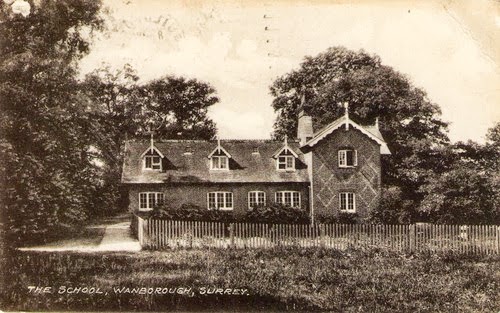
Wanborough School

Posted in Archive - Imported from Blogger | Tagged , | Leave a comment

George Butcher (1908 – 1974)

52 Ancestors in 52 Weeks
No Story Too Small

This post is for week 5 of the 52 Ancestors in 52 Weeks Challenge by Amy Crow from No Story Too Small.

You can read the list of my posts HERE

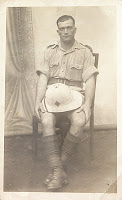
George Butcher circa 1940

I am way behind with this weekly look at my various ancestors, but what better way than commemorating what would have been my Grandfather’s 106th birthday than to write about him this week.

My Grandfather was born to Charles Butcher and his wife, Annie Prudence nee Harris in 1908 in Wanborough Surrey. He was one of 9 children who survived into adulthood from a family of 12. 

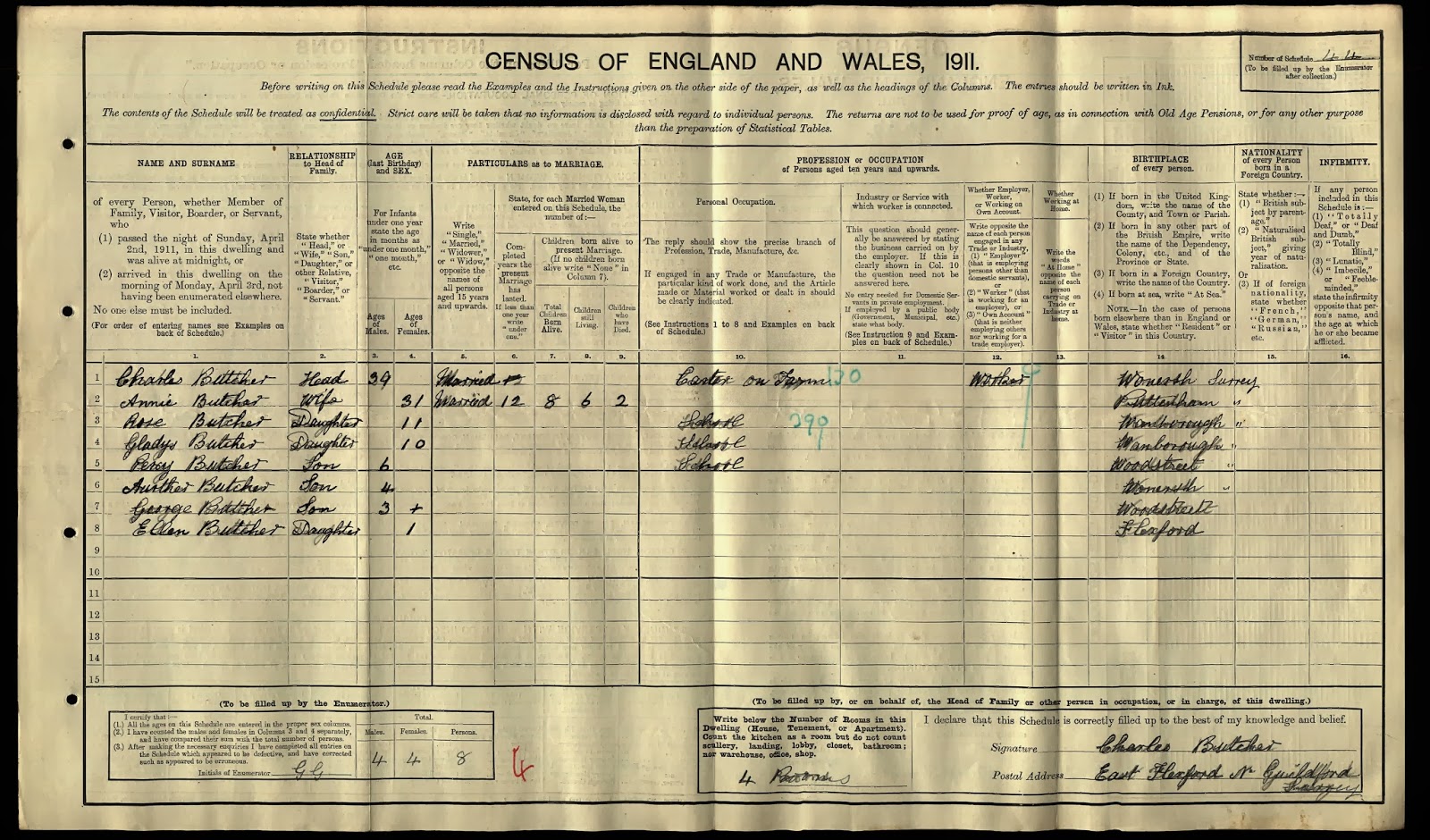
Here he is aged 3 years old on the 1911 Census for Flexford a hamlet very close to Wanborough.

Image courtesy of Ancestry Surrey Collection
Class: RG14; Piece: 3098; Schedule Number: 44

The family remained at Wanborough until about 1925 when the family moved to Strawberry Farm at Worplesdon and then to their final destination of Manor Farm, Onslow Village Guildford.

Once working at Manor Farm he and his brothers took to having a “swift half” referring to a pint of beer, at The Plough Farnham Road Guildford. We know from my late Grandmother that, that was the same pub used by her brothers and I guess that is how the two families met. My Grandfather married my Grandmother in 1939 and his sister Marge married my Grandmother’s brother in 1938.

I wish I could say that was the only family connection between the two families, it was not the other though took place about 100 years or so previously making my Grandparents 6th cousins!

My Grandfather worked on the land, along with his brothers and the majority of his brother in law’s, and at some point moved to nearby Shackleford to live with his sister Ellen and her husband. In 1939 he married my Grandmother and they moved to Bright Hill Guildford.

My Grandfather was at this point working at Unigate Dairies when he remained working, apart from his military service until he retired in 1973.

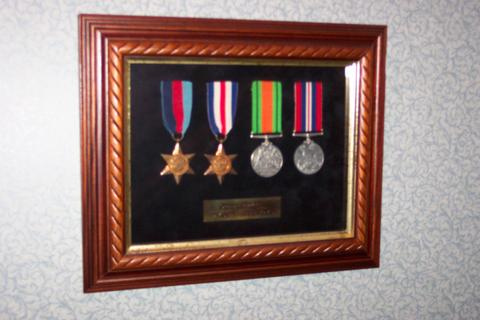
In 1940, my Grandfather joined the Army. A man of principle. My Grandmother told me that she was really cross that he joined up rather than return to the farm where his family were, but the principle was his Country needed him and he was therefore doing his duty. How wonderful was that? His military life is well documented. I called for his service record back in 2008 and I recall Mum and I being so excited when it arrived. I talked about ordering it in this blog post. My Grandfather spent about two and a half years in West Africa. When he passed away he left a lovely piece of material which he had embroidered on symbols reflective of his time in the military in Africa, which now hangs on my landing in a lovely frame. His pay book and his medals, which now hang framed on my landing.

J Goucher – October 2008

There is so much of his life that I still want to unravel, and those appear in my actions list below. 

After the war, my Grandfather returned to Unigate Dairies. He worked up until he was 65 and was presented with a gold watch in recognition of 30 years loyal service. I still have that watch. As retirement neared, he was, along with another colleague asked to stay on whilst someone was on sick leave. He and the other colleague did.

Then serendipity struck. The colleague who also stayed on beyond retirement for a few months, was taken ill about the same time as my Grandfather. They were diagnosed and admitted to the same hospital with the same condition. They both died on the same day, 20th July 1974 at exactly twelve hours apart, my Grandfather at 9am. It was more than a decade later when I was at senior school I realised that I was class mates with the grandson my Grandfather’s colleague. The cause of both deaths was lung cancer, caused by a mixture of smoking, inhalation of coal fumes, asbestos and whoever knows what else.

As a small child I loved to sit and snuggled with my Grandfather. He was, like my Mum taken before their time, both at the age of 66 years. When he was at Milford Chest Hospital I would be taken to visit him. I was never frightened of the cables, wires and strange hospital machine noises and perhaps it was that, that in some way made me quite comfortable with hospitals, the machines and illness.

Perhaps it is those early memories that encouraged me to become the person I have in the profession I chose; undertaking my time in the hospital environment. A complete contrast to my Mum who hated hospitals with a passion because of her early experiences. Those experiences which without doubt made my Mum’s last few months difficult for her and it was a pleasure for me to support her. Sometimes in life it would seem, there are these curiosities, coincidences, and things that happen for a reason.

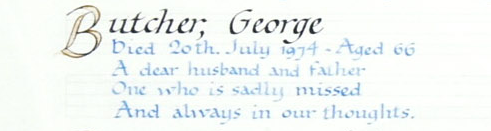
After my Grandfather died in July 1974 he was cremated at Guildford, the Crematorium has the Book of Remembrance on-line which can be searched here

From the Book of Remembrance at Guildford CrematoriumSourced 3rd March 2014

What is interesting about the entry, is that I am completely missing from the entry. I have the original bill for the funeral and the bill for the entry into the Book of Remembrance, so perhaps it was around cost that I was omitted. Who knows? As a child, we routinely visited the Crematorium to see his name in the book on the anniversary of his death date. We would ask the Crematorium always to look at his entry on his birthday and at Christmas. Why my Grandmother did that I don’t know, but it is something that my Mum continued and now I shall. My Grandmother lived another twenty one years and missed her beloved George every day.


Actions
  1. Decipher military record
  2. Check directories 1939 – 1974
  3. Unigate History and Employment Record
  4. Update George’s War more frequently
  5. Research meeting with George Formby
Posted in Guildford, Surrey, England | Leave a comment

Mastering Genealogical Proof Study Group 2 – Chapter 2

The Hangout discussing Chapter 2 of Mastering Genealogical Proof

+DearMYRTLE Community

Tagged , | Leave a comment

Book of Me, Written by You, Prompt 27

Today is week 27 of what is going to be a 15 month project. Each Saturday, at around 12.30 am UK time I will release the prompt for that week’s Book of Me, Written by You.

If you are new here, welcome! The details, background flyer and Face Book link to the Book of Me can be found HERE.

This week’s prompt is – Cars and Transport

  • Did you have a car in your family whilst you were growing up?
  • What methods of transport were there? And what did you & your family typically use?
  • Your Driving Test
  • Where Did you learn? – Can you drive?
  • Your first car?
  • Your Favourite Car?
  • Do you name your cars?
  • Can you remember the registration details? And perhaps explain what the registration means.
Tagged | Leave a comment

Society for One-Place Studies – Learn and Do Hangout

The February Society for One-Place Studies hangout is scheduled for 8pm GMT on Friday 28th February, so this Friday! The discussion topic is Learn and Do. We shall have a discussion about the latest book about One-Place Studies written by Janet Few and much more!

The Society has a G+ Community and you can visit the Society blog and website for more information.

Tagged , | 1 Comment

Mastering Genealogical Proof Study Group 2 – Homework Chapter One

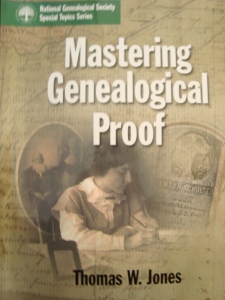
Mastering Genealogical Proof by Thomas W. Jones
Published by NGS

Reference: Thomas W. Jones, Mastering Genealogical Proof (Arlington, Virginia: National Genealogical Society, 2013), 6. Book available from the publisher and from Amazon in Kindle format (UK) & (US)

Defining genealogy can be problematic. Here in the UK genealogy is typically taken to be the linage of individuals whereas family history is the “fleshing out” of those pedigrees.

Genealogy is about reconstructing pedigrees, typically forgotten or unknown relationships but of course can include individuals that are known to the pedigree creator, living individuals,adoptive lineage and martial family.

As someone who is conducting two one-name studies registered with the Guild of One Name Studies and three one-place Studies registered with the Society for One-Place Studies I also use pedigrees to establish lineage between individuals that are not related to me. As I am a visual person, I also use pedigrees to trial a hypothesis

Genealogy is multi disciplinary. It draws its knowledge base from many other fields such as anthropology, genetics, law, economics and sociology.

Genealogy uses a variety of sources, which were devised and used by other disciplines, organisations and processes such as legal, demographic, governmental, medical, religious and many more.
As a research discipline genealogy, has it’s own standards and skill set.
There are five elements for Genealogical Proof Standards:
  1. Thorough research
  2. Informative
  3. Analysis and Comparison
  4. Resolution
  5. Written Statement, list or narrative
All of this five elements are required and therefore proof can not be partial proved.

How do you know though, that you have conducted a “reasonably exhaustive search”? Michael Hait from MGP 1 stated in last year’s video “reasonably exhaustive search is when you have enough evidence to prove your conclusion”

Removal of the evidence and statement of facts is detrimental to the integrity of the genealogical research undertaken. The research therefore does not  have providence to support the claim the researcher is claiming.

The first stages in research is to ask questions about the individual we are researching. Who, What, Where, When & How.

You can watch the discussion of Chapter one HERE

Other references – http://www.bcgcertification.org/resources/standard.html (accessed 23rd February 2014)

Image courtesy of Dear Myrtle

Tagged , | 4 Comments

Mastering Genealogical Proof Study Group 2 – Chapter 1

The Hangout discussing Chapter 1 of Mastering Genealogical Proof

+DearMYRTLE Community

Tagged , | Leave a comment

Book of Me, Written by You, Prompt 26

Today is week 26 of what is going to be a 15 month project. Each Saturday, at around 12.30 am UK time I will release the prompt for that week’s Book of Me, Written by You.

If you are new here, welcome! The details, background flyer and Face Book link to the Book of Me can be found HERE.

This week’s prompt is – Technology

  • What technology changes did your ancestors see?
  • What technology changes have you seen?
  • Did your family own one of those early changes? – such as television
  • Do you like or dislike technology?
  • What do you think has been the best technological change in your lifetime and historically?
Tagged | Leave a comment

Putting Your Ancestors in their Place ~ A Guide to One Place Studies by Janet Few

I recently had the opportunity to read a review copy of the latest book by Janet Few.

There are so few books dedicated to the subject of One Place Studies therefore this is a very welcomed addition to the genealogical and local history arena.

The book has been thoroughly researched and whilst is heavily slanted at such studies in the United Kingdom, those who are pursuing studies, or contemplating studies outside of the United Kingdom would without a doubt benefit from reading this book. In my personal opinion it is an absolute guide for those interested in the places of our ancestors or of a community.

The book itself is divided into three distinct sections, over 12 chapters. Setting the scene, sources and the final section is pulling the data all together. Starting with the definition of a One Place Study, choosing the boundaries of a study and considers the options if the study has been previously undertaken or already exists.

We then move onto chapter two; the reconstruction of the community or place, looking at maps and locations. Understanding the boundaries, looking at buildings, farms, fields and streets.Chapter three centres around the population of your place of interest, analysing the population and social structure and collating biographical information of key individuals.

Chapter four commences the section focusing on sources. In this chapter locating sources is fully explained.

Chapter five features the time period of after 1900 and is a very comprehensive chapter. Looking at the Census material of the twentieth century, photographs and pictures, in addition to other forms of media, oral history and looks at the fascinating subject of child mortality and the effect that had on the community and its sustainability. Also explored is the 1910 Inland Revenue Valuation Survey and whilst that is a source that solely covers England and Wales, it does provide as a potential research idea for areas outside of England and Wales. Does anything exist for your location in your part of the world? This chapter also includes directories, community minutes and of course the effects of the First World War. Those that served, named on a memorial, Rolls of Honour, Voters Lists. Land Registry and the National Farm Survey from the 1940’s.

Chapter six looks at the nineteenth century and again is a comprehensive chapter. Starting at understanding the Census material that covers this period, household structure and how the community and society dealt with any disabilities. Tithe Maps are an important feature in this chapter as is understanding the roles that religion and the church played in the life of a community. This chapter also looks at cemeteries and crematoriums, Education and school, newspapers and parish magazines.

Chapter seven looks at the eighteenth century in a very comprehensive manner, covering Manorial records, land taxes, early military records & militia, apprentices, gravestones and documentation that was traditionally retained by the parish in the Parish Chest.

Chapter eight covers the seventeenth century. Here featured are Protestation Oath Rolls, Hearth Tax, Compton Census, Poll taxes and Surname Survey.

Chapter nine features the period before 1600 and therefore covers the Doomsday Survey, early taxes, Chancery courts, wills and Parish Records. Chapter ten features the issue around today’s census.

Chapter eleven and twelve cover the last section and the issue of pulling together all the data available into a workable archive and project. Chapter eleven looks at linking people, and covers migration both into and from your place of study, trades and occupations; residential histories and families within the area that are of importance to your place, and perhaps remain in the location and standing for generations.

The final chapter features around the topic of publishing your study, whether that is through a book or website. It also looks at the aspect of funding for a study and the importance of the future of your study.

The final pages are given over to examples of some studies, a comprehensive bibliography, magazines and journals, Societies and addresses, courses and an index.

At the end of each chapter there is further reading and of course many website addresses are presented so that you can explore as you read. There is also projects that can be undertaken as you read. I particularly like this idea, as it enables you to look at your place and community, layer by layer, by person and surname and understand how the individuals were in relation to their community.

This is a good grounding for those undertaking One Place Studies anywhere. The resources are obviously aimed at those within England and Wales, but that itself can give rise to contemplation of what similar records exist in your location where ever you or your study are in the world. I personally recommend this thoroughly researched and comprehensive guide to anyone who has an interest in understanding the places in which their ancestors lived.

Putting Your Ancestors in their Place ~ A Guide to One Place Studies by Janet Few is published by Family History Partnership in February 2014 and is being launched at Who Do You Think You Are Live in London this weekend. Janet is giving a talk to accompany her book and you can purchase signed copies at the London event.

Copies are also available from the author direct and from Amazon (UK) or Amazon (USA). Currently the book is so new there are no copies available via Amazon at the moment because the official launch is not until 22nd February!

ISBN – 9781906280437. Author’s website

Tagged , , , , | Leave a comment

Those Thursday Places – Richmond Poor Law

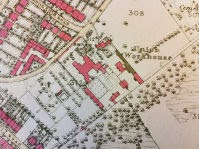
Map showing Richmond Union Workshouse
Courtesy of Surrey Records Centre

Today I read that Surrey Records Centre has released via their web page the Richmond Poor Law Union Applications and Report Books.

This is a fantastic resource which has indexed by a team of volunteers.

Not many of these records have survived for Surrey, so we are indeed very lucky that these have, and that an index has been published.

The data itself is spread over two pages and provides an assortment of information

  • Number in the Relief List
  • Date of Application
  • Names of Applicants
  • Age
  • Residence
  • Length of time in Union
  • Calling or Occupation
  • Marital Status
  • Ability (i.e. whether disabled)
  • If in receipt of relief
  • Present cause of seeking relief
  • Observations and names of relatives liable to relieve the applicant
  • Weekly earnings
  • Date of last visit
  • Quantity and nature of relief
  • Relief ordered by Guardians
  • Other orders
  • Observations
The alphabetical indexes are available to use and download from the Surrey Heritage website. They cover the period of 1870 – 1912 and contain some 103,000 names.
Tagged , , | Leave a comment