Book of Me, Written by You, Prompt 41


Today is week 41 of what is going to be a 15 month project. Each Saturday, at around 12.30 am UK time I will release the prompt for that week’s Book of Me, Written by You.

If you are new here, welcome! The details, background flyer and Face Book link to the Book of Me can be found HERE.

This week’s prompt is – Blood Group

Do you know your blood group? Many people don’t.
In fact here in the UK many General Practitioners (family doctors) do not even know or have it on record.
A simple and yet important snippet of information.
Do you have a popular blood group?
What about other members of your family?

Tagged | Leave a comment

Worplesdon Cricket Ground – Circa 1909

Posted in Archive - Imported from Blogger | Tagged , , , | Leave a comment

St Catherine’s Cottages, Guildford Circa 1900

Posted in Archive - Imported from Blogger | Tagged , | Leave a comment

Book of Me, Written by You, Prompt 40


Today is week 40 of what is going to be a 15 month project. Each Saturday, at around 12.30 am UK time I will release the prompt for that week’s Book of Me, Written by You.

If you are new here, welcome! The details, background flyer and Face Book link to the Book of Me can be found HERE.

This week’s prompt is – Where do you think?

How do you record those thoughts?
Or don’t you?
Does thinking happen when you are in the bath, on the settee?
Where do you go or what to you do when you need to seriously think of something?

Tagged | Leave a comment

Armchair BEA – More than Just Words

Armchair BEA

When this prompt was devised I am sure that what I am going to mention wasn’t perhaps thought of, so I have taken a different spin on things today.

We associate books with the printed word. A way of sharing information, knowledge or quite simply a story that acts as a chill out factor.
Being an historian I think that in addition to the printed word we can learn a lot from an image.
An image can capture the imagination, prompt a chain of thought reactions and lead us on path of discovery. We each capture with our eyes many thousands of images each day. Our eyes are our biological camera. They capture the detail that we recognise and identify with and also capture things that we do not necessarily focus on or identify with, perhaps ever or immediately.
Over the last twenty years or so I have collected postcards and images that relate to my home town of Guildford in Surrey. A large town that is located 30 miles south of London. The only location to have a Cathedral built in the twentieth century. I have collated and shared many of those images via a website and will at some point in the future do more with those images. The pictures and postcards track events, history and locations and pretty much everywhere in the world has an image captured that brings alive a location.
Many of the local history publishers have released books that relate to what I have just talked about. Images of (insert any place you would like to). The general rule of thumb is a picture or historical image and some text about the location. Some books go a small step further and present a then and now set of images of a location.

Children’s books are typically introduced to children at a very young age, first cloth books then progressing to hardback or paperback books. Each of those shares perhaps a story illustrated by pictures. The picture becomes the prime focus to keep the attention of the child and the writing has less feature. As the child gets older the focus on the picture reduces and is replaced by words which represents the educational journey of the child. 
Even instruction booklets for flat packed furniture has words and diagram pictures to make the quest easier. (Is it me or do those illustrations and instructions always take longer than predicted?) Do we really need pictures? Or are we using pictures and illustrations to dumb down such a task, creating a false sense of security (really we say an hour with one person, but the reality is your flat wardrobe needs two people, three hours and lots of patience!)
An image captures the imagination. It automatically sets the wheels of thought moving and whether that thought process is a fictional story, or tells an historical journey or setting will depend on the image, the personal viewing and the reason why it was viewed in the first place.
And because I always like to share an image. Here is an image of from my home town that I spotted on Twitter earlier today (27th May 2014)

Image of Swan Lane Guildford Courtesy of
Guildford Borough Council via Twitter

The image is a lovely one. I would it dates from circa 1940 because there is a service man on the left of the picture. The building on the left is Salsbury’s the jewellers, which was the location that my Grandfather purchased my Grandmother’s engagement and eternity rings. The cobblestone street is a reminder of the period of time before cars, and is like (or at least in the 1940’s) the cobbled High Street. Cobbled because of the horses. The chap with his bicycle looking in the paper shop window on the right. I can tell that because there is a sign above saying Players which were a cigarette brand. The church spire in the background is St Saviours Church which was (and still is) located on Woodbridge Road. When I was a child there was a toy shop called Dolls Hospital located where the dry cleaning shop is.

Such wonderful memories all prompted from a picture; absolutely more than just words.
Tagged | Leave a comment

Armchair BEA – Literature

Armchair BEA

Today kicks of Armchair BEA.(You can read the Agenda HERE) I have participated the last few years and especially enjoyed last year. This year I have been a little out of sorts spending some days completely preoccupied with other issues; issues that I can not change. One thing that has helped me is reading, which is always my emotional bolt hole!

So without further ado let me kick off the start of BEA week with today’s post. I have selected to write about Literature, but you can write an introduction or do both! You can read my introductory post for 2013 HERE. You can read all my previous Armchair BEA posts HERE

Literature

“What do you think of when you think of literature? Classics, contemporary, genre, or something else entirely? We are leaving this one up to you to come up with and share the literature that you want to chat about the most. Feel free to share a list of your favorites, break down your favorite genre, feature your favorite authors, and be creative about all things literature in general.”

The Oxford Dictionary on-line defines literature as written works, especially those considered superior or demonstrating lasting artistic merit. Considered by whom? 

When reading the same book a group of people will typically take something different away from the book. That is because we are all individuals and have our own preferences. The book group I attend  recently read Hamlet. Not my choice. I have flashbacks to senior school O-level English. Hamlet is, in my opinion best viewed rather than read. 

We recently read with the same book group Animal Farm by George Orwell. Most of the group had never read it, someone thought it was ridiculous and a child’s book because the animals were talking. I recounted that this was also a set English lit book for O-level and was read around the same time as my history O-level group were looking at Russia. There were some blank looks around the room, before the realisation that actually Animal Farm was quite a clear book. I wonder what it was that prompted George Orwell to write such a book. 

It seems to me that literature can be whatever we want it to be. It can be books that have left a lasting impression on us as individuals and thus my list will perhaps have similarities with others but will probably not be identical to someone else.

Books that have left a lasting impression with me are
and there are many more. Each has left an impression on me for different reasons, and several of these books I have read more than once.
What are the books that have left a lasting impression with you?
Tagged | 2 Comments

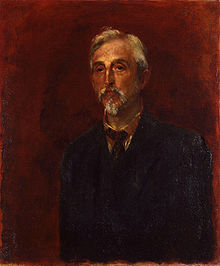
Survey into Life and Labour in London (1886-1903) by Charles Booth

Charles Booth painted by
George Frederic Watts 1901

Charles Booth (1840- 1916) was an English social researcher. 

Booth is most well-known for his huge piece of work where he documented the working classes of London.  
 
In 1886 Booth started visiting every street in London where he recorded the details of the residents. He visited thousands of streets and it took him 17 years to do so. 
 
When he finished visiting the streets he set about documenting his findings in a series of maps, colour coded identifying the rich who employed servants and every classification right down to the label of black which was reserved for the vicious and semi criminal.
 
It was the basis of this study and Booth’s findings that started the basic foundations for a campaign against poverty. It lead to the Old Age Pension and School dinners, thus providing some form of care for those who were most at risk and vulnerable.
 
In 2012, a BBC journalist set about making a programme, which revisited 6 of those London Streets recorded in Booth’s map to see just what had changed in the intervening 100 years or so. The BBC aired the series of 6 programmes in the summer of 2012. 
 
On the blog written to accompany the series the director stated that “There were no ‘experts’ in Deptford High Street and historians don’t specialise in single streets.” The journalist is wrong, but I cannot tell him that as comments to the blog are closed, but more on that later!
 
The BBC Series was called Secret History of Our Streets (http://www.bbc.co.uk/blogs/tv/2012/06/secret-history-of-our-streets.shtml)
 
The London School of Economics has placed the entire map on-line which is searchable. This is a fantastic resource. The website is available at http://booth.lse.ac.uk. There is a searchable facility and really my advice is to explore the site and see what gems you discover.
 
To give you an idea lets go on a little tour……
 
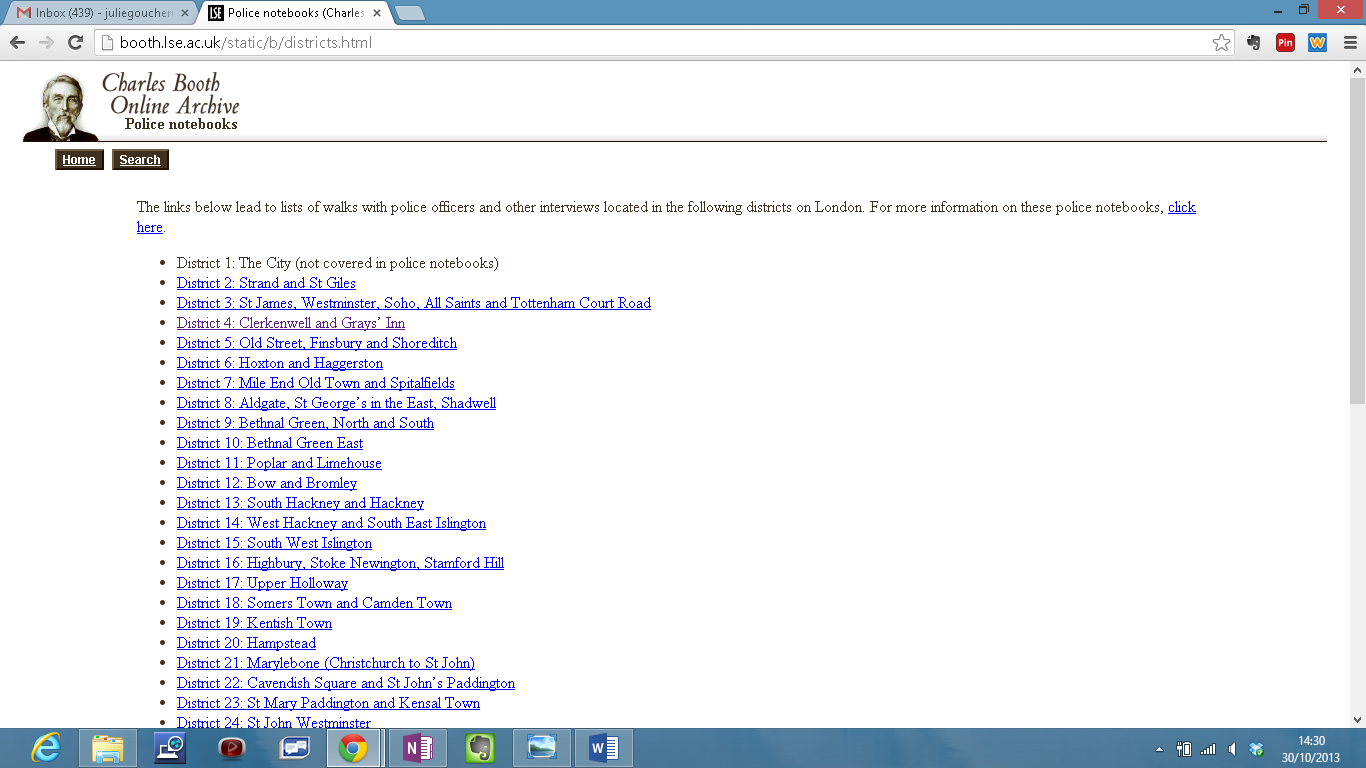
From the main page I selected the Police digital notebooks
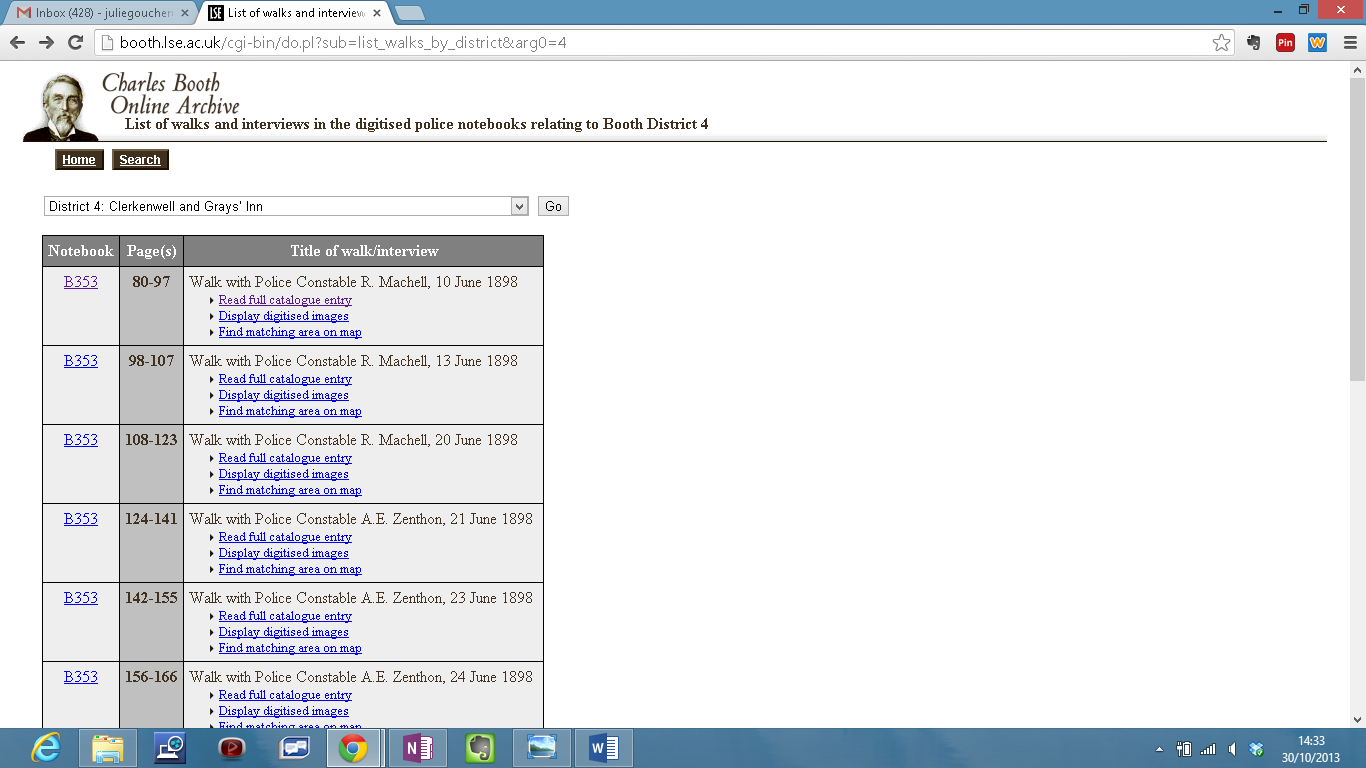
I then chose district 4 – Clerkenwell and Greys Inn, which is the area known as Little Italy.
There are now several options, all the notebook interviews undertaken by Booth with the Police Constables who worked in this area of London. You can select the book to look at and then break the browse viewing by different pages.
 
I choose to at the first book and then to read the catalogue pages. At this point you can do a search for Italian to get a varied choice of responses. I then selected the fourth option – B353 Page241 “The Italian Quarter”. If you now click through to the map you will see a map of the area. By selecting the option see scanned pages you can view Booth’s writing (http://booth.lse.ac.uk/notebooks/b353/jpg/241.html) and there is also an option to see the other references on the same page.
The images can take a while to load, depending on your download speed, but what a phenomenal historical gem. The survey allow us to look at a community and delver deep in to the social, economics and domestic lives of the inhabitants
 
I mentioned that the producer said no one researched streets. Well they do, but perhaps not in his areas, or perhaps he didn’t ask the right people! Check out the Society for One-Place Studies.

Sources
Secret History of Our Streets – http://www.bbc.co.uk/blogs/tv/2012/06/secret-history-of-our-streets.shtml

A Tourist Guide to Our Secret Streets, written by the Open University in association with the BBC https://css2.open.ac.uk/outis/docs/publications/OZNOSS.pdf

BBC Four have produced their London Collection which has a list of videos – hopefully they are available to those outside of the UK (http://www.bbc.co.uk/bbcfour/collections/p00synd3/london)

Charles Booth – Survey into Life and Labour in London (1886-1903) http://booth.lse.ac.uk/

The Society for One-Place Studies http://www.one-place-studies.org

The Anglo Italian Family History Society http://www.anglo-italianfhs.org.uk/
I have previously published this post (and appears here with minor amendments) in The In-Depth Genealogist, Across the Pond column Issue 12, pp 45-50, January 2014
Posted in Genealogy | 2 Comments

Book of Me, Written by You, Prompt 39


Today is week 39 of what is going to be a 15 month project. Each Saturday, at around 12.30 am UK time I will release the prompt for that week’s Book of Me, Written by You.

If you are new here, welcome! The details, background flyer and Face Book link to the Book of Me can be found HERE.

This week read the prompt and record what you immediately thought of.

This week’s prompt is – Do you have a safe place?

  • This can be somewhere that you gravitate to, to make decisions or reflect
  • Somewhere you go to think
  • Somewhere you go to take time out
  • Somewhere you keep things you must not loose
    • or do you have more than one safe place?
Having looked at the prompt hints have you changed that immediate thought?
Tagged | Leave a comment

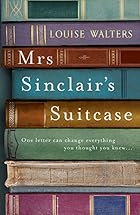
Mrs Sinclair’s Suitcase by Louise Walters

Mrs. Sinclair's Suitcase by Louise…This is the story of Roberta interspersed with the story of Dorothy who is Roberta’s Grandmother.

Dorothy has been a widow for many years, her husband her Polish serviceman killed in the line of duty. That is the story fed down the generations of Roberta’s family.

Roberta likes to read, and she loves to see what information she can find in books, items that were former bookmarks. Then one day she is reading a letter that has spent decades in a book that was once owned by her Grandmother and all of a sudden there are questions and curiosities to discover.

The letter which had been found in a book, inside a suitcase which had the name label on “Mrs Sinclair” was clearly addressed to her Grandmother by her Grandfather. The date on the letter was after the date in which her Grandfather had been killed in action. Yet who was Mrs Sinclair?

Roberta starts to ask her father some questions, without mentioning the letter. He repeats that as far as he knew his father had been killed in the war. Roberta ponders on whether to ask her Grandmother, who by now was resident in a residential establishment. Dorothy sadly has dementia.

The letter and is central to the characters in this story, and across the pages, we suddenly on occasions head back to the war years and to the early life of Dorothy. The things that happened and are remembered, those that happen and yet forgotten and those that happened and are twisted to weave a different set of events. A family history and background that is shaped because of actions of several people.

This is a great book. Having been in a reading slump for the last six months or so, I have got back to normal and read this book over the space of a few days. The storyline is complex, yet not complicated, the story is told on several levels and for a first novel the author has done remarkably well. This book is a genealogists dream!

Tagged , , | Leave a comment

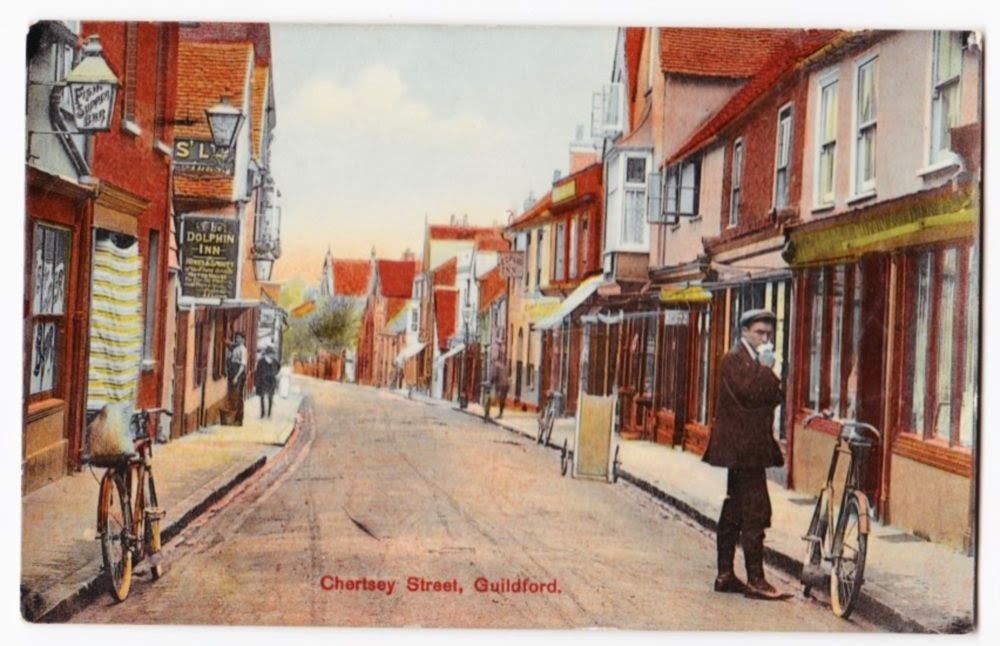
Chertsey Street, Guildford ~ Circa 1907

Posted in Archive - Imported from Blogger | Tagged , , , , , , | Leave a comment