

Created by Julie Goucher, 2023
Borders are easy to cross and frequently invisible. They are consistently impacted by a multitude of factors, with those factors being variable, depending on perception or wider implications.
In essence, borders is not a topic for which there is black or white, instead there might be a murky grey colour with varying undertones.
I am going to start with an image that I have shared many times before. This is a postcard and shows a ten mile radius of Guildford in Surrey. This postcard for me is a great focus point when I am looking for a geographical spread of where a missing individual might be. I am frequently amazed at the number of places within the radius, and those just outside of it, and how far my ancestors managed to get to without the modern invention of cars, buses and trains.
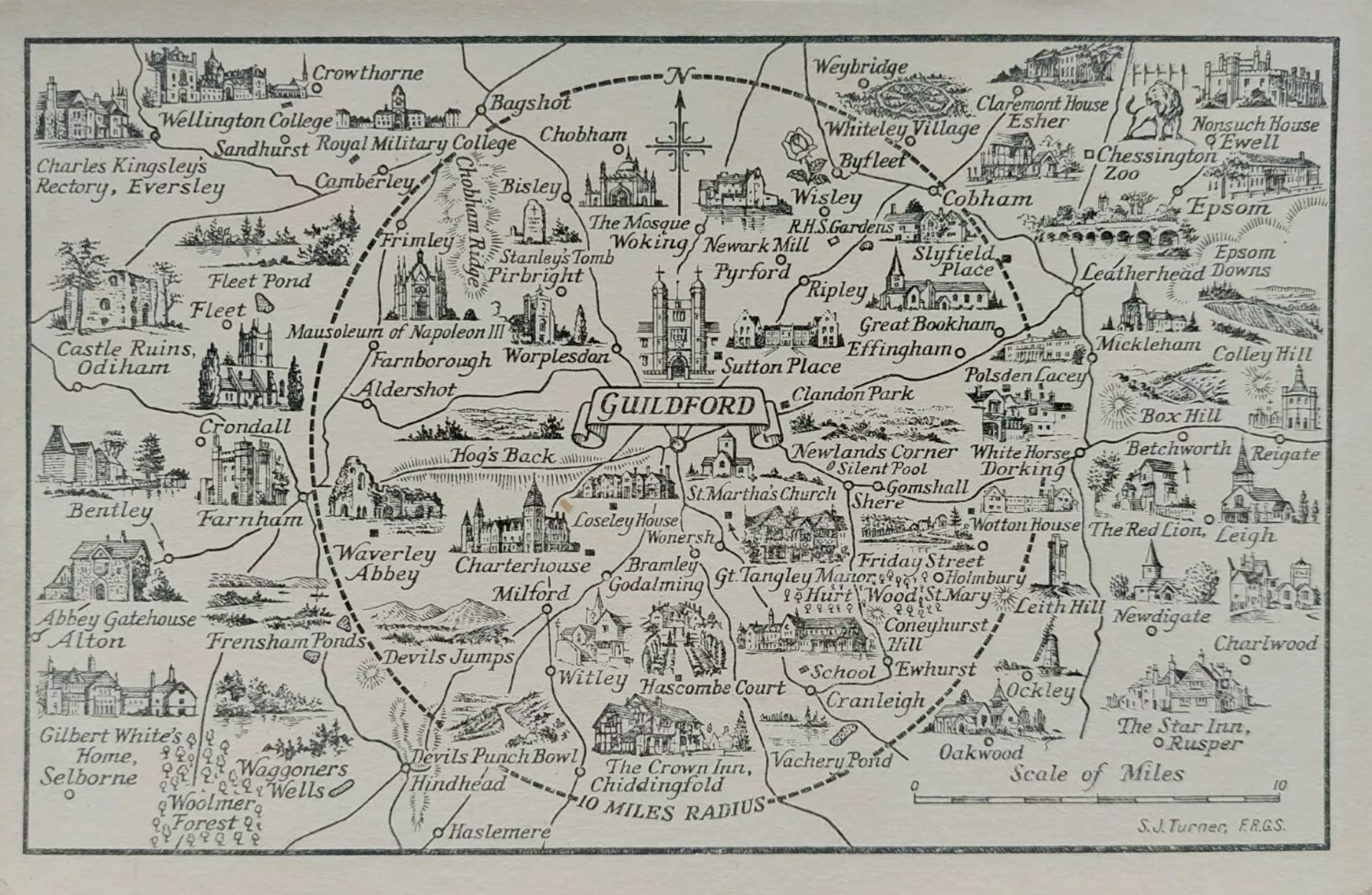
10 Mile Radius of Guildford, Surrey (England) – Part of the Guildford & District Collection – Julie Goucher
From my One-Place Study, the rural village of Puttenham is located near what is described on the postcard as Hog’s Back. On 9 April 1824, the parishioners of Puttenham joined together to undertake what they called the perambulation of Puttenham – you can see the list of parishioners HERE, with my ancestors marked in green.
This annual walk of the parish was to determine how far the parish spread and where the next parish began. This was necessary to determine whether the parish would help or provide assistance to individuals. If someone was within the parish they would be entitled to help, for those outside the parish then the responsibility fell to the neighbouring parish.
For those researching their ancestors in Europe, borders can be significant headache. In the times before border agencies, walking across a border was much easier and probably without any checks. Through periods of war then we see military gains and losses, some of which were reversed or maintained once the war had concluded.
If we look back to the second world war, people left Germany and Austria and migrated to other parts of Europe sure in the belief that they were safe from persecution. They likely did not consider that the safest thing to do was to cross the channel to Britain or to go much, much further.
At the end of the second world war, 8 May 1945 in Europe and 15 August 1945 in the Far East, the amount of displacement from those that survived was not insignificant. Prisoners of War – military and civilians were repatriated fairly easily, however, those that were in the far east found themselves in camps spread far and wide across the region, repatriation began by created hubs, essentially gathering individuals in one place or another that were going to a specified country. Regardless of which theatre of war, individuals that had experienced the horrors of war, internment, enforced labour, and worse found themselves in countries that were not theirs. In some cases they did not want to return home, home was gone, their family gone and it was time for a new start. Others did return home, to a country that was broken by the war, and in some cases to countries that was now in a country heavily influenced by Russia – essentially from the Russian zone of Berlin, and all the way east to Russia.
The redrawing of borders impacts family history significantly, because records that might be within the borders of a post second world war country, maybe actually in another country, or perhaps in a third country. General history of the country is important, it sets the foundations for research in understanding why records are not available, not where they “should be” and perhaps in the last place a researcher might think to look, moreover, records might be in two or more places, each signifying a period of history which impacted the peoples of a nation.
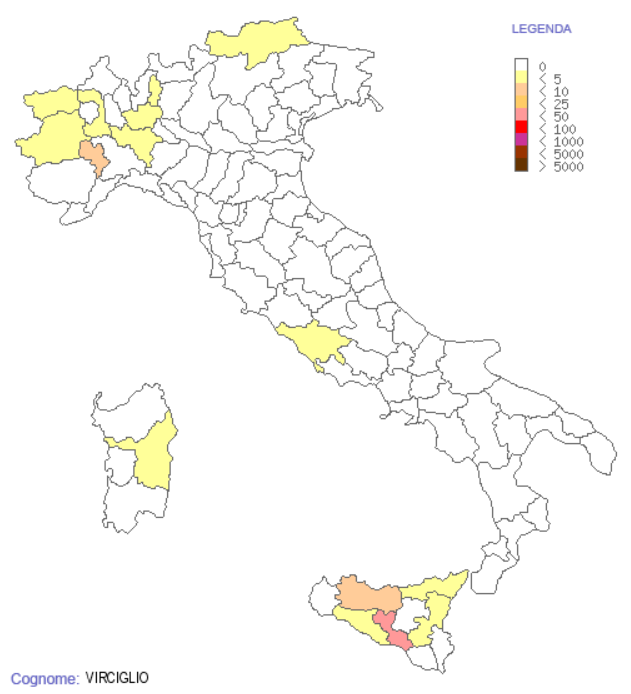
Surname Distribution Map from gens.info
The biggest reason why a One-Name Study aims to be global is because migration, across any period of time impacts the spread of individual surnames.
My Great grandmother had the surname of Virciglio, not a particularly common name. You can see the spread of the surname across Italy. None came to England and Wales prior to 1945. Some went to the United States from the last 1860s and even fewer Australia, predominately after the second world war. I have written about the surname previously, that post can be found HERE
Borders is a topic we look at in the Researching European Ancestors course that I teach – see HERE for details, it begins on 5 May 2025, just before the 80th anniversary of VE Day.


 Julie Goucher ~ Anglers Rest