
Merry Christmas image – from the collection of Julie Goucher, 2021
However you spend the season, I hope you enjoy it whatever you are doing. Perhaps with friends, family and perhaps a little genealogy too.

Merry Christmas image – from the collection of Julie Goucher, 2021
However you spend the season, I hope you enjoy it whatever you are doing. Perhaps with friends, family and perhaps a little genealogy too.
 Migration is the reason that a true one-name study is global. There have been peaks of migration, from the United Kingdom and various countries in Europe over time. The reasons for that migration varies depending on the starting point for the migration.
Having made the decision to migrate there are a number of factors to consider, here some are listed from the view point of the migrant and the view point from the researcher. They are listed below in a potentially random fashion and I plan to as we move into 2026 undertake a series of posts.
Each point should be considered in alignment with WHO, WHAT, WHEN, WHERE, WHY and HOW.
With all that, I am sure you can see why migration plays such a part in researching surnames.
As I said, I will look at this element in the early part of 2026, so if you are not a subscriber, either watch out on social media or to ensure you receive the posts, please subscribe.
Created by Julie Goucher, 2018 using word clouds
The way we each learn is different, I prefer to write notes, so for me I am likely to recall something if I wrote it down having read it or heard it. There is a plethora of genealogical and historical learning offerings out there, so much so it is easy to feel overwhelmed by it all. If I am undertaking research, say planning a book, article, course, I tend to make notes as I read.
If I make a direct copy, perhaps a sentence that “speaks to me” then I do that in a different colour and create the citation so that I and anyone else can find their way to the same information, in the same format. I must stress, this is not taking someone’s work as mine, it is identifying that this particular bit (sense, concept, theory etc.) was written by author/presenter ABC in (name of book, presentation etc.) and published/presented (year and publisher or date and host if in a presentation. This is about recognising and respecting another person’s work product mentioning what they said and in what format they said it.
The more reading and listening you do the more grounded your knowledge and subsequently your research will be. However, it is not just about reading and listening on our own. Interactions with us – peers, tutors, presenters etc is just as valuable and provides a mechanism for sharing ideas.
The following are the Pharos courses that I teach the first three are about Surnames and these are in a layered learning style:
Introduction to One-Name Studies course – a foundation for undertaking a study – learning about the numbers that reflect the people in your study, the history of surnames, and then drawing conclusions as to the history of your surname of interest.
Practicalities of a One-Name Studies course – focuses on tools that you can use in your study. I am often asked whether this should be taken first, or the Introduction course, and it is probably as broad, as it is long. If I was coming to this as a fairly new genealogists, or surname researcher, I would likely take both courses; they focus on different things and provide a rounded focus on researching a surname and developing a study.
Advanced One-Name Studies course – builds on the material learnt in the introduction course and is probably best taken when you have some time under your belt with a study. This provides the opportunity to create an article and for those who elect to, to have the article tutor assessed and published in the Journal of One-Name Studies.
Each time a course runs, students are invited to leave feedback. Feedback is important and provides a mechanism for me to develop the course, or perhaps create an additional paper. A recent addition, as a support document is guidance for developing, and building a study profile – you can download a copy HERE.
Researching Ancestors in Continental Europe – this is a course that I designed to give a broad understanding to mainland Europe. The course has description can be read HERE. There is focus on how complicated Europe is, given how many countries make up the Continent, the differences and similarities, religious focuses and prejudices. We look at the scale of influence of Europe and most importantly, we hone in on events within the last 100 years or, BUT, war in the 20th Century can and does impact records from pre 20th Century era.
This course is very much about getting the basics right, building research on solid foundations, because without that, it would be a bit like building a house in the middle of a swamp. As this is already quite lengthy, I am going to continue this on day 21!
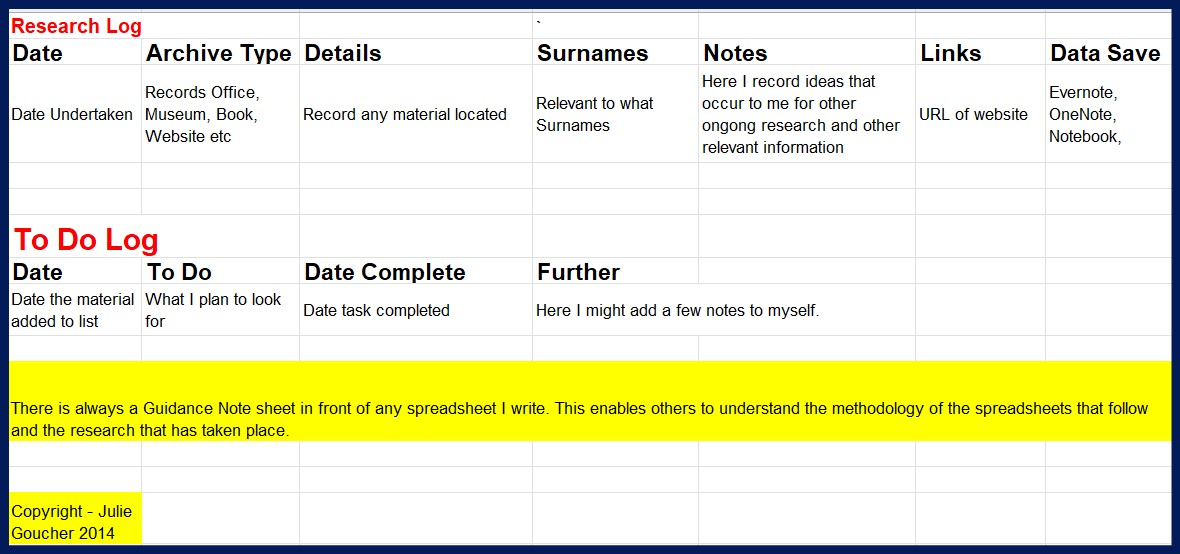
Screen capture of the Guidance information – research log – copyright Julie Goucher, 2014
Keeping track of our research, successes, next steps and research ideas is really important. Without it, and I speak for myself here, when I say, if it is not written down then all bets are off if I will remember or not.
I maintain a research log. Over the years this has existed in various forms, but all forms record the same information. There is a spreadsheet research log available to download HERE. There are three sheets in the Excel workbook:
Screen capture of the Guidance information – research log – copyright Julie Goucher, 2014
Those of us who have been researching a while, often know the next step, where we might be able to prove or disprove A, B, or C; if you play chess, that moment when you can see the potential next moves depending on your opponent.
I never add discovered material directly into my family history software, or into my database for any specific studies or online offering until I verify the facts. Everything is written down in my notebook, I know what the date was, as I date each page. I make a firm note of what I looked at, what database, what provider, that is in addition to my written notes of the actual information. Subsequently, I write my next steps and firm up those steps when I next focus on that particular individual. I also make sure that I incorporate the reference number the software gives to each individual person.
A research log also records negative searches – as that too helps over time, as it provides:
Each year or so I re-evaluate if my process for recording research by considering if it is thorough enough – let me clarify this – is the way I record search results sufficient? Sometimes you can only tell this, by actually doing the process, then see where there are holes in the process, or perhaps a change is needed because there is additional material further down in the process that needs to be considered and/or incorporated.
Earlier this year I began sorting through a huge collection of images, these were screen captures, book covers, images of documents etc etc, not all genealogical. As part of that I began to consider the wider focus and that led to a larger project that is not going to be completed anytime soon. Essentially, a change was going to be needed and I have spent a couple of months checking that my provisional change is robust enough and won’t need changing in the future. I will come back to this in 2026 and share the details in a future post.
In closing, as I finish each notebook I go back through the pages, checking the “To Do’s” – I always tick if complete and each entry is accompanied with the date. If I am part the way through, I make a note in a different colour pen (if at home, pencil if in an archive) of where I got to, then add this symbol >> to the page, thus indicating the item has moved to the next To Do list, it is worth mentioning that I do this whether this is to the next page or later page in the same book or a new book; and of course there is a larger entry in the dated research log itself.
Family history is akin to going on journey. When we start we do not necessarily know where we are going, we don’t know what we might see on the journey, nor the destination.
We use our starting point and move forward, doing rough arithmetic to estimate the year of birth for the next generation back. We work through the census hoping that the first names are different and therefore it is easier to establish who is who. The reality is that the family used the same few first names and therefore we may have two or more people with identical names, in some cases they marry someone whose first name is the name of their mother, if we are very unlucky they marry again, to someone with the same first name.
It is examples such as these that frequently why someone undertakes a one-name study. I have also encountered researchers who are focusing their research on an individuals who each bear the same name. In my own instance of this, it is Ralph Butcher and I am sure I will get round to sharing why the focus is on Ralph, but I am going to leave that for another day.
In the case of my several times Great Grandfather, George Ellis he married three times. The image immediately below is his second marriage from 1805 where he declares he is a widower. His bride was Sarah Beagel, and I descend from one of the son’s of this marriage. In 1823, Sarah dies, leaving George with a family.
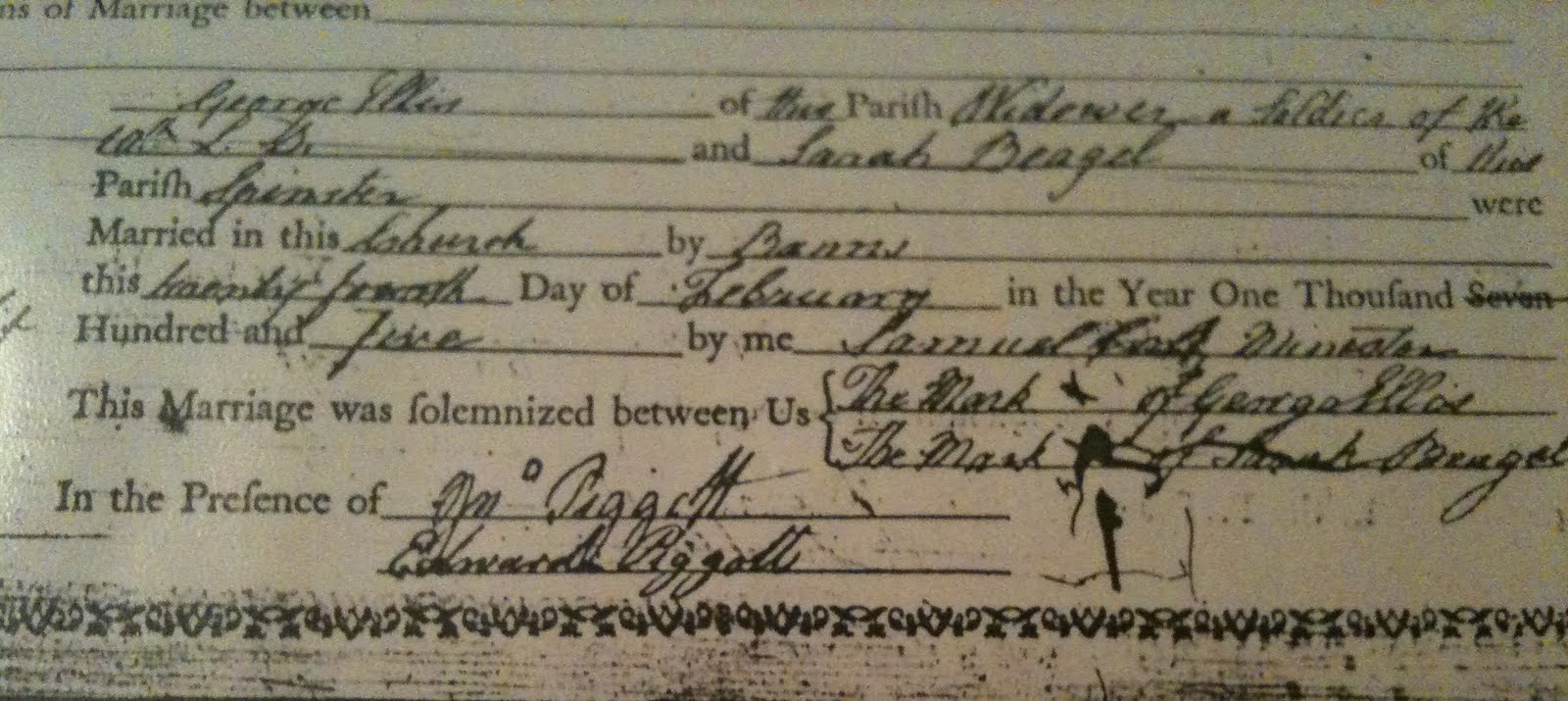
Marriage of George Ellis and Sarah Beagel 1805, St Mary’s church, Guildford. Parish Register, Surrey History Centre
In 1824, George remarries to Mary Virgo who is herself a widow. If you look carefully at the certificate below you can hopefully see the error that was made on the marriage certificate.
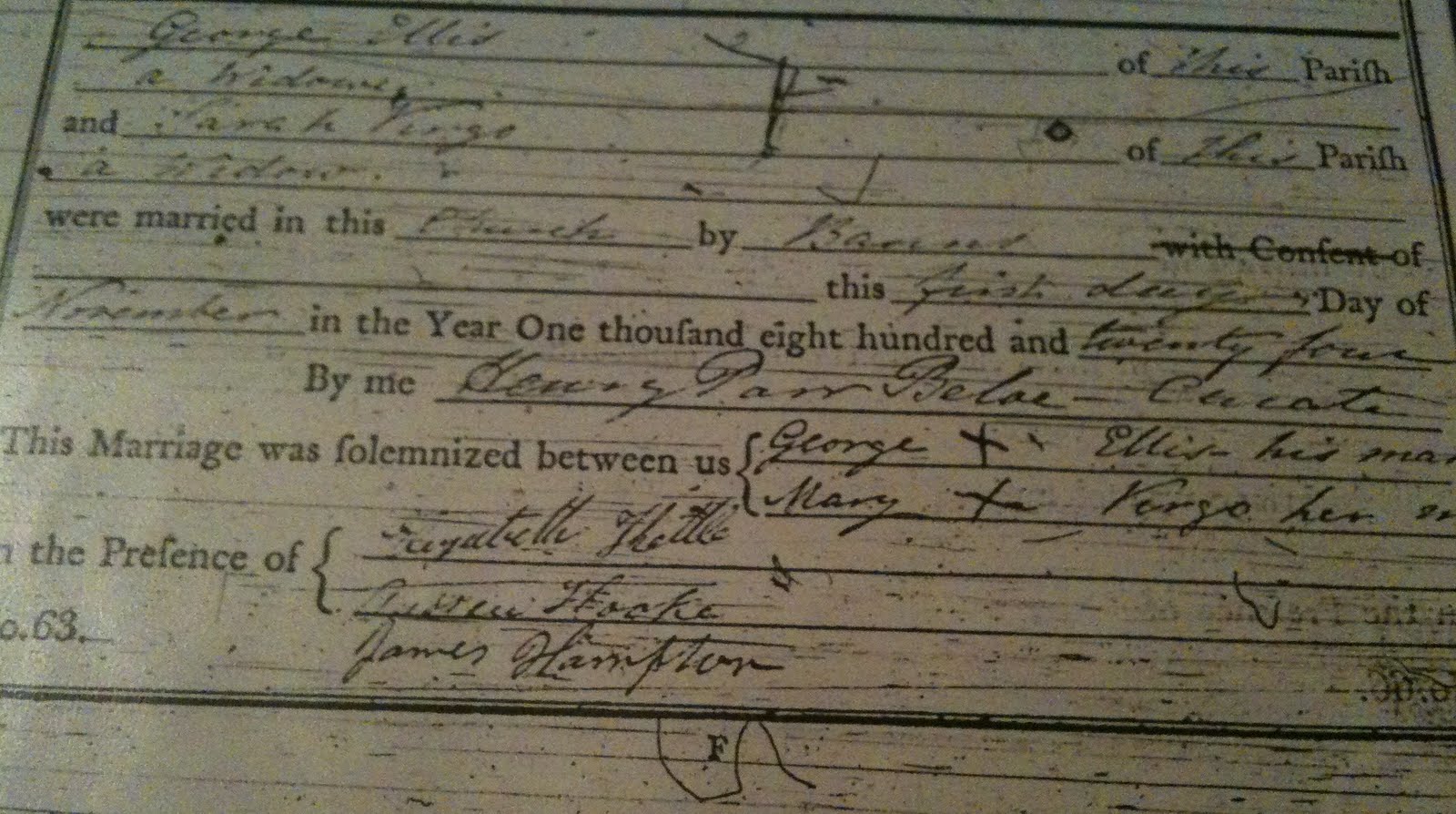
Marriage of Mary Virgo to George Ellis 1824, Holy Trinity Parish, Guildford, Surrey. Parish register, Surrey History Centre.
At time time of Sarah’s death, she and George had been married for just under 20 years. He therefore would have been used to calling to his wife. Was this a slip of the tongue? Or something that went on over the years? Was it true love, or a marriage that was simply transactional? We will never know, but these are ponderings that I had not considered when I first found the marriage.

Created by Julie Goucher, 2018
I am always amazed at the number of genealogists who are surprised or curious about the concept of One-Name studies.
Broadly speaking, we all have a surname. It might be one we were given at birth, one that was “given” to us, through adoption, one that came to us via marriage, or perhaps, if we are being individualistic, and have a surname that is a compound name; essentially this is one that typically exists through the joining of two surnames, though the name itself usually does not have any “history” to it.
There are also hyphenated names, names that appear as middle names, that are surnames, giving a nod to a former generation. The opportunity for research is wonderfully exciting, regardless of how you have acquired your surname.
There is also, for Italian families, surnames that are known as Detto’s. This is where a nickname is given to an individual, but instead of it being connected to one individual, this continues to further generations. I have one in my own family, the name Magro Malosso, the true surname is Malosso,
Given how much variation there is around the way we have surnames, we should not be surprised that there are recognisable types of surnames, and all studies are completely different. We cannot compare apples to bananas, but we can compare apples to apples!
In the case of surname studies they are all different – different aims, different starting places, different statistical information. Essentially anything goes!
The Genealogical community, both on and offline is in the main a friendly one, where sharing knowledge and ideas for research is given freely and frequently.
The internet has shrunk the world to the size of a matchbox, with interactions using social media platforms, or online provisions such as those operated by archives, record societies, local history groups and many, many other formats.
Essentially the genealogical global community is friendly, knowledgeable and welcoming.
This post is a little late, and I am glad it is. I gave a presentation on Tuesday evening, to a genealogical group online, about researching in Europe. I expressed that there had been a great distribution map for France, and having merged into another site, it had vanished. A lady in the online audience was French, and in France, she advised the site was still there….and it is, in French. With a bit of twiddling, by clicking on the French flag, and then selecting the surnames section, I could see the map….again.
It is the little things in life that make all the difference.

The site shows the distribution of the surname, in this case for ORLANDO across France in four time blocks – 1891-1915, 1916 -1940, 1941 – 1965 and 1966-1990. By clicking the buttons under the map, you change the distribution. Each department in France is revealed along with the number of births, when the mouse hovers above the individual region. You can look and see your surname distribution in France HERE
Thanks of course, once again to the lady who provided the link and for the guidance navigating the idiocrasies of the website.
You can download my Researching in France document HERE. I wrote a series on French research which I indexed and you access it HERE.
You might also be interested in my European Ancestors Course HERE
Created by Julie Goucher, 2018 – using wordclouds.com
Any One-Name and surname research project will involve the collection of material, what I refer to as raw data.
Regardless of where your surname originated from or where you reside, to undertake a One-Name Study and register this with the Guild the study should be global and there is no pressure on how soon you go global.
So what follows below, in no particular order, are some global quick wins. Sites where you can acquire material from without a paying subscription, even if you acquire the material and do not process it immediately – there are some real gems and my Orlando study has benefited greatly by several of the sites.
We talk more about Collecting data in the in the Pharos Introduction to One-Name Studies course.
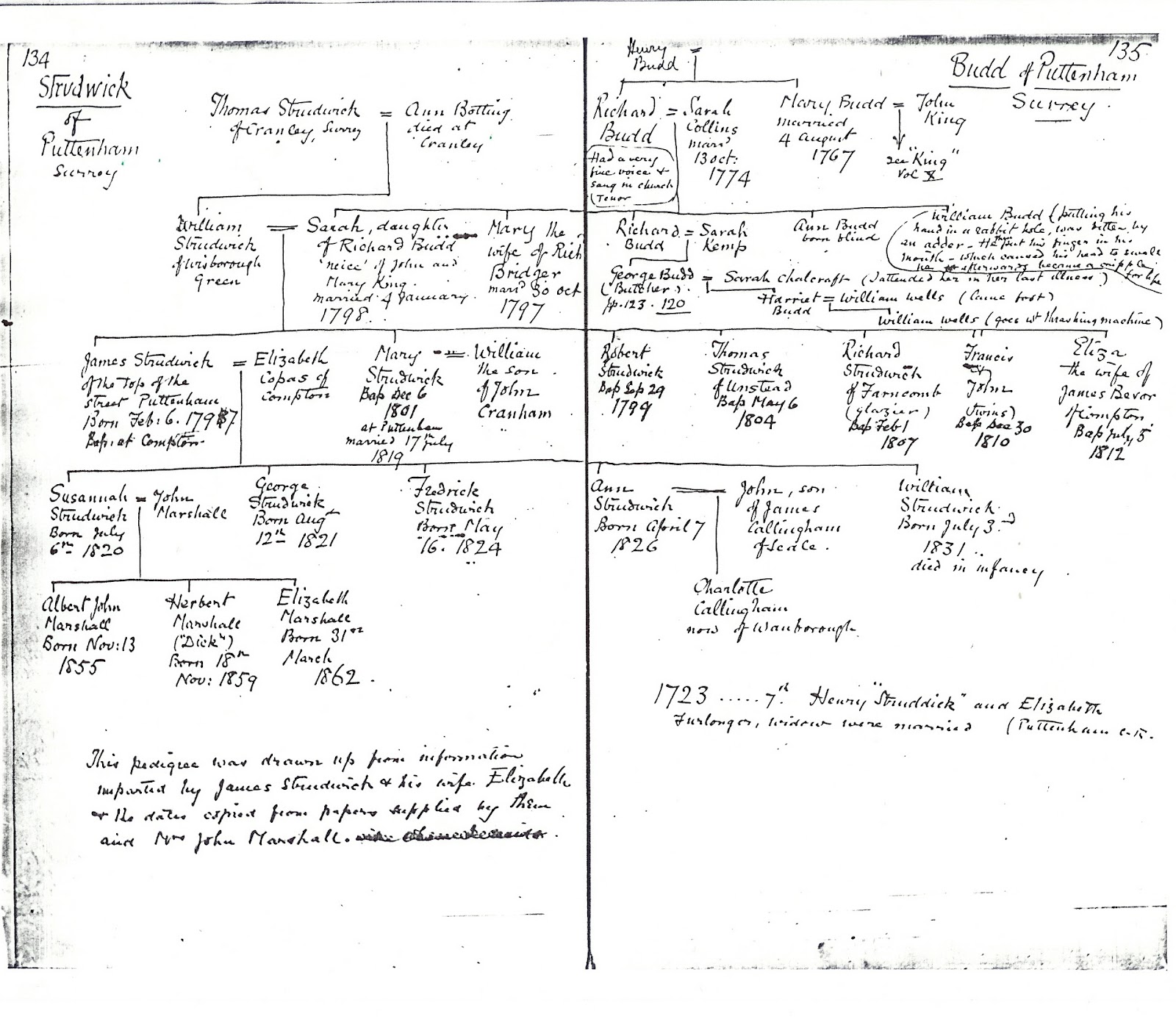
Taken from the manuscripts of Rev Charles Kerry (vol 10)
Family Trees, Pedigree, or lineage – are they the same, different or simply different things to different people?
A family tree is something that I produce when I am researching. It is a rough drawing of who sits where in the family group, on occasions, the group has overlaps, siblings marry siblings, strengthening the relationship or connection with two families.
It might have some basic information, perhaps a birth date, a source might appear as an abbreviation, a place where something happened represented by an initial or two. For me this is a work in progress, it helps me think and I frequently have more than one version – each version is dated. The versions appear as I perhaps move notebooks, or perhaps I take one individual, then move them to a page of their own and build their tree.
The image at the top of this post is repeated below in a larger format.
Taken from the manuscripts of Rev Charles Kerry (Vol 10).
I talked yesterday about the Budd family. This is a pedigree that was drawn by the curate of Puttenham Surrey, Charles Kerry. Kerry kept a series of manuscripts, which included things told to him by parishioners, information from parish registers and little antidotes, for example, he refers to my several times great grandfather, Richard Budd as having a fine tenor voice. Richard Budd was born in 1742, there is no way that I can think of that I would have known that fact, had someone note written that down. It is the little details like that, which takes a pedigree and turns it into something resembling a family tree.
Here is another example of a family tree created using pen and paper….

Butcher “Tree” – created Julie Goucher, 1993
Drawn in the format of a rough mind-map it puts people where they should be, adds in varying information – dates, places, occupations, legal/inheritance/taxation information.
A pedigree is names, dates and perhaps places. It is a document that shows the ancestral pathway of an individual, their parents, siblings, and ancestors. If you look back at the first image, you will see that under the Budd family, Kerry mentions the word pedigree. As I said, different things to different people.
A Lineage Society is essentially researching direct descent from an ancestor; ancestry or pedigree; there is a list of some of the Societies HERE. You could think that my research with Henry Budd was an example of this, and perhaps it is, however, what makes it different, is that I have researched the Budd’s which includes some which is not related to me. I have not researched every individual or family with the Surname Budd. Usually with Lineage Societies you provide genealogical evidence with sources cited and pay the subscription fee to join.
A One-Name Study or Surname Study as defined by the Guild of One-Name Studies, aims to research ALL instances of the surname wherever they appear globally and across all dates. There is no time constraints as to when the study goes global – think marathon, rather than a sprint! The reason for the remit to be global is because of migration.
There are “micro versions” or “focus studies”, where people are researching all of a particular surname in a county, or two, or perhaps all the people with a specific name, for example Henry Budd.
For my own Butcher One-Name Study, I have devised that I will work through material in batches, essentially following counties that are neighbouring, as that typically means migration paths. For me that is Surrey and Sussex which is where my own family hails from. Then I am moving to Hampshire and the Isle of Wight, Devon and Cornwall and so forth. For Countries outside of the UK, I am focusing Australia, beginning with Tasmania, New South Wales and Western Australia. That does not mean I have not deviated from my plan, sometimes the research itself dictates a path way.

Julie Goucher, 2019 using wordcloud.com
Regardless of what research you are undertaking, every separate fact contained within a document should be individually recorded into a database, and subsequently, every fact should be supported by evidence.
The evidence documented with the citation, which subsequently can be seen/obtained from…..
Let me provide an example:
Below is an extract from the Practicalities of a One-Name Studies course which I wrote and tutor for Pharos Tutors and Teaching. The document shows two certificates, both representing the same event: Marriage of 2 April 1902 of Charles Jelley and Edith Annie Matthews which took place in Guildford, Surrey.
Each fact, such as occupation of the groom, address of both bride and groom, ages at the time of marriage, occupations of their fathers are all recorded as separate facts within my database for each individual.
Whilst both certificates show the same event, they are different source documents, with different citations. Copies of both certificates can be viewed or obtained in different ways. Furthermore, there is a difference between both certificates, can you spot it?
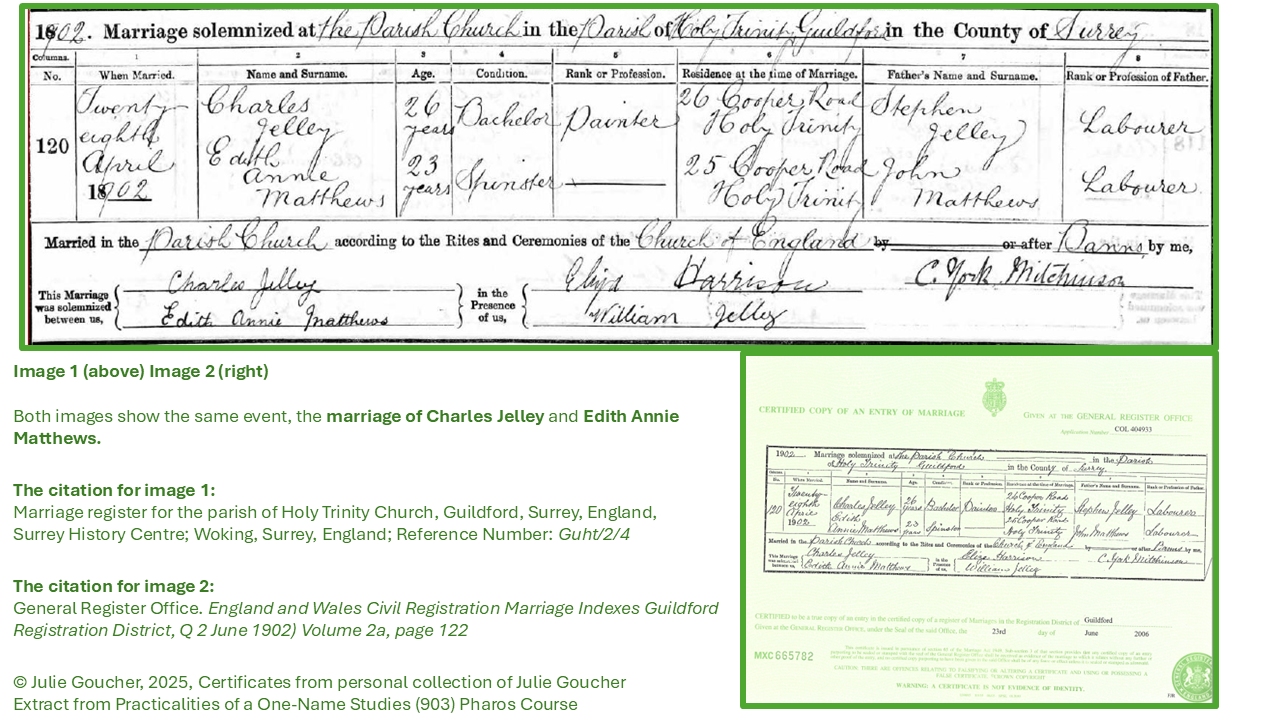
© Julie Goucher, 2025, Certificates from personal collection of Julie Goucher – Extract from the Practicalities of a One-Name Studies (903) Pharos Course
In addition to that, there is a reference list, which might be saved as footnotes or end notes, or in a separate section, a repository list and a bibliography.
Sources themselves can be defined as three different types:
The point of evidence is that it gives credence to claims made. It means that future researchers can follow the pathway to events, substantiating or not, earlier research.
One thing to remember is, person A can undertake research and provide evidence of all claims made. However, person B might verify the research of person A, but also have a document that person A is completely unaware of. Does that devalue the research of person A? I think not, but I would go a stage further.
In a perfect world we would try to find as many sources as possible so to verify a fact, or to disprove one. We might have a hypothesis, something we think could be the case, or might be so. We might have reasoning because we know records have not survived, as far as we are aware. An example of this might be:
My several times great grandfather, Henry BUDD married Martha OTTWAY in 1723, in the parish of Chertsey, Surrey. They settled in Puttenham, Surrey and raised a family of eight children, I descend from Richard BUDD who was their second to last child, born in 1742. The family thrived in Puttenham from 1724 onwards, but there is still more work to be done.
Two things of note are:
1:- Upon looking for Henry’s birth, I spot a reference to Henry Budd made by the curate of the time, Charles Kerry. The reference states that the baptism of Henry’s eldest child, Martha was “first of the Budd’s” I had already deduced that from a thorough viewing of the parish registers. Thus, Henry came from elsewhere, but where?
In 1720, Henry is witnessing a marriage in Elstead, which is just a few miles from Puttenham. A further search revealed that it was likely that Henry came from a family of Budd’s just over the border into Hampshire; the parish of Binsted. At this point I had not undertaken a more rigorous search
2:- By complete chance, I came across a reference from Sussex Family History Group, where the identified some marriages that had taken place between grooms from Sussex to brides in Surrey. A look down the list, and I spotted a Daniel Budd of Lurgershall marrying Alice Willson in 1704 in the parish of Peper Harrow, a village within a mile or two from Puttenham.
Is Daniel connected to Henry? I have a few ideas and hunches. I have created a timeline of information relating to both Daniel and Henry. What is clear, is that the material relating to Peper Harrow parish is scanty prior to 1837.
In closing today’s post, evidence is vital and at this point I cannot say with certainty that I have located all instances relating to this family of Budd’s, but I do have a hypothesis, and that is the best I can do.

The Anglers Rest blog first went online at Blogger in 2002. At the time of transfer, the counter was at 349,463.
It was moved to this site on 18th December 2015 when the counter was reset -:(
 Julie Goucher ~ Anglers Rest