Web Wednesday (9)

Created by Julie Goucher, 2023

The web-Wednesday site for this week is:

Postal Museum

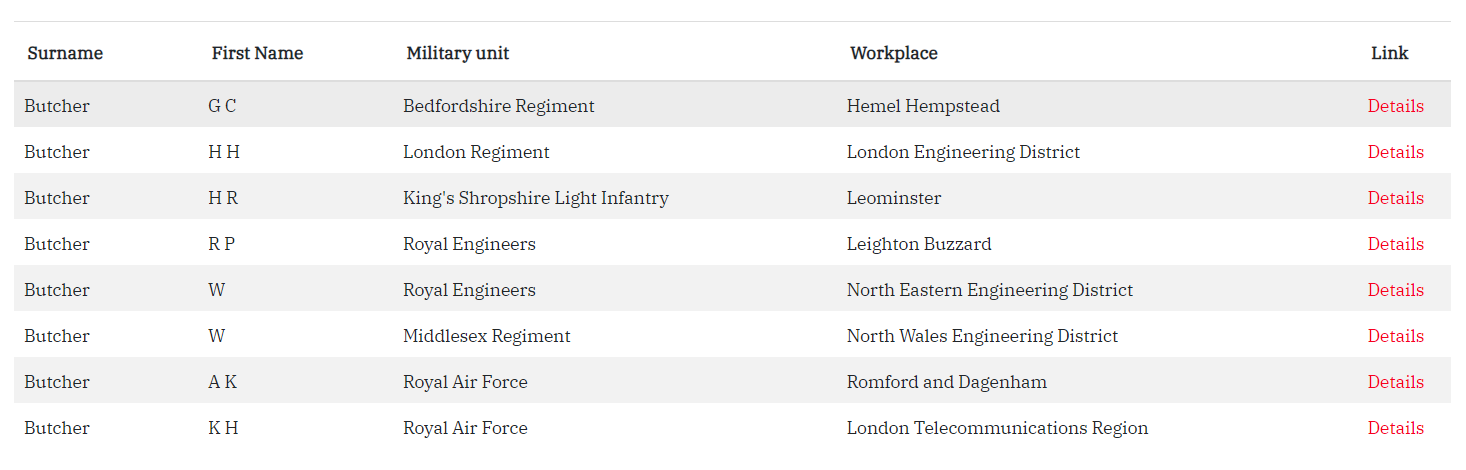
There is limited material online, but there is a useful catalogue. A search of the catalogue for the name BUTCHER, produced three individual who served in the First World War, all of whom were commemorated on memorials. There was also reference made to individual who, with another received a letter of appreciation and a reward of £10 for handling a fire in 1949.

There is a useful Research Guide for Family historians that can be downloaded. There is also a really interesting list of historical job roles and an explanation of what each one meant, you can read this here. A second research guide is provides and overview of material available and explains the legal aspects of the sending and delivery of post and postal services and this can be downloaded here.

Posted in Web Wednesday | Leave a comment

Web Wednesday (8)

Created by Julie Goucher, 2023

The web-Wednesday for this week is a topic focus on WILLS, after all, it is #WillsWednesday!

Wills give us tremendous insight into who:

  1. a person, the testator was,
  2. people they cared about, and
  3. the items they treasured.

This post is not looking at the language in wills, nor the demographics relating to the proving of wills. Instead it acknowledges that wills, inventories, and any other associated documents can be found in a variety of places, and all add value to our genealogical research, therefore, I list below a selection of links:

These sites are all able to be accessed free of charge.

A final comment –  please don’t forget the Wills Consultation Paper which I wrote about previously.  You will find the relevant links, to the paper and petition in my earlier post the closing date is 23 February 2024

Posted in Web Wednesday | Leave a comment

Web Wednesday (7)

Created by Julie Goucher, 2023

The web-Wednesday site for this week is:

GB Names

This is a really useful site to those interested in the distribution of a surname across Great Britain, using census data for the years 1851, 1861, 1881, 1901 and 1911 (1911 excludes Scotland), and for the more recent years 1998, 2006 and 2016.

This is an interesting way to see the focus areas, but it is not going to be absolutely accurate, though when I searched for my own surname, it did mention further down the page, where the historical places were, which were correct and one of the popular given names was Samuel, which is something that does follow the data for my husband’s family.

Posted in Genealogy, One-Place Studies, Web Wednesday | Leave a comment

Web Wednesday (6)

Created by Julie Goucher, 2023

The web-Wednesday site for this week is:

Durham Mining Museum

This is an EXCELLENT website for those researching in:


Durham Mining Museum

  • County Durham
  • Northumberland
  • Cumberland
  • Westmoreland
  • North Yorkshire (Ironstone Mines)

The site is absolutely jammed pack with material for those researching mining as a broad subject, the individual pits and there is some material relating to those who worked at various pits. There is also material on various mining disasters.

For those researching elsewhere, then the links page which can be found HERE. There is also links to mining in Scotland, especially Fife which was a topic that came up in the recent tutorial session for the Introduction to One-Name Studies course.

Posted in Web Wednesday | Tagged | Leave a comment

Desk Ramblings (32)

Created by Julie Goucher, July 2019

We are fairly recently back from a visit to Scotland where we had some challenging weather. I have been visiting Scotland, at least once a year for the last thirty years.

In all that time, I do not think I have ever encountered the weather as harsh and cold, as this most recent trip. The temperature plunged to -6, though was predicted to be as low as -7. It was of course much colder further north – Annan is a market town just over the border, about 5 miles from Gretna. We did take the opportunity to visit and have cuddles with our great Niece, who is now five months old.

When we got home we had two events to get through, firstly was the emptying of the loft ready for insulation and then a couple of days later, a new central heating boiler.

Activity in the genealogical world has picked up. The latest Introduction to One-Names Studies course began just last week, then on Saturday I attended the virtual family history fair hosted by the East Surrey Family History Society – which was the topic for Web Wednesday (4). Three of us virtually manned the stand, which was enjoyable, we met other genealogists and caught us with some existing members. The event was well received and will take place again next January, so that is something to look forward to.

This week I begun to receive the assignment from students who took the Advanced One-Name Studies course last November and opted for their assignment to be marked.  I have not confirmed dates for the Advanced course for 2024, but if you would like to take the course, please get in touch.

Image created by the SOG, and used with permission

I am adding the final touches to a presentation, Beyond the Marriage Certificate, which is being delivered to the Society of Genealogists in two weeks – to read more information and to book please look HERE.

That is it until next time!

Posted in Desk Ramblings! | Leave a comment

Web Wednesday (5)

Created by Julie Goucher, 2023

The web-Wednesday site for this week is:

Who Owns England?

This is a fascinating site and attempts to answer the important question of Who Owns England? Which is a key question for those of us who interested in local history, whether that is an extension to our own family history, or linked into a One-Place Study, or even connected to individuals in a One-Name Study.

The site informs readers that they will be adding in some history, some politics, photographs and much more.

Coming back to the question of Who Owns England? couple that with my thinking of land that was  held in my own family, my questions are below:

  • Does it matter who owns what land? 
  • When did they begin owning it?
  • How did they acquire the land?
    • Inherit
    • Purchase
    • Acquire though common usage
  • What does the land ownership tell us about the individuals?
  • Is the land subject to rights of way?
  • Is, or was the land part of an historical estate?
    • How many acres? 
    • What was the use of the land
      • farm land – crops
      • farm land – cattle
    • What happened to the estate?
    • Has the land been sold off?
      • New Housing?
      • Neighbouring farmer?

There are many questions that can be asked around this topic, and there are many research opportunities that can be embraced and explored as we move forward in answering the various questions.

Posted in Genealogy, Local History, Web Wednesday | Leave a comment

Ironside Tartan

Tartans are a significant part of Scottish identity and heritage; though not every surname is represented by a tartan. People traditionally where a tartan which reflects their surname or an associated family.

I have no Scottish ancestry, but one family that I am researching, with the surname, of IRONSIDE, is one that is found in Aberdeenshire. The family moved across the border into County Durham, then down to Dorset in the West Country of England and then a branch migrated north (ish) to Surrey. The move to Surrey is where the family connects to my personal Butcher family, which is part of my One-Name Study. Despite this, there is no historical tartan for the surname, but there is a tartan that was created for a specific event

Ironside Tartan

Courtesy of the Scottish Register of Tartans

3rd July 2001 – Estimated count for display purposes only. A restricted tartan created for the Golden Wedding Anniversary of John T. and Frances A. Ironside of a farming family from Methlick, Aberdeenshire.

I can see why tartans have appeal to those who are researching their heritage, it is as though there is an invisible piece of elastic linking to forebears and making that connection.

Having searched the site, Clans.com for the surname IRONSIDE, just one result was revealed which identified three different pallets – Reproduction, Modern and Ancient. Upon selecting one of the Tartans, Robert Burns Legacy (Robert ‘Rabbie’ Burns) Tartan you can see the slight variation to the colour in the image below.

Screen capture of Ironside Tartan, courtesy of the Clans.com website – accessed 25 Jan 2024

After the Battle of Culloden in 1746, the government in London passed an Act of Parliament, in which Highlanders were disarmed and the wearing of tartans outlawed. Highlanders were subject to the strict enforcement of those rules and by the time the legislation was repealed in 1785, Highlanders apparently had become accustomed to wearing usual apparel.

The revival of the wearing of tartans did not begin until 1822, when George IV suggested that everyone who was attending the formal functions should wear their respective tartans, or Clans Tartans.

Clan Tartans are appropriate for the populous to wear in the event that an individual does not have a specific tartan. Alternatively, they may decide to wear the tartan representing the town in which they or their family resided in.

In the photograph here, the pipe band of Newton Stewart, Dumfriesshire, are celebrating St Andrews’s Day (1 December) and wearing the Stewart Tartan.

St Andrews Day Newton Stewart 2019

Copyright Julie Goucher, 1 December 2019 . Pipe Band, Newton Stewart, Dumfriesshire St. Andrew’s Day

Royal tartans are only permitted to be worn by members of the Royal family. There are also other restrictions, such as this one, belonging to the White House Historical Association which was created to promote the work of the Scottish stonemasons in the building of the White House in Washington DC, United States.

Other links which might be useful to explore:

Those interested in focusing on Tartans and how they may connect to a particular family line, might find the first two websites useful

Posted in Butcher One-Name Study, Genealogy, Ironside, Surnames | Leave a comment

Burns and Burns Night (Part 3)

I couldn’t write about Burns Night, or a Scottish surname without writing about Clans and Tartans, even if it is in a limited way. Upon searching the site, Clans.com for the surname BURNS, it revealed 11 such tartans. Each tartan subsequently identified three different pallets – Reproduction, Modern and Ancient. Upon selecting one of the Tartans, Robert Burns Legacy (Robert ‘Rabbie’ Burns) Tartan you can see the slight variation to the colour in the image below.

Screen capture of Robert Burns Legacy Tartan, courtesy of the Clans.com website – accessed 25 Jan 2024

The Scottish Register for Tartans recorded 14 results when I searched the site for BURNS, and you can see those results HERE.

The subject of Tartans, Clans and Septs is an interesting one and I will write about those in the coming months.

Posted in Genealogy, Scotland, Tartans & Clans | Leave a comment

Burns and Burns Night (Part 2)

Having written the earlier post about Burns Night (Burns Night Part 1), I realised that I had not explored the surname more fully. I don’t have time to create a significant post, but did want to share a few things with you, as I was quite surprised.

I headed to Forebears.io and looked at the distribution of the surname BURNS for 1881 – direct link to the data HERE

Distribution Map from Forebears.io for 1881 – Surname of BURNS


Place Incidence Frequency Rank in Area
England 13,287 1:1,835 242
Scotland 6,563 1:570 89
Wales 323 1:4,856 334
Isle of Man 27 1:2,010 260
Guernsey 11 1:2,969 521
Jersey 1 1:51,882 3,898

The map shows that in 1881 there were no instances of the surname anywhere but the United Kingdom. There are some anomalies here.

The data does refers to Great Britain which is England, Wales and Scotland. Isle of Man, Jersey and Guernsey are not the part of Great Britain or the UK, but they are Crown Dependencies.

The results show there were more that double instances of England than in Scotland.

There is some data for 1880, which is only for the United States, but if you look at the distribution map and click the actual map, it does populate each state – Check this out HERE

The site also provides some data for 1901, with only Ireland being shown. At this point, Ireland was one country.

Place Incidence Frequency Rank in Area
Ireland 7,394 1:599 86

There is no further historical data, what is available from the site is relative to the Census data. As you might expect by 2014, which is the other date that provides data, the distribution map shows the surname is more widespread.

Distribution Map from Forebears.io for 2014 – Surname of BURNS

The data for 2014 shows the distribution across the most incidences for the top 10 locations, and you can click the link to see more data

Place Incidence Frequency Rank in Area
United States 221,560 1:1,636 131
England 34,808 1:1,601 179
Australia 23,318 1:1,158 117
Canada 17,125 1:2,152 236
Scotland 11,211 1:478 55
Northern Ireland 4,752 1:388 33
Ireland 4,304 1:1,094 218
New Zealand 2,845 1:1,592 196
South Africa 2,562 1:21,147 2,680
Wales 1,326 1:2,334 254

Looking at surname distribution is one of the elements of the Introduction to One-Name Studies course – The course has just started, but there are a few spaces left if you would like to join us, just click the link provided.

Posted in Burns, Introduction to One-Name Studies (Pharos course 901), Scotland, Surnames | Leave a comment

Burns and Burns Night (Part 1)

Robert Burns, 1759 – 1796

Across the globe, thousands of people with Scottish Heritage celebrate the birth of the Scottish Poet Robbie Burns on 25 January. The first Burns supper was hosted by the Burns Club on 29 January 1802 which was thought to be the poet’s birthday, however, a search of the Ayr parish records revealed that he was born on 25 January.

Traditionally there is a Burns Supper of Haggis, Neep and Tatties to celebrate the event.

The formal supper starts with a welcome and announcements then the Selkirk Grace.

Selkirk is one of the oldest towns in the Borders of Scotland. The Grace itself is a prayer and said before a meal. Here is the prayer in both Scottish and English translation:

Some hae meat and canna eat,
And some wad eat that want it,
But we hae meat and we can eat,
Sae let the Lord be thankit.

Some have food and cannot eat,
And some would eat that lack it,
But we have food and we can eat,
So let God be thanked.

After the Grace everyone stands as the Haggis is carried into the room to the sound of bagpipes. The Haggis is laid at the hosts table and then there is the cutting of the Haggis and the famous poem “Address to a Haggis” is read.

Fair fa’ your honest, sonsie face,
Great chieftain o’ the puddin-race!
Aboon them a’ ye tak your place,
Painch, tripe, or thairm:
Weel are ye wordy o’ a grace
As lang’s my arm.

The groaning trencher there ye fill,
Your hurdies like a distant hill,
Your pin wad help to mend a mill
In time o’ need,
While thro’ your pores the dews distil
Like amber bead.

His knife see rustic Labour dicht,
An’ cut you up wi’ ready slicht,
Trenching your gushing entrails bricht,
Like ony ditch;
And then, O what a glorious sicht,
Warm-reekin, rich!

Then, horn for horn, they stretch an’ strive:
Deil tak the hindmaist! on they drive,
Till a’ their weel-swall’d kytes belyve,
Are bent like drums;
Then auld Guidman, maist like to rive,
“Bethankit” hums.

Is there that o’re his French ragout
Or olio that wad staw a sow,
Or fricassee wad mak her spew
Wi’ perfect scunner,
Looks down wi’ sneering, scornfu’ view
On sic a dinner?

Poor devil! see him ower his trash,
As feckless as a wither’d rash,
His spindle shank, a guid whip-lash,
His nieve a nit;
Thro’ bloody flood or field to dash,
O how unfit!

But mark the Rustic, haggis fed,
The trembling earth resounds his tread.
Clap in his wallie nieve a blade,
He’ll mak it whistle;
An’ legs an’ arms, an’ heads will sned,
Like taps o’ thristle.

Ye Pow’rs wha mak mankind your care,
And dish them out their bill o’ fare,
Auld Scotland wants nae skinkin ware
That jaups in luggies;
But, if ye wish her gratefu’ prayer,

Gie her a haggis!

At the end of the poem there is a whisky toast to the Haggis. Then the meal is consumed.

The meal itself is Haggis served with mashed potato known as tatties and mashed neep which are turnip if you are in Scotland or Suede if you are south of the border!

When the meal reaches the coffee stage there is a toast to the Monarch . After the meal an “Immortal Memory” takes place. This is usually a speech on the life and poetry works of Robert Burns and the evening concludes with the singing of Auld Lang Syne.

Should auld acquaintance be forgot,
and never brought to mind ?
Should auld acquaintance be forgot,
and auld lang syne* ?

CHORUS: 
For auld lang syne, 
my jo, for auld lang syne, 
we’ll tak a cup o’ kindness yet, 
for auld lang syne.

And surely ye’ll be your pint-stowp !
and surely I’ll be mine !
And we’ll tak a cup o’ kindness yet,
for auld lang syne.

CHORUS

Ready cooked Haggis

Haggis can be found in most super markets here in the UK. They are usually found on the fresh meat counters and can be frozen. I routinely have at least two in the freezer. They do need defrosting before cooking.

Haggis can be cooked in a variety of ways

  1. Haggis can be cooked on the hob, in a pan of boiled water. As soon as the water boils reduce the heat and add the Haggis, with the water simmering it takes around an hour.
  2. Haggis can also be cooked in the oven, remove from the plastic casing and wrap in tin foil. Place the Haggis into an oven proof dish with a little water and cook, usually for around an hour.
  3. Haggis can also be cooked via the microwave, I usually remove the outer plastic and skin, and don’t forget the metal clips at the ends! Cut the Haggis into small segments and cook on full power. Length of time will vary depending on your microwave.

Haggis Pie

Cook Suede and Potatoes
Haggis cooked for about 3 minutes in the microwave (mine is 900w)
Cut Haggis into sections and place in bottom of a dish, I use a Lasagna dish
Mash Suede and place on top of Haggis
Mash potato and place on top of Suede.
Place in Oven for (mine is fan assisted) so 20 minutes until nice and brown.

Wee Beestie!

Cook Haggis and break into bits with a fork.
Serve on a bed of mashed potato and mashed suede (neep)
cover with cheese sauce and a light dusting of black pepper to taste

Haggis is available in most supermarkets in the UK, either as fresh, or in some cases tinned – our preference is for the fresh.

For those residing in Scotland there is ready meal of Haggis, Tattie and Neep available all year round, they even make a larger portion for the big night itself. We can vouch for the ready meal, and no trip to Scotland is complete until we have picked up some to bring home!

Posted in Scotland | Leave a comment