I’ve Collected Data, now What?

Now what.

Courtesy of Wordcloud.com

Having downloaded and acquired data you need to do something with it. Not every member of the Guild does family reconstruction, and that might depend on the size of your study and your personal preference.

Personally I do reconstruct families and with a large study that is time consuming, but worthwhile.

Remember though, this is YOUR study so as long as you meet the requirements of the Guild of One-Name studies, you can make your own rules!

Reconstruction, in the main, can be started from either of two points:

  • Census
  • Marriage Records

However, it does depend on how you have decided to maintain your database. You might have elected to

  • include every person in which case you will have random references
  • only include family groups and keep others in spreadsheets.

I know Guild members who use both methods and there is no right or wrong answer here. I personally start from marriages and keep a spreadsheet of marriages devised by Country, so England and Wales from a mixture of FreeBMD and the GRO, Scotland and so forth. I add a number of fields into the spreadsheet, which are mainly for my benefit – have I the marriage certificate or a faux certificate from a Guild marriage challenge, have I entered the details into the Guild indexes and have I uploaded a copy of the certificate to the website.

A few weeks ago, I was talking to the Guild Chairman, Paul Howes in which Paul explained that he also starts from a marriage and the details of his spreadsheet. After our conversation I pulled up my spreadsheet and could see an real advantage to adding the extra fields – the date of the marriage and the church.

For readers outside of England and Wales or unfamiliar with the GRO and FreeBMD. The indexes merely tell you the marriage, the registration district and which volume and page. So in order to gain the details such as occupations, father of bride and groom, witnesses you need to send for the certificate which depending, on availability and time frame will between £6 and £9.25. Those of us who have purchased certificates and provided the information to the indexes help others and the marriage information populates into Marriage Locator. Of course, an alternative to the GRO certificate the marriage from the Parish Registers will also provide the relevant details.

Another element to looking at the data you have is spellings of the surnames – Surnames have changed over time caused by a variety of things, language, accents, unfamiliarity to the name, in the case of some, the alphabet changes and the ability of reading & writing.

We look at the topic of variants and deviants in the course and the differences between them. It is not necessary to register a variant and they can be added over time and research.

Analysing death and burial records might lead you to believe that there was an epidemic or alike of illness such as Cholera. Other analysing of London parishes might lead you to Charles Booths study of London

It is during this stage that you will draw a conclusion which might change over time as more research is done, or you might form a hypothesis .

You might find that during this phase that the evidence and tells you one thing, but you get a sense of X, and that can be determined by a DNA project.

We talk more about a number of these points in the Pharos Introduction to One-Name Studies course.  Meanwhile, I’ll be back tomorrow talking about drawing conclusions from Data

Posted in Introduction to One-Name Studies (Pharos course 901), One-Name Studies | Leave a comment

Quick Wins for Surname Collection

Data Collection

Image courtesy of Wordcloud.com

Any One-Name and surname research project will involve the collection of material, what I refer to as raw data.

Regardless of where your surname originated from or where you reside, to undertake a One-Name Study and register this with the Guild the study should be global and there is no pressure on how soon you go global.

So what follows below, in no particular order, are some global quick wins. Sites where you can acquire material from without a paying subscription, even if you acquire the material and do not process it immediately – there are some real gems and my Orlando study has benefited greatly by several of the sites.

We talk more about Collecting data in the in the Pharos Introduction to One-Name Studies course. Meanwhile, I’ll be back tomorrow talking about what to do with the data once you have collected it.

Posted in Introduction to One-Name Studies (Pharos course 901), One-Name Studies | 2 Comments

Before you get Started – Organisational Considerations

Organisation Considerations

Courtesy of wordcloud.com

Undertaking a One-Name Study and surname research should be fun, so it is worth taking time to think about the way forward.

It doesn’t matter if you change systems, I did three times before I proceeded with what I have now and I wish that someone had said that to me when I started all those years ago with reams of paper!

There is no right or wrong  way to proceed, you need to select the option that works for you. If you don’t, the study won’t proceed and it will stop being fun!

What follows below are a few considerations:

  • Create your Study Profile – If you are a Guild member with a registered One-Name Study you will have one set up for you. This is the shop window of your study. It alerts others to the study and encourages interaction. The profile can evolve as the study does. Here are a few profile examples:
  • Decide how to keep your study
    • Raw data into spreadsheets
    • Database using a Family History programme. – The most popular amongst Guild members are Roots Magic, Legacy and Family Historian
    • I personally keep spreadsheets of vital records and once I have started family reconstruction the individuals are added to the database, I use RootsMagic
  • Website – We touch on this a little later in the series, but do give this some consideration, especially if you decide you will want to join the Guild’s Members Website Project and use TNG – A good example of a site using TNG is the Howes Study.
  • Methodology 
    • Be organised – where are you going to keep your archive of material? Material to be processed? Consider Evernote or One-Note and files in Dropbox.
    • Use the Guild Library to archive your records, even if you have a website
    • Consider paper versus electronic or both
  • Data Overload – It is easy to get bogged down in material as data sets are released. By all means download the material as you find it, but process it into your study in a methodical way. If you need to, write out a research flow chart that explains your data process method.
  • Keep a ONS Log – This does not need to be grand.
    • word document, spreadsheet, your genealogy programme or notebook
    • Record where you search and what you find. Include a date and the URL if it is a website.
    • Record include nil results so that you know that you have searched
    • You can revisit sites as data is continually being uploaded to websites and in some cases records offices may switch providers
    • As you search you might find you want to create your to do list
  • Citations for your work – this is really important, if you need to revisit a database, document or archive this will help you and will save time. It also means that others can follow your research and know where the information came from.
  • Talk to others – Guild members are amongst the friendliest genealogists I know. Sharing of hints, tips and advice is readily available. A One-Name study is not a case of one size fits all, every study is different, just as every researcher is different.

More about Organisation of a study is covered in the Pharos Introduction to One-Name Studies course.


Posted in Introduction to One-Name Studies (Pharos course 901), One-Name Studies | 1 Comment

More on Surname Maps

Last week, when I launched this One-Name Studies and surname research series I mentioned the website Surname Profiler and included the map which detailed the occurrences relating to the surname of Orlando.

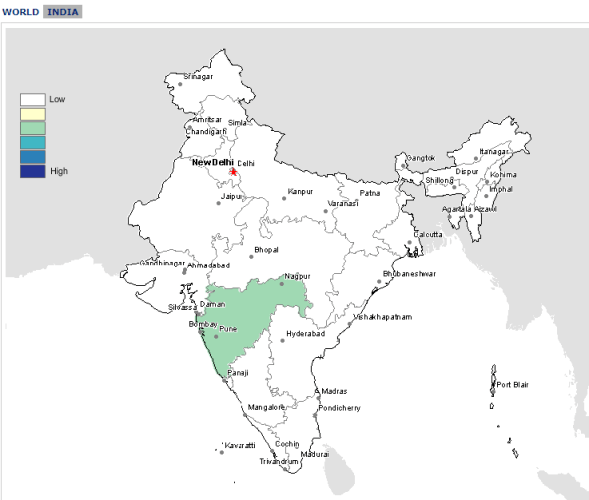
As I was writing that post, which you can read here I noticed that there appeared to be instance of the surname in India, which I can only assume that I had overlooked previously.

Orlando India

The region highlighted is Maharastra and this is a great example of what I said yesterday when I commented that a map can prompt thought, discussion and research.

Maharastra came under British rule from 1818, first under East India Company and then from 1858, the Crown. Not getting very far, I turned to FamilySearch

Searching for Orlando in India revealed four results, one Orlando which was a death in 1869 in Barrackpore, Bengal, India,  two of the results related to the surname of Orland which I discounted and the other Urlando which I find curious, for no particular reason.

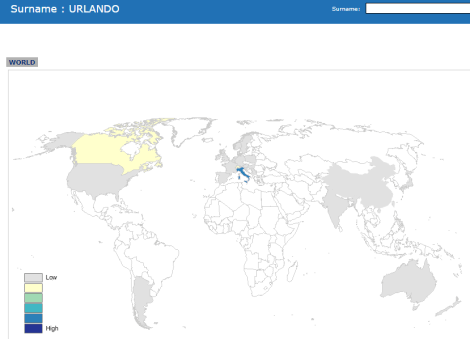
Urlando

I then put the surname of Urlando through the map at Surname Profiler and was surprised at the results.

Low results in Australia, United States, Europe, India and China, Low results in Canada, but more than the United States, and Italy had a high concentration.

From just this one action of looking at the frequency of the surname, I have found an instance of the surname in India, been surprised by another surname, which may or not be a variant, revisited the map for the output of the surprise surname. I have a hunch that I might explore the surprise surname a little more and explore records in China. Not to mention I still need to explore the Orlando & Italian connection to Maharastra.

With a One-Name study, you need never be genealogically bored again!

More details and information is covered in the Pharos Introduction to One-Name Studies course.

Posted in Introduction to One-Name Studies (Pharos course 901), One-Name Studies | 2 Comments

Surname Distribution Maps and Migration

Surname distribution maps add a new and different dimension to a One-Name study.

A surname may well have it’s origins in one Country, and a map can provide an interesting insight to how migration can influence the geographic spread of a surname. Going a step further, historical events can influence migration which in turn can be identified using a distribution map.

Especially those of us researching European surnames, a map can be used to identify where to start. In Europe, excluding UK and Ireland, events are recorded in the town & village in which they occur. If you are researching and find a Census or passenger list which simply lists the Country of origin as the place of birth, that is helpful, but not going to break those brick walls down.

Virciglio

courtesy of Gens.info

In my Italian family I have the surname of Virciglio. This map from Gens.info shows where the surname appears in Italy and the Islands. As you can see it is not a name that is widespread, although it is reasonably popular in “my” bit of Sicily.

We know, because history tells us, that there was significant peaks of migration from Italy and in particular south of the mainland and the islands. Famine was widespread, the only way of having a reasonable life was to migrate to other Countries and one of those countries was the United States.

Virciglio USA

Courtesy of Gens.info

Using another map from the same site shows the distribution for the same surname across the United States. This is especially helpful for the United States because, like Italy, records are held at local level, so I can discount all the states where there is no colour, at least initially.

Do surname distribution maps provide all the answers? – No, but they do provide scope for further research and considerations.

orlando Map

Courtesy of Gens.info

That said, when I insert my Italian study surname into the Gens.info website, the map looks like this which does not tell you anything beyond it is a popular surname and especially in the South and in Sicily.

There are a number of other surname distribution sites covering a number of other European Countries and there is a very useful Facebook Group too.

Don’t think that this site is not worth exploring if you are researching British surnames, a quick search of two Guild registered surnames, Butcher and Howes both produced a map, and whilst not the colour explosion of the Orlando map, certainly of interest nonetheless.

More details and information is covered in the Pharos Introduction to One-Name Studies course.


Posted in Introduction to One-Name Studies (Pharos course 901), One-Name Studies | 1 Comment

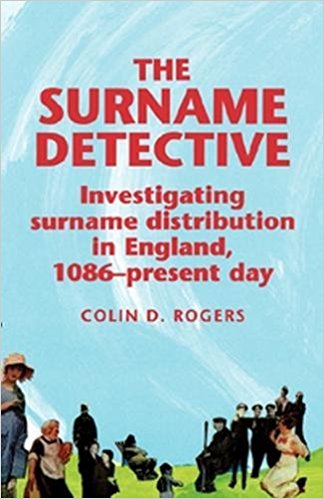
Favourite Book(s) #6 – Surname Detective by Colin D Rogers

This is a fascinating read of investigating surname distribution in England from 1086. The author took a sample of 100 surnames, some of them fairly common and followed the migration of people through the centuries.

Also covered is how surnames started, typically as the name of a place, a nickname, a christian name or as an occupational name.

This book is one of my favourites and is good foundation reading for the Pharos Introduction course in One-Name Studies and the Advanced Course in One-Name Studies

Posted in Books, Favourite Book(s) | 2 Comments

How Big is My One-Name Study?

Surname Size

As the image here might suggest, you are going to need to think and write notes relating to the size of your potential One-Name Study, it is nothing complicated, I promise!

Not all surnames are equal and understanding the frequency of the surname will be determining factor. The more frequency a surname appears, then the bigger the study is going to be and the more time it will take to collect, analyse and organise.

Whilst a large study is a challenge, they are, in the modern era very achievable. A fellow member of the Guild of One-Name Studies told me that it took him 10 years to collect all the instances of his surname from the General Registration Office (GRO) indexes. Now, thanks to sites like FreeBMD it is possible to download the data in a matter of minutes. That study has gone on to create a large database of about 77,000 instances of the surname. That study is the Featherstone One-Name Study which began in the 1990’s. Another large study is that of the Howes One-Name Study, which began about 10 years ago and has circa 130,000 individuals in reconstructed families.

For a moment, lets turn our attention to surnames whose origins are England and Wales. To determine the frequency of those names, we would look see how many instances of the name occur in the 1881 Census.

  • 1-30 Tiny study
  • 30-300 Small study
  • 300 – 3,000 Medium study
  • 3,000 – 30,000 Large study
  • 30,000 – 300,000 Extra large study
  • >300,000 are huge studies such as Jones Smith

For my Orlando One-Name Study, there are less than 300 in England and Wales, so that appears to be a small study, but the surname is an Italian one, with huge peaks of migration to other Countries – Look back to the Surname Profiler Map that I mentioned a few days ago.

For surnames in the United States turn to Ancestry and check the frequency of the surname there.

There are other considerations too, in the case of European surnames there will be peaks of mass migration caused by important aspects of European history.

There is a useful page on the Guild of One-Name Studies website about choosing a surname and about the size of a study. In fact you can see the numbers relating to the Orlando, Featherstone and Howes studies, so it is worth reading and you can do so here

Why not consider the surnames of your four Grandparents – would they be suitable as One-Name Studies? And if no, why not? – Go on, leave a comment or write about it on you own blog and leave the URL below.

More details and information is covered in the Pharos Introduction to One-Name Studies course.

Posted in Introduction to One-Name Studies (Pharos course 901), One-Name Studies | 5 Comments

Why Have a One-Name Study?

Question MarksAs any genealogist or family historian will tell you there are always more questions than answers and always a burning obsession to find out more, even if the odds are against a successful search.
There are a variety of reasons for researching a surname, here are just a few:

  • General curiousity about the surname.
  • Where does the surname come from?
  • My name is foreign, how did it get here?
  • Spellings of different surnames and are they related?
  • An attempt to demolish a genealogical brick wall.
  • By collecting all the references to a given name, it means that you do not necessarily miss your elusive ancestor.
  • …….the list is endless; and there is no right or wrong answer.

More than likely you will have already started your surname research before you become aware of the concept and before you have considered the basic foundations for a study.

What are the foundations? well here are a few things to consider:

  • Seek to understand the history of the surname
    • Where did it come from
    • What does it mean
    • How big might my study be?
  • What do you want to achieve by undertaking your study?
    • It doesn’t matter if you don’t have a firm idea, but begin thinking about it.

More details and information is covered in the Pharos Introduction to One-Name Studies course.

Posted in Introduction to One-Name Studies (Pharos course 901), One-Name Studies | Leave a comment

Seven Steps to One-Name Studies and Surname Research

The Guild of One-Name Studies advocate the Seven Steps of a One-Name Study. These are effectively the stages of surname research and the it is not necessary to move through the steps in the order they are displayed here.  It would be quite usual to spend considerable time in the collect stage before proceeding to the others.

Seven Pillars Higher Res

courtesy of the Guild of One-Name Studies one-name.org

It might also be, especially if a member blogs about their study, to publish about a person, group of people, migration details, in fact anything about the study and then publicise the blog post using social media.

7POWThe Seven Pillars of Wisdom is available from the Guild directly (Guild members should login) and for those of you wanting a Kindle version, via Amazon.

More details about the Seven Steps is covered in the Pharos Introduction to One-Name Studies course.

Posted in Introduction to One-Name Studies (Pharos course 901), One-Name Studies | Leave a comment

What is a One-Name Study?

IMG_1467Yesterday I shared the information that the next Pharos Introduction to One-Name Studies course will begin on 13 February.

I thought that  some people might be wondering what a One-Name study is.

Essentially it is a project which focus’ on a single surname, regardless of any connection between people bearing the same name. If the surname is registered with the Guild of One-Name Studies then there is a commitment to aspire to research the surname globally.

Over the years, a number of people have said they find that too challenging, and I have a number of things to reassure. The Guild does not assert any pressure on the study registrant – there is no time span, you work on your study at your own pace.

Global Considerations:

  • Depend on the size of the study
  • Access to records – not everything is online
  • Time commitment from the registrant

I have three studies registered, one I am about to pass to my husband as that relates to his family. That is fairly small, even on a global scale. Certainly in England and Wales it is very regional – predominately in the Counties of Suffolk, Norfolk, Cambridgeshire, Essex and Yorkshire. Even in the United States there appears to be relatively few instances of the surname.

My two studies that relate to my own family represent the surnames of my parents. One is an occupational name and it is a medium to large study, the other is for an Italian surname. From an assessment of English records, it appears to be a reasonably small study. I said appears to be, because the reality is, in Italy and not surprising the United States the surname is very popular and that means it is another medium to large study.

So I have essentially two large studies that represent my parental families. Over the coming months I will share bits about the studies but the reality is, the few items I have listed above will influence how quick you leave one Country and move to another. If you start your research in the United States it might take you ten years to leave the US because of the availability of records or the amount of records or perhaps both of those elements come into play.

Have a look at the website World Names Public Profiler insert your surname of interest and your email address and a map of the world will populate and that will give you an idea of where your surname appears.

Here is the map for my Italian surname of ORLANDO

World Profiler - Orlando

So they are definitely global with the majority appearing in Italy, Argentina, Australia, United States, Canada, India and through parts of Europe.

Apart from being a surname research project, it is a wonderfully interesting way to add dimension to your family history and genealogical pursuits.

Posted in Introduction to One-Name Studies (Pharos course 901), One-Name Studies | 3 Comments