#DNA18 – DNA Day 2018

DNA Day2018

courtesy of #AncestryHour

 Today is National DNA and marks the anniversary of:

1. The discovery of the double helix which was presented in the Journal “Nature” published on 25th April 1953
2. The completion of the Human Genome Project in April 2003

If you have been researching your ancestry for some time you will likely recall the moment when this fascinating tool began to be seen in a variety of genealogical journals, magazines, scientific publications and the concept of Surname and location DNA Projects.

Family Tree DNA (FTDNA) are the only company offering such projects and both my husband and I have projects for our One-Name Studies:

I do not profess to be an expert in the field of DNA, except to say that it can provide a fascinating insight to any genealogical or surname research project. DNA is not covered at all in the Pharos courses, but members of the Guild will aware of the offerings and expertise of a number of Guild members in this regard. Just last week the Guild’s webinar was about DNA and your One-Name study from Guild member and DNA expert, Maurice Gleeson – if you are a Guild member do watch the webinar.

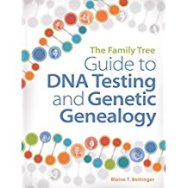
DNA - Blaine BettingerThere are a number of books on the subject and my personal favourite is from Blaine Bettinger and I talked about that book HERE

The Guild of One-Name Studies has an extensive DNA section written by DNA adviser, Susan Meates, on the website with a good number of pages available to the public and many more to members. We are very lucky to have a number of well known and respected DNA experts within our membership.

There are a number of DNA sales on today and unsurprisingly I believe it will be the subject of choice for #AncestryHour on Twitter, to whom thanks must go for the logo at the top of this post. I plan to take part and the hashtag is #DNADay & #DNA18.

I will do a small series on my DNA test results in the coming months, so stay tuned!

Posted in DNA & Surname Projects, Genealogy, Introduction to One-Name Studies (Pharos course 901), One-Name Studies, One-Place Studies | Leave a comment

A-Z Challenge 2018 – Variants and Deviants

a2z-h-smallThe topic of variants and deviants is addressed in detail during the Introduction to One-Name Studies course. Essentially we have likely all come across variants and deviants to our surnames, even if we have not called them that.

Variants

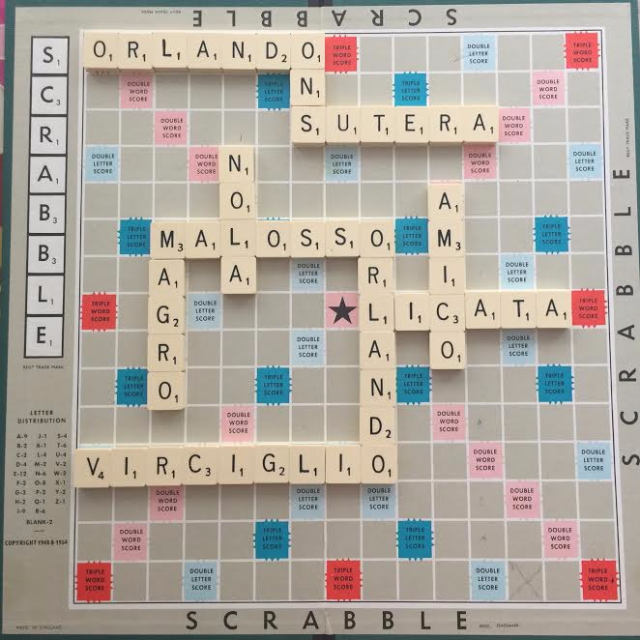
For the purposes of my own One-Name Studies I have registered two variants for ORLANDO, these are ORLANDE and ORLANDA. For my BUTCHER study I registered just one, BUTCHERS. It is also worth pointing out that you do not need to register a variant and at the initial point of registering the surname Butcher I did not register a variant. I did so when I came across a divorce record in the name of Butchers in which the male stated that his name was Butcher and not Butchers.

When looking at my husband’s ancestry his early Goucher ancestors were recorded as Goacher. The Goucher surname is listed as a variant in the Goacher One-Name Study by another member of the Guild of One-Name Studies.

Deviants

A deviant is a change of surname that happens inconsistently. In the case of the 1939 Register, my husband’s Grandmother, was recorded as GROUCHER.

Why do variants exist?

Accents, spelling and people writing what they think they hear rather than what they actually do – Goucher is a case in point and I regularly receive correspondence in the name of Goucher and Groucher. In a letter recently, I was referred to as Goucher and Goacher, within the same sentence and that is not all, the envelope was handwritten and addressed to Mrs Groucher!

In a time when not everyone could read and write it was very easy for the inconsistencies with the spelling to exist because the person writing the surname would not be corrected if the person could not read what was written down.

Those with “foreign” surnames might change their surname, to make themselves fit in more and I gave an example recently. Surnames that have spellings that are not familiar in one country might become changed over time, just to be easier to manage.

You might find this page on the Guild of One-Name Studies website useful as you consider your own surnames and their potential variants. Those of you who read this post from earlier in the year might find it useful to read it again and consider the potential variant I discovered. I will at some point write about this again and my hypothesis about this.

Posted in A-Z Challenge, A-Z Challenge 2018 - Surname Research Series, Introduction to One-Name Studies (Pharos course 901), One-Name Studies | 2 Comments

#Museum Week – Migration Museum

logoMWThe Migration Museum in Adelaide Australia is a great venue and one that I have been lucky enough to visit. The slogan, “every item in our collection has a special story,” reminds me of our One-Name Studies. The people with our surname of interest all have unique story and that is what makes surname research so fascinating.

Australia is a culturally diverse Country and whilst many people have descendants who were transported to Australia, many others migrated from other parts of the world in search of a better life.

This tweet was shared, the image is of a lovely wall hanging which was made by women in the refugee camps in Thailand in the late 1970’s to remind themselves of their former life and their experiences.

One of the things I especially want to see on my next visit is the paving project which you can read about HERE.

Each of those paving stones represents a family or individual who migrated to start a new life.The sad part is that not everyone made the decision freely, even in today’s world it was the act of necessity and of survival.

Posted in #MuseumWeek, Genealogy, Introduction to One-Name Studies (Pharos course 901), One-Name Studies, One-Place Studies, Research Resources | 1 Comment

A-Z Challenge 2018 – Understanding Surnames

a2z-h-smallUnderstanding our surnames is a really important element of any One-Name study. In much the same way as building a house, with the foundations first, a One-Name study is built and developed the same way.

In today’s post I am going to focus on Italian surnames and why they perhaps give us some insight.

There is nothing more frustrating than looking for your Italian ancestor on Census or document and where it says place of birth it simply says Italy. By understanding the surname, it perhaps gives us further clues.

Italian surnames are mostly derived from:

  • Patronymics, meaning they are essentially from the male of the household, and that might include any variation to the name – such as Giovanni
  • Geographical, based upon the place – such as Bulgari, Lazio, Sutera,
  • Nicknames – and not always complementary ones – Grassi (big or fat), Forte (strong), Gambacorta (short leg), Gentile (Gentle)
  • Occupational – Medici (Physician), Pastore (shepherd), Barbieri (barber)

Some spellings might determine a specific region:

  • Those ending in isi as in Troisi, could indicate the family is from Neapolitan or Sicilian.
  • Surnames ending aloro such as Favaloro are Sicilian surnames.
  • Surnames ending igo such as Barbarigo are Venetian
  • Those ending with utti such as Zanut are from Fiuli Venezia Giulia (on the border with Slovenia and Austria)
  • Those ending iu such as Mongiu are Sardinian

Old records may also influence some surnames as they are converted from Latin to Italian and sometimes in to dialect. Later changes may have occurred as the are converted into English or Americanised – Giuseppe Pastore converts to Joseph or Joe Shepherd.

Those children who were foundlings often have a surname of the town where they were found, and were often stigmatised because of that. Later the ruling changed so that the children were given the name of another town, which of course didn’t help with the stigma issue either, especially if that surname did not exist significantly in the town. In these cases a DNA test might help.

We look at a number of the points raised here and especially over the last few posts (S for Synthesis and T for thinking about surnames) in the Introduction to One-Name Studies course.

Posted in A-Z Challenge, A-Z Challenge 2018 - Surname Research Series, Introduction to One-Name Studies (Pharos course 901), One-Name Studies | Leave a comment

Guild of One-Name Studies webinars available for a short time only to non-members!

Last chance to listen to the DNA webinar from  which was broadcast live on Tuesday 17th April.

As a special treat the entire collection of Guild webinars from  Family History Week ( are still available until the end of Tuesday (24th April London time) so !

All the webinars then become a members benefit at the end of of Tuesday (24th April London time). The next Guild webinar will be live on 15 May 2018 and you can register HERE

DNA Webinars

I will be back later today with the latest post in the A-Z Challenge before moving onto chatting about Family History Week (#FHWeek)

Posted in Genealogy, One-Name Studies | Leave a comment

#Museum Week – Faces of Auschwitz

logoMWOne of the organisations I have spotted during #MuseumWeek is the site Faces of Auschwitz.

Anyone who has been reading this site over the last few weeks will know that I recently established that at least three Orlando’s had perished at Dachau Concentration Camp.

We know the horrors of the Second World War, but I had not considered it in the concept of my One-Name Study. Just looking at the tweets from the Faces of Auschwitz and their re-tweets you can see the scale of things. One of the things that I found very poignant, was this tweet and the selection of images that Faces of Auschwitz retweeted from Auschwitz Museum & Memorial. The tweet relates to  a group of Jewish women who had been deported from Hungary. They left their names and other personal information on a wall of the disinfection barracks at Auschwitz II-Birkenau BIa sector – part of the female camp.


Posted in #MuseumWeek, Genealogy, Introduction to One-Name Studies (Pharos course 901), One-Name Studies, One-Place Studies, Research Resources | Leave a comment

A-Z Challenge 2018 – Thinking about Surnames

a2z-h-smallOver the next two days we are going to be thinking about surnames. In many ways, T & U are not only linked together, but also to S for Synthesis.

The main question is What does my surname mean? There are a number of key surnames and where they originate can determine what kind of surname they are. You can read an earlier post HERE.

I have two studies, one for the surname of Butcher which is an occupational name. The other is for the surname of Orlando which suggests it is a Patronymic surname with links to Roland and Rowland. I am not entirely happy with the conclusions that I have drawn about this surname, but over the coming weeks I will discuss it more here. Incidentally, both of my One-Name Studies sites are deep under construction, I have 25 years of paper to process!

My husband has a study for the surname of Worship which was the maiden name of his paternal grandmother, I have always felt that the surname was very much linked to either a post holder name, someone who was connected with the church in some way and, having searched the Clergy of the Church of England Database there are a number of Worship entries as you can see below and some of them are quite early.

By thinking about your surname you are building up a profile about the surname, it’s origins and focus. Those factors give a One-Name study a good grounding and are these are discussed in the Pharos introduction to One-Name Studies course and in the Guild publication, Seven Pillars of Wisdom, the Art of a One-Name Study, available from the Guild or Amazon.

I’ll be back to tomorrow talking about….see you tomorrow!

Posted in A-Z Challenge, A-Z Challenge 2018 - Surname Research Series, Introduction to One-Name Studies (Pharos course 901), One-Name Studies | Leave a comment

#MuseumWeek – Launch of Museum Week 23-29 April 2018

logoMWThe power of social media means that organisations can band together in the spirit of unity and promote a common cause.

Having just got to the end of Family History Week #FHWeek which I didn’t really manage to share via this site (but I will do), and almost at the end of A-Z Challenge, I stumbled across #MuseumWeek and you can read about it at the special website.

I thought that I would perhaps take opportunity to discuss some museum sites which might be of interest to those of us undertaking a One-Name Study but to be honest, any genealogical pursuit would benefit.

So over the next week I will share some of the sites I have encountered and hope you enjoy them and can see how those sites can benefit your genealogical pursuits.

Posted in #MuseumWeek, Genealogy, Introduction to One-Name Studies (Pharos course 901), One-Name Studies, One-Place Studies | Leave a comment

Favourite Book(s) #16 – Floating Brothel by Sian Rees

Floating BrothelI have read my copy of this book so often that the cover is looking a bit tatty and the glue that holds the paperback cover in place is a bit loose.

The book is based upon the true historical events of 18th Century ship and the female convicts that were transported to Botany Bay.  The title does suggest that that the contents are “racey” but it is not especially so.

This is the  very readable account of the transportation of women on board the vessel Lady Julian. 

At the back of my mind, I am sure there was talk of this being made into a film, but it appears nothing came of that, either that, or I am dreaming!

Posted in Books, Favourite Book(s) | Leave a comment

A-Z Challenge 2018 – Synthesis and what it means for a One-Name Study

a2z-h-smallThose of you who have been reading this site for a while may well recognise the image I shared a few days ago of the Seven steps of a One-Name Study. The third step is Synthesis and today we are going to explore what that means.

Synthesis is essentially taking the results of analysis and going a stage further, by giving some substance to your data, drawing conclusions about your surname.

You can do this by

  • Exploring the meaning of your surname.
  • Looking at the geographical origin of your surname – you might look at surname distribution maps for this stage.
  • How and where possible variants to your surname came from.
  • Looking at patterns of distribution – considering patterns of emigration and immigration, what caused those patterns of migration and was the migration permanent.

All these are discussed in the Pharos introduction to One-Name Studies course and in the Guild publication, Seven Pillars of Wisdom, the Art of a One-Name Study, available from the Guild or Amazon.

Over the next two days we are going to be thinking and understanding surnames in more depth, so I do hope you will continue to read along and perhaps share any instances that you have come across and your thoughts.

Posted in A-Z Challenge, A-Z Challenge 2018 - Surname Research Series, Introduction to One-Name Studies (Pharos course 901), One-Name Studies | Leave a comment