European Ancestors – Surname Distribution Maps

Surname distribution maps are very helpful in identifying a presence for a surname in a particular country. Below there are a list of Country specific distribution maps.

On a global scale is best site is World Profiler – this site which is run by a university in the UK has had issues for a while. The site takes a surname, asks for an email address and the gender of the requester, these are for statistical purposes. The site also uses Adobe Flash Player and coupled with the statistical material it often sends some browsers into a panic!

I have used the site initially successfully with Chrome, then Microsoft Edge without issue. Sadly the site is, at the time of writing (23 May 2019) unavailable and I hope it returns, which is why I have left the link in place. If you find it working, please do leave me a comment! In the meantime, you can see an example below for the surname of Orlando

World Profiler - Orlando

Surname distribution for the name of ORLANDO

Posted in European Ancestors, Genealogy, One-Name Studies, Surname Distribution Maps, Surnames | Leave a comment

European Ancestors – Migration Links Polish in Persia (Iran)

From 1942 until the end of the Second World War there was a population 120,000 strong of Polish migrants in Iran, this was part of around 300,000 Poles that had been forced out of their homeland by the Russians and forced into the east of the Soviet Union and Siberia.

The details are fascinating and strictly speaking outside of the remit here, but they should not, and if you are researching Polish ancestors, must not be overlooked.

  • Iranian Documentary, “The Lost Requiem” produced by Khosrow Sinaiin 1983. This film took twelve years for the producer to make as he researched, filmed and interviewed as many people as he could locate from the former Polish community which spent the years from 1942 in Iran. The film has been made available by the producer and can be found at YouTube.

Other Links

Posted in European Ancestors, Genealogy, Poland | 6 Comments

European Ancestors – Bulgarian Research

bulgarian flag

Courtesy of Wikipedia

Continuing with the migration of the European Ancestors material. The flag shown here is of Bulgaria since 1990 until the present day.

Bulgaria is the oldest state in Europe to have kept its original name since AD681 and most of the population are descendants of the Bulgarian invasion of the South Danube. On two occasions during the medieval period Bulgarians managed to establish empires. On 22nd September 1908 Bulgaria was proclaimed an independent state.

The history of the Balkans is a complex one due to the invasions, petitions and general chaos in the region. By the 20th Century Bulgaria was ruled by a Monarchy which during the Second World War joined forces with the Axis powers. In 1944, after the death of King Boris, the Soviet Union backed the alternative regime and a Republic was declared.

The Republic was Communist and those who were against the Regime or believed to be against the regime were observed, challenged and on many occasions interned into the Labour camps, very similar to those that existed in Russia.

The close proximity of mainland Greece to Bulgaria meant that there was often natural migration between the two countries. Border changes in the region meant that on occasions overnight Greeks became Bulgarians and were asked to change from the Greek Orthodox religion to Muslim. Once the Communist regime was established there was a lack of tolerance to religions, and those who were not comfortable with the regime naturally wanted to cross the border. Those wishing to leave the Country were seen as traitors and if caught fleeing were interned. Those that did make it out were labelled traitors and could never safely return to the Country.

Bulgarian National Archives can be found HERE (the site has been, and still is under construction).

The state archives of the People’s Republic of Bulgaria was formed on 10th October 1951 and carry out a nationwide policy of collection, storage, organisation and use of archive material. There is very little emphasis on assisting researchers.

In 1839 the Emperor of the Ottoman Empire declared that all subjects in the Empire would be afforded the same rights. It is from this time that we see the formation of Official Registers.

There are also the following repositories which may hold information

  • Bulgarian National Library in Sofia
  • National Library in Plovdiv
  • District State Archives
  • Military Archives in Veliko Tyrnovo
  • Church Archives in Sofia

The district archives use the 28 districts which had divided the Country. Each district had a capital which was responsible for the records in that geographical location. In the 1980’s the 28 districts structure was abandoned and instead 9 larger provinces were established, but the former structure was deeply embedded into the structure of the country and establishment of the provinces merely fragmented the storage of official documents.

The 9 Provinces are:

  • Burgas
  • Khaskovo
  • Lovech
  • Mikhaylo
  • Plovdiv
  • Ruse (Rousse)
  • Sofia (Sofya)
  • Sofrya Region
  • Varna

Documents that can be found are:

  • Birth Records
  • Marriage Records
  • Death Records
  • Index of Funds Records
  • Taxation Records

Because of the historical links to Turkey through the Ottoman Empire there are some Turkish records to be found in Bulgarian records. Documents will be in Bulgarian and some early records in Latin script.

In this region there has always been a Jewish population. In the period of the Second World War whilst there was a complete lack of tolerance to the Jewish religion across the German occupied territories, Bulgaria retained its Jewish population and broadly speaking did not deport them, but did deport around 11,000 of those who were of the Jewish faith during its occupation of Yugoslavia and Greece during this period.

A very useful resource is The Foundation for the Advancement of Sephardic Studies and Culture (FASSAC)

With the demise of the Communist Regime in this region there has been an increased availability of documentation about the Country and individuals and therefore research in the region should not simply be restricted to what is available in Bulgaria. Those who were seen as potential enemies of the regime, whether that was correct or not were observed and records were maintained. The reality is that no one really knows for sure how many more records are potentially available about those who lived in this region during this regime.

Researching in Bulgaria is complex because of being part of the Ottoman Empire, boundary changes with Greece, the alignment with Germany during the Second World War and finally the Communist regime that occurred from 1944. From these few historical facts a whole new set of research opportunities presents themselves.

Top Tips

  • Research Wide – in much of Europe there is a necessity to research generally before drilling down to the details of specific individuals. It is imperative to understand the Country and the social, political and economic stance of the time and how that would have affected individuals.
  • Look at the Surnames and Places. Even through the turbulence of region, religious and political intolerance not everyone left their area or homeland. Some changed faiths and political beliefs and adopted a new way of life.
  • Research the places that your ancestors live. Has the place always been in the Country that it was or is in?
  • What was the dominant religion in that place?
  • Border Countries
  • Other researching in the geographical place
  • Others researching the surname anywhere – where there is a regime of intolerance there is migration – therefore there maybe others researching the same surname in other parts of the world.
    • Identify periods of migration
      • Depending on religion (1930 – 1945) – Whilst the Bulgarian Jewish population were not deported during the Second World War how many fled believing that they were in danger? Potentially someone of Bulgarian Jewish faith living in Greece could have been deported.
      • Migration during the Cold War era. Subjects that left were often subject to interrogation by the Country that they entered – as a way of ensuring that they were genuine and not agents of a Communist Regime.
      • Migration that occurred through border changes (Bulgaria and Greece for example)
    • Understanding the Migration. Those fleeing often did so with very little of anything, in an attempt to hide their impending migration. Did they cross the border into another Country and establish themselves there in order to finance their migration on to the US or other parts of Europe?
      • Where was the nearest port? Which might not have been in the country of origin.
      • Where was the cheapest port?
  • Obtain a history of the Balkans such as:
    • A short history of the Balkans by Mark Mazower, published 2002
    • The Balkans 1804 – 2002: Nationalism, War and the Great Powers by Misha Glenny, published 2012
  • Maps
    • Map of the Balkans showing the border towns with Greece and Romania
    • Map of Bulgaria showing Provinces and towns.

Posted in Bulgaria, European Ancestors | 1 Comment

European Ancestors – Article Digging up Family Roots in Sicily by Russell Shorto

Picture taken from the New York Times. The article by Russell Shorto who holds the Copyright.

As I continue the movement of European Ancestors material, I read this article by Russell Shorto, who is an American author, historian and journalist. 

It was an interesting and fascinating account of researching roots in Sicily. The New York Times published the article in the travel section on 16th August 2013.

What I like about the article is this “connection” with the “homeland” and the feeling of “just do it”, reach out to folk in the Sicilian village and see what happens, who you can connect with.

In rural communities especially, there eventually comes a time when links to the original town are lost. Those who migrated have moved on, literally and figuratively.  The connection between the older and younger generations widen, and each does not know of the other’s existence.  Italians are not known for their interest in genealogy, but once you head back to the original village then there is likely a warm welcome.

Posted in European Ancestors, Genealogy, Italy | Leave a comment

European Ancestors – Researching in Lithuania

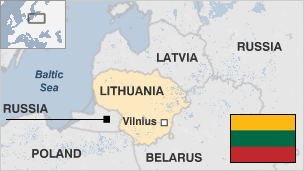
59349369_lithuania

Courtesy of Wikipedia

Continuing with the European Ancestors material with focus on Lithuania.

There is an interesting site called the Virtual Electronic Heritage System. The site is attempting to thread and bring together a variety of resources, books, manuscripts, Ephemera and more as a way of giving context to the lives of Lithuanian people.

There is a huge amount of material available at Family Search relating to Lithuanian records and they can be found HERE

The Lithuanian-Jewish Special Interest Group is an excellent resource as is Jewish Gen. Whilst the focus is obviously aimed at those with Jewish ancestry, do not discount searching these fabulous indexes. A number of people can be found in the indexes of the various Nazi camps and they were not Jewish, so it is most certainly worthwhile checking the site.

The following sites are other fascinating and informative ones of interest to those researching in Lithuania.

Arolsen Archives

This is an very interesting and informative site. The focus is to return items that been confiscated by the Nazi regime to the family members. The focus tends to be on the groups that were known to be persecuted by the regime, but that is not always the case.

Anyone who has read this site for a length of time may recall that I found several Orlando’s in the files of the Dachau Concentration Camp. Indeed, two of those individuals have documents within the Arolsen Archives and there are others Orlando’s referenced too, who had items confiscated.

Posted in European Ancestors, Genealogy, Lithuania | Leave a comment

European Ancestors – Researching in Lithuania

There are five regions in Lithuania which are known as Rajonas. Each region has a post office that serves the outlaying villages and that town was known as the Pastas. A village or small town town was known typically as Kaimo.

Courtesy of Visit Lithuania (visitlithuania.net)

  • Samogitia
  • Lithuania Minor
  • Dzukija
  • Suvalkija
  • Aukstaitija

Each region has different folk culture, topography, flora, fauna and dialect. With some location names changing during the Soviet era.

Surnames in Lithuania

  • Married women drop the end of the male surname and add the suffix of iene which is the equivalent to Mrs.
  • Unmarried women add the suffix of either aite, yte, ute or te
  • In the latter part of the 20th Century there was an increase in married women retaining their maiden names, particularly if they were  employed in the creativity or artist industries.

Migration 

Those from the Suvalkija region in Lithuania were amongst the first to migrate from the country. Many came to the United Kingdom, via Hamburg and the Netherlands. Some remained in United Kingdom whilst others continued on to the United States, although there may well have been time delays between leaving Lithuania and arriving in England before continuing to the United States.

This region in Lithuania is well known for labouring and mining. Many found their way to Scotland and worked there, after iron deposits were found just south of Glasgow in the mid 1800’s. Later as mines were establishing themselves in the United States many moved across the Atlantic to the United States, in some cases leaving family members behind in Scotland or other mining regions of the UK.

Posted in European Ancestors, Lithuania, Surnames | Leave a comment

European Ancestors – Researching in Lithuania

Courtesy of Wikipedia

Image courtesy of Wikipedia

Lithuania gained its independence after the fall of the Soviet Union in 1990. Lithuania has a population of around 3 million people. The official language is Lithuanian, but also spoken is Polish and Russian.

Records of the Grand Duchy of Lithuania between 1765 and 1784 were written in Polish before the second partition of Poland, and records written after 1782 in Russian.

The Lithuanian State Historical Archives holds material from the 13th Century up until 1918 when the Declaration for Independence was made.

Here the records of state institutions, religious communities, popular organisations and families are held. Also in this archives material also reflect the history of Russia, Belarus, Poland, Ukraine, Latvia and other countries.

At the moment, the archive reports that it holds in excess  of 1,360 million items that have been preserved. That is a phenomenal amount given how much turmoil the country has historical experienced.

The Archive advises that documents they hold are in 8 major record sets:

  • Documents of the various offices of the Grand Duchy of Lithuania dating back to 15th–18th Centuries
  • Records of offices and organisations of Vilnius, Kaunas and Suvalkai Governorates of Russian Empire, and records of commissions responsible for the liquidation of offices to be evacuated to the Soviet Russia (1792–1918)
  • Records of offices in Lithuania relating to the period of occupation by German Empire (1915–1918)
  • Records of confessional institutions and communities operating in Lithuania between 15th–20th Centuries
  • Records of private persons and families  from 15th Century until 1941
  • Documents collections between 15th and 20th Centuries
  • Collections of microfilms of documents and collections of digital images of documents between 13th and 20th Centuries
  • Civil vital records from 1940–15 August 2007

Also maintained are the vital record books for birth, marriage and death of the different religious communities and churches of today’s Lithuania dating up to 1940 and civil registration records up to 2008 year; documents about the nobility of different families from Vilnius ( Vilno ), Kaunas ( Kovno ) and Augustavas Gubernias.

There is no computer data-base in the archives, meaning that searches are being undertaken by hand.

As you might expect, there are some restrictions on access to more recent records. Article 20, part 5 of Law on Documents and Archives for the Republic has laid out fixed restrictions on access to the documents which contain information on person’s private life, as well as to structured sets of personal data 30 years after the person’s death. In the event of failing to determine the date of death a term of 100 years from his birth is imposed.  If neither the date of birth nor the date of death of a person is determined, the access shall be limited for a term of 70 years from the creation of the documents.

There is also material in the special archives relating to individuals who were identified as being convicted for political purposes. Deportation of individuals to remote areas of the former USSR, German deportation during the Second World War. Filtering of individuals who were identified as permanently living outside of Lithuania. Also are records relating to the mandatory military service under the Soviets from 1944 to 1990. A list of Roman Catholic church records that have been digitised can be found HERE.

Posted in European Ancestors, Lithuania | Leave a comment

European Ancestors – Italian American Podcast

Italian American PodcastGenealogy is so much more than names and dates. Researching our ancestry is about understanding the locations, cultures and traditions that affected the lives of our ancestors.

To be successful at researching European ancestors you will need to put your European ancestors into the context of their Country during their time

In late 2016 I  became aware that this podcast series The Italian American Podcast had been launched in 2015. Sadly it took me until July 2016 to listen to the backlog and now I try to listen as each edition is released and if I don’t manage it then I binge listen!

For those researching their Italian genealogical links from a United States perspective this is a great interesting resource and even though my Italian links came to the United Kingdom, some did leave Sutera and head to the US, it is a fascinating insight into the Italian cultural experience.

Posted in European Ancestors, Genealogy, Italy, Podcasts | Leave a comment

Memorial – Kings Cross Station

In my last post I shared my Harry Potter experience on the way into Kings Cross. On the way out of Kings Cross I spotted the memorial to the men who perished in the First and Second World Wars who worked for the Railways.

The photographs are copyrighted to me, but if you click on the image you can read the list of names easily and likely download a copy. If you do so and then use the images, please cite me as the owner and do let me know as I may well share that on social media.

Posted in Genealogy, Memorials | 2 Comments

Harry Potter and Platform 9 3/4 – #50Before50

It was by pure chance that I was able to tick off another #50Before50 item. Last year I confirmed that I would happily speak at the Society of Genealogists again, on the subject of European Ancestors. Trains from my part of England arrive at Kings Cross station and then I realised that I was within easy reach of the Harry Potter and Platform 9 3/4 shop.

IMG_1196

Copyright – Julie Goucher 2019

IMG_4987

Copyright – Julie Goucher 2019

The shop is actually way to small for the amount of visitors it gets which includes visitors from around the world. I heard Spanish, Polish, Japanese, Italian and French being spoken and of course English. Outside there is a trolley going into the wall, just as the scene in the Philosopher’s Stone (Harry Potter film 1). There was a huge queue to have a photo taken at the trolley, a queue that is likely never ending. I grabbed a photo between people. What is bizarre is that having had the photograph taken by the “official” photographer you do not even have to purchase it.

IMG_4994

Copyright – Julie Goucher 2019

I managed to squeeze between the people, mostly adults from my two visits to the shop (one on the way into London and one on the way out!). There was a delightful little girl crying because there was a small stuffed toy of Harry’s owl on the floor and she thought it was hurt – cute! and she had the loveliest brown curly hair. I smiled as I walked past as her Dad was trying to explain that it was not real, which I think made the cries louder!

Like all these types of places, the merchandise is pricey, but if you purchase what you actually will use then I am, at least in my case, happy with that. I purchased a magnet for my filing cabinet and a bookmark. Hubby purchased a pen and notepad.

The bookmark was put to use as I began reading one of the two books on the way home that I purchased at the Society of Genealogists bookshop, making use of my member discount. I was rather pleased with my strategic purchasing!

Posted in #50Before50 | 1 Comment