(Advent 1) – Aims of a One-Name Study

Created by Julie Goucher, 2018, using wordclouds.com

One of the questions that is asked, of students on the Introduction to One-Name Studies course is about Organisation. The way we keep our study may differ from that of our own family history research.

As I responded to a question from a student, I simply commented that it was important to look at the aims of your study. What followed, was that my fingers travelled across the keyboard at a fairly rapid rate and before I knew where I was I had written a very lengthy post. I then cut and pasted that into a document. Since then I have realigned and updated the post, using questions to confirm clarity and then published it in the Journal of One-Name Studies.

How we organise our material will depend on what our aims are for our studies. Are you simply wanting to:

  • Collect instances of the surname
  • Reconstruct families
  • Do you going to want a website to share and preserve your material?

This is not a case of collect or reconstruct, as a number of members, me included do both. The key thing is, if a website is on your horizon, but you have elected to keep your material on index cards then you are going to have to do a whole lot of work and retyping to turn the contents of the index cards into a means used to create a website.

There is nothing wrong with the index card approach, and I use them, but they are not my only means.  I did a review of my aims and methods a five years ago and decided that I was going to computerise my entire research, digitise 25 years of papers and insert the scrappy bits of paper drawn trees into my software programme and ensure that I had the evidences to support the tree.

I also knew I wanted to use TNG (The Next Generation) software and opted to sign up for the Members Website Project, which is a members benefit for Guild of One-Name Studies members, and enables me to use a website on the Guild’s server AND to preserve my work, whilst still allowing me to update and continue working on my study. I get to the website and TNG from my computerised study by means of a GEDCOM and the ability to add what is referred to a “media” which is images, documents and a number of other elements.

My GEDCOM is not perfect because I have 25 years of work in the filing cabinet and numerous computer files – it remains as a work in progress, as I ensure that I have source citations and so forth all appropriately identified. My aim is that I am going to share how I made the jump from paper to my database.

So, what are your aims for your One-Name Study, where do you want your study to be?

For those interested in joining the Introduction to One-Name Studies course, please visit HERE – if you are quick you can use the discount code for the Black Friday event

Posted in Genealogy, One-Name Studies | Leave a comment

Q & A – About Surnames

Created by Julie Goucher – Feb 2020 Using Wordclouds.com

A few weeks ago I received the following Question.

Julie, I have been reading your site for quite a while. Would you be able to share some posts about One-Name Studies?

Thanks, M

I did answer M a few weeks ago and said that I would pull together a few posts.

At the end of last week I was in the car, on the way down the M1, which is a long way from my native Surrey. I was pondering when I would get these post written, as I usually spend time writing posts during the advent period.

As I had not formulated any posts I thought that I would pull these post together, over the next few weeks. The posts will start on 1st December and run through to 26 December, what we call Boxing Day in the UK.

As I am literally just home, this will be a short post introducing the series, which will start tomorrow, 1 December 2025 – I hope you will join me, read along and perhaps ask a question or two?

Posted in Advent Posts, Q & A | Leave a comment

Desk Ramblings (33)

Created by Julie Goucher, July 2019

It has been some time since I wrote here, let alone write a Desk Ramblings. I needed to take a step back and remove one stress factor. That said, I don’t view writing here as a stress. It has simply been a casualty of me getting overwhelmed. 

I am feeling much better, there are still issues for me to deal with, but the worse is behind me. My never-ending to do list has grown by several items, both caused by WordPress. 

I am a creature of habit. I dislike writing in blocks and routinely write posts with the classic edit option. Except the option has disappeared and is only available to those with business accounts. Whilst I do pay for my site, I do not have a business account and currently do not feel it as value for money.

Whilst I was pondering and debating the classic edit I noticed that there were some changes on my site that I had not done, and as I pondered on that, I decided that my categories and archives were too long and could do with some tidying, so you will see some tweaks in the coming days weeks

Back in the summer I had issues accessing my Twitter or X account. After a number of attempts at logging in I finally managed it, however this was not a case of me forgetting a password. 

Someone had hacked into my account, changed the email on the account and then deleted all my saved posts, messages, followers and those accounts I was following. I reached out to Twitter support and frankly they were useless. Then the hacker changed my email back so I could login and inspect the damage. I have no idea who might have done this, but the whole situation left a bad taste and Twitter support were frankly a disappointment.

This was just a few weeks after a cyber incident involving a well known UK retailer. I did not think much of it, until I had a bogus debit, resulting in the bank completely replacing my card and going through a rather tedious online form which returned the funds to me.

I firmly believe in looking forward, not back which is curious for someone who a genealogist and historian, but there we are. Meanwhile, I need to get this online space tweaked and adjusted. Whilst I am still on Twitter, I have moved my account to BlueSky, but I am still at that stage which is akin to wearing in a new pair of shoes. I have also been looking at Sub-Stack, but we shall see.

In the meantime, I am almost at the end of another busy year of tutoring for Pharos – I have just started tutoring the last course for 2025, and all courses will be available in 2026. It has been another busy year giving presentations to various groups, including the Society of Genealogists, I have three talks to wrap up the year. I am trying to conclude a couple of projects that have been underway for too long.

That said, I am keen to get back to my online space, I have missed it. Until next time!

Posted in Desk Ramblings! | 2 Comments

July 2025 Round up

Happy July everyone!

I have another busy month with tutoring and presenting. 

I have three talks with the Society of Genealogists:


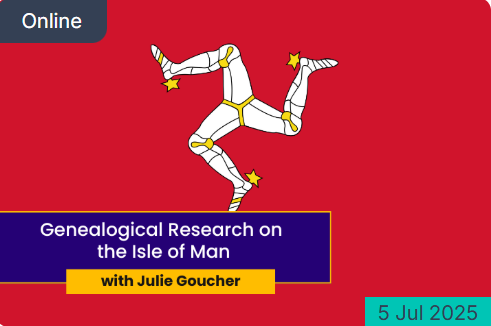
5 July 2025 – Genealogical Research on the Isle of Man – Information and book HERE


12 July 2025 – My Ancestor was an Alien – Information and book HERE                


17 July 2025 – Getting the Most from a One-Name Study – Information and book HERE

The three images shown here are courtesy of the Society of Genealogists.

The Pharos Tutors Advanced One-Name Studies course continues for another two weeks and another four tutorials. This course will next run again in 2026 – information or to book HERE.

That is it for today’s post. I will be ramping up my postings once again, the last couple of months have been quite busy – more on that at a later date.

Posted in Advanced One-Name Studies (Pharos Course 902), Genealogy, Presentations | Leave a comment

H is for History

Created by Julie Goucher, 2023

Our Genealogical pursuits are underpinned with the history relevant to the country where our ancestors hailed from, and also by wider current affairs. Our people, much like us today did not live in isolation. They, as we are, were affected by social, economic, political and religious facts. Impacted by decisions made by politicians, either those in office, or those that were part of a previous government. It is those elements that underpinned the life factors of our ancestors. 

I am reminded of my great aunt who was born in 1900, telling me that she remembered her grandmother, Caroline Ellis who was born in 1844, qualifying for a pension from the government of 10 shillings a week.

I knew that my great Grandmother had looked after her mother, so my grandfather, my aunt and the rest of the siblings were used to, and aware of the extended family approach to society. Without that family support there was only one other viable option and that was the workhouse.

The ‘Old Age Pension’ was introduced in the UK in January 1909. A pension of 5 shillings per week, or 7 shillings and sixpence for a married couple, was payable to a person with an income below £21 a year. The original state pension qualifying age was 70, and was subject to a means test.

There is a discrepancy of how much the pension was, but whatever the amount I am sure that it was a welcomed addition to the family coffers. The family “home” comprised of:

  • my great grandparents – Annie (Harris) & Charles Butcher
  • my great great grandparents – Caroline (Ellis) and Henry Harris
    • Caroline born 1844 – died 1935
    • Henry born 1843 – died 1929
    • In 1911 Caroline and Henry are living next door to Annie & Charles. Also living with them is Caroline’s brother, Edward who is now a widower.
  • my grandfather – George Butcher plus 11 siblings born between 1900 & 1917. Three sadly died as infants, 1902, 1903 and 1912.

Two additional points of reference:

  1. The extended family was an important of my family. Of the row of six cottages, at least half was occupied by family.
  2. Edward Ellis had spent a little over four years in the Army, as part of the 67th Regiment of Foot (Royal Hampshire). He contracted chronic Hepatitis whilst serving in Thyetmoo in what was noted as British Burmah, (Burma), where he had spent two years. His condition was recorded as significantly impaired, resulting in an enlargement of his liver. He was found unfit for further service.

Edward returned back to Surrey where he married in 1882. His wife died in 1907 and by 1911 he was living with his brother in law and sister Caroline. He died in 1921 at the workhouse in Guildford, likely because he was unable to receive the care he needed from the family at home.

Posted in A-Z Challenge, Genealogy | Leave a comment

G is for Groups and Societies

Created by Julie Goucher, 2023

The range of material that is key to unravelling our family histories is quite astounding. In the modern world with the commercial organisations holding rafts of data it is easy to believe that the material has always been available in this way, and anyone who has researched their family history for decades will be aware that over the last 25 years or so the internet has revolutionised the way we research, access and explore historical material.

Before the big commercial organisations there were organisations such as these:

  • Family History Societies & Organisations
    • County organisations such as
      • West Surrey Family History Society
      • East Surrey Family History Society
    • Organisations based on geographical elements
      • Families in British India Society (FIBIS)
    • Organisations based on nationality groups
      • Anglo German FHS
      • Anglo Italian FHS
    • Organisations that are based on specifics
      • SurnamesGuild of One-Name Studies
      • PlacesSociety for One-Place Studies
    • Organisations based on Local History
      • British Association for Local History
      • Family and Community History Research Group
    • Organisations that have a broader presence
      • Society of Genealogists*

All of these societies and organisations operate with volunteers only (* the SOG has limited staff AND volunteers). Volunteers have sustained these organisations for decades through indexing projects, database building, website maintaining, and much much more. That need for volunteers continues, and without it we risk damaging the very organisations and ethos that we love.

These are not the only organisations that are relevant to family history, there are also

  • Museums
  • Archaeological Societies
  • History Societies
  • Record Societies
  • Archives & Heritage Centres
  • Local History Libraries
  • Specialist libraries
  • Open Air Museums/Rural Life 
    • Down and Weald, at Chichester which holds the watermill that was once at Lurgershall, Sussex – this is the watermill that my great great grandmother, Mary Denyer (1838 – 1913) would have seen. – How wonderful is that?

Many of these organisations may hold information that directly refers to our ancestors or to people in our wider families. Additionally they may hold information that provides context or wider information about a specific topic.

In this post I have highlighted a few of the Societies and organisations I am involved with, or a member of; in two of these instances I am a founder member. There are many, many more out there, across the UK, Europe, United States, Canada, Australia, New Zealand, South Africa and elsewhere.

It is also worth mentioning that a number of organisations have research rooms, such as Norfolk and Oxfordshire Family History Societies etc, and a second useful thing maybe that there is a catalogue of material that can be searched by the public – the Society of Genealogists for example have SOGCAT.

We really are only limited by our imaginations. We can cast the net wide whilst researching, otherwise you might just miss a gem.

Posted in A-Z Challenge, Genealogy | Leave a comment

F is for Family

Created by Julie Goucher, 2023

Let me start by asking what is Family?

Is the definition that you might find in a dictionary consistent? Has the meaning changed over the years? Has it broadened or

As any former student of the One-Name Studies courses knows I reconstruct family groups and my starting point is from a marriage, and not a census. I am often asked why that is the case, and here is the reason.

A Census, whilst being an important historical document might include immediate family of the head of the household, those marked as in laws, cousins, visitors, boarders, servants and friend. Whilst I want that historical document, I do not want it immediately because visitors and boarders might include family members, or people with whom there is some family connection that is not overly clear.

So once I establish the marriage, I then look for children through the parish records, followed by parents and siblings. Anything that is not clear, or which throws up something is noted and I come back to it. I then move to Census records for that family starting with the Census on which the individual was recorded, as a child. Here is an example:

My Great Grandmother was born in 1878 therefore I focus on the 1881, 1891, 1901, 1911 and 1921. I also include the 1939 Register. I then do the same for spouse, and in the case of my Great Grandfather who was born in 1869, that is the 1871, 1881, 1891, 1901, 1911, 1921 and the Register. As they married in 1898 there is some overlap between 1901 and 1939.

In addition to that, family might include references that are basically inaccurate as the word chosen was the perceived best option. In our modern world we have terminology for:

  • children of first (previous) marriages – Step children
  • relationships with friends of parents – “Aunt and Uncle” and those of us of a certain age will recall that as respectful titles
  • children that have been fostered or adopted – Formalised adoption did not start until 1927. 
  • children that were illegitimate children of a daughter, on occasions incorporated within the children of a family as a son/daughter instead of grandson/granddaughter
  • Cousin used to explain an individual who might be a second/third cousin, or other
  • Blended families, where children from earlier relationships are included – here is a 19th and 20th Century example: 
    • My maternal Great Grandfather, Charles Butcher was born in 1823. He married in 1858 and had a family of 8 children between 1858 and 1877. His wife died in 1877, the same year as his youngest child was born. 
    • He then remarried in 1881 and had a child with his wife before they married in 1880. Following the marriage there were a further 5 children born between 1882 and 1894.
    • The 1891 Census records Charles aged 77 years, his second wife aged 50 years. Next is three children, a son Walter aged 25 years, George aged 19 years and Mabel aged 7 years. The first two are children of Charles and his first wife and Mabel, the youngest of his second family of children. Charles died in 1906. Whilst the two family groups were exactly that, the relationship between the half siblings ignored the distinction.
  • Individuals that are Friends and no relationship by blood at all. I am sure that many of us have friends who are like a sibling, in some cases closer than actual siblings.

The terminology of FAN Club [note 1]:

  • F = Family
  • A = Associates
  • N = Neighbours                                                                                                                                 

Now, as then, the institution of family can be whatever we want it to be.

[note 1] Concept devised by Elizabeth Shown Mills

Posted in A-Z Challenge | 1 Comment

E is for Europe

Created by Julie Goucher, 2023

Researching European ancestry is many things, from frustrating, saddening, exciting, challenging, and many other emotions. I tutor the Researching Ancestors in Continental Europe course for Pharos Tutors which starts in May 2025.  The course which runs over five weeks is accompanied by a 120 page

Tracing Ancestors from Continental European – Copyright Julie Goucher, 2021

resource pack. Writing such a course was fascinating, in our modern world as more and more material is coming online enabling research for afar as a starting point.

Whilst a former student said they did not find the course helpful as they were researching in the 18th Century, they had not grasped that war, including the Second World War impacted resources, material, border changes. In some instances, the collective historical narrative is missing, destroyed or severely impacted. When I explained that, it was a light bulb moment. Recent history can and does impact historical material from earlier periods.

It is vital to lay the foundations to researching in a specific country, and the wider continent. Without that foundation, it is a bit like building a house in a swamp.

At the end of this course students will be able to:

  • Recognise the broad and complex history of Europe
  • Summarise the resources available across Europe and how to obtain access to them, and the questions to ask
  • Analyse the social and personal factors to be considered and how those factors potentially impact on their research
  • Evaluate the impact of War, Displacement, border changes and how they significantly impact the lives of our ancestors

If you are researching in Continental Europe why not join me next month – Information and joining details can be found HERE

Posted in A-Z Challenge, A-Z Challenge 2025 | 1 Comment

D is for Directories

Created by Julie Goucher, 2023

Directories enables us to see a snapshot in time, whether that is a home or a business address. If you look at the image here which shows three directories from Guildford in Surrey, representing 1953, 1955 and 1963.

I casually flick through the pages, coming across family members that have long since passed, living in areas that were once independent of Guildford, but now a suburb, in houses since demolished,  working for businesses long since closed, or farming on land on which the University of Surrey sits.

These snapshots enable us to pinpoint a work or home address and build into the individual’s timeline.

The University of Leicester has a special collection of digitised directories which can be accessed free of charge here. There is also a collection of city and county directories dated between 1766-1946 on Ancestry here

Crockford’s Directory is a Clerical Directory. It outlines where a cleric is serving and when  they are doing so. This online version is current, covering entries from 1968 onwards. Access is by subscription, which costs £10 for one month of access. The Clergy of the Church of England database covering 1540 – 1835 is a similar offering, though access is free of charge. 

Directories in the modern era have moved away from a published printed version and moved to an online provision. Here is one example from Canada – Royal College of Physicians and Surgeons. This is a current version of those practicing in the medical profession in Canada, there are similar websites for medics in other countries. However, a search for the surname of Butcher for my one-name study revealed four individuals, including one who is resident in Australia, but registered in Canada.

A last example is from the University of New England who have published in Australia a database of individuals who were Magistrates of Van Diemen’s Land (modern day Tasmania) between 1804-1860. The database is able to be downloaded, which I did, then I  searched for Butcher which reveals two of my ancestors, John Hunt Butcher and Edward William Burchell Butcher. The methodology that has been undertaken is discussed in THIS article.

Whilst we do not necessarily think of databases being directories, they are a modern spin on it. In closing, one of the really helpful elements of the original printed directories is the preamble at the front of each area. In this section is describes the locale, identifies those who are landowners, and other such prominent people, some trades people such as undertakers etc.

Posted in A-Z Challenge, A-Z Challenge 2025 | Leave a comment

C is for Culture

Created by Julie Goucher, 2023

On the face of it culture might not have relevance to genealogy or family history. Frequently and more important in our ever changing world, things that are central to our heritage fade into the past. Replicated by the passing of the matriarchs in our families, the individuals that are the glue of our families. 

If I look back at my own family, I am distinctly aware that as one generation fades the next one takes their place. It is easy to understand how 100 years ago if an individual moved away from the family area then they might loose touch, and in doing so sets the wheels in motion for cousins and others to loose track of each other. Whilst that is true, or individuals in my own family, it is even more sad when that happens in our modern time, the time of emails and many social media tools.

It is not just the loosing of that connection, but also the loss of communal knowledge and culture. I was asked recently by someone to define the Sicilian culture. I did so, but later as I reflected on my responses, I realised that I had neglected to share the more important element – culture is in many ways individualistic. 

It is more than feeling a swell in the chest when you hear a national anthem, or national pride when a sports team is the winner as the time whistle blows. It is understanding what makes us British/Italian/French and so forth. As someone who has dual heritage, do I feel more British or Sicilian? or is it a case of feeling less British/Sicilian? Do I feel different when I am with British family or friends, compared with Sicilian. Of course, it is not just about nationality changes, there is even regional differences. Whilst I am from the south east of England and I live in the north east of England, I am very much in tune with my southern roots. 

As genealogists we need to understand the culture of our heritage and our forebears. How important is religion to our families? or the national viewpoint. Going to church in England 150 years ago was important, whereas now in England that is not necessarily the case. How does that compare to life in Italy or Sicily? Is Italy and Sicily one and the same? That might be the same thing to some people, and not to others. For me there is a difference.

Culture is the fundamentals that we identify with, the things that underpin our lives in their various elements. It is also about the sayings, experiences, traditions, some of which might be seen as out of date/touch.

Posted in A-Z Challenge 2025 | 2 Comments