E is for Europe

Created by Julie Goucher, 2023

Researching European ancestry is many things, from frustrating, saddening, exciting, challenging, and many other emotions. I tutor the Researching Ancestors in Continental Europe course for Pharos Tutors which starts in May 2025.  The course which runs over five weeks is accompanied by a 120 page

Tracing Ancestors from Continental European – Copyright Julie Goucher, 2021

resource pack. Writing such a course was fascinating, in our modern world as more and more material is coming online enabling research for afar as a starting point.

Whilst a former student said they did not find the course helpful as they were researching in the 18th Century, they had not grasped that war, including the Second World War impacted resources, material, border changes. In some instances, the collective historical narrative is missing, destroyed or severely impacted. When I explained that, it was a light bulb moment. Recent history can and does impact historical material from earlier periods.

It is vital to lay the foundations to researching in a specific country, and the wider continent. Without that foundation, it is a bit like building a house in a swamp.

At the end of this course students will be able to:

  • Recognise the broad and complex history of Europe
  • Summarise the resources available across Europe and how to obtain access to them, and the questions to ask
  • Analyse the social and personal factors to be considered and how those factors potentially impact on their research
  • Evaluate the impact of War, Displacement, border changes and how they significantly impact the lives of our ancestors

If you are researching in Continental Europe why not join me next month – Information and joining details can be found HERE

Posted in A-Z Challenge, A-Z Challenge 2025 | 1 Comment

D is for Directories

Created by Julie Goucher, 2023

Directories enables us to see a snapshot in time, whether that is a home or a business address. If you look at the image here which shows three directories from Guildford in Surrey, representing 1953, 1955 and 1963.

I casually flick through the pages, coming across family members that have long since passed, living in areas that were once independent of Guildford, but now a suburb, in houses since demolished,  working for businesses long since closed, or farming on land on which the University of Surrey sits.

These snapshots enable us to pinpoint a work or home address and build into the individual’s timeline.

The University of Leicester has a special collection of digitised directories which can be accessed free of charge here. There is also a collection of city and county directories dated between 1766-1946 on Ancestry here

Crockford’s Directory is a Clerical Directory. It outlines where a cleric is serving and when  they are doing so. This online version is current, covering entries from 1968 onwards. Access is by subscription, which costs £10 for one month of access. The Clergy of the Church of England database covering 1540 – 1835 is a similar offering, though access is free of charge. 

Directories in the modern era have moved away from a published printed version and moved to an online provision. Here is one example from Canada – Royal College of Physicians and Surgeons. This is a current version of those practicing in the medical profession in Canada, there are similar websites for medics in other countries. However, a search for the surname of Butcher for my one-name study revealed four individuals, including one who is resident in Australia, but registered in Canada.

A last example is from the University of New England who have published in Australia a database of individuals who were Magistrates of Van Diemen’s Land (modern day Tasmania) between 1804-1860. The database is able to be downloaded, which I did, then I  searched for Butcher which reveals two of my ancestors, John Hunt Butcher and Edward William Burchell Butcher. The methodology that has been undertaken is discussed in THIS article.

Whilst we do not necessarily think of databases being directories, they are a modern spin on it. In closing, one of the really helpful elements of the original printed directories is the preamble at the front of each area. In this section is describes the locale, identifies those who are landowners, and other such prominent people, some trades people such as undertakers etc.

Posted in A-Z Challenge, A-Z Challenge 2025 | Leave a comment

C is for Culture

Created by Julie Goucher, 2023

On the face of it culture might not have relevance to genealogy or family history. Frequently and more important in our ever changing world, things that are central to our heritage fade into the past. Replicated by the passing of the matriarchs in our families, the individuals that are the glue of our families. 

If I look back at my own family, I am distinctly aware that as one generation fades the next one takes their place. It is easy to understand how 100 years ago if an individual moved away from the family area then they might loose touch, and in doing so sets the wheels in motion for cousins and others to loose track of each other. Whilst that is true, or individuals in my own family, it is even more sad when that happens in our modern time, the time of emails and many social media tools.

It is not just the loosing of that connection, but also the loss of communal knowledge and culture. I was asked recently by someone to define the Sicilian culture. I did so, but later as I reflected on my responses, I realised that I had neglected to share the more important element – culture is in many ways individualistic. 

It is more than feeling a swell in the chest when you hear a national anthem, or national pride when a sports team is the winner as the time whistle blows. It is understanding what makes us British/Italian/French and so forth. As someone who has dual heritage, do I feel more British or Sicilian? or is it a case of feeling less British/Sicilian? Do I feel different when I am with British family or friends, compared with Sicilian. Of course, it is not just about nationality changes, there is even regional differences. Whilst I am from the south east of England and I live in the north east of England, I am very much in tune with my southern roots. 

As genealogists we need to understand the culture of our heritage and our forebears. How important is religion to our families? or the national viewpoint. Going to church in England 150 years ago was important, whereas now in England that is not necessarily the case. How does that compare to life in Italy or Sicily? Is Italy and Sicily one and the same? That might be the same thing to some people, and not to others. For me there is a difference.

Culture is the fundamentals that we identify with, the things that underpin our lives in their various elements. It is also about the sayings, experiences, traditions, some of which might be seen as out of date/touch.

Posted in A-Z Challenge 2025 | 2 Comments

B is for Borders

Created by Julie Goucher, 2023

Borders  are easy to cross and frequently invisible.  They are consistently impacted by a multitude of factors, with those factors being variable, depending on perception or wider implications.

In essence, borders is not a topic for which there is black or white, instead there might be a murky grey colour with varying undertones.

I am going to start with an image that I have shared many times before. This is a postcard and shows a ten mile radius of Guildford in Surrey. This postcard for me is a great focus point when I am looking for a geographical spread of where a missing individual might be. I am frequently amazed at the number of places within the radius, and those just outside of it, and how far my ancestors managed to get to without the modern invention of cars, buses and trains.

10 Mile Radius of Guildford, Surrey (England) – Part of the Guildford & District Collection – Julie Goucher

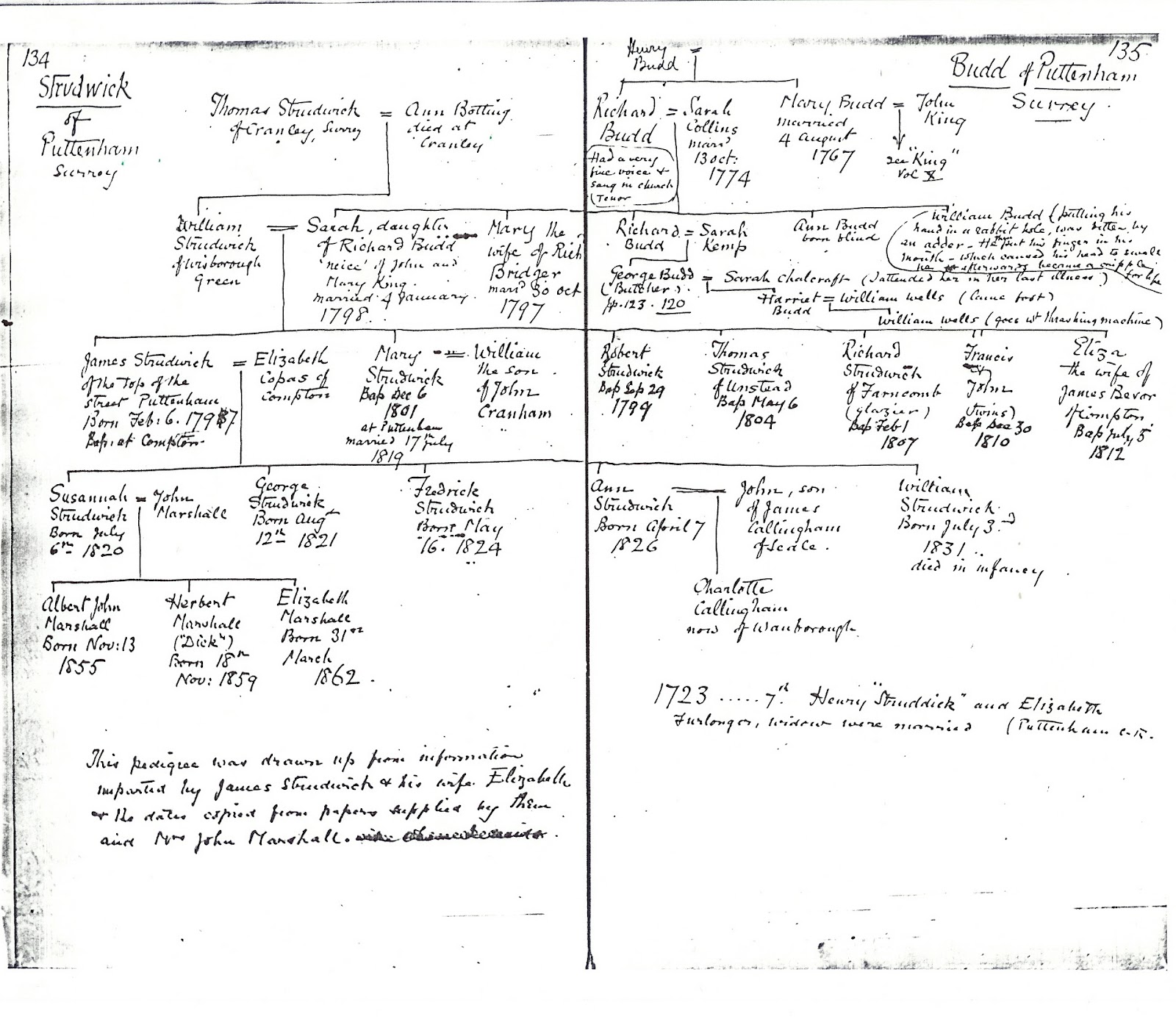
From my One-Place Study, the rural village of Puttenham is located near what is described on the postcard as Hog’s Back. On 9 April 1824, the parishioners of Puttenham joined together to undertake what they called the perambulation of Puttenham – you can see the list of parishioners HERE, with my ancestors marked in green.

This annual walk of the parish was to determine how far the parish spread and where the next parish began. This was necessary to determine whether the parish would help or provide assistance to individuals. If someone was within the parish they would be entitled to help, for those outside the parish then the responsibility fell to the neighbouring parish.

For those researching their ancestors in Europe, borders can be significant headache. In the times before border agencies, walking across a border was much easier and probably without any checks. Through periods of war then we see military gains and losses, some of which were reversed or maintained once the war had concluded.

If we look back to the second world war, people left Germany and Austria and migrated to other parts of Europe sure in the belief that they were safe from persecution. They likely did not consider that the safest thing to do was to cross the channel to Britain or to go much, much further.

At the end of the second world war, 8 May 1945 in Europe and 15 August 1945 in the Far East, the amount of displacement from those that survived was not insignificant. Prisoners of War – military and civilians were repatriated fairly easily, however, those that were in the far east found themselves in camps spread far and wide across the region, repatriation began by created hubs, essentially gathering individuals in one place or another that were going to a specified country. Regardless of which theatre of war, individuals that had experienced the horrors of war, internment, enforced labour, and worse found themselves in countries that were not theirs. In some cases they did not want to return home, home was gone, their family gone and it was time for a new start. Others did return home, to a country that was broken by the war, and in some cases to countries that was now in a country heavily influenced by Russia – essentially from the Russian zone of Berlin, and all the way east to Russia.

The redrawing of borders impacts family history significantly, because records that might be within the borders of a post second world war country, maybe actually in another country, or perhaps in a third country. General history of the country is important, it sets the foundations for research in understanding why records are not available, not where they “should be” and perhaps in the last place a researcher might think to look, moreover, records might be in two or more places, each signifying a period of history which impacted the peoples of a nation.

Surname Distribution Map from gens.info

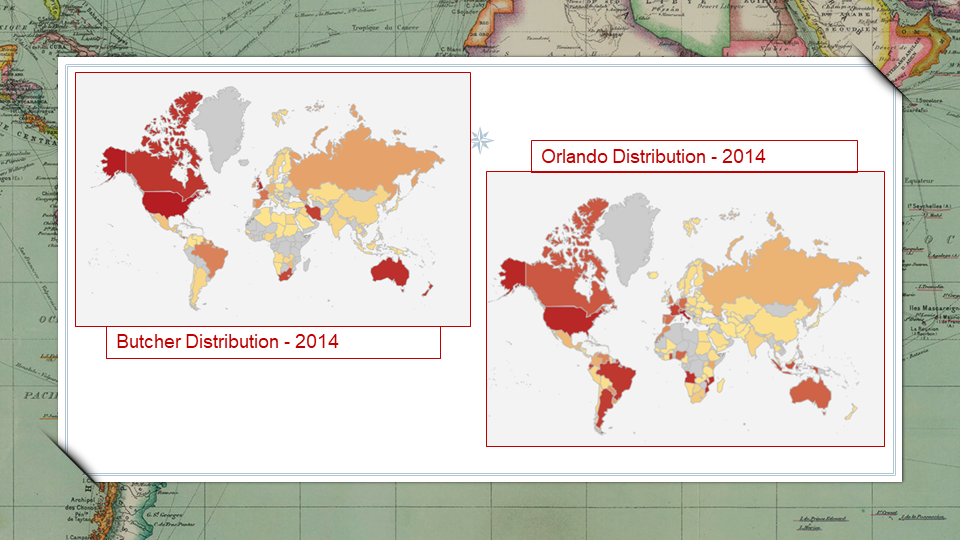
The biggest reason why a One-Name Study aims to be global is because migration, across any period of time impacts the spread of individual surnames.

My Great grandmother had the surname of Virciglio, not a particularly common name. You can see the spread of the surname across Italy. None came to England and Wales prior to 1945. Some went to the United States from the last 1860s and even fewer Australia, predominately after the second world war. I have written about the surname previously, that post can be found HERE

Borders is a topic we look at in the Researching European Ancestors course that I teach – see HERE for details, it begins on 5 May 2025, just before the 80th anniversary of VE Day.

Posted in A-Z Challenge | Leave a comment

A is for Alphabet

Created by Julie Goucher, 2023

One of the challenges genealogists encounter is the spelling of names, surnames and places. The challenge rather depends on several things.

People write what they think they hear, which is impacted by unfamiliarity of accents, dialects and other languages

Russian alphabet blocks – personal collection of Julie Goucher – 2020

Challenging the misspelling of a word is only has possible if you can read what was written in the first place.

In countries where there is a Roman Catholic influence, it is common to see males with the middle name of Maria. 

Alphabets are not all the same, not all countries have the same number of letters, some use accented characters and others might use Diacritic marks.

Armenian Alphabet

In some instances, the alphabet has changed over time, as a country has developed and formed it’s own identity. In some instances the alphabet is not in written format at all.

Signed alphabet


Posted in A-Z Challenge 2025 | 2 Comments

Announcing A-Z Challenge 2025 #AZChallenge

Created by Julie Goucher, 2023

I frequently teach and present on surnames and researching in Europe, but rather than be specific on either of those topics or others I present on, this year the A-Z theme is going to be focused on:

  • Research considerations
  • Resources
  • Hints and Tips to assist in research
  • Records, notes and sources
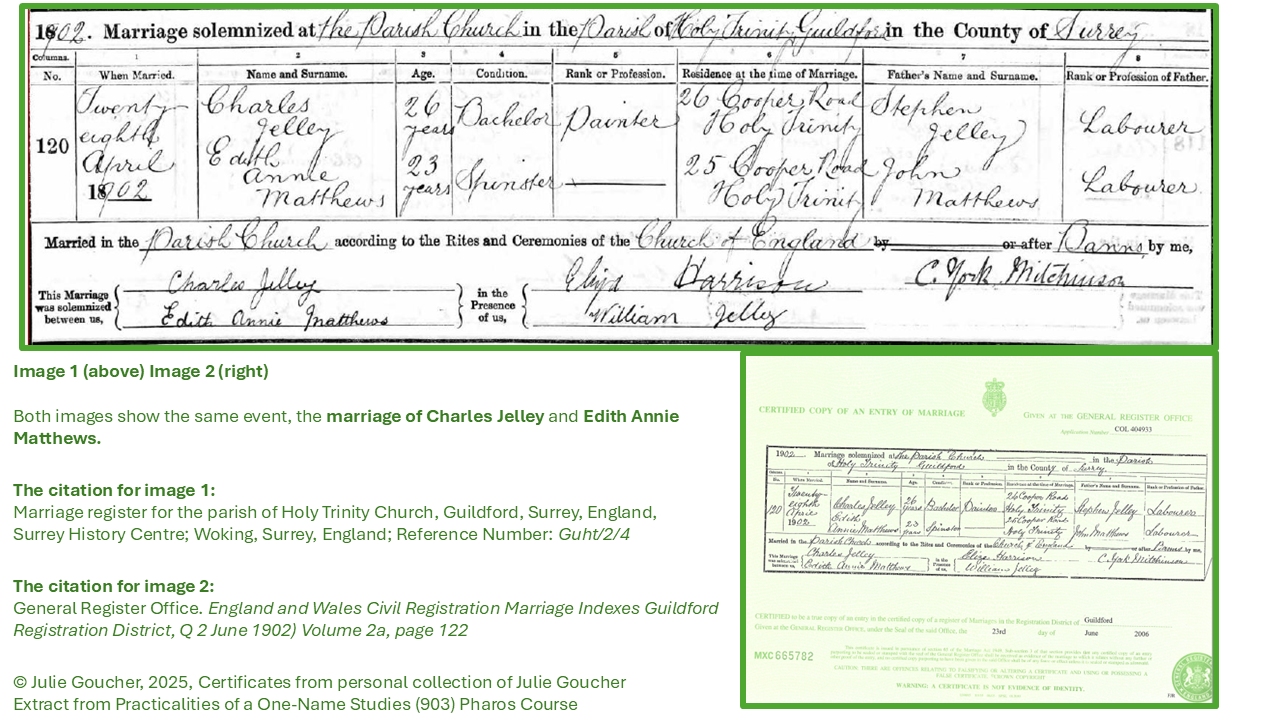
  • Citations, abbreviations
  • Location of records
  • Repeating of surnames across the globe
  • Writing of dates
  • Research logs
  • Reasons for hypothesis in the absence or lack of facts

amongst other topics. Do read along during April it promises to be a fascinating A-Z Challenge!

Posted in A-Z Challenge 2025 | 1 Comment

Researching in the North East of England

Penshaw Monument, 2019 © Julie Goucher

Yesterday I watched a great series of presentations hosted by the Society of Genealogist in collaboration with the Northumberland and Durham Family History Society. The event was free to attend, and the recording is linked.

Firstly, we heard Else Churchill, Genealogist at the Society of Genealogists talk about materials held, both online and at the premises in Wharf Road, London.

This was followed by an informative section by Carolyn Ball, archivist at The Story. This is the new archive and resource centre for County Durham. Next it was Northumberland Archives, where we heard from Jo March about some of the collections at England’s most northerly archive.

We then heard from Joyce Jackman of Northumberland and Durham FHS who talked about the offerings of the society, including materials at the resource centre. Membership is £15 annually, and like many societies, is run solely by members who volunteer their time.

We then moved on to the Archives of Tyne and Wear, where we heard again from Carolyn Ball, who worked for 20 years at the archive. Carolyn stepped in as a replacement for her former colleague. We heard about some of the material held at Tyne and Wear on their twelve miles of shelf space!

Each of the archive services shared examples of their holdings, typically linked to heavy industry – rail, shipbuilding, mining, and much more.

In the final segment we heard from the Historic Town Trust and about the work they do on historical maps, The Victorian County History (VCH) and the Vision of Britain through Places.

I thoroughly recommend this collaborative presentation, even if you do not have ancestors involved in heavy industry, there were other records mentioned. Also mentioned was which archive covered what and where, essentially framing County Durham as the locale sandwiched between the River Tyne and River Tees, with some exceptions!

I am the Guild of One-Name Studies regional rep for Northumberland and Durham, where I write an occasional newsletter for Guild members, with the last issue (May 2024) available HERE as a download to everyone.


Posted in England, UK & Ireland (Eire) Genealogy Series | Leave a comment

Genealogical Research Before 1538

The introduction of Parish Records in England and Wales began on 5 September 1538. The Vicar General, Thomas Cromwell mandated that clergy were to keep a written record of baptisms, marriages and burials that occurred within their parish.

The Parish Chest, Ludlow Church, Shropshire England © Julie Goucher, 2014

The records were required to be held in a chest with two locks, with the clergy holding one key, and the Churchwardens the other.

This was a defining moment in the History of England and Wales – It was the pathway of England and Wales splitting from Rome and the Catholic Church, and the establishment of the Church of England, as we know it.

At a risk of stating the obvious, that means that prior to September 1538, England and Wales were Roman Catholic. There were no official written record of birth, marriages or deaths, although some parish priests did keep informal records of local families.

Despite the lack of vital records, there are other records available to us, many around taxation, with many of the records written in Latin. Surnames were not at this point well established. Frequently they were in the format of occupational or based around a place or descriptive location. Here is one such example:

Adam Butcher son of Henry the Butcher…..1368

Source –

Monastic Database, University College London, DDCC 98/1 accessed 17 February 2025 

This was not an isolated example, here is another one from Northampton Kings Bench Indictments

Geoffrey Bocher of Harrold, Butcher

I went back and looked for a few other examples of datasets that were available – these are all online, with access free of charge, and are listed below:

Notes

  • The links provided here were all accessed 17 February 2025.
  • These datasets were typically undertaken by research grants at various universities, and in some cases the projects were undertaken collaboratively.
  • These datasets are all in addition to the various documents that might be identified by searching the catalogue at county records offices, heritage centres, museums and national archives.
  • English Date Calendar, adjusting dates based on days of the week, regnal years, ecclesiastical dates and new/old style dates – https://aulis.org/Calendar/Welcome.html
Posted in Genealogy, History, Medieval Period, Scotland, UK & Ireland (Eire) Genealogy Series | Leave a comment

All About Surnames

A busy surname week for me. 

Copyright – Julie Goucher, 2025


On Wednesday 15 January  I am delighted to be delivering my talk Pursuing Surnames to members of Nottinghamshire Family History Society.


Copyright Pharos Tutors 2023, used with permission.

Then next week, the first Pharos one-name study course of 2025 begins on Monday 20th January.

Guild of One-Name Studies members, can access a promotional code via a page on the Guild’s website. This enables members to receive a discount on the price of the course.

Copyright – Julie Goucher & the Guild of One-Name Studies

The course is open to non-Guild members and those that pay for the course receive free membership. The details of which can be found in the course forum.

There is lots of information about surnames and the Guild on their website located at one-name.org  There is also lots of information on this site, under surname research. You can read earlier posts or threads, or subscribe and await until the next batch of posts, which will be ready soon.

You can also send me questions and I will respond as part of my Q & A Series


Posted in Genealogy, Introduction to One-Name Studies (Pharos course 901), One-Name Studies | Leave a comment

Book Review – Jamaican Genealogy Research by Vilma Ruddock

Book Cover copyright – Vilma Ruddock, 2024

A day or so ago I ordered my copy of Jamaican Genealogy Research by Vilma Ruddock, which arrived yesterday.

I have an individual from my Puttenham One-Place Study who left his wife in England, and with at least one of his children, sailed to Jamaica. He died there and his will was proved there also. This has been on my To Do list for several years and this seemed the time to see if I could nail this down. In addition, I am always on the look out for Butcher and Orlando individuals for my One-Name studies.

The author has added the by-line A Practical Guide to the Best Resources for Tracing Your Ancestry” Across 483 pages,  and 42 chapters, Ruddock has produced an excellent guide to researching in Jamaica, for both new researchers and those of a professional standard. Readers are taken on a journey, from beginning to research, asking family members and starting from what the individual researcher knows of there own family history.

The chapters that follow include:

  • Documenting and preserving research
  • History of Jamaica’s parishes
  • History of Jamaica’s record keeping
  • Civil registration records
  • Church records
    • Church of England
    • Dissenter church records
    • Roman Catholic records
    • Jewish Synagogue records
  • Family Search website
  • Jamaican family search
  • Ancestry website
    • Jamaican resources
    • Free ancestry resources
  • The slave Registers of former British Colonial Dependencies
  • The legacies of British Slavery database
    • How to search the data
  • Other useful genealogy websites
  • The Gleaner and other newspaper archives
  • Compiled online databases
  • Register General Department
  • Jamaican Archives and Records Department
    • History of the department
    • Jamaican Archives collections
    • The Manumission registers
  • Roman Catholic Archives
  • The Institute of Jamaica
  • National library of Jamaica
    • Plantation records & family papers
  • University of the West Indies
  • National Archives, Kew
  • The British Library
  • Records of England and Wales
    • Church records
    • Civil Registration
  • Records of Scotland
  • Records of the Republic of Ireland
    • General Register Office Civil registrations
    • National Archives of Ireland Church records
    • National library of Ireland
    • IrishGenealogy Website
  • Records of Northern Ireland
  • Tombstones & Monumental Inscriptions
  • Wills and Probate 
    • Wills probated in Jamaica
    • Access to wills lodged in Jamaica
    • Wills probated in England
    • Wills probated in Scotland
  • Courts and Legal system
  • Jamaican Censuses & Lists of Inhabitants
  • Census in other countries
    • Great Britain & Ireland
    • England and Wales
    • Scotland
    • Ireland
    • United States
    • Canada
    • Australia
  • Maps and Land Surveys
  • Patients & Deeds
  • Military & Militia
    • British Army in Jamaica
    • Jamaican Militia
    • British Royal Navy
    • West India Regiments
    • Jamaica Defence Force
  • Almanacs, Handbooks, Directories & Periodicals
  • Books, Manuscripts and other writing
  • Library Resources
  • DNA Testing
  • Immigration – Origins of Jamaican Ancestry
    • History of Jamaica People & Heritage
    • Taino Indians
    • Miskito and other Amerindians
    • Spanish
    • English/British
    • African people
    • The Maroons
    • Jews
    • Irish
    • Scots
    • Welsh
    • North American Loyalists
    • Central and South America
    • The French
    • Immigrants after Emancipation
  • Jamaican Emigration
    • Central America & the Caribbean
    • Panama
    • Costa Rica
    • Cuba
    • Great Britain & Ireland
    • United States and Canada
    • Australia
  • Jamaican genealogy groups, Websites, Blogs and Forums
  • History of Jamaica
    • Spanish Jamaica 1494-1655
    • English/British Jamaica 1655-1962
    • Independent Jamaica

To conclude, there is a bibliography, a section of important addresses and an Index.

There is something useful and informative in this book for all level of genealogists. It has been written and collated in a manner which is easy to read, and outlines the historical complexities and context of Jamaican history. Whilst I have not fully explored the book as yet, I have already began to enjoy the read.

This review is unsolicited; I purchase the book myself from Amazon, and recommend it.

Posted in Book Reviews, Books, Genealogy | Leave a comment