The Olympics – London 2012 – Reading Challenge

Well, the opening ceremony was beamed around the globe last night and I was blown away by the ceremony. OK there was the occasional cringe moments, but overall it was an amazingly well produced and arranged ceremony.

As I sat and watched the presentation of the Countries participating in the Olympics I was surprised at some of the names – some I had never heard of, some were new Countries, those created following the collapse of the USSR.

My mind wandered very slightly across to books and I wondered if I could read a book written in or by an author that represents all of the Countries participating in the 2012 Olympics? I think I can and therefore I will set myself a personal reading challenge which will commence today on the first full day of the Games and conclude on the day of the next opening ceremony in 2016.

Whose going to join me? You can read the details HERE

Tagged , , | Leave a comment

The Olympics – London 2012

We are just hours away from the Olympics opening ceremony. The Olympics runs from 27th July  through to 12th August. The focus seems to be typically on London, but there are numerous other venues around the Country taking part. The official website is HERE

I came across the following video which is about how the BBC Olympic theme was created for the opening ceremony.

Here is the video featuring the famous band Muse, who has links to the Devon town that I live in. This is the official Olympic song.

This morning I was reading the Daily Mail on-line and spotted that an article that there was to be no official photograph of Team GB. A sports photographer from the Daily Mail then set about photographing all the athletes taking part.

Although all 541 of Team GB are representing us as a Country they are not all going to be in the same place, so with the aid of some technology a single photograph of the individual athletes or small groups of them has been taken and then it has all being pieced together.

GB
Courtesy of The Daily Mail

You can read the full article with names of all the participants of Team GB and see a video of how it was all done HERE. From what I can establish this is of the Olympic Games, and I hope that the Daily Mail will produce something for the Paralympic Games.

The Olympics – London 2012 runs from 27th July  – 12th August 2012
The Paralympics – London 2012 runs from 29th August – 12th September 2012

Good luck to Team GB!
Tagged , | Leave a comment

Inside the Olympics by Nick Hunter

An interesting book looking back to the start of the Olympics and the revival of it through the International Olympics Committee. 
The book features the early aspects of the Olympics from its conception in Greece through to the most recent Olympics to be held in London 27 July – 12 Aug 2012. 
The involvement of women at such events from women being unable to watch let alone participate in the games to the very fact that women play an considerable part in the games. The book also includes the Winter Olympics and Paralympics.
A well planned book showing not just the history of such an event, but much of the behinds the scenes planning.


Tagged , | Leave a comment

Library Loot – 23rd July


My book group met on Monday, so I tied this is with a trip to the library to return one of the books I read last week and renew a book that I have had at home for far too long.

As always I could not resist looking at the shelves and left with a few books.

Butterfly soup by Jan MarshThe Particular Sadness of Lemon Cake by…Riptide Volume 7 (Riptide Journal) by Bill…

The book we discussed was Slaughterhouse-Five by Kurt Vonnegut, which I did not enjoy. You can read my review HERE. For me the mix of genres didn’t work and from the discussions around the table only one of the group enjoyed it.

The next book for the group was issued, so I shall see what that is all about over the coming weeks.

The Midwich Cuckoos by John Wyndham

Taking part in Library Loot and you can read the details HERE

Tagged | 1 Comment

Guest Post – Anne M Powers

Author ImageI recently had the opportunity to interview Anne Powers, author of the recently published A Parcel of Ribbons – The Letters of an 18th Century family in London & Jamaica. Here is what Anne had to say –

As you researched the story of your ancestry was it always your  intention to publish this as a book or did it just happen that way?

I had no idea that what I would find would be so interesting or worth writing a book about – but when I found the Lee letters I felt they deserved a wider audience. That’s how the book came about, and while I was working on it I felt I wanted to share my Jamaican research, so that was how the website was born.
What was the biggest surprise as you researched and wrote ‘A Parcel of Ribbons’?
The biggest surprise was discovering the connection with Jamaica. I had been searching for an ‘Indian Princess’ and had spent quite a lot of time looking at the Lee family of Virginia, searching for a family Pocahontas. I knew there was someone called Richard Lee in the family and I had found his Will which connected him to my mother’s great grandmother. Then I found his 1851 census entry. This was the first time place of birth was recorded and I was astonished to find he had been born in Jamaica in 1765. Had he not lived to such a great age I’d probably never have realised the family had been in Jamaica, nor that my ‘Indian Princess’ came from the West Indies.
Are there any tips you would like to share about the research or publishing stage of your book?
Most of my research has been done on the internet, or by contacting people directly. People are incredibly helpful when it comes to family history research and I wrote to a number of people along the lines of ‘You have no idea who I am, and do feel free to bin this letter, but….’. On numerous occasions people got back in touch, often to say they could not help, ‘But, do try my cousin so-and-so’. I always enclose a stamped self-addressed envelope and give full details of my email and phone so they can choose how to make contact.
Although so much material is now available on-line, including wonderful scanned images of parish registers and other documents, there are times when only an actual visit to see an original will do. The best advice I could give for that is to be sure you know in advance what you are looking for, that you have all your own id with you to register as a reader, and to allow plenty of time. We are so used to instant access on-line that sitting waiting 40 minutes for a document to be brought up can seem a slow process, especially if it is handed out one page at a time. Plan to have something else to be getting on with while you wait – even if it’s just grabbing a coffee!
As for publishing, I decided to go down the print-on-demand route as it gave me full control – the down side of course is that you do have to do everything yourself which otherwise would be handled by an agent and a publisher. I am very happy with how the book has turned out – now I just have to hope others are too!
What’s next?
There are always stories that pop up on the fringes of what you are researching – which is why my ‘Jamaican Connections’ database on Ancestry now has over 5,500 individuals, and my family one is almost as big. I record lots of people who may not be of interest now, but who might be relevant one day. I am intrigued by the story of the Rooker family. Lydia Rooker is mentioned in my book as the ‘lady from Chelsea’ with a fortune, who married schoolmaster William Rothery. She had several sisters who made interesting marriages (one whose husband made his fortune in Jamaica) and a brother involved as a key witness in a court case concerning the murder of two little apprentice sisters. I’d like to find out more about them.

Synopsis
Set among the sugar plantations of Jamaica and the balls and masquerades of Georgian London the story is told by the Lee family in their own words. In 1749 thirteen year-old Robert Cooper Lee sailed to Jamaica taking a parcel of ribbons for sale. When his family was left all but penniless, Robert and his brothers forged new lives in Jamaica, fathered children with women who were the descendants of slaves and supported their sister left behind in England. Robert returned to London with his family in 1771. A prominent attorney, respected throughout Jamaica and among the West Indian lobby in London, he had built a fortune that enabled his children to mix with royalty. This remarkable collection of letters tells a story of triumph against adversity, of a family that suffered sickness, bankruptcy, sudden death, a clandestine marriage and an elopement. Through it all the bonds of family endured.

A Parcel of Ribbons – The Letters of an 18th Century family in London & Jamaica was published in July 2012 and is available from HERE
Anne’s website to accompany the book is at http://aparcelofribbons.co.uk/
Tagged | Leave a comment

Slaughterhouse-Five by Kurt Vonnegut

Slaughterhouse-Five by Kurt VonnegutRecently read for my book group. I really struggled with this one….again.

I first came across this book when I was sitting my English O Levels back in the mid 1980s. I hated the book and struggled to get into the book then, finally gave up and together with a friend we clubbed together and purchased the study guide! More than 25 years later I was confronted with the book again. I still dislike the book, but this time I read it.

I simply did not understand the need for the science fiction part of the story. Was this the way the author copied with his feelings of survivors guilt I wondered? For me the story had to be either about his time as a prisoner of war, which he spent in Dresden or a science fiction novel, a mix of the two did not work for me and I was relieved that I finished the book.

Tagged | 2 Comments

Olympic Torch Relay – 20th July 2012

Posted in Archive - Imported from Blogger | Tagged , , , | Leave a comment

Historic Tapestry

I am excited to announce that I am to become part of a regular and established group blog called Historical Tapestry with four other people –

Ana of Aneca’s World

Kailana of The Written World

Marg of The Intrepid Reader

Nannette of Confessions of a Recovering English Major

Why not nip over to Historical Tapestry and read my introductory post

Tagged | 3 Comments

Guest Post – Gillian Mawson

I have recently had the good fortune to interview Gillian Mawson, author of the forthcoming book, Guernsey Evacuees. This is a fascinating subject and I am delighted that Gillian agreed to be interviewed. Here is what Gillian had to say –

What was it that inspired you to research the topic of Guernsey Evacuees?
In early 2008 I was researching the Manchester Blitz of December 1940, when I discovered a June 1940 newspaper which described the arrival of thousands of Guernsey evacuees in England. 2,000 of them arrived in my home town of Stockport, Cheshire and I knew nothing at all about these evacuees. I tried to find out more but could discover very little, and I realised that this was an untold story of the Second World War Home Front which needed to be captured. This prompted me to trace surviving evacuees, when I discovered that many had not returned to Guernsey after the war, but had remained in England. As I began my interviews in England and in Guernsey, I was gripped by these previously untold stories and, due to the advanced age of the evacuees, I decided to record as many stories as I could before it was too late. I left my full time job as a university administrator/researcher to pursue this Guernsey research more fully, and I have now interviewed almost 200 evacuees.

At what point did you realise that your research could become a book?

Between 2008 and 2010 I began to put together the various pieces of the Guernsey evacuation story and it was similar to putting together the pieces of a jigsaw puzzle. I realised quite early on that these emotional and untold stories would make a great book, but I was intent on continuing to collect as many personal stories as possible. Last year I was delighted to be approached by the History Press who asked me to write a book for them. I chose to write a book aimed at the general public rather than to write an academic book. I want to bring out the very human element of these evacuee experiences – the joy, the sadness, the family separation, the courage and determination, and the bonds that were formed between many of the evacuees and their neighbours in England. Many of these bonds continue today.

What was the most surprising thing you learnt from your research?

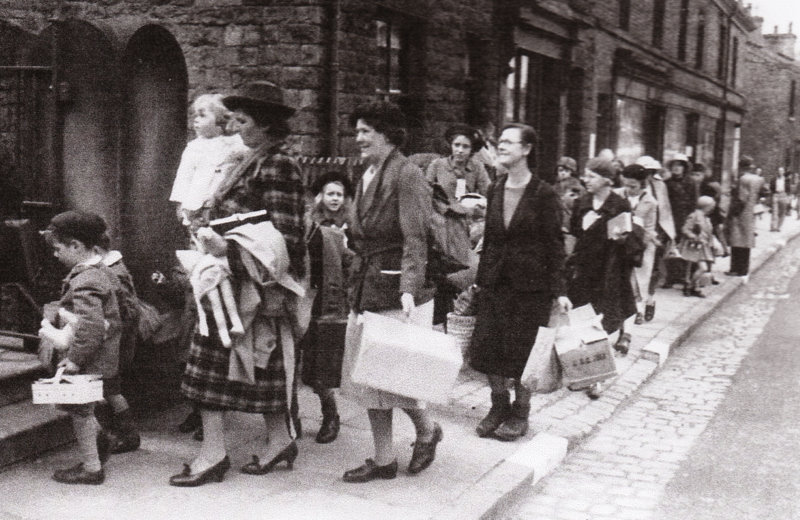
Guernsey evacuees arriving in
Cheshire, Summer 1940
I was surprised by the way that these evacuee experiences gripped me, due to the emotional issues contained in each unique evacuee’s story. The research practically took over my life. I was not only drawn into the history of the island of Guernsey, but also drawn in to the story of the English Second World War Home Front in a way that I had not previously been. Five thousand school children were evacuated from Guernsey with their teachers and some of these schools were re-established in England for the duration of the war.  Thousands of Guernsey mothers left home with their infants in their arms and little else, and created new lives for themselves in England. In addition, the Guernsey evacuees’ contribution to the British war effort during the Second World War was amazing! 
I have formed friendships with many of the evacuees I have interviewed. I attended an evacuee reunion in Guernsey in May 2010, and in June 2010 I organised an evacuee reunion in England which was attended by evacuees, their friends and many local people. After this event I set up a community group for the evacuees who remained in northern England after the war, to enable them to share their wartime experiences with the local community. I also produced a short documentary film about ‘Guernsey Evacuees in Lancashire, England’, with my colleagues from Bury Archive Service. I sell copies of the DVD via my website to raise funds for our evacuee community group.

We also speak to school children and museum audiences to bring home the story of the Guernsey evacuation, and this brings the younger and older generations together in a unique way. I also organise ‘Guernsey evacuation’ events in museums and galleries. 300 people attended our event in Stockport in October last year, which was filmed by the BBC. You can watch an online clip of the event at http://www.bbc.co.uk/news/world-europe-guernsey-15536660

How easy was it to conduct the research & interviews?

I prefer to interview evacuees in person, but I sometimes have to conduct interviews over the telephone as I cannot always afford to travel to their homes. I have travelled around England interviewing evacuees who did not return to Guernsey after the war.
I have visited Guernsey six times and spent most of that time interviewing people. A typical day includes interviewing an evacuee in the morning, another at lunch time, another in the afternoon and sometimes one more in the evening! The cost of travelling from England to Guernsey is prohibitive, so I have to do as much as I can each time I make the journey. I also try to squeeze in a trip to a Guernsey archive during these visits. Sadly, this leaves little time for me to undertake any sightseeing on that beautiful island!
I have used the internet recently too, contacting evacuees via email to ask if they could email their story to me. I have also been approached by evacuees through my website, and also through Twitter where I can be found as @Guernseyevacuee

What’s next?
I hope that my book is successfully received by the public, and I hope to write another. I have a number of ideas for books, all relating to the British Second World War Home Front. However, I will continue to capture Guernsey evacuation stories for as long as there are evacuees around to share them with me. There are so many aspects of the evacuation that are still a mystery to me. I will also continue to work with my Guernsey evacuee community group for as long as they are fit and able to share their stories with the public.
My book “Guernsey Evacuees: The Forgotten Evacuees of the Second World War” is available for pre order now, via amazon.co.uk, and amazon.com – published on 1 November.
My website and blog can be found at:
and you can read my diary of an evacuated Guernsey Mother at:

Gillian, Very many thanks for such a great interview, and I am really looking forward to reading and reviewing Guernsey Evacuees.

Images courtesy of Gillian Mawson and published here with permission.

Tagged , | Leave a comment

Library Loot – 18th July

Having read a review of Address Unknown by Kressman Taylor last month I ordered it from the library. I went to collect it yesterday and have devoured it already. A review will be up shortly.

I hadn’t planned on selecting any more, or at least until next week, but just as I was leaving I spotted One Musician’s War on the shelf and hesitated just for a moment. Thankfully I had hubby’s library ticket so that one went on their as I already have 12 books out in addition to the 3 e-books I wrote about last week.

Address Unknown by Kathrine Kressmann TaylorOne Musician's War: From Egypt to Italy…

Taking part in Library Loot and you can read the details HERE

Tagged | 6 Comments