Family History Writing Challenge 2013 – Day 1

Regular readers of this blog will have seen me make a reference to the family of John King and Mary Budd from Puttenham. John and Mary married on 4 August 1767 at Puttenham, a rural village in Surrey some four miles from my home town of Guildford.

It is this family that always makes me think of Mrs Bennett in Pride and Prejudice and her desire for her daughters to marry well. Mary and John had 10 children, one son and 9 daughters, so I am sure this caused some concern.
Early research revealed the second eldest daughter was called Esther who married George Bridges Bellasis and spent much of her life in India and a few years in Australia because George was sentenced to 14 years at Botany Bay. You can read the details in an early post HERE. I had always thought that perhaps this held some appeal to appear in a book and then added the idea to a job for the future on the back that there might not be sufficient information to warrant such a publication.
Then a few weeks ago, I looked again at the list of Esther’s siblings. I already had the briefest of details of spouses and dates gleaned from either journals or diaries written by family members at the time and earlier research. But what other data and research could I unravel?
I was delighted to spot something that I had been unaware of. I have therefore spent the last 4 weeks further exploring this and once again my initial thought has entered my mind, over many, many waking hours. To quote my husband, “oh Esther again” I am sure his eyebrows rose ever so slightly, but I could not be sure.

For some strange reason I have grown rather attached to a lady born 199 years before I was. She has a remarkable story, as does her siblings and I think it deserves to be told.

Tagged | 4 Comments

February Collage Photo Festival – Day 1

We kick off of a month long visit through our family photos. Over the next 28 days you will see in detail the photographs that were in the collage I created and appeared in yesterday’s post.
This first photograph is of my Grandmother, Lilian Edith Butcher nee Matthews. 
Gran was born on 18th December 1912 and in this photo she is aged 12 years, so I am estimating that this was taken during 1925. Was this taken to commemorate a special event? I wish I had asked my Grandmother now.  
My Grandmother also had a brother born the same year. My Uncle was born in Jan 1912. What a tough time my Great Grandmother must have had. Two children the same age, in addition to her older children. 

Tagged | 4 Comments

Creating a Photo Collage (the easy way!)

As you might have seen yesterday, I created this collage for February Photo Collage Festival.

When the conversation first came about over at Family History Across the Seas there was a debate of how the collage was created.

On the day I felt like creating my collage I was not within easy reach of the software package I had planned to you. Being a little lazy to walk up 30 stairs to my study I wondered if I could create something on line, free of charge.

Here enters the website PhotoVisi. Now, I was a first time user to the site. I have to say it was fairly easy. So, get a cup of tea, ensure you have access to the digital images and then click the link to the website.

  1. PhotoVisi
  2. Select choose a design and then hit enter
  3. Click on the large + button at the top left and add your photos (clicking on add photos each time)
  4. Click Finish and select the resolution you require
  5. Hit continue
  6. Then you can download your collage
A box appears giving you the option to email, send your collage to Face Book or Tweet it, you can simply hit the X and towards the bottom of the page is your collage to download.
So if you thought perhaps you could not make a photo collage, oh yes you can!
Come and join in the fun! – Sign up HERE and follow on Twitter – #fpcf13
Tagged | 9 Comments

Photo Collage

My good genea blogging friend Pauline of Family History Across the Seas was my inspiration for this post and a thread of posts that will happen over the coming month. Pauline was originally inspired by Kristin of Finding Eliza.

I have quite an arsenal of family photographs. Some I have inherited, some given to me by others and others I was allowed to borrow and make copies. However they have been acquired I treasure them all. I spent a few hours recently, looking through these photographs and selecting 28 of them for this collage.


Starting on 1st February I shall take each photo in turn share the full version and talk about the photo, the people and the location. Each photo means something to me, they are all connected to my family.
If you want to play along visit the sign up page! Twitter  – #fpcf13 


Tagged , | 1 Comment

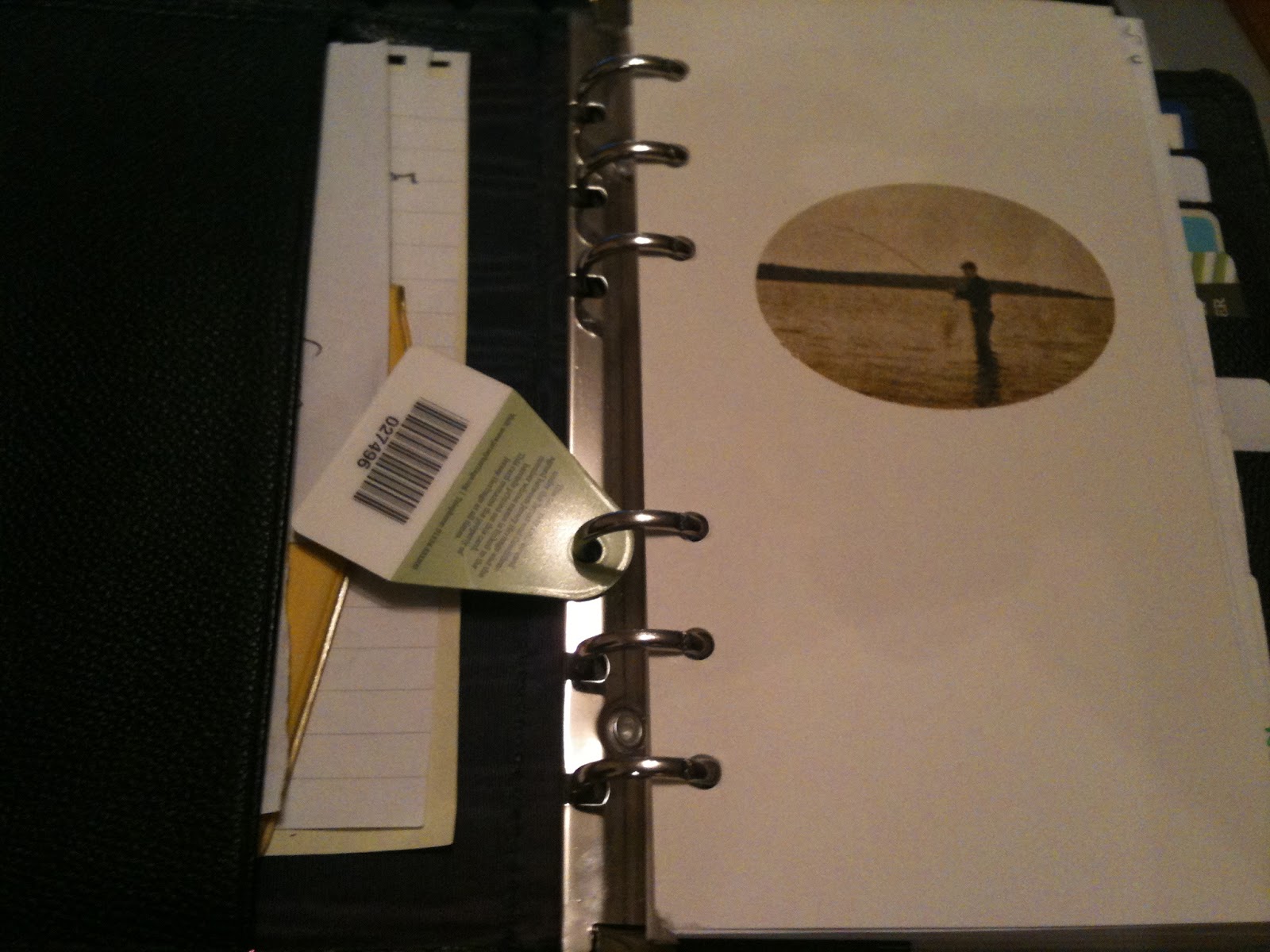
Filofax – Part Three

In two earlier posts (HERE & HERE)  I explored my Filofax and how it worked for me. One of the comments that was left was that it seemed complicated. I then thought, Was it?

I looked again at my structure and realised that perhaps, just ever so slightly it was and perhaps I should merge some of those sections together. Those sections could be merged because as long as I could find things then that was the most important; and no one else used my Filofax anyway.

I planned to live with my structure for another few weeks then to review. In the meantime, I read another Filofax post, where the writer commented that she was wrestling with her Filofax. I got a sense that like me the writer of that post simply had to have her Filofax just right. She used the wonderful expression of “her brain on paper” and I thought that is exactly what my Filofax is to me.

So, the final decisions for this Filofax is the following layout –

  • Notes – including book titles,book reviews, websites etc.
  • Expenses – keeping track of family history subscriptions and payments to professional bodies.
  • Personal – birthday list etc
  • Projects – here is where I record ideas for blog posts and keep a note of specific posts are to appear on various sites
  • Genealogy – here is where I keep details on various research lines, or ideas for research
  • Work – a mixture of CPD opportunities, research clients, and other professional review work
The back card section holds my Jersey Heritage card and entry cards to The National Archives and Society of Genealogists. It also holds my membership number to the pharmacy professional body.
I am still keeping my diary separately as I prefer the page a day variety where I record appointments, hours worked, social engagements and notes such as that I paid the credit card bill.
My next task is to source some nicer dividers and to explore potential uses for the other Filofaxes that are in my study. As luck would have it I have a spare set of blank dividers from WHSmiths quite a few years ago and they come in a set of 6!
Posted in Stationery, Filofax, Journals & Notebooks | 4 Comments

Library Loot – 28th January

This week I have been to the library twice! – I nipped in on Saturday with a very large bag of books, returning some, renewing some and to collect a book. Today I went as it is the venue for my book group meeting.

Here is this week’s loot
Bird by Bird: Some Instructions on Writing…Dona Nicanora's Hat Shop by Kirstan…Golf (Companion Guides) by DK Publishing

Bird by Bird is the title for the book discussion of The Progressive book group – to discuss by 20th Feb. You can read the details HERE.

Dona Nicanoras Hat Shop is the book for the next reading group – this was actually my selection, so I hope it is a good read.

Golf, is my husband’s choice. For some reason I was slightly put out that he should want to borrow a book against his library ticket!


Library Loot is a weekly event co-hosted by Claire from The Captive Reader and Marg from The Adventures of an Intrepid Reader that encourages bloggers to share the books they’ve checked out from the library. If you’d like to participate, just write up your post-feel free to steal the button-and link it using the Mr. Linky any time during the week. And of course check out what other participants are getting from their libraries!

Tagged , | Leave a comment

Holocaust Memorial Day

On this day, in 1945 saw the liberation of The Auschwitz-Birkenau Camp. Today, we use this date as a way of commemorating the thousands of families and individuals who suffered during this period of our World history.

Earlier this week, a friend emailed me a few pictures and said that she had gone home, back to Poland and visited the museum, which now located at the camp. Those pictures showed the queue of visitors awaiting access to the museum all standing wrapped up and warmish whilst the snow fell.

Despite being Polish, my friend had never visited the museum. Each year her family send a representative to pay tribute to their family members who entered the various camps. Many never returned. This year my friend was asked if she would make the journey from England to Poland to see her family and make the annual pilgrimage. She agreed.

The photos and emails she has shared with me have been a treasure and pleasure for me to read, despite her and her families obvious upset of the events of the past. Her last sentence read “You’re an historian, you’ll understand all of this” Actually I am an historian and genealogist; despite this I do not have any personal family knowledge of these situations. Do I understand? I understand her family need that someone attends yearly to show their continual respect. Continuing a link with the past. What I do not understand is that over 60 years later the world has learnt very little from those terrible events.

copyright AuthorAttic

I wrote back and said the same, and asked that had she considered how she would share her family events to her children when the time was right? What followed was a series of emails and the title of books, the most well know of which was The Diary of Anne Frank.

The image here is from AuthorAttic, and the cover compels me to have another read of this book. My own copy is a hardback fairly non-descript version that I have owned for over 25 years, and was purchased following a school trip to The Netherlands where I visited the home of Anne Frank

These emails coincided with the launch of an iPad app which is based upon The Dairy of Anne Frank. You can watch a trailer of the app HERE. The trailer promises an amazing application and from the feedback I have seen via the app’s review page and from a friend who downloaded it, they concur with my initial thoughts. You can read the article from The Daily Telegraph HERE

Posted in History | 3 Comments

Australia Day 2013

Back in 2011, I shared the details of my earliest ancestral links to Australia with a post about Captain George Bridges Bellasis and his wife, Esther nee King.

I first became aware of the Bellasis connection to my ancestry back in the late 1980s. I then did little research into that line beyond the records that existed in the rural Surrey parish of Puttenham and created what is on line as the Puttenham One Place Study


Esther was born Ester King in 1770, the daughter of John King and Mary nee Budd. The whole story resembles that of Pride and Prejudice as John and Mary had a family of 10 children, 9 of whom were girls. I can almost here the cries of Mary King as she worries about her daughters finding good husbands. 

Just how the King daughters became connected to the Bellasis family is intriguing, but all but two of the girls (one married in England and the other died in 1795 aged 17 years) married men connected to the Honourable East India Company (HEIC) and their son also spent time in India before dying in the Gulf of Persia in 1812. The link to how I established this is rather wonderful. The Curate of the parish of Puttenham was a man called Charles Kerry. During his time in the village he kept a series of manuscripts and as part of those there is a reference or two to the Bellasis connection. It was this fact that acted as my springboard.

Ester married George Bridges Bellasis in 1796 in Calcutta India. George was known as the most “Handsome man in India” a fact gleaned from the book written about the Bellasis family called “An Honourable Company” by Margaret Bellasis published in 1952. What has been established is that the girls went out to India in instalments, as they became of age and they were dispatched to parts of the “Empire” in the care of the elder sisters. 


The story is that one of Esther’s sisters was proposed to by Arthur Forbes Mitchell, a partner in Forbes & Co. The proposal was later retracted and a dual between the Forbes Mitchell and George Bridges Bellasis ensued. As a result George Bridges Bellasis was sent to Botany Bay for life for killing the proposer, having been transported on board the ship called “The Fly” in 1802. When he arrived in Sydney, George was immediately given a conditional pardon by Governor King and on 24 June 1803 received a Royal pardon as an “act of commiseration towards a gallant, but unfortunate officer and an afflicted dying wife”.


I wondered about Ester. Just what had her life been like? Married to a well to do member of the HEIC, was she shamed because of the dual and subsequent outcome of that?, then transported like a common criminal? I wish I knew just what she thought and felt. I wondered just what research material had been left behind of the Bellasis time in Australia. George it is well documented as a military man in Australia and India, there is evidence that he was involved in the Freemason movement in the early days of the colony.


I did a search on line for “Mrs Bellasis”+Australia and for variations of – Botany Bay, Ester Bellasis and was very surprised to find this painting. Pink Hibiscus and is titled “The Carrajan by Mrs Bellasis, Sydney and was painted circa 1803.

I sent off to the archive, The Mitchell Library, State Library for NSW, for a electronic copy and it is one of my genealogical treasures. What is especially wonderful is that the painting by Ester Bellasis is the earliest known piece of artwork by a woman in Australia, so it looks like Ester made her mark after all.

George and Ester returned to England in the early 1800’s and Ester is commemorated at Puttenham Church having died in 1805 in Berkshire, at the Bellasis home. George returned to India and later remarried, to his deceased wife’s sister, Elizabeth Kent nee King, herself a widow. George died in India in 1825 and the sister Elizabeth in Kent in 1837.

Since that initial research I have spent time researching the life of Esther’s sisters. From research it is possible to say that Esther was not the only one to have married well and I can almost feel the excitement and relief of John and Mary King.

Tagged | 2 Comments

Sepia Saturday 161

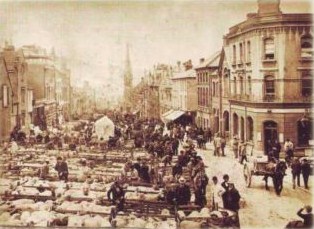
This week I am sharing one of my favourite images from my Guildford collection. It is an early picture, dating to 1880 and is of the cattle market at Guildford, which was in 1880 situated in North Street. At some point the cattle market moved to Slyfield where it is still held, but not with any of the busyness and rush of this picture.

North Street had in times gone by the unfortunate name of Lower Backside! although, that was before my time.

I have always known it as North Street and I guess the alternative name reflects its status as it was less popular that the High Street which effectively runs parallel to North Street at the left of the picture.

The High Street in comparison was the main shopping area with a beautiful clock dating back to the 1650s and a cobbled street, which has survived today.

During my childhood this market was not there in this form, but appeared every Friday and Saturday and for those two days, come rain or shine provided the local population with fruit, vegetables and flowers. My Grandmother always used two stalls in particular, one of which was called Hone’s. My Mum tells me that she went to school with one of the chaps whose family operated the stall.

Its formation I am sure stems back to when farmers grew their own produce and the surplus they sold, of course over time they simply grew more and more so they could sell it. The stalls have demised the invention of supermarkets and the trendy and affluence of Guildford and the Saturday produce market has almost lost its soul.

Now it is represented by an extension of other market stalls and for my traditionalist brain that is just not right!


Taking part in Sepia Saturday

Tagged , | 14 Comments

Weekend Cooking – Burns Night (Part Two)

Having experienced the process of a Burns Supper yesterday. How do you actually go about cooking it?

Haggis can be found in most super markets here in the UK. They are usually found on the fresh meat counters and can be frozen. I routinely have at least two in the freezer. They do need defrosting before cooking.

Picture of ready cooked Haggis

Haggis can be cooked in a variety of ways

  1. Haggis can be cooked on the hob, in a pan of boiled water. As soon as the water boils reduce the heat and add the Haggis, with the water simmering it takes around an hour. 
  2. Haggis can also be cooked in the oven, remove from the plastic casing and wrap in tin foil. Place the Haggis into an oven proof dish with a little water and cook, usually for around an hour. 
  3. Haggis can also be cooked via the microwave, I usually remove the outer plastic and skin, and don’t forget the metal clips at the ends! Cut the Haggis into small segments and cook on full power. Length of time will vary depending on your microwave. 

Haggis Pie

Cook Suede and Potatoes
Haggis cooked for about 3 minutes in the microwave (mine is 900w)
Cut Haggis into sections and place in bottom of a dish, I use a Lasagna dish
Mash Suede and place on top of Haggis
Mash potato and place on top of Suede.
Place in Oven for (mine is fan assisted) so 20 minutes until nice and brown.

Wee Beestie!

Cook Haggis and break into bits with a fork.
Serve on a bed of mashed potato and mashed suede (neep)
cover with cheese sauce and a light dusting of black pepper to taste

Weekend Cooking is hosted by BethFishReads

Tagged | 15 Comments