A few days ago I came across a blog post with the recipe for Rock cakes. I have not had rock cakes for years, and in fact it has been years since I really did any cake baking. So, whilst Stuart has gone off fishing I had a sort through the cupboards to see if I had all the ingredients. I did, so cooking commenced.
My Grandmother was a pretty good cook. She cooked for memory mainly but she did own a few cookery books and I now own the ones that she did. A favourite was rock cakes. Mum, whilst I was at school was in fact a dreadful cook. I have memories of taking sponges to school that had a dip in the middle. I don’t know what happened, different recipe, different oven, but at some point the sponges stopped having dips. I can’t recall who made the rock cakes of my childhood, but as I got this batch under-way I was deep in thought of yesteryear.
Perhaps it was not enough concentration, because my batch are not an absolute success, but they are edible. I know as I have just had one! I think next time I will make a small amendment, a splash more milk, but only a splash!
Weekend Cooking is a weekly meme hosted by Beth at BethFishReads
The first general meeting of Next Gen took part in Tuesday evening, well it was the early hours of Wednesday morning here in the UK.
I had planned to try and watch live via the Google+ Community whilst sitting in my pyjamas. Are you not relieved that I not join live?
So on Wednesday morning I sat and over a cup of tea I watched the recorded and archived version of the meeting. It is wonderful that like +Society for One-Place Studies that +The NextGen Genealogy Network is embracing social media and taking genealogy to the next level in terms of engagement.
After the introductions, +Jen Baldwin, co-chair of Next Gen raised a series of questions and then encouraged conversation with the panel and those watching live. Here are the questions then I am going to chip in with a few answers
What can we, as a virtual organisation do to make an impact right now in the genealogical community?
What can we physically do to support the mission of the Society? …….“empower genealogists world wide”
How can we assist more traditional societies?
Where should we be focusing our energy right now?
How do we connect at national events?
What special interest groups are required within NextGen?
How do you genealogically “geek out”?
Some really great and thought provoking questions. I will share some thoughts with you.
Next Gen exists as a virtual group. The society embraces social media and by doing so is setting the scene for the next generation of genealogists to join those already involved. The biggest issue is, we as an arena of genealogists need to over the ageist aspect of genealogy. Whether you are 10, 40, 60 or 102 you can all be genealogists. Young does not equal new. We need to stop labelling as young and new. We need to be inclusive of race, gender, age, geography. We need to open our arms wide and welcome anyone who is interested in genealogy or history in this way. We need to stop the elitist view.
Next Gen goes some way to stop that and does bring people, location and genealogy together. There is quite a journey ahead as Next Gen bridges the gap from the traditional ages of genealogists to the actual varying ages of genealogists. Next Gen provides an arena for enabling that conversation to take place between say parents, grandparents and extended family with the youngsters of the family. We need to build on the interests of those youngsters, by getting them engaged with what is around them.
The children of today, are it seems, (as I don’t have any children), children for less time now. Or is that a sign that I am getting old? The kids have mobile phones and often not parted from them. Then there are Playstations, x-boxes and hosts of other games. All pretty much technologically driven. What happened to Monopoly or is that old fashioned?
Engagement needs to happen in the arena where the kids are. Get genealogist Grandma on Facebook and share those photographs. Perhaps pointing out the resembles to current, live family members, especially the youths.
Next Gen, by simply being “out there” is providing an arena to encourage dialogue Firstly with the youth that are interested in genealogy and secondly, for the want of a better term, the genealogical adults to try and engage the family next generation.
Think about it. Great grandma would have potentially milked a cow or walked five miles to the farm to purchase milk in a jug. Junior these days opens the fridge and it is in a plastic container. The concept and dimensions of something familiar to everyone is completely different.
In the hangout the example was given of engaging youths in the Pension Rolls for 1812. Sounds a great idea. About three years ago I visited The Underground Hospital on the island of Jersey in the Channel Islands.As you enter the museum visitors are presented with a card bearing someone’s name. There was limited information, but the genealogist in me asked why? Having been round the museum, the cafe had a series of pictures of people on the wall.You took the card you received when you arrived and searched the wall to establish the fate of the named individual. It interested me and pretty much every adult and child there.
The fate of some people was unknown, some had survived the Second World War (the Channels Islands was under German control from 1940) and others sadly perished. Sobering for the children, but that is a conversation for a parent to explain. I have written about the Underground hospital before, but you can see the post HERE. What is interesting is that about a year ago I had an email from someone whose parent knew one of the people named on one of our cards. That was fabulous as it meant that, the individual had survived the war and I passed the details onto the museum in Jersey. Sometimes joining the dots is great!
By being an on-line organisation the possibilities are endless for engagement and testing the water with technology. Encouraging those more seasoned genealogists to toe dip into the fantastic on-line genealogical world. The bottom line is that we can learn something new every day. The internet has revolutionised the way we do everything, including genealogy. Lets use it to an advantage to engage another generation of our families.
Society Website where you can find out more details about the Society and join
Disclaimer – I write a regular column called Right Here, Right Now for NextGen Dispatch, the quarterly newsletter for the Society and I am also Chair for Social Media. I have also write occasionally for the Society blog and have been featured as Member Spotlight. The views expressed here are mine and do not reflect the Society.
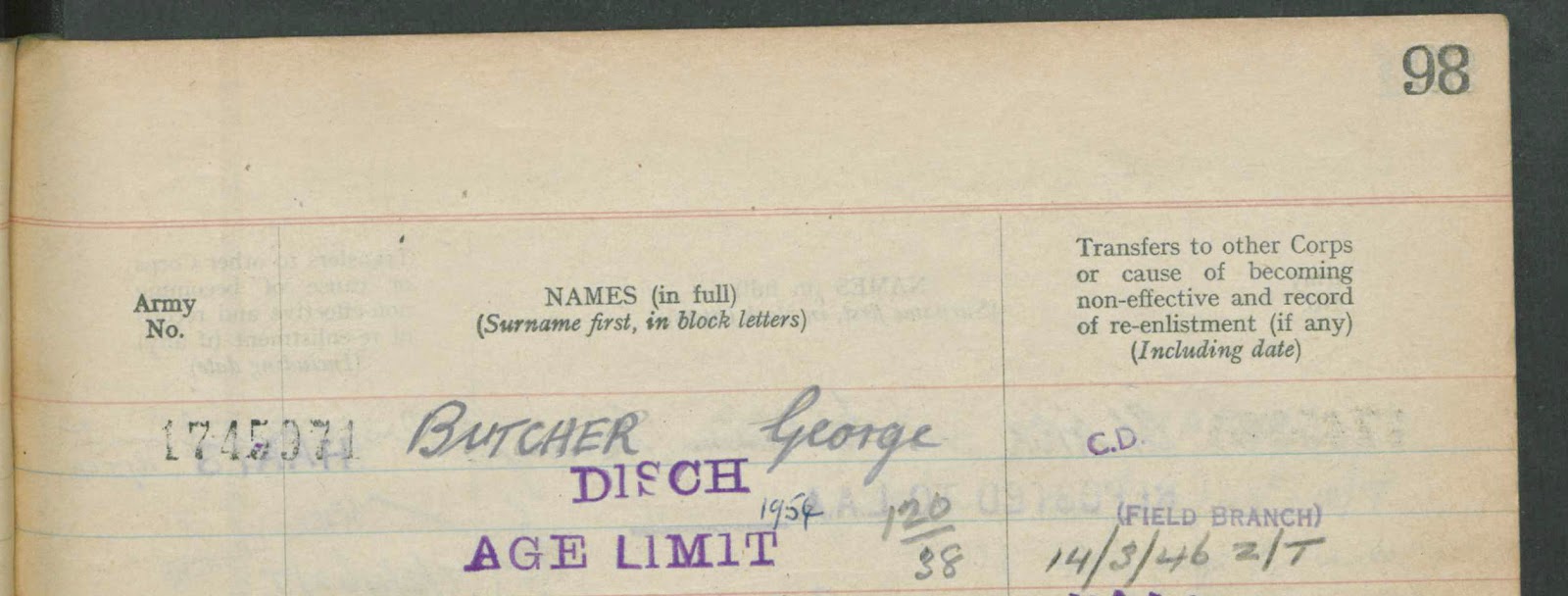
A few days ago, FindmyPast announced that they had released as part of their 100 record sets in 100 days the Royal Artillery Attestation Papers (1883 – 1942).
I already have my Grandfather’s military record which I ordered from Veteran Affairs back in 2008. The day it arrived I was away and Mum was as excited as I was to see what the record said.
This morning I went to the search facility and inserted my Grandfather’s name along with his year of birth (1908) and his service number which I knew from his military pay book. I hit search. Then, up popped a reference.
Courtesy of FindMyPast
I was surprised as usually anything in more recent times is withheld, but sure enough it was a document relating to my Grandfather. And something not seen before.
Courtesy of FindMyPast
I so wish Mum had been here to see this little discovery about her Dad. Today I miss her even more.
Today is week 36 of what is going to be a 15 month project. Each Saturday, at around 12.30 am UK time I will release the prompt for that week’s Book of Me, Written by You. If you are new here, welcome! The details, background flyer and Face Book link to the Book of Me can be found HERE.
This week’s prompt is – Your Year
This week the prompt is in two parts:
Think back over your life. Which year was “your year” in terms of happy, special and treasured events?
Think back over your life. Which year was absolutely not “your year”
Thing in terms of health, wealth, happiness or a degree of sadness, back luck and years when you simply wish you could go back and relive or redo something.
Yesterday, a dear genealogy friend who I have know for about 25 years posted on her Facebook wall
“Imagine getting the country behind one day a year whereby they actually post a ‘real’ letter. Where children write to a friend or family member, or even perhaps they exchange letters with a class somewhere else in the country or even the world. Anyone in the world can do this.
S end N yone A n I nteresting L etter
It has become apparent to me that few people ever write a letter. Most of our children no longer know the excitement of mail arriving in the letterbox with their name on it. Many wouldn’t even know how to write a letter to a friend.
As I recently sat and watched my 37 year old daughter and her friend sitting on the floor, surrounded by their children, reading aloud letters they’d written to one another as young teenagers, and laughing at the stories those pages held within, I realised what we are losing. All those memories and family history which is now either doesn’t get recorded, or is stored on a computer. How much is lost when a computer crashes?
It made me think it would be a great idea to create new memories, and new experiences by having one day a year when we all send some SNAIL MAIL. June 13th is the anniversary of my dear Mum’s death, and she was an avid letter writer, so what better day to get this going.
Please share this and let’s make it happen.”
After I read this post from Judi, I spent an hour or so looking through my files and found the letters I received from Judi, all the way from New Zealand. I pondered at the memories and the pleasure I always felt when I saw the envelope and the stamp and would take the letter to read on the train, as I took the daily commute to work.
What struck me as wonderful is that this project is in memory of Judi’s Mum who passed away on 13th June and what a wonderful way to commemorate a lady so close to Judi’s heart.
So in the spirit of friendship and a great project I am going to write a letter and mail it to Judi. You can write a letter to who ever you see fit to write to, but I am going to wander down memory lane with Judi.
Because the world we live in is so much driven on-line, there is a Facebook page for the project. Facebook and the internet, concepts that our ancestors, even more recent ancestors would simply be in awe of.
Then just as I was about to go to bed I looked at Facebook and spotted this picture and immediately thought of Judi and this project.
Today is week 35 of what is going to be a 15 month project. Each Saturday, at around 12.30 am UK time I will release the prompt for that week’s Book of Me, Written by You.
If you are new here, welcome! The details, background flyer and Face Book link to the Book of Me can be found HERE.
This week’s prompt is – Aunts and Uncles
As you may have noticed, I rarely have themed prompts, but this week unless you are related to me you would not know that today is always a sad and yet happy day in the April family calendar and in tribute to two very special people we have this week’s prompt. If you want to know more about my special people for 26th April, then stop by later! So, without further ado.
Did you have Aunts and Uncles?
Did you know any of your Great Aunts and Uncles?
Did you have people that you called Aunt and Uncle, yet there was no blood connection at all?
In fact, does that even matter?
So this week, tell us those about those people whose names appear within our family history and perhaps you even had a favourite or two?
I firmly believe that the way we can understand our genealogy is to read and become aware of the historical, and perhaps other aspects in the way of life relating to the historical community that we hail from.
By way of demonstration, I shall share with you a newly published book that explains what I mean. BBC Radio 4 here in the UK routinely has a “Book of the Week”. This week the book is “The Land where Lemons Grow” by Helene Attlee.
Over the course of five days, the book has been abridged and shared with listeners across the radio airwaves. You can see the details, and perhaps listen to the segments of the book HERE. If you are outside of the United Kingdom I can not confirm if you can still hear the abridged version.
What I will say is that I have really enjoyed listening to the abridged version, so much that I have purchased a copy.
The book displays a degree of food, cookery and history of Italy and Sicily. Sicily is of course where my own genealogical interests lie.

 A few days ago I came across a blog post with the recipe for Rock cakes. I have not had rock cakes for years, and in fact it has been years since I really did any cake baking. So, whilst Stuart has gone off fishing I had a sort through the cupboards to see if I had all the ingredients. I did, so cooking commenced.
 Perhaps it was not enough concentration, because my batch are not an absolute success, but they are edible. I know as I have just had one! I think next time I will make a small amendment, a splash more milk, but only a splash!






 Julie Goucher ~ Anglers Rest