

Julie Goucher, 2019 using wordcloud.com
Regardless of what research you are undertaking, every separate fact contained within a document should be individually recorded into a database, and subsequently, every fact should be supported by evidence.
The evidence documented with the citation, which subsequently can be seen/obtained from…..
Let me provide an example:
Below is an extract from the Practicalities of a One-Name Studies course which I wrote and tutor for Pharos Tutors and Teaching. The document shows two certificates, both representing the same event: Marriage of 2 April 1902 of Charles Jelley and Edith Annie Matthews which took place in Guildford, Surrey.
Each fact, such as occupation of the groom, address of both bride and groom, ages at the time of marriage, occupations of their fathers are all recorded as separate facts within my database for each individual.
Whilst both certificates show the same event, they are different source documents, with different citations. Copies of both certificates can be viewed or obtained in different ways. Furthermore, there is a difference between both certificates, can you spot it?
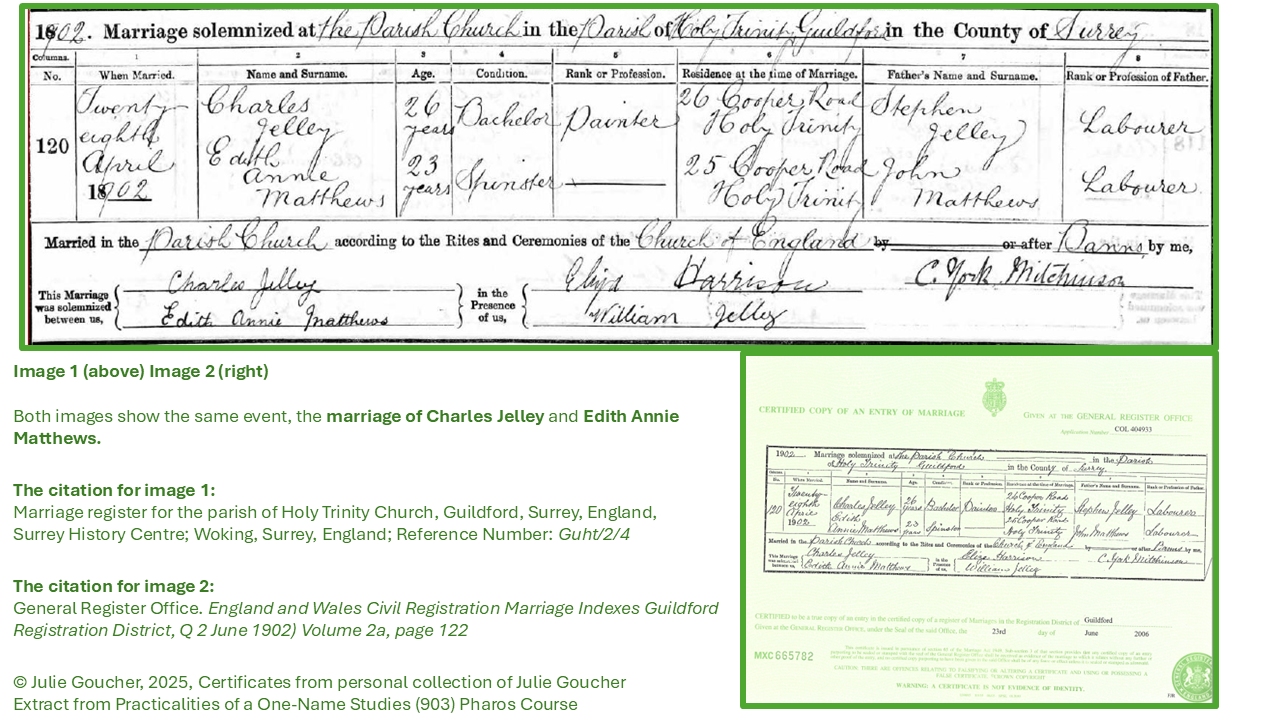
© Julie Goucher, 2025, Certificates from personal collection of Julie Goucher – Extract from the Practicalities of a One-Name Studies (903) Pharos Course
In addition to that, there is a reference list, which might be saved as footnotes or end notes, or in a separate section, a repository list and a bibliography.
Sources themselves can be defined as three different types:
- Primary Sources – identified as something written at the time an event took place, or soon after the event.
- Secondary Sources – identified as something written about an event.
- Tertiary Sources – identified as something written, as a summary that incorporates both primary and second sources.
The point of evidence is that it gives credence to claims made. It means that future researchers can follow the pathway to events, substantiating or not, earlier research.
One thing to remember is, person A can undertake research and provide evidence of all claims made. However, person B might verify the research of person A, but also have a document that person A is completely unaware of. Does that devalue the research of person A? I think not, but I would go a stage further.
In a perfect world we would try to find as many sources as possible so to verify a fact, or to disprove one. We might have a hypothesis, something we think could be the case, or might be so. We might have reasoning because we know records have not survived, as far as we are aware. An example of this might be:
My several times great grandfather, Henry BUDD married Martha OTTWAY in 1723, in the parish of Chertsey, Surrey. They settled in Puttenham, Surrey and raised a family of eight children, I descend from Richard BUDD who was their second to last child, born in 1742. The family thrived in Puttenham from 1724 onwards, but there is still more work to be done.
Two things of note are:
1:- Upon looking for Henry’s birth, I spot a reference to Henry Budd made by the curate of the time, Charles Kerry. The reference states that the baptism of Henry’s eldest child, Martha was “first of the Budd’s” I had already deduced that from a thorough viewing of the parish registers. Thus, Henry came from elsewhere, but where?
In 1720, Henry is witnessing a marriage in Elstead, which is just a few miles from Puttenham. A further search revealed that it was likely that Henry came from a family of Budd’s just over the border into Hampshire; the parish of Binsted. At this point I had not undertaken a more rigorous search
2:- By complete chance, I came across a reference from Sussex Family History Group, where the identified some marriages that had taken place between grooms from Sussex to brides in Surrey. A look down the list, and I spotted a Daniel Budd of Lurgershall marrying Alice Willson in 1704 in the parish of Peper Harrow, a village within a mile or two from Puttenham.
Is Daniel connected to Henry? I have a few ideas and hunches. I have created a timeline of information relating to both Daniel and Henry. What is clear, is that the material relating to Peper Harrow parish is scanty prior to 1837.
In closing today’s post, evidence is vital and at this point I cannot say with certainty that I have located all instances relating to this family of Budd’s, but I do have a hypothesis, and that is the best I can do.


 Julie Goucher ~ Anglers Rest