
Tartans are a significant part of Scottish identity and heritage; though not every surname is represented by a tartan. People traditionally where a tartan which reflects their surname or an associated family.
I have no Scottish ancestry, but one family that I am researching, with the surname, of IRONSIDE, is one that is found in Aberdeenshire. The family moved across the border into County Durham, then down to Dorset in the West Country of England and then a branch migrated north (ish) to Surrey. The move to Surrey is where the family connects to my personal Butcher family, which is part of my One-Name Study. Despite this, there is no historical tartan for the surname, but there is a tartan that was created for a specific event
Courtesy of the Scottish Register of Tartans
3rd July 2001 – Estimated count for display purposes only. A restricted tartan created for the Golden Wedding Anniversary of John T. and Frances A. Ironside of a farming family from Methlick, Aberdeenshire.

I can see why tartans have appeal to those who are researching their heritage, it is as though there is an invisible piece of elastic linking to forebears and making that connection.
Having searched the site, Clans.com for the surname IRONSIDE, just one result was revealed which identified three different pallets – Reproduction, Modern and Ancient. Upon selecting one of the Tartans, Robert Burns Legacy (Robert ‘Rabbie’ Burns) Tartan you can see the slight variation to the colour in the image below.
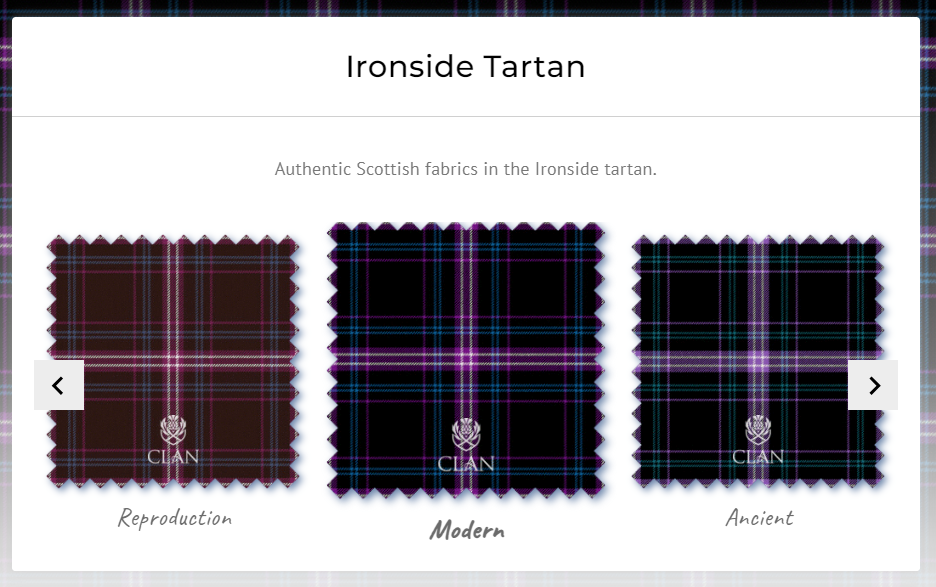
Screen capture of Ironside Tartan, courtesy of the Clans.com website – accessed 25 Jan 2024
After the Battle of Culloden in 1746, the government in London passed an Act of Parliament, in which Highlanders were disarmed and the wearing of tartans outlawed. Highlanders were subject to the strict enforcement of those rules and by the time the legislation was repealed in 1785, Highlanders apparently had become accustomed to wearing usual apparel.
The revival of the wearing of tartans did not begin until 1822, when George IV suggested that everyone who was attending the formal functions should wear their respective tartans, or Clans Tartans.
Clan Tartans are appropriate for the populous to wear in the event that an individual does not have a specific tartan. Alternatively, they may decide to wear the tartan representing the town in which they or their family resided in.
In the photograph here, the pipe band of Newton Stewart, Dumfriesshire, are celebrating St Andrews’s Day (1 December) and wearing the Stewart Tartan.

Copyright Julie Goucher, 1 December 2019 . Pipe Band, Newton Stewart, Dumfriesshire St. Andrew’s Day
Royal tartans are only permitted to be worn by members of the Royal family. There are also other restrictions, such as this one, belonging to the White House Historical Association which was created to promote the work of the Scottish stonemasons in the building of the White House in Washington DC, United States.
Other links which might be useful to explore:
Those interested in focusing on Tartans and how they may connect to a particular family line, might find the first two websites useful
- Scottish Tartans Authority
- Scottish Register of Tartans – was established by an Act of the Scottish Parliament in 2008.
- West Highland Museum
- West Highland Museum – Jacobite page where you can access a leaflet relating to the Outlander series, a taste of the world of Claire & Jamie Fraser
- Outlander Series by Diana Gabaldon ~ recommended fictional reading!
- ScotsClan site
- Scotlands People


 Julie Goucher ~ Anglers Rest