
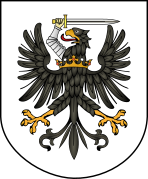
Coat of arms of Royal Prussia. From 1772 coat of arms of West Prussia – Source Wikipedia
Today we are going to take a step back and explain how there were so many Germans in the area in the lead up to 1944.
The Nazi’s had made partial plans in terms of the occupation of the region, and by the time of the Nazi defeat in 1945, those partial plans had only been partially undertaken.
The plan was to remove all Jews and Slavic people from east Europe and settle with Germans. The death toll as a result of these population shifts is tricky to calculate, and is likely to be somewhere between 500,000 to 2.5 million.
There were three phases of these removals, all of which overlaps:
- The organised evacuation of ethnic Germans by the Nazi’s from mid 1944 until early 1945 as the Red Army was advancing west.
- The disorganised fleeing of ethnic Germans following the defeat of the Wehrmacht
- The organised expulsion following the Potsdam Agreement, among the British Government, the United States and Russia.
The number of Germans that had left the area by 1950 varies –
- Russia indicated that 12 million Germans had fled or were expelled, whilst
- West Germany estimated that the figure was about 14.6 million which included
- about a million ethnic Germans who had settled in territories claimed by Nazi Germany during the war.
- Also included in that number was children born to expelled parents, with the largest number from eastern territories of Germany that were ceded to the Peoples Republic of Poland and the Soviet Union which totalled about 7 million
- A further three million from Czechoslovakia
- Included were those from the Free City of Danzig whose German inhabitants had been forcibly deported
- Those from the Second Polish Republic which existed between 7 October 1918 – 6 October 1939
- Those from Hungary, Romania, Yugoslavia, and the Baltic States of Estonia, Latvia and Lithuania.


 Julie Goucher ~ Anglers Rest